Exciting vision from @connacher_ for how to wield the institutions of human alignment for AI
"While the question of alignment for AI systems is relatively new, the question of how to align human interests—themselves complex and multipolar—is much older and eminently recognizable. Human society today enjoys astounding material prosperity thanks to commerce, supported by the rule of law and reputational incentives."
You can read the piece on the Cosmos Institute Substack: https://t.co/vr1yRS4847
Check out our website and sign up for the waitlist: https://t.co/O0Vvmhd9l2
“We cannot risk neglecting solutions human society has devised over the millennia.”
Guest essay from @silicoase founder @Connacher_ on why markets, courts, and reputation, which already align self-interested people, could align AI agents.
https://t.co/DqAaEppBHB
We’re pursuing this vision of alignment through commerce at @silicoase. In this effort, we expect to see novel forms of company structure, what economists like to call the study of firm boundaries.
In our future, there are no firm boundaries on firm boundaries.
“We cannot risk neglecting solutions human society has devised over the millennia.”
Guest essay from @silicoase founder @Connacher_ on why markets, courts, and reputation, which already align self-interested people, could align AI agents.
https://t.co/DqAaEppBHB
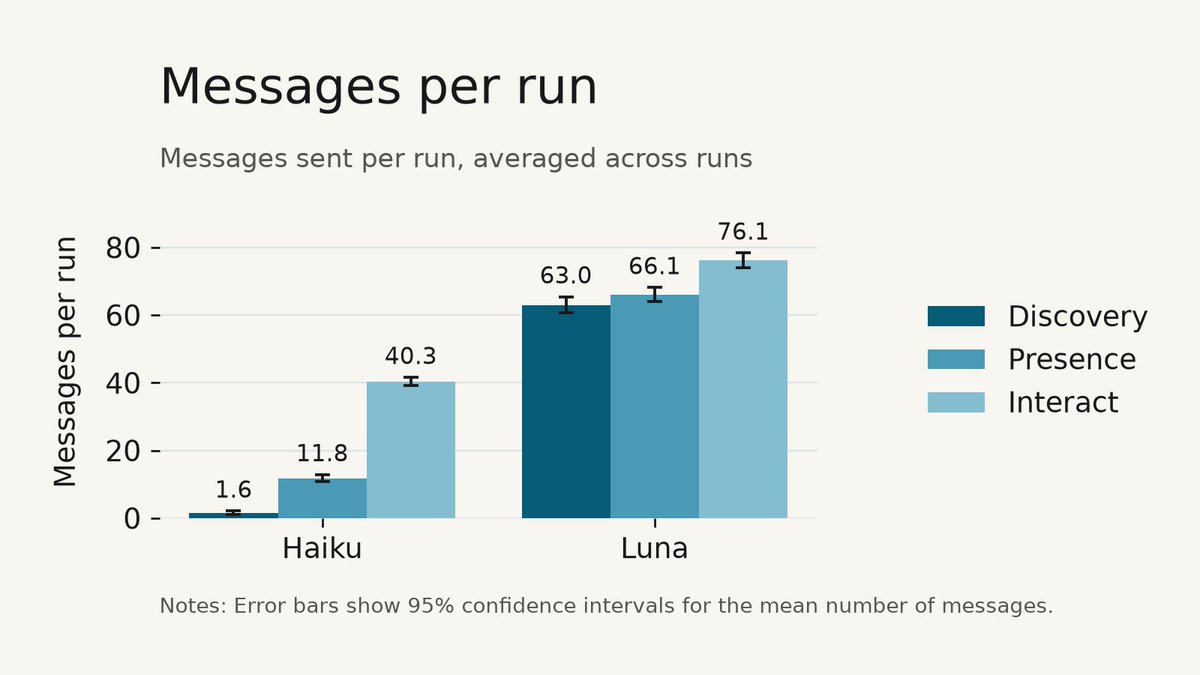
I’m surprised by the difference in collaboration propensities b/t models of similar capability.
I gave 5 agents the same black-box optimization task. GPT-6 Luna agents start collaborating as soon as they have a message tool, while Haiku 5.5 needs explicit prompting to interact.
We're releasing exploratory work on propensities for collaboration. Groups of 5 agents are given a black-box optimization task. The point at which agents jump into a collaboration mode differ by model. We explore these tipping points in our post.