I for one am glad EOD finally gets to experience having to wait on someone else for a change. The number of hours of sleep and missed chow waiting on EOD is finally coming home to roost.
Decided to try a lingonberry/peppery mix on this shoulder. We shall see. $1.50/lb pork shoulder and a smoker allows some experimentation that doesn’t potentially end up ruining a $100 piece of beef.
Every few days I get a text from Moe’s in Auburn about some great burrito or bowl deal they have going and from 750 miles away that feels like harassment.
We are where we are today. The fact they should’ve potentially done something awhile ago doesn’t change the fact we’l are dealing with where it is today now.
Less harmful according to what metric? And what percentage chance of human death are we calling acceptable?
I doubt this data center announcement has anything to do with the timing.
Experienced opinion on the IAAP situation. This is pretty close to how I feel about it, we can Monday morning quarterback how we got here all we want. At this point, if the material is prone to uncontrolled detonation you blow it in place with as many mitigating factors as you can.
Scattering a the remnants of a few hundred pounds of product over tens of thousands of acres is preferable to both uncontrolled and/ or loss of life attempting to move it.
Do we want to put human life at risk over an environmental issue?
Thanks to @Liborio4 and @Kagan_M_Dunlap and many others for highlighting this alarming problem of lead azide storage in Iowa.
In March 2026, a safety review at the Iowa Army Ammunition Plant near Middletown, Iowa, found 68 barrels (roughly 9,7004 lbs/5 tons) of degraded, recrystallized lead azide stored for about 20 years. Because officials determined moving the material risked an accidental explosion, the U.S. Army obtained an EPA emergency permit to dispose of it via a controlled in-place detonation, which would disperse a plume of lead-containing dust. Following lawsuits from environmental groups over short notice and health concerns, a federal appeals court issued an administrative stay pausing the planned detonation.
Lead Azide Pb(N₃)₂ is a primary explosive, meaning it is very sensitive and is used in primers. Lead azide is a shock- and friction-sensitive primary explosive that requires wet storage—typically submerged in an ethanol-water mixture—inside certified, earth-covered storage magazines to maintain stability.
If water or liquid levels drop due to evaporation over time, lead azide can crystallize. Crystallized lead azide is significantly more sensitive to friction, shock, and cold temperatures, making transport unsafe and raising the risk of accidental detonation. Seventy-one percent of the material is lead, which is the problem.
My opinion - The material could detonate spontaneously if allowed to continually sit. If it forms large, pure needle-shaped crystals (especially those exceeding 0.1 mm to 1 mm in length), it becomes acutely sensitive to friction, static, shock, and spontaneous detonation. It is going to blow whether under control conditions or just sitting there. Each barrel contains 143 pounds of lead azide. It would have to be moved by a forklift. It would be great if the entire operation could be destroyed remotely.
We lost two EOD techs and a third person destroying lead azide on 12 March 1973.
SSG Roy Phillips and SP4 Daniel E. Helton were assigned to the 58th Ordnance Detachment (Explosive Ordnance Disposal), Fort MacArthur, San Pedro, California. They were killed while setting up a demolition shot of some unserviceable military ordnance on the demolition range at Fort Irwin, California. The demolition shot prematurely exploded, killing SSG Phillips, SP4 Helton, and SFC Philip Neal Strang, age 45, from San Diego, California who was assigned to the California Army National Guard and worked at Range Control on Fort Irwin. SFC Strang had gone with the EOD team to show them where the demolition area was located.
Among the items to be destroyed were some primary explosives (lead azide). The primary explosives were in one-gallon size “paint” cans and were supposed to be wet. The investigation assumed that one of them may have dropped something into one of the open cans and the explosive initiated.
An alternative theory is that the fuse lighter spit flame into the primary explosive. The exact cause of the detonation was never determined. The last radio contact with the team was at 1630 hours. The three men were found dead at the crater, and their trucks were damaged. Among the ordnance that was being disposed of was a 250-pound bomb that was found a week before by a camper in the Mojave Desert. It is not known if the bomb was a practice bomb or an explosive-filled bomb.
Tomorrow, I’ll post the history behind our losing four EOD techs because of an environmental issue. In short, the Environmental Protection Agency would not allow the Explosive Ordnance Disposal team to destroy the detonators in their burn kettle. Details on Monday.
7-4 Auburn and 9-2 Bama for the Iron Bowl. This team has been good enough to beat Bama on a couple occasions. Just have to show up and play that way Saturday.
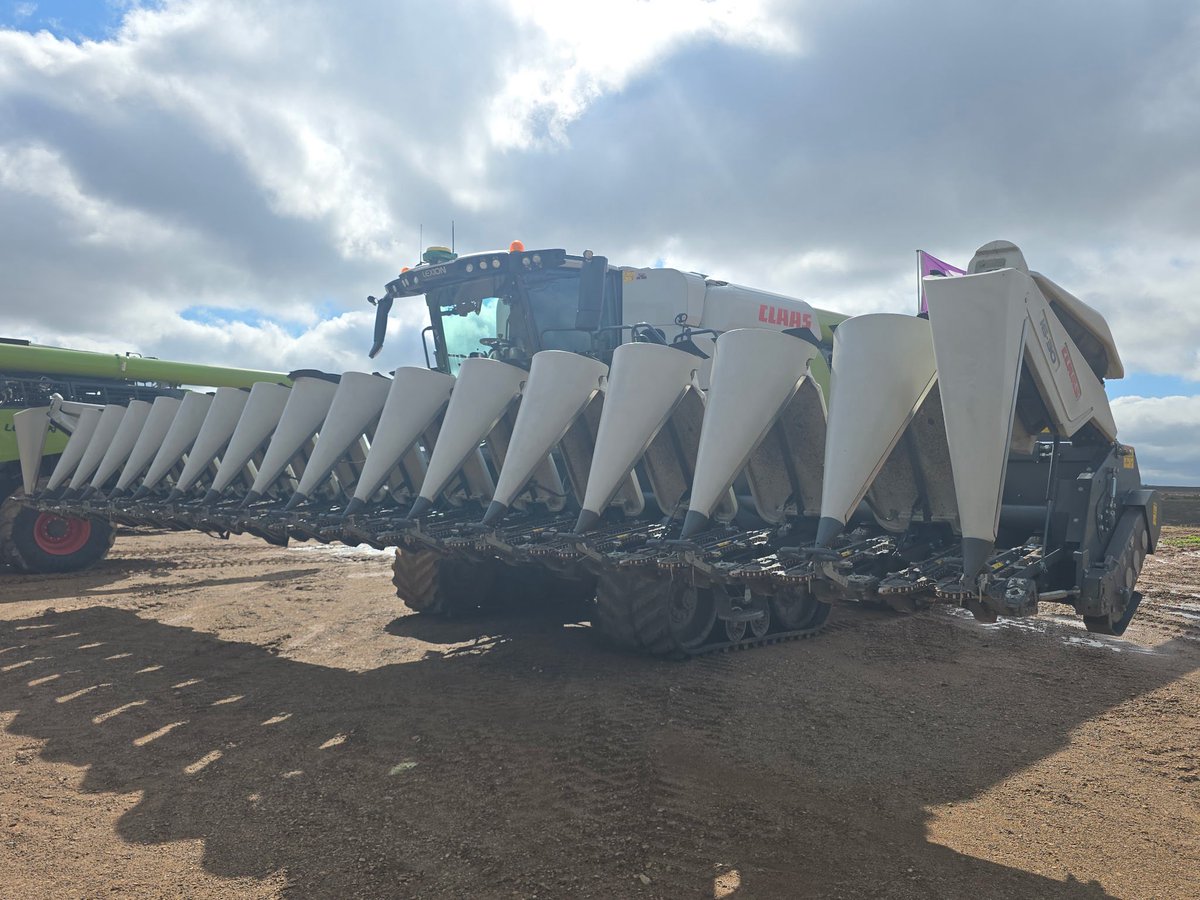
FOR SALE: 2023 Claas 16 row corn head. 5 height sensors with row guidance. Non chopping. Can sell with a set of Yetter devastators. $80,000 @CLAAS_America
I have a Puma 145 with just under 5000 hours, a 12 row Vulcan strip till unit with 1000 gallon stainless steel tank, and a 3408 cornhead with yetter devestators that are headed to auction unless anyone here on #AgX has interest in them. Send me a message and I am happy to chat.
Guy #1 woke up to the news he got a 700 on his SAT verbal and modestly improved his Math as well. He is looking forward to the incentive payment his dad promised him.
His dad is looking forward to the extra merit scholarship money it will save him.