Tesla's 2024 is looking ridiculous.
As 2023 is coming to a close, I've spent the last few days thinking about 2024 and what it means to the broader US car market.
One thing is becoming quite obvious - 2024 will be a banner year for Tesla.
As EV adoption continues to ramp, and more automakers adopt Tesla's charging plug and network, there are 4 unique variables that apply specifically to Tesla that should set it apart from the rest.
These are:
- Current EV demand is significantly higher than production capacity
- UAW union strikes and its impact to Legacy auto cost structures
- Federal EV tax credit change in 2024
- Cybertruck
Let's start with EV demand.
This is a study from The Washington Post in partnership with The University of Maryland (Penn State owns you haha losers) of 1,404 US adults. This study aims to understand which car Americans prefer - gas cars, hybrids, or EVs.
Although 80% of the American population generally siding with gas powered vehicles (including hybrids) seems like a bad sign for EV adoption, it’s important to put this number within context.
Per this study, 19% of Americans prefer to own an Electric Vehicle. Using this number, we can get a rough idea of how many cars this is if every one of these folks were to own an EV.
The average number of cars owned per household in the US is roughly 1.88. There’s 124 million households per the latest census. That’s roughly 233 million cars on the road in the US of all kinds (compacts, SUVs, Pick Ups, etc.), not including cars that are owned exclusively by businesses.
If we extrapolate this to the % of Americans that prefer to own an EV, and assume that this % is roughly the same for households, we get 44 million cars owned by people that prefer EVs over gas and hybrid cars. To be conservative, let’s knock this number down by 20% and call it 35 million.
As of today, there are about 2 million EVs on the road in the US, with last year’s EV sales coming in at 918,500. As you can see, the number of people who prefer EVs (35 million) is vastly higher than the number of EVs on the road today (2 million) and the number of EVs that are sold per year (918k).
The total addressable market (TAM) of EVs in the US is 35x larger than yearly EV sales, and 17.5x larger than the current fleet of EVs.
This means that room to grow for EVs in the US, even at 19% of the population wanting an EV, is massive. The limiting factors for people to actually buy an EV that want an EV, as covered by countless studies, are range, charging infrastructure, and price. Now you might ask yourself - which car company has an advantage in these variables? And the answer, of course, is Tesla, with their Supercharger network and superior range for the price on most head-to-head comparisons.
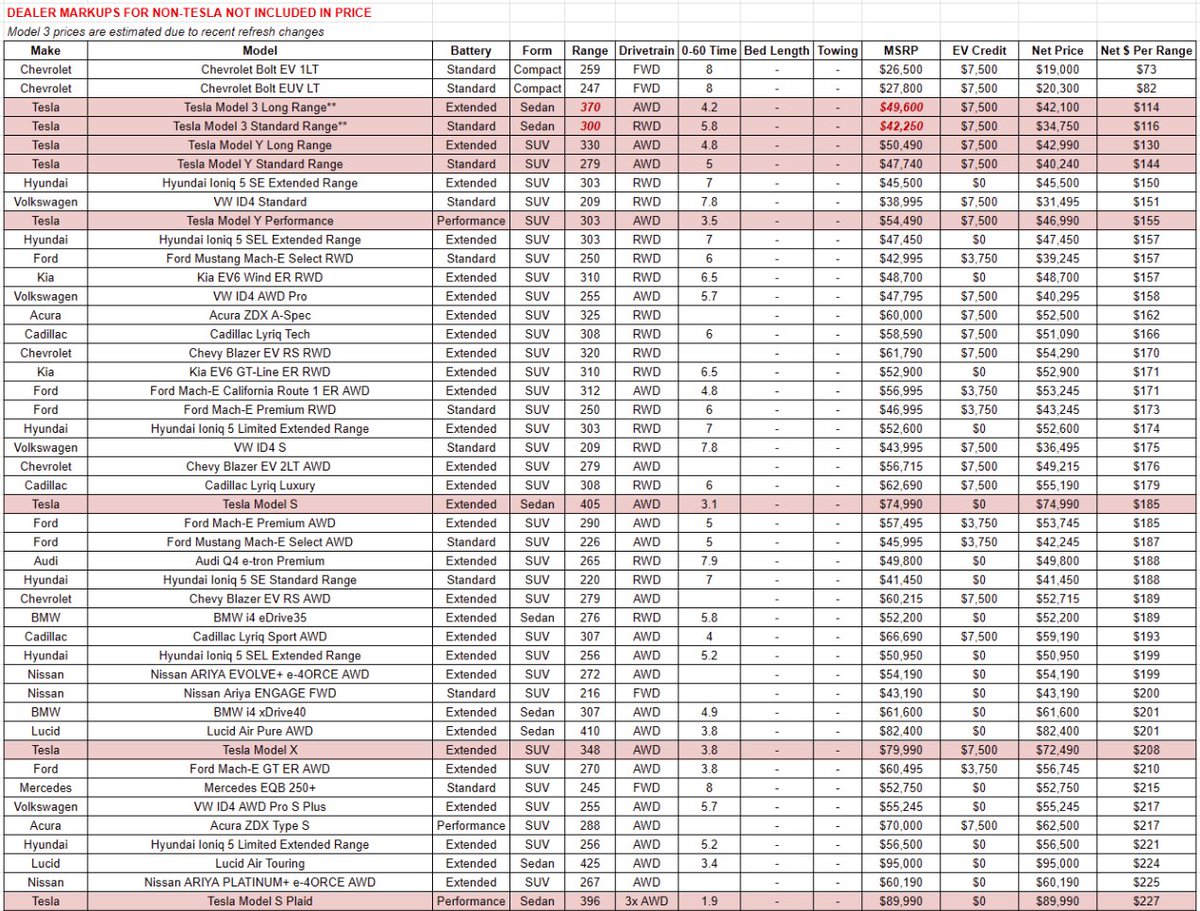
Here’s a chart outlining this - I’ve sorted all EV models sold in the US by cheapest $ per mile. This is a calculation that figures out how much money a person spends per mile of range the car has. Lower number means that the car gives you the best bang for your buck for battery mileage. Outside of the Chevy Bolt compact, Tesla offers the best bang for your buck per mile of range.
This means that as Tesla builds out its production capability in Austin, there will be more and more Teslas available for sale in the US at the most competitive pricing out there, and could potentially go down further as economies of scale at their factories continue to build, which will lower costs even further.
It’s no wonder that Tesla currently has over 60% of the US EV market share without any advertising. The numbers speak for themselves.
This variable on its own could be enough to convince folks that Tesla is set up for a massive 2024, but there are 3 more variables at play that will supercharge their advantage.
Union Strikes at Legacy Automakers
I’m sure most of us have heard that the UAW, the Union that’s in charge of a significant portion of the Big 3’s (GM, Ford, Stellantis) factory staff, is currently under strike at multiple facilities in a fight for higher wages and shorter work weeks.
The Union is currently asking for 40% higher wages and a reduced work-week from 40 hours to 32 hours. The Union is currently threatening to put in place more strikes if the companies do not come to the table with an offer that gets them close to this number.
Rough calculations show that this would increase net costs to Big 3 automakers anywhere between 2-5%, with most studies coming in at around 3%. Although this number appears small, the Big 3 run on very thin single digit margins, which could lower their net profits by as much as 50%. This means that in order to uphold similar levels of profits, these automakers will need to figure out how to cut costs and increase pricing on their vehicles.
In a land where their main competitor in EVs, Tesla, is starting to dramatically lower pricing across its entire vehicle line-up, this conflict couldn’t have been more ill timed.
You now have a situation where the Legacy automakers are at a losing proposition regardless of the outcome with the UAW. Here are their only two options:
Refuse increasing wages for union workers, which will lead to more strikes, lower production, and significant losses to the business due to shut down factories
Accept higher wages, which makes your costs higher, likely leading to significantly higher pricing, putting you at a major disadvantage vs your main competitor in Tesla (which by the way, isn’t unionized)
As you can probably see, from a competition perspective, this puts Tesla further ahead due to higher pricing from the Big 3, which makes their products even more compelling from a pricing perspective.
And if this wasn’t enough, there’s another lever that’s being implemented in 2024 that will make Tesla’s even cheaper, and that is:
Federal EV Tax Credit changes, including Point of Sale
The Inflation Reduction Act, which was passed in 2022 and went into effect in 2023 for Electric Vehicles, gives taxpayers access to a $7,500 credit which they can claim on their 2023 tax returns as long as they meet certain income requirements AND purchase a vehicle that meets certain criteria for battery sourcing.
Starting in 2024, this tax credit can be claimed at point of sale. This means that instead of waiting for the end of the year to claim for $7.5k credit, you can now have it be part of the net cost of the vehicle which will lower monthly payments by ~$150 on a 72 month term.
In addition, starting in 2024, the requirements for battery sourcing become more strict, meaning that EVs that don’t source their battery materials from neighboring and partner countries will begin to lose access to the credit. Luckily for Tesla, they have the most localized supply chain out of all other automakers. This means that their vehicles, especially the Model Y and the Cybertruck, will fully qualify for the $7.5k credit well into the decade, giving them an outsized advantage vs their competition.
Since most of America are payment buyers when purchasing a vehicle - meaning that we are most focused about getting a car that meets a certain monthly payment - this change will significantly increase how many folks can afford a Tesla. This is especially true if Tesla continues to lower costs and decides to pass this on to customers as they ramp up their Austin factory and implement cost savings to their in-house 4680 battery technology.
This will soften the blow of having to increase pricing due to union demands at the Big 3, at least for those that can source battery materials from qualified regions in order to qualify for the change. But the key thing to remember is that their competitor, Tesla, will still be significantly ahead in pricing due to the dynamics we just outlined.
And last but not least, if this wasn’t enough, Tesla’s new car will be ramping up and will likely garner the most attention any car has received in recent memory. Of course, I’m talking about…
Cybertruck
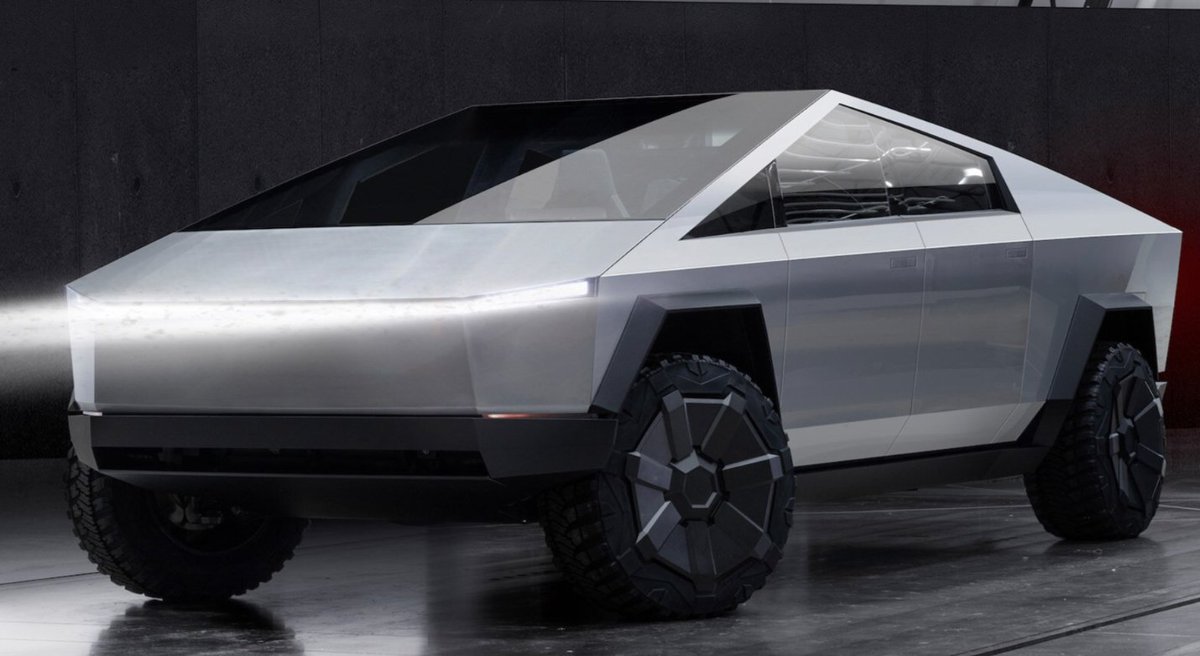
Love it or hate it, this thing invokes a ton of emotion and attention. I have yet to talk to someone that says “meh” when they see a picture of this thing. The reactions are either “OMG I love this” or “WTF I hate this”.
Either way, it’ll be in front of millions of eyeballs, which at the very least will force people to look up who makes the car, what it is, and why it is. And when this happens, a material amount of people will end up on Tesla’s website browsing their current catalog of products and offerings, where they’ll find their superior pricing and range vs its competitors.
As far as the Cybertruck goes, one of the missing pieces is its price and specifications. These will likely be unveiled at Tesla’s upcoming delivery event for the Cybertruck, rumored to happen sometime in October/November.
However, it’s not unreasonable to expect Tesla’s Cybertruck to fall in a similar area vs where Tesla’s current product offering falls against its competitors.
Since we have some EV trucks in the market already with various range and pricing ranges, we can assume that Tesla will offer a Cybertruck with 350-400 miles of range somewhere between $70k and $80k. Most importantly, at these pricing levels, the Cybertruck will qualify for the $7.5k EV Federal Tax Credit, which one will be able to take at point of sale starting in 2024.
I expect this level of pricing to surprise a lot of people, with an effective net price of ~$67k which makes it price competitive with most F150, Silverados, and RAM 1500’s sold today.
In short, although Tesla’s growth thus far has been extremely impressive and has shocked many, it’s very likely that we are just getting started.
And we’re not even talking about the $25k car that they’ll likely start shipping sometime in 2025.
Hold on, folks.
For the Tesla FSD test drive in Palo Alto tonight, I will ask the car to drive to @finkd’s house.
Will also test latest X livestream video, so you can monitor our adventure in real-time!
If we get lucky and Zuck my 👅 actually answers the door, the fight is on!
Small molecule oral cancer drug kills 100% of solid tumors across 70 evaluated cancer types in vitro and in animal models with a therapeutic index of 6 and no discernible side effects
Phase 1 trials now underway
https://t.co/PfpvPaRD4L
Q2 2023
Revenue
Tesla — $25 billion
GM — $44.7 billion
Ford — $45 billion
Net Income (Profit)
Tesla — $2.7 billion
GM — $2.6 billion
Ford — $1.9 billion
Vehicles Sold
Tesla — 466,140
GM — 1,584,000
Ford — 1,119,000
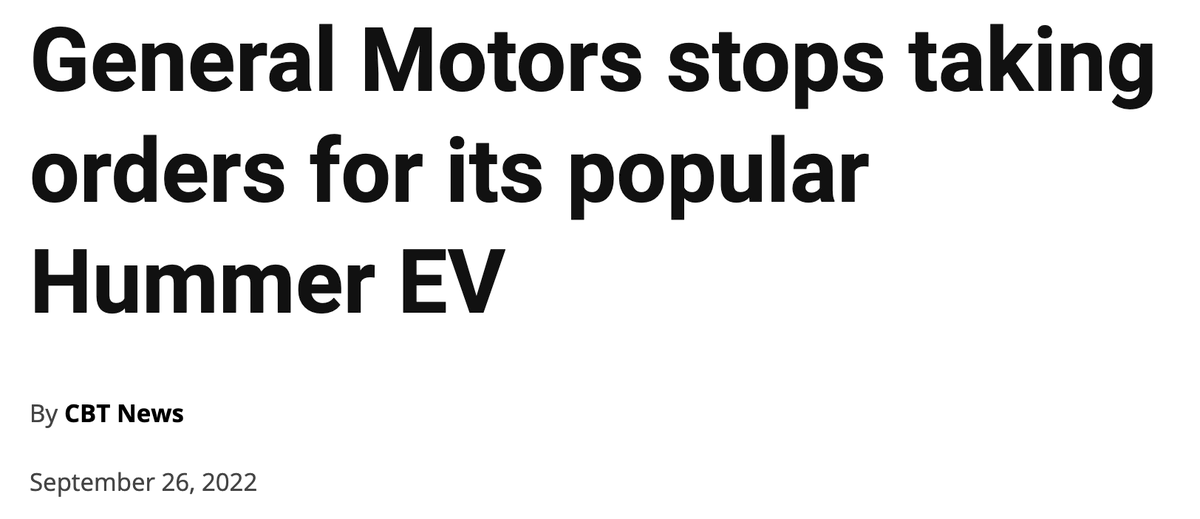
Remember when $GM announced it had to stop taking orders for the Hummer EV w/ 90,000+ reservations last year?
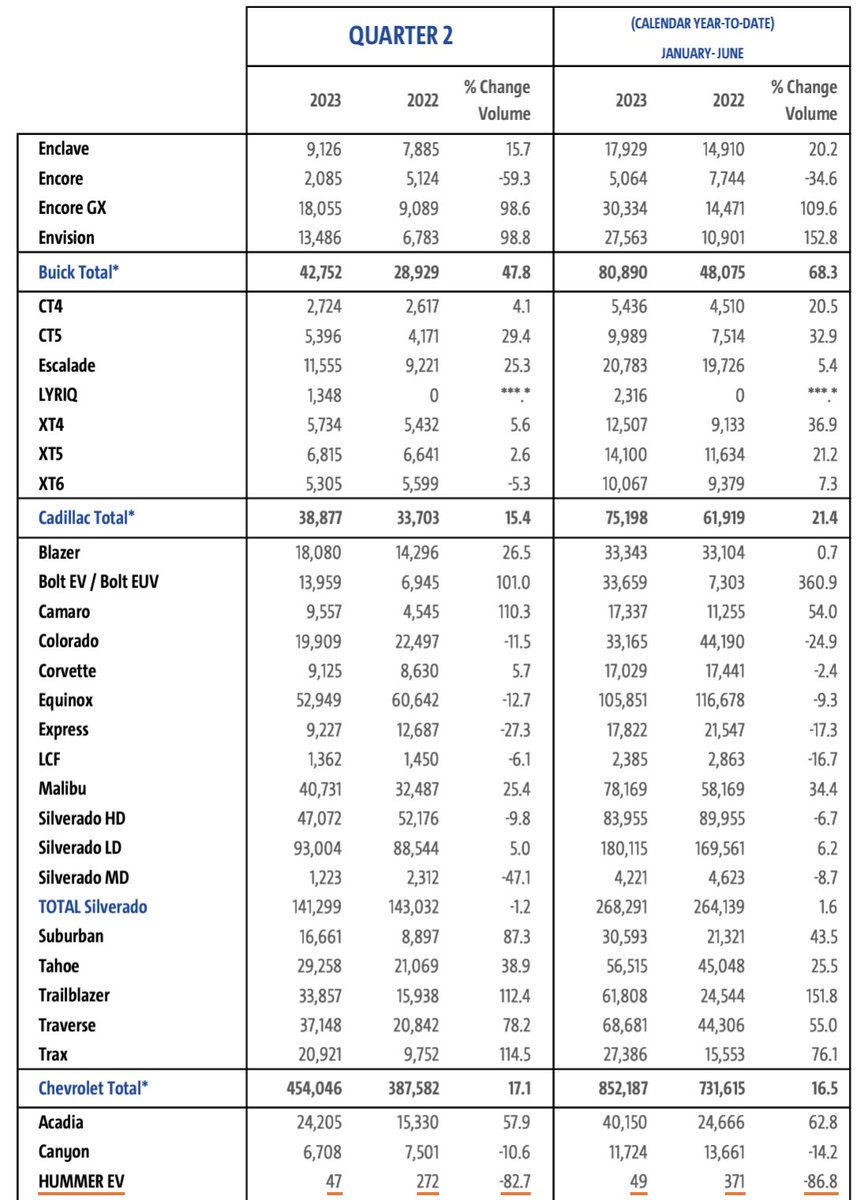
They sold 47 in Q2 this year
Can you imagine the headlines if Elon/Tesla were doing things like this? $TSLA
Zuckerberg v Musk? I think not. Musk is a hero, without whom the Biden regime censorship would never have been exposed thanks to his purchase of Twitter. Zuckerberg is a tyrannical hack for the Biden administration censorship operation; moreover, Zuckerberg spent hundreds of millions to influence the last presidential election with dark money targeted to help Biden. Musk did none of that. Zuckerberg is a leach and a punk. Musk is a patriot.
RFK Jr. just flipped the entire audience (and me) on his vaccination stance.
That means he can solve his biggest negative.
Oh, and he wants the free market to deal with climate change. Because it can.
Good luck debating him.
I did an impromptu training session with @elonmusk for a few hours yesterday. I'm extremely impressed with his strength, power, and skill, on the feet and on the ground. It was epic. It's really inspiring to see Elon and Mark doing martial arts, but I think the world is served far better if they train martial arts but not fight in the cage. That said, as Elon says, the most entertaining outcome is the most likely... I'm there for them, no matter what.
They claim to have a “wall” between news & advertising, but reporters know full well who butters their bread.
For example, there were nonstop bogus articles about electric cars on fire, even though they’re 500% to 1000% less likely to burn than combustion engine cars.
As soon as the big car companies started advertising electric vehicles, those articles mysteriously disappeared …