𝐖𝐡𝐚𝐭 𝐊𝐞𝐞𝐩𝐬 𝐀 𝐃𝐞𝐜𝐞𝐧𝐭𝐫𝐚𝐥𝐢𝐳𝐞𝐝 𝐍𝐞𝐭𝐰𝐨𝐫𝐤 𝐀𝐥𝐢𝐯𝐞 𝐖𝐡𝐞𝐧 𝐄𝐯𝐞𝐫𝐲𝐨𝐧𝐞 𝐆𝐞𝐭𝐬 𝐖𝐡𝐚𝐭 𝐓𝐡𝐞𝐲 𝐖𝐚𝐧𝐭?
This is one of the less obvious challenges in distributed infrastructure.
Consider BitTorrent's original file-sharing model.
A user downloads a file, receives the content they need and can simply leave the network.
But what happens to the next person who wants that same file?
If enough participants leave without continuing to upload, the network gradually loses available copies.
BitTorrent identifies this as a structural problem with traditional seeding incentives.
Its response is interesting.
1. Turning bandwidth into an economic resource
BitTorrent Speed introduces a BTT-based incentive layer that allows users to pay other peers for upload bandwidth.
Instead of relying entirely on voluntary sharing, bandwidth can be allocated through bidding.
Importantly, this is not mining.
Participants earn BTT for bandwidth actually delivered.
2. The auction mechanism is worth examining
The October 2026 whitepaper illustrates a multi-unit uniform-price auction.
Imagine a provider has five available upload slots and receives seven bids.
The five highest bidders receive priority.
But here's the interesting detail: all five winners pay the same price, determined by the highest losing bid.
In the whitepaper's example, that price is 1.3 BTT per unit.
This creates a market-based way to allocate limited bandwidth while giving providers an economic reason to contribute.
3. The same coordination challenge appears in AI
BTTInferGrid takes the resource-sharing concept into another domain.
Instead of coordinating upload bandwidth, it coordinates GPU resources for AI inference.
Its proposed workflow includes:
- GPU resource onboarding
- Task scheduling
- Inference execution
- Result verification
- Reward distribution and penalties
The verification component is particularly important.
A decentralized compute network cannot simply trust every node to report that a job was completed correctly.
BTTInferGrid describes task challenges, cross-verification and node scoring to help establish whether submitted work meets requirements.
4. Where BTTC fits
BTTC provides the on-chain execution and settlement layer.
It connects service requests, operational records and payment settlement through smart contracts.
This gives the wider ecosystem a mechanism for coordinating services and their economic outcomes.
My observation:
The interesting part of BitTorrent's evolution isn't simply moving from file sharing into AI.
It's the attempt to solve one recurring infrastructure problem across different markets:
How do you coordinate independent resource providers, measure their contributions and compensate them fairly?
Bandwidth, GPU computing and blockchain settlement are different technical problems, but they all require effective coordination.
That is the infrastructure challenge worth watching as BitTorrent expands its ecosystem.
The real test will be sustained usage, reliable service quality and actual demand from developers.
@BitTorrent@justinsuntron
#TRONEcoStar
𝐈𝐧 𝐃𝐞𝐅𝐢, 𝐘𝐨𝐮 𝐂𝐚𝐧 𝐁𝐞 𝐑𝐢𝐠𝐡𝐭 𝐀𝐛𝐨𝐮𝐭 𝐘𝐨𝐮𝐫 𝐀𝐬𝐬𝐞𝐭 𝐚𝐧𝐝 𝐒𝐭𝐢𝐥𝐥 𝐋𝐨𝐬𝐞 𝐘𝐨𝐮𝐫 𝐂𝐨𝐥𝐥𝐚𝐭𝐞𝐫𝐚𝐥.
How?
By misunderstanding liquidation risk.
Consider someone who deposits ETH into a USDD Vault and mints USDD against it.
Their borrowing position may look healthy today.
But ETH doesn't need to crash for that position to become uncomfortable. A sustained price decline can gradually reduce its collateral ratio while the debt remains outstanding.
This is where I think users should pay more attention to USDD's risk-management infrastructure.
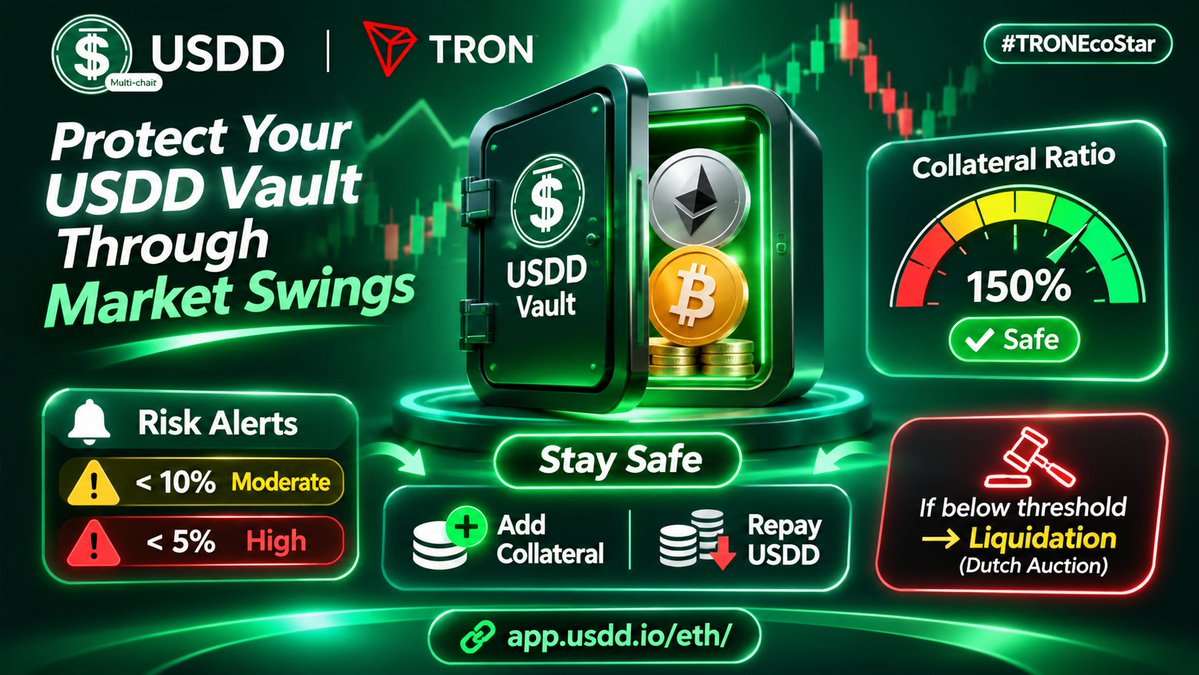
The collateral ratio is the number to watch.
It measures the value of your deposited collateral against your outstanding debt.
When collateral value falls, the ratio falls too.
When it approaches the minimum collateral requirement, liquidation risk increases.
Here's an interesting detail in USDD's documentation.
Its Risk Alert system identifies two warning levels:
- Moderate risk: Within 10% of the liquidation threshold.
- High risk: Within 5% of the liquidation threshold.
On-page alerts are always active, while users can enable additional email notifications.
This matters because monitoring a Vault shouldn't begin when liquidation is already happening.
What can a borrower do when risk increases?
There are two important defensive actions:
1. Add more collateral to increase the collateral ratio.
2. Repay part of the USDD debt to reduce the amount owed.
Withdrawing collateral has the opposite effect: it reduces the safety buffer.
If the collateral ratio falls below the minimum requirement, the Vault becomes eligible for liquidation.
USDD's documented liquidation process moves the collateral into a Dutch auction, where its price decreases over time until a buyer participates or the auction ends.
My bigger observation:
The real value of a collateralized borrowing system isn't just how much liquidity it allows you to access.
It's also how clearly users can understand and manage the risks attached to that liquidity.
For ETH and WBTC holders exploring USDD Vaults, understanding the liquidation mechanism should come before maximizing borrowing capacity.
Borrowing is easy to calculate.
Managing the position through market volatility is the real discipline.
Explore: https://t.co/r2aSExbBw4
@USDDecentralize@justinsuntron
#TRONEcoStar
𝐖𝐡𝐚𝐭 𝐇𝐚𝐩𝐩𝐞𝐧𝐬 𝐖𝐡𝐞𝐧 𝐀𝐈 𝐀𝐠𝐞𝐧𝐭𝐬 𝐍𝐨 𝐋𝐨𝐧𝐠𝐞𝐫 𝐍𝐞𝐞𝐝 𝐇𝐮𝐦𝐚𝐧𝐬 𝐭𝐨 𝐏𝐚𝐲 𝐅𝐨𝐫 𝐄𝐯𝐞𝐫𝐲 𝐓𝐚𝐬𝐤?
Think about how AI agents operate today.
They can process requests, use tools, access models and complete complex workflows.
But there's still a limitation: their ability to operate economically often depends on infrastructure controlled by humans.
Someone provides the API credentials. Someone funds the account. Someone handles payments.
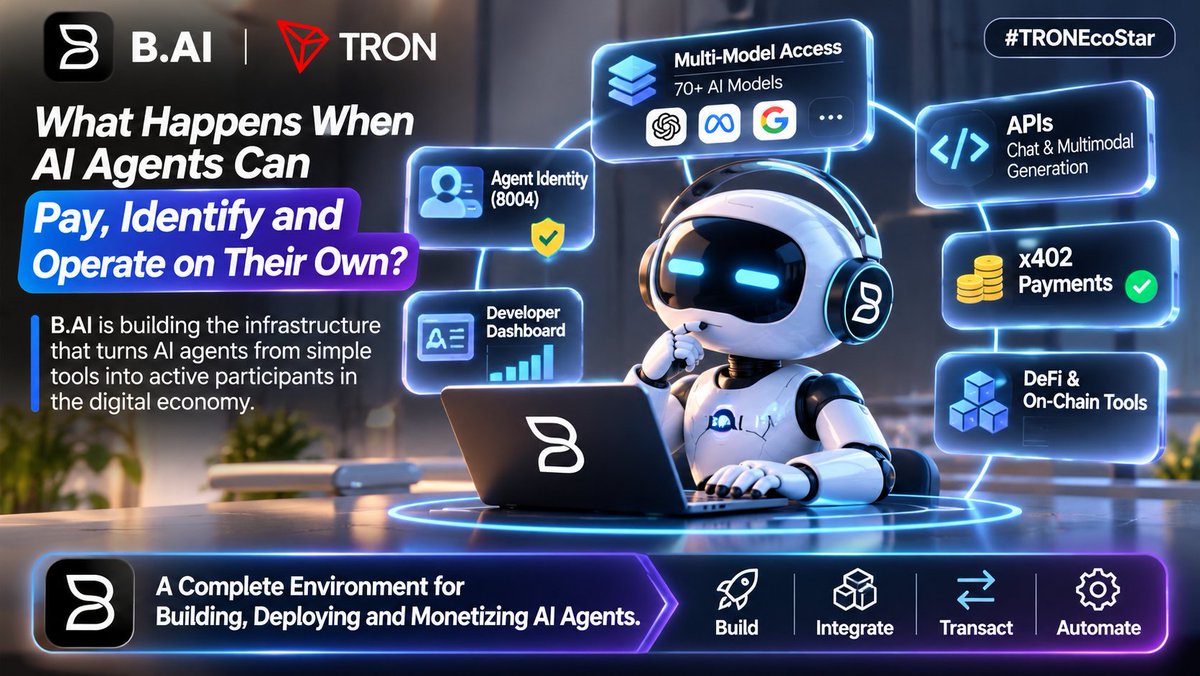
https://t.co/23A8leA9AX is exploring a different model.
Instead of treating AI agents as tools that only respond to instructions, it is building infrastructure that could allow them to participate more independently in the digital economy.
Here's where it gets interesting.
1. An agent needs an identity
Through its 8004 protocol infrastructure, https://t.co/23A8leA9AX is working on giving agents identifiable on-chain identities.
This creates a foundation for distinguishing agents and supporting trust between autonomous systems.
2. An agent needs purchasing power
With x402 payment infrastructure, agents can access payment rails that allow them to pay for services programmatically.
This means an agent could pay for the resources required to complete a task without relying on a separate manual payment for every interaction.
3. An agent needs access to financial services
https://t.co/23A8leA9AX also connects agent workflows with DeFi capabilities through MCP servers and Skills.
This introduces possibilities for lending, swapping and accessing yield-related services.
4. Intelligence needs infrastructure
https://t.co/23A8leA9AX's multi-model access and API services provide another important layer.
Developers can connect applications to different AI capabilities rather than building every model integration independently.
Why does this matter?
Imagine an AI agent that can identify itself, purchase the computing resources it needs, pay for external services and interact with financial applications.
That is a very different operating model from a chatbot waiting for its next prompt.
https://t.co/23A8leA9AX's participation in BNB Chain's Agent Survival Pack is an interesting step in this direction, bringing payments, identity and DeFi access into one integration.
The bigger question is no longer just how intelligent AI agents can become.
It's how independently they can operate, transact and coordinate with other digital systems.
That is an important part of the infrastructure https://t.co/23A8leA9AX is exploring.
@BAI_AGI@justinsuntron
#TRONEcoStar
𝐖𝐡𝐚𝐭 𝐈𝐟 𝐀 𝐒𝐦𝐚𝐫𝐭 𝐂𝐨𝐧𝐭𝐫𝐚𝐜𝐭 𝐂𝐨𝐮𝐥𝐝 𝐑𝐞𝐚𝐝 𝐌𝐨𝐫𝐞 𝐓𝐡𝐚𝐧 𝐁𝐥𝐨𝐜𝐤𝐜𝐡𝐚𝐢𝐧 𝐃𝐚𝐭𝐚?
Imagine building a decentralized application that needs to know whether a flight has landed, whether a sports match has ended, or what the current traffic conditions are.
The information exists outside the blockchain.
But how does a smart contract access it?
This is an interesting problem that @WinkLink_Oracle addresses through its AnyAPI service.
Here's what makes this particularly interesting.
1. Developers define what information they need.
Instead of limiting applications to predefined price feeds, developers can create custom requests for external information.
Examples include:
- Flight arrival and departure times.
- Sports match results.
- Traffic conditions.
- Custom API responses.
2. The request triggers an off-chain process.
A consumer smart contract initiates a request through WINkLink's operator contract.
The request generates an on-chain event that WINkLink nodes can monitor.
3. WINkLink nodes do the external work.
The node picks up the request, communicates with the specified external source and processes the response.
Its internal adapters can retrieve information, parse JSON responses and perform transformations before returning the result.
4. The information returns to the application.
After processing, the node submits its response to the operator contract, which delivers the result back to the requesting smart contract.
The application can then use that information according to its programmed logic.
Why does this matter?
Consider a decentralized insurance application designed around flight delays.
A developer could build a system that requests flight information through an external API and uses the returned result to evaluate predefined insurance conditions.
Or consider a gaming application that needs real-world sports results to trigger an on-chain outcome.
These are examples of what custom data connectivity can make possible, not claims of existing WINkLink deployments.
The bigger opportunity:
The next generation of decentralized applications will need more than token prices.
They will need access to different categories of external information, custom data processing and automated responses.
WINkLink AnyAPI provides infrastructure for developers to build around those requirements.
Sometimes the most important blockchain innovation isn't another token or another chain.
It's giving existing applications access to information they couldn't previously use.
@WinkLink_Oracle
#TRONEcoStar @justinsuntron
162,000 USDD in rewards. Two blockchains. 60 days of earning opportunities.
The next @GateDEX Bonus campaign is approaching, bringing BNB Chain Season 8 and Ethereum Season 6 together.
Here's what participants should know.
Campaign Highlights
- Total rewards: 162,000 USDD across both chains.
- Duration: 60 days.
- Networks: BNB Chain and Ethereum.
- Existing participants: Can continue earning by maintaining their eligible positions, subject to campaign rules.
How to Position Yourself
1. Choose your preferred network: BNB Chain or Ethereum.
2. Understand the USDD Earn mechanism before committing funds.
3. If you're already participating, review the continuation requirements for your existing position.
4. Monitor your eligible stake and reward allocation throughout the campaign.
5. Track the actual APY rather than assuming advertised returns will remain constant.
Campaign Timeline
November 27, 2026 – January 26, 2027
18:00 SGT (11:00 WAT)
What makes this interesting is the opportunity to participate across two ecosystems while keeping USDD at the centre of the strategy.
One important thing: Reward opportunities should be evaluated alongside smart contract, stablecoin and network risks. Higher advertised yields do not mean guaranteed returns.
Two chains. 60 days. 162,000 USDD in rewards.
The next chapter of USDD x GateDEX Bonus is almost here.
@justinsuntron@USDDecentralize #TRONEcoStar
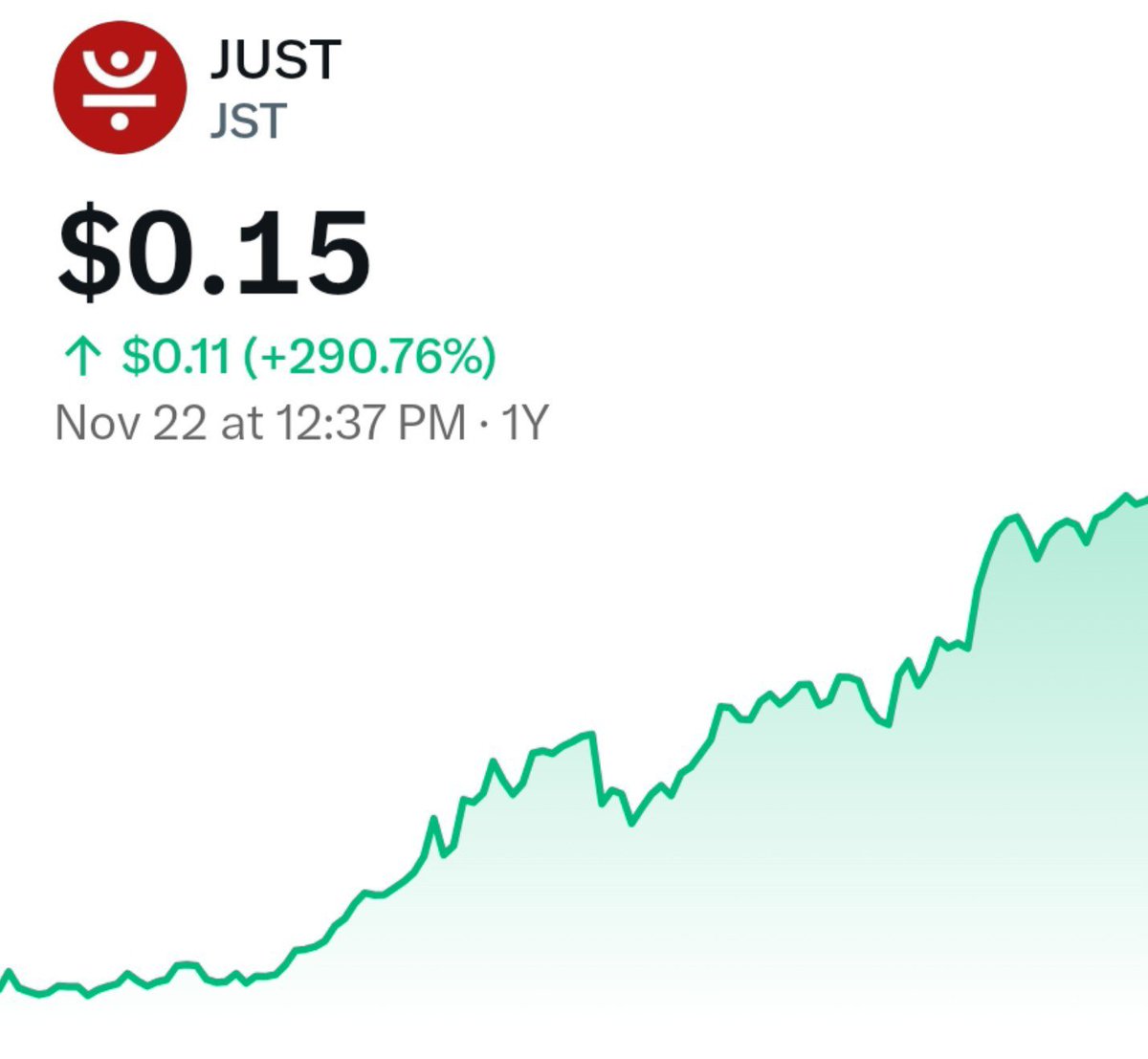
JST has surged 290.76% in one year, reaching $0.15 in the November 22 snapshot.
With five completed buyback-and-burn rounds, the JUST ecosystem has given the market another reason to watch $JST.
Is this the beginning of a bigger JST growth story?
@DeFi_JUST@justinsuntron #TRONEcoStar $JST
TRON'S NETWORK ACTIVITY TELLS A BIGGER STORY THAN A 90-DAY CHART
A token's price can change in a day. Network activity gives us another way to measure whether people are actually using the infrastructure.
TRON's Q3 2026 figures offer an interesting picture.
the numbers behind the network
- $92.25B in average stablecoin supply.
- $2.18T in quarterly stablecoin transfer volume.
- 1.08B transactions processed.
- 17.81M average monthly active users.
- $0.64 average transaction fee.
These figures point to something bigger than price movement: TRON is processing substantial stablecoin activity while maintaining relatively low average transaction costs.
what makes this important?
Stablecoin supply shows the capital held on the network.
Transfer volume shows how much value moves through it.
Transactions and active users provide another perspective on actual network usage.
Together, these metrics offer a more complete picture of adoption than a token's 90-day price chart alone.
the bigger question
Can TRON convert this level of network activity into sustained demand for its ecosystem and native token?
That is a more meaningful question to follow than simply asking whether TRX is outperforming another coin this month.
Which metric would you consider the strongest indicator of blockchain adoption: stablecoin volume, active users or transaction growth?
@justinsuntron #TRONEcoStar $TRX
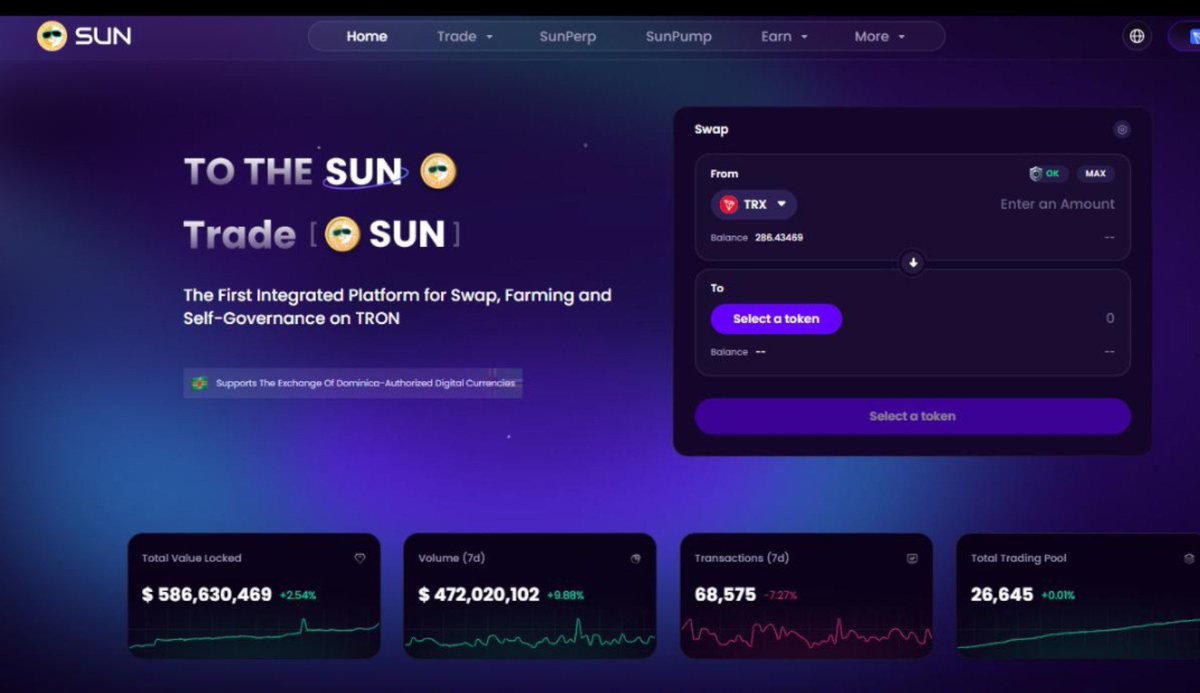
BEYOND BUYBACKS: HOW MUCH HAS https://t.co/Pv0fNS03Cu REALLY ACHIEVED IN 2026?
https://t.co/eEClf3Es2u is expanding its DeFi infrastructure across liquidity, spot trading, derivatives, and token buyback activity.
On March 2, 2026, https://t.co/eEClf3Es2u launched SunSwap V4, introducing Hooks, Singleton Architecture, and Flash Accounting. The upgrade expanded developer customization while reducing energy consumption for transactions.
The ecosystem's reported milestones highlight the scale of activity across its products:
➜ SunSwap TVL: Nearly $645 million across more than 26,800 active liquidity pools as of October 26, 2026.
➜ Daily activity: More than 14,000 on-chain transactions, with average daily trading volume exceeding $50 million.
➜ Q3 trading volume: Nearly $15 billion across https://t.co/eEClf3Es2u's product lines, comprising over $5 billion in spot DEX volume and approximately $9.7 billion in perpetual trading volume.
➜ Perpetual market growth: Q3 perpetual trading volume increased approximately 25% from the $7.75 billion recorded in Q2 2026.
➜ SUN buyback and burn: Cumulative burns reached 685.78 million SUN following the 52nd burn on October 27, 2026. This represents approximately 3.44% of the token's total supply.
These milestones show that https://t.co/eEClf3Es2u's development goes beyond exchange upgrades. Its ecosystem now spans liquidity provision, spot markets, perpetual trading, and a buyback mechanism funded by revenue from its core products.
The important measure going forward is whether this activity can translate into sustained liquidity, stronger protocol revenue, and lasting value for the SUN ecosystem.
@OfficialSUNio@justinsuntron #TRONEcoStar
𝗧𝗥𝗢𝗡 𝗗𝗲𝗙𝗶 𝗚𝗿𝗼𝘄𝘁𝗵: 𝗪𝗵𝗲𝗿𝗲 𝗟𝗶𝗾𝘂𝗶𝗱𝗶𝘁𝘆 𝗔𝗻𝗱 𝗟𝗲𝗻𝗱𝗶𝗻𝗴 𝗔𝗿𝗲 𝗘𝘅𝗽𝗮𝗻𝗱𝗶𝗻𝗴
Looking beyond TRON's stablecoin activity, its Q3 2026 DeFi numbers reveal another interesting development: growth in liquidity and lending demand.
According to CoinDesk Research, here's what changed between Q2 and Q3 2026:
TRON DEFI ECOSYSTEM
Total DeFi TVL
$4.5B → $5.7B
+26.6% QoQ
Lending share of total TVL
68%
CDP share of total TVL
22%
Together, lending and CDP accounted for approximately 90% of TRON's DeFi TVL.
JUSTLEND DAO PERFORMANCE
Total Value Locked
$3.9B
Share of TRON DeFi TVL
~68%
Active loans:
Q2: $127M
Q3: $199M
+56.7% QoQ
There's an interesting contrast here.
TRON's overall DeFi TVL expanded by 26.6%, while JustLend's active loans grew by approximately 56.7%.
That difference suggests lending activity expanded faster than the ecosystem's overall TVL during the quarter.
JustLend's position also highlights how important lending infrastructure has become within TRON's DeFi economy.
For me, the bigger story isn't just the increase in locked capital. It's how that capital is being deployed across the ecosystem.
@DeFi_JUST@justinsuntron #TRONEcoStar @trondao
TRON has built a strong position in stablecoin transfers and blockchain activity, and there's certainly room to discuss its long-term growth.
But $30 per TRX would imply a market capitalization of approximately $2.85 trillion at today's circulating supply.
That's a very ambitious target, especially for one altcoin season.
I'm bullish on the potential of the TRON ecosystem, but adoption, token demand and realistic valuations should guide these conversations.
@justinsuntron , what do you think is the next realistic milestone for $TRX?
#TRONEcoStar
@Trondao
Bitcoin is widely recognized as a store of value, but its utility doesn't have to stop at holding.
Through WBTC, Bitcoin-denominated value can enter other blockchain environments and interact with decentralized financial applications.
TRON is one of those environments.
But the more interesting question isn't whether WBTC exists on TRON. It's how much of that liquidity is actually being put to work.
𝗪𝗛𝗔𝗧 𝗧𝗛𝗘 𝗡𝗨𝗠𝗕𝗘𝗥𝗦 𝗦𝗛𝗢𝗪
The WBTC transparency dashboard recorded approximately 99.84 WBTC on TRON on November 18.
Against a reported global WBTC supply of roughly 116,459, that represents only about 0.086%.
The gap is worth watching.
𝗙𝗥𝗢𝗠 𝗛𝗢𝗟𝗗𝗜𝗡𝗚 𝗧𝗢 𝗙𝗜𝗡𝗔𝗡𝗖𝗜𝗔𝗟 𝗨𝗧𝗜𝗟𝗜𝗧𝗬
JustLend has already opened a WBTC lending market, allowing users to:
➜ Supply WBTC and earn market-based interest.
➜ Use eligible WBTC collateral to borrow other supported assets.
➜ Access Bitcoin-backed liquidity within TRON's DeFi environment.
Its dashboard currently shows approximately 4.69 WBTC in available market liquidity.
However, available liquidity alone doesn't establish how actively the market is being used.
𝗧𝗛𝗘 𝗔𝗗𝗢𝗣𝗧𝗜𝗢𝗡 𝗤𝗨𝗘𝗦𝗧𝗜𝗢𝗡
For WBTC to become a meaningful part of TRON DeFi, several things need to develop together:
➜ More WBTC entering the network.
➜ Deeper trading and lending liquidity.
➜ Consistent borrowing demand.
➜ Useful applications that give Bitcoin holders a reason to participate.
𝗧𝗛𝗘 𝗥𝗘𝗔𝗟 𝗧𝗘𝗦𝗧 𝗜𝗦 𝗨𝗧𝗜𝗟𝗜𝗧𝗬
Bringing Bitcoin-backed assets onto another blockchain is only the starting point.
The stronger measure of adoption is whether those assets become useful within the network's financial applications.
For WBTC on TRON, the next story to watch is not simply supply growth.
It's whether that supply translates into meaningful lending, borrowing, trading and liquidity activity.
Research sources: WBTC Transparency, TRONSCAN and JustLend.
@WrappedBTC@justinsuntron #TRONEcoStar
𝗪𝗛𝗔𝗧 𝗔𝗖𝗧𝗨𝗔𝗟𝗟𝗬 𝗕𝗔𝗖𝗞𝗦 𝗨𝗦𝗗𝗗? 𝗔 𝗗𝗘𝗘𝗣 𝗟𝗢𝗢𝗞 𝗜𝗡𝗧𝗢 𝗜𝗧𝗦 𝗖𝗢𝗟𝗟𝗔𝗧𝗘𝗥𝗔𝗟 𝗦𝗧𝗥𝗨𝗖𝗧𝗨𝗥𝗘
A stablecoin's real strength isn't determined by its $1 price alone.
What matters is what stands behind each token, how those assets are managed and whether the collateral can withstand market stress.
So, what actually backs USDD?
𝗜𝗡𝗦𝗜𝗗𝗘 𝗧𝗛𝗘 𝗖𝗢𝗟𝗟𝗔𝗧𝗘𝗥𝗔𝗟 𝗦𝗧𝗥𝗨𝗖𝗧𝗨𝗥𝗘
USDD uses a multi-collateral vault model. Its documented collateral types include:
➜ TRX: Native TRON asset used in dedicated collateral vaults.
➜ sTRX: Staked TRX exposure.
➜ USDT: Stablecoin collateral and liquidity support.
➜ WBTC and ETH: Additional crypto collateral types supported by the protocol.
Users can lock eligible assets into vaults and mint USDD against them. Each collateral type has its own minimum collateral requirements.
𝗪𝗛𝗔𝗧 𝗗𝗢𝗘𝗦 𝗢𝗩𝗘𝗥-𝗖𝗢𝗟𝗟𝗔𝗧𝗘𝗥𝗔𝗟𝗜𝗭𝗔𝗧𝗜𝗢𝗡 𝗠𝗘𝗔𝗡?
USDD's October 2026 transparency report recorded:
➜ Circulating supply: approximately $1.50B.
➜ Reserve assets: approximately $2.21B.
➜ Reported collateral ratio: 146.99%.
In simple terms, the reported reserve value was greater than the circulating supply.
But an aggregate ratio doesn't tell us everything about the quality, liquidity or deployment of those assets.
𝗧𝗛𝗘 𝗦𝗠𝗔𝗥𝗧 𝗔𝗟𝗟𝗢𝗖𝗔𝗧𝗢𝗥: 𝗔 𝗗𝗜𝗙𝗙𝗘𝗥𝗘𝗡𝗧 𝗟𝗔𝗬𝗘𝗥 𝗢𝗙 𝗘𝗫𝗣𝗢𝗦𝗨𝗥𝗘
Independent on-chain analysis identified a substantial USDD Smart Allocator position associated with lending platforms including Spark, Aave, JustLend and Morpho.
This introduces another dimension to the collateral discussion.
Assets deployed into external lending protocols carry additional considerations, including smart contract vulnerabilities, liquidity constraints and counterparty or protocol-specific risks.
That exposure deserves attention alongside the headline collateral ratio.
𝗧𝗛𝗘 𝗥𝗜𝗦𝗞 𝗤𝗨𝗘𝗦𝗧𝗜𝗢𝗡𝗦 𝗪𝗢𝗥𝗧𝗛 𝗔𝗦𝗞𝗜𝗡𝗚
➜ How concentrated is the collateral in volatile assets such as TRX?
➜ How quickly could deployed assets be accessed during market stress?
➜ What happens if an external lending protocol experiences a liquidity or security event?
➜ How frequently can users independently verify the composition of the reserves?
These questions matter because collateral value and collateral availability are not necessarily the same thing.
𝗧𝗛𝗘 𝗔𝗡𝗔𝗟𝗬𝗧𝗜𝗖𝗔𝗟 𝗧𝗔𝗞𝗘𝗔𝗪𝗔𝗬
USDD's collateral model combines crypto-backed vaults, stablecoin liquidity and a Smart Allocator that introduces external DeFi exposure.
That makes its structure worth examining beyond a single reserve ratio.
A stronger assessment of any stablecoin should consider three things together:
➜ What assets back it.
➜ Where those assets are deployed.
➜ How accessible they remain when market conditions deteriorate.
Because the real test of collateral isn't simply how much is reported during normal conditions.
It's how reliably that backing can support the system when it is under pressure.
Research sources: USDD October 2026 Transparency Report, USDD documentation and DIA independent on-chain analysis.
@justinsuntron@USDDecentralize #TRONEcoStar
𝗛𝗢𝗪 𝗖𝗔𝗡 𝗔 𝗦𝗠𝗔𝗥𝗧 𝗖𝗢𝗡𝗧𝗥𝗔𝗖𝗧 𝗔𝗖𝗖𝗘𝗦𝗦 𝗜𝗡𝗙𝗢𝗥𝗠𝗔𝗧𝗜𝗢𝗡 𝗢𝗨𝗧𝗦𝗜𝗗𝗘 𝗧𝗛𝗘 𝗕𝗟𝗢𝗖𝗞𝗖𝗛𝗔𝗜𝗡?
Imagine a prediction market that needs the result of a football match before settling its users' positions.
The smart contract can execute the settlement logic, but it cannot independently visit a sports website to check the final score.
This is one of blockchain's fundamental limitations.
𝗪𝗛𝗘𝗥𝗘 𝗪𝗜𝗡𝗸𝗟𝗶𝗻𝗸 𝗖𝗢𝗠𝗘𝗦 𝗜𝗡
WINkLink acts as a bridge between TRON smart contracts and external information sources.
Through its AnyAPI service, developers can request information such as sports results, flight schedules, weather conditions and other custom data.
𝗛𝗢𝗪 𝗗𝗢𝗘𝗦 𝗧𝗛𝗘 𝗣𝗥𝗢𝗖𝗘𝗦𝗦 𝗪𝗢𝗥𝗞?
➜ 1. Request: A smart contract initiates a data request through WINkLink's on-chain operator.
➜ 2. Detection: A WINkLink node monitors the blockchain and detects the request event.
➜ 3. Retrieval: The node accesses the specified external API and retrieves the requested information.
➜ 4. Processing: The response is extracted, transformed and formatted for the smart contract.
➜ 5. Delivery: The node submits the result back on-chain, where the consumer contract receives it through a callback.
The external information can now be used by the contract's programmed logic.
𝗙𝗥𝗢𝗠 𝗘𝗫𝗧𝗘𝗥𝗡𝗔𝗟 𝗗𝗔𝗧𝗔 𝗧𝗢 𝗢𝗡-𝗖𝗛𝗔𝗜𝗡 𝗔𝗖𝗧𝗜𝗢𝗡𝗦
This opens up possibilities beyond financial price feeds.
Smart contracts can be designed around information from sports, transportation, weather and other external services.
However, retrieving data does not automatically make it trustworthy. Source quality, node reliability and verification remain important considerations.
The real value of oracle infrastructure is giving blockchain applications a structured way to interact with information they cannot access independently.
That is an important part of what WINkLink brings to the TRON ecosystem.
Explore: https://t.co/kmK7RczyA5
@justinsuntron@WinkLink_Oracle #TRONEcoStar
𝗔𝗜𝗡𝗙𝗧: 𝗪𝗛𝗔𝗧 𝗗𝗢𝗘𝗦 𝗔𝗡 𝗔𝗜 𝗔𝗚𝗘𝗡𝗧 𝗡𝗘𝗘𝗗 𝗧𝗢 𝗢𝗣𝗘𝗥𝗔𝗧𝗘 𝗢𝗡 𝗕𝗟𝗢𝗖𝗞𝗖𝗛𝗔𝗜𝗡?
Imagine asking an AI agent to check your wallet, find a DeFi opportunity and execute a token swap.
Understanding the request is only the beginning. The agent also needs access to blockchain tools, instructions for using them, a way to pay for services and an identifiable presence.
This is where AINFT's AI agent infrastructure becomes interesting.
𝗙𝗢𝗨𝗥 𝗣𝗜𝗘𝗖𝗘𝗦 𝗢𝗙 𝗧𝗛𝗘 𝗣𝗨𝗭𝗭𝗟𝗘
➜ MCP SERVER — TOOL ACCESS
An AI model cannot interact with smart contracts just because it understands them. AINFT's MCP Server provides structured access to external tools and blockchain operations, including data queries, balance checks, transfers and contract interactions.
➜ SKILLS — TASK EXECUTION
Tools need workflows. AINFT's Skills library provides reusable instructions that help agents coordinate specific operations, including integrations for SunSwap, x402 payments and 8004 identity functionality.
➜ x402 — MACHINE-TO-MACHINE PAYMENTS
Using the HTTP 402 payment mechanism, x402 allows services to communicate payment requirements. This creates a way for AI agents to pay for eligible digital services without requiring a person to handle every individual payment.
➜ 8004 — AGENT IDENTITY
An agent that can interact with applications also needs an identity. The 8004 framework explores on-chain agent identification, declared capabilities and reputation records. Identity, however, does not automatically guarantee trustworthy behaviour.
𝗪𝗛𝗬 𝗧𝗛𝗜𝗦 𝗠𝗔𝗧𝗧𝗘𝗥𝗦
These components address different requirements: accessing tools, coordinating tasks, paying for services and establishing identity.
The bigger technical challenge is making them work together securely. An agent performing an on-chain action is not the same as proving that the action was authorized, safe and successful.
AINFT is exploring infrastructure for this next stage of Web3: AI agents that can move beyond conversation and interact with blockchain applications.
@AINFTcom@justinsuntron #TRONEcoStar
590 MILLION CLIENT ACCOUNTS: WHAT DOES THIS MEAN FOR BITTORRENT'S NETWORK?
What happens when a network grows beyond hundreds of millions of generated client accounts?
The interesting part isn't just the number. It's what a large distributed client ecosystem can contribute to content delivery.
BitTorrent has reported 590,019,979 client accounts generated across its network.
But why does this matter?
Understanding the infrastructure
Unlike traditional file delivery, which can depend heavily on centralized servers, BitTorrent uses a peer-to-peer distribution model.
Connected clients can participate in sharing data, allowing downloads to draw on resources distributed across multiple participants.
Three important things stand out:
➜ Network reach: A large client footprint gives the ecosystem a broad distribution presence across different regions.
➜ Distributed capacity: Clients can contribute upload and download resources, helping distribute content across a network of peers.
➜ Resilience: Peer-to-peer delivery reduces dependence on a single source for distributing popular content.
Why geographic distribution matters
The October 2026 BitTorrent whitepaper highlights node density and geographic distribution as important factors in swarm throughput and resilience.
A broader distribution of connected clients can help improve content availability and delivery, although actual performance still depends on active peers, bandwidth and swarm conditions.
The important distinction
590 million generated client accounts is a measure of ecosystem scale. It should not automatically be interpreted as 590 million active users or simultaneously connected devices.
The more interesting question is how effectively BitTorrent can translate that footprint into active participation, reliable content distribution and useful infrastructure.
Because network growth is impressive, but the real value lies in how that network performs.
@justinsuntron@BitTorrent #TRONEcoStar