⚠️IMPORTANT⚠️In the next couple of days, a new shitcoin will fork off Bitcoin. It is a big security risk for people who just believe they will get an "airdrop" and want to sell it, to get more bitcoin.
I will write more about it, but here is the TLDR: 👇
PSA: Wallets generated by COLDCARD at risk!
Wallets generated by COLDCARD Mk3 using a firmware version 4.0.1 (March 2021) or later, up to the latest version may be vulnerable to theft, unless used in combination with a strong passphrase or entropy was generated externally.
Please see the Coinkite security advisory (https://t.co/xuhBOGhkPX).
The attack is easy to reproduce with LLM assistance. There are reports that Mk2, Mk4, and Mk5 may be affected by (weaker) variants of the same vulnerability. If your wallet may be affected, please carefully move your funds to an unaffected wallet ASAP.
‼️@parman_the is taking advantage of people’s empathy, using the donation to mine BIP-110.
This is absolutely ridiculous and unethical.
If he really wants to do it right, he should mention it in his first tweet and separate donation addresses.
Huge red flag 🚩
Are you okay?
Coldcard users are getting rekt, fees are at 2 sats/vB, and the only thing you can talk about is JPEGs?
THE MOST LOW LEVEL MARKETING I HAVE EVER SEEN.
No one from Ocean or the BIP110 crowd has done ANYTHING to help with this issue.
Meanwhile, the people you've been attacking were the ones who stepped up, figured it out, and helped users.
Shame. You've completely lost the plot.
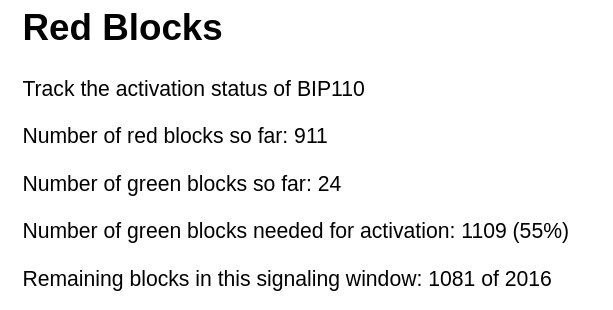
Even if every single remaining miner flips sides today, they’d still top out at 1105 blocks, it needs 4 blocks again. Mathematically proving BIP-110 is "dead on signaling."
Will all miners switch over once mandatory signaling starts? Will it be #BIP110 or #RIP110 that wins?
⚡️BIP-110 should die.
The proposal crosses Bitcoin’s constitutional line by turning a faction’s judgment about acceptable transaction purpose into consensus law.
Once that precedent survives, every future coalition learns the same lesson: capture enough developers, miners, companies, or public opinion, manufacture an emergency, then rewrite neutrality in the name of protecting the network.
That is how political money is born.
Bitcoin’s deepest property is not merely the 21 million cap. It is the credible assurance that nobody can easily alter the rules governing property after capital enters. Scarcity without rule stability is fragile. Ownership without neutral settlement is conditional. A monetary constitution that changes whenever a powerful faction declares a use illegitimate eventually becomes another discretionary system.
The data-storage externality is real. Nodes carry costs that individual users may not fully pay. Bitcoin must still address measurable burdens through fees, relay policy, technical efficiency, and conservative engineering. The network cannot begin judging what bytes mean. The moment consensus distinguishes virtuous transactions from undesirable transactions, miners stop serving a market and begin enforcing an ideology.
Saylor sees the danger clearly because this is Bitcoin’s post-victory phase.
External attacks strengthened the network. Bans failed. Ridicule failed. Competing coins failed to capture its monetary consensus. Institutional adoption now introduces the subtler threat: ownership and influence concentrating around custodians, mining pools, ETF issuers, exchanges, treasury companies, regulated intermediaries, and security consortiums.
Bitcoin remains decentralized in code while economic power around the code becomes increasingly centralized.
That is the real terrain.
The institutions entering Bitcoin will initially swear loyalty to neutrality. Later they will discover regulatory obligations, reputational concerns, national-security demands, sanctioned addresses, prohibited content, environmental mandates, and “systemic risks.” Each exception will arrive as a narrow necessity. Every narrow necessity will create infrastructure for the next exception.
The capture sequence is predictable:
First, undesirable behavior is identified.
Then neutrality is framed as irresponsibility.
Then restrictions are presented as temporary protection.
Then dissenters are accused of endangering adoption.
Then the exception becomes precedent.
Then Bitcoin still exists, but ownership increasingly requires permission.
BIP-110 is dangerous because its activation design tries to manufacture inevitability before genuine consensus exists. A contentious cultural dispute does not justify coercive signaling, bundled restrictions, uncertain compatibility costs, or chain-split risk. The technical flaws found around late upgrades make the entire exercise even more reckless.
Bitcoin has reached the stage where the people claiming to protect it may become more dangerous than the people trying to destroy it.
The enemy at the gate could not rewrite the ledger.
The faction inside the walls might persuade participants to rewrite it themselves.
Bitcoin survives victory only if every proposed exception encounters a culture strong enough to ask one question:
Does this preserve neutral, voluntary, permissionless property, or does it give somebody new power over somebody else’s transaction?
BIP-110 gives a faction new power.
Reject it.
@start9labs Shame on you. This is the definition of UASF (according to your ideology). Consensus is a mutual agreement reached by all parties involved. You should probably read more books. Grab your dictionary.
New to #Bitcoin?
1)💩Avoid altcoins.
2)🕴️Avoid KYC purchases.
3)🧼CoinJoin before/after identity leaks.
4)💰Just DCA & HODL.
5)🤓Learn GPG & Tor.
6)☑️Learn how to run a full node.
8)⚡Learn how to use LN.
9)🗝️Learn good cold-storage.
10)👛Learn good coin-selection.
Welcome!
Bitcoin RBF (Replace By Fee) Tutorial [Reposted]
This tutorial is relevant today because RBF will probably be the most accessible way to split your UTXOs in the event of a sustained BIP-110 chain split. I'll make a new tutorial soon showing how to do that.
Bitcoin Could Split on August 8th - How To Protect Your Stack
@PortlandHODL and @w_s_bitcoin join to discuss:
🔸 What to do with your BTC during a chain split
🔸 Policy vs. Consensus
🔸 Who actually governs Bitcoin
📺: https://t.co/TV3rPP7lPW
Let’s walk through several premises that are agreed upon by both sides of the BIP 110 debate.
1. Luke since 2018 has toyed with the need for a proof of work change.
2. Luke has defined any miner who does not signal for bip 110 as malicious and needs to be fired.
3. You can’t let a blockchain stall for days / weeks to figure out what POW algorithm you need to go to after SHA256. It involves writing code, testing, etc.
4. Luke had previously proposed consensus changes after having written the code months earlier.
5. Threatening a proof of work change would be negatively received by existing bitcoin miners / mining pools.
6. Sharing plans of a hard fork basically guarantee it happens.
——
Opinion, my conclusion: Luke has a proof of work change already staged.
@GrassFedBitcoin - how long is it acceptable to have a stalled proof of work chain in the event the miners are hostile?
2017: Barry Silbert and Digital Currency Group brought together the largest Bitcoin companies for the New York Agreement.
2026: Michael Saylor and Strategy have brought together many of the largest financial institutions and Bitcoin companies in the Bitcoin Security Consortium—BlackRock, Fidelity, Coinbase, Galaxy, Anchorage, ARK, Block, and even Blockstream.
Interesting how Blockstream opposed the New York Agreement but is now part of this consortium.
Different initiative.
Same lesson.
Bitcoin doesn’t belong to corporate consortiums.
Consensus belongs to the people running nodes and holding their own keys.
Self-custody remains Bitcoin’s greatest defence.
Nice try, Financial Industrial Complex.
Craig Wright aka Faketoshi removed the limits on OP_RETURN in his BSV Scam, and his chain got flooded with CSAM.
He also impersonated SN and was found liable for it.
Today, he is anti-#BIP110.
It seems that morons are going to be morons forever…
Poor @CsTominaga@Dr_CSWright