Update:
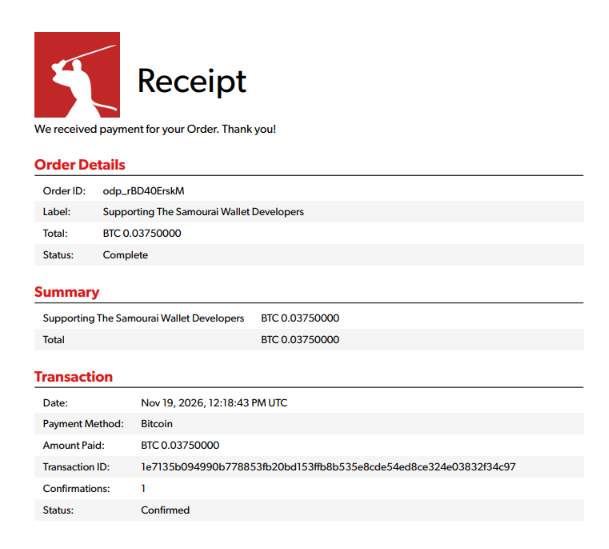
Our very gracious supporters declined to receive their sats back and instead asked for their donations to be sent to support the Samourai devs
These are all very wonderful people:
@coinjoined@TheSoloMiningCo@newzealandhodl@BTCProofofPlay@TheBTCoinQueen@rich_rdctd
I have added a contibution of my own and in total that means 3,750,000 sats going to support the families of Bill and Keonne
Not a bad result, but not the one we wanted. We were hoping we could have raised 20m sats this time round. Apologies again if you were looking forward to this.
If you still want to support the Samourai Devs I will drop a link in the tweet below where you can donate directly 👇
For now, I'm going to go buy some chips to go with all the egg on my face
#FREESAMOURAI
I finally found the time to dig into the different covenant soft fork proposals out there and make up my mind.
I think #BIP448 is what we should go with (+ #BIP54 of course, that's a no-brainer).
With just three opcodes (OP_TEMPLATEHASH, OP_CHECKSIGFROMSTACK, OP_INTERNALKEY) we
Personal update: I’ll be leaving @ledger at the end of 2026. After nine years, those words are strange to type.
I joined as CSO in December 2017. No desks, no team, just a blank page. I built the @DonjonLedger, our attack lab. Since then it has broken smartphone secure-boot chains, responsibly disclosed vulnerabilities in hardware, software, infrastructure across the industry, pushed research into post-quantum cryptography and AI-driven security...
Later, as CTO, I helped grow Ledger from a small startup into a unicorn. Ledger has now sold more than 8 million signers in 180 countries, and they protect roughly 20% of the world’s crypto assets. We built a full line of signers (Ledger Nano, Stax, Flex, Gen5 and Atom), the Ledger Wallet app, and Ledger Enterprise, which now serves 100+ financial institutions and brands. I’m proud of all of it.
I learned a lot along the way. In nine years, crypto went from a niche to infrastructure for modern finance, and cryptography made fifty years of progress in ten. Bitcoin is still permissionless money, and we still need it.
The threat landscape changed too. AI is making attacks cheaper, faster and easier to scale; The Donjon now uses AI to hunt bugs, and attackers do the same. The question we spent a decade answering for crypto (how do you protect what matters when any device can be compromised?) is now a question for every company, every AI agent and every government.
Thank you to @_pgauthier and the early team for trusting me with that blank page. To all the teams: you are exceptional, and it has been an honor to build with you.
We’ve been preparing this transition for many months, so Ledger’s teams, partners and roadmaps are ready. I’m bullish on Ledger’s future.
As for me, I’m building something new. I’m gonna dedicate my time to solving this security mess. More very soon.
Stay safe. Stay honest about your trust assumptions.
Washington is deciding who gets to build or use powerful technology. We think the answer should be everyone.
Bitcoin Policy Institute is now the Finney Foundation for Open Technology, and brings Hal Finney’s vision of technology as a tool for freedom to our nation’s capital.
A Bitcoin outage that could have been.
It took me 6+ months to build the full-system Bitcoin fuzzer (Fuzzamoto) that eventually found this bug, and in the end it found it while I was testing a state-space exploration feature inspired by @AntithesisHQ's sometimes assertions.
One of my goals with Fuzzamoto was to find the unknown unknowns that only emerge from testing the full system and its interactions. And that's exactly what happened!
For those familiar with my Fuzzamoto work, I'd describe Antithesis as a generalized, productionized version of it, with many, many years of additional R&D behind it.
This week, we shipped the Teams plan: low-cost, self-serve access to Antithesis for teams looking to catch bugs before they become outages.
If you're building software that handles people's money, safety, or other critical systems, it's worth checking out.
You can get 50% off your first month here: https://t.co/3OLC7X73vz
On the first day of Christmas, my true love gave to me…
1 zero-day in my dependency.
2 leaked seed phrases,
3 compromised keys,
4 malicious commits,
5 CRITICAL CVEs! 🎶
6 nodes a-crashing,
7 wallets draining,
8 devs a-patching,
9 hackers laughing,
10 servers burning,
11 exploits spreading,
12 months of audits…
And a zero-day in my dependency!
There is no shortage of important things to tackle in Bitcoin, and there is not enough of us to tackle it all.
If you care anon, get involved. Don't assume "it's being worked on".
That's already plenty right there, but there is a lot more. You also brush over the details with large categories, which is where 99% of the real work is, and where the number of people contributors decreases sharply.
Every day i am frustrated by how many interesting things i did not work on while i was focusing on other things. It's happened every single day since i've been working on Bitcoin full time, there is just too many important things to do, and so few people willing to do the work.
So stating "there isn't many things to work on" is just mind boggling to me. Maybe your interest is elsewhere now, and that's fine, but there is plenty of important things to tackle for whoever is interested in contributing to Bitcoin.
I left my overflowing todo list at the office, so here a few things off the top of my head while i'm in the train:
- stale tip relay
- more robust package relay that does not rely on orphanage
- block propagation through software improvements (net processing / validation split)
- CPU DoS mitigations through software improvements (idem)
- IBD improvements (idem)
- leveraging LLMs to write better security research tooling (fuzzing harnesses inside the project, fuzzamoto / Bedrock style frameworks, extensive invariant testing through blackbox and unit test s)
- tons of security hardenings all over the place (just look at the stopgap solution we add to mitigate CVEs and never cleanup as people move on to side projects or fixing more new CVEs)
- consensus protocol level hardenings with bip 54
- hardening address relay, which is vulnerable to spam while not being a great protection against motivated eclipse attacks
- reducing latency between pools and hashers through Stratum v2
- p2pool v2
- hardening the Core mining IPC interface which is new yet quickly becoming systemic infrastructure
- formal proving for some consensus critical parts of Core
- completing the pinning fixes for Lightning
- making Lightning gossip not dox your utxos
- explore scaling solutions that make alternative tradeoffs to Lightning, like Ark
- research more scaling solutions
- make progress on conservative first steps for more scripting capabilities like bip 448
- research game theory around CRQCs more rigorously
- help with efforts to bring a PQ output type to Bitcoin without compromising on important properties
- research more rigorously what a systemic change of cryptographic assumptions would look like, if possible without sacrificing core properties
- tons to explore and bring to market in self custody and hardware..
.. But stopping there as im getting off the train now. There is more, but i hope that already gives an idea that no there isn't nothing to work on these days.
I think the root issue in this difference of perspective is this common tendency in open source to just assume that "someone else is doing it". And i'm guilty of it too, last week we had somebody visit the office who is working on something i consider to be a priority for Bitcoin, ask around "who is working on X? Who is working on Y?" (both sub projects of the broader important work) and i was extremely surprised nobody picked those up yet. Everybody is talking about this, surely somebody must be working on THAT part?! Well no. The person has his hands full with another part, there is another person helping, and.. Barely anybody else.
Once you get into the weeds and get more familiar with who does the work concretely, the bus factor in Bitcoin is crazy, especially when put in perspective with what's at stake.
I'm replying to Ben but this is really a message to anybody reading this.
If you care about Bitcoin and find something interesting: step up anon, don't assume somebody else is already doing it, pick it up and contribute.