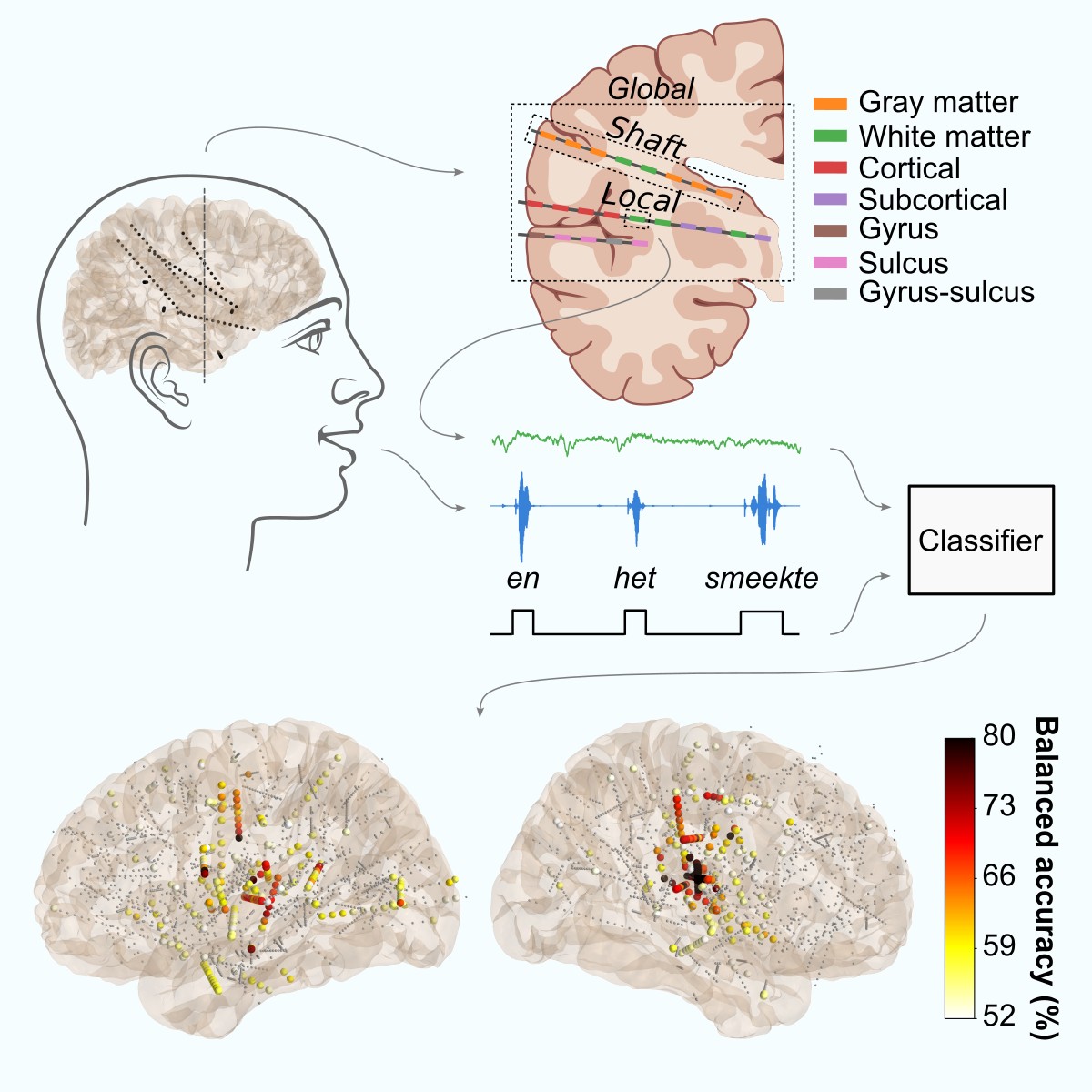
Can we move beyond the motor cortex for speech neuroprosthetics? We've explored just this question in our paper published today in Cell Reports!🧠
https://t.co/gc0yaeLIy6
Our speech presentation work has now been published in Communications Biology!
Can this be a start to create a more flexible speech BCI based on differential representations of speech and anatomical areas?
https://t.co/ykT2l3HOAf
📜New preprint!📜 Speech neuroprosthetic research has focused primarily on the sensorimotor cortical surface, but what if this region is damaged?❌ What are potential alternative areas for speech BCIs?🧠 Let’s explore this!👇 1/6
As always, the complete (raw!) dataset is freely available! Check out our preprint, which contains the links to the dataset and code as well: https://t.co/RfErfPoMGx 6/6
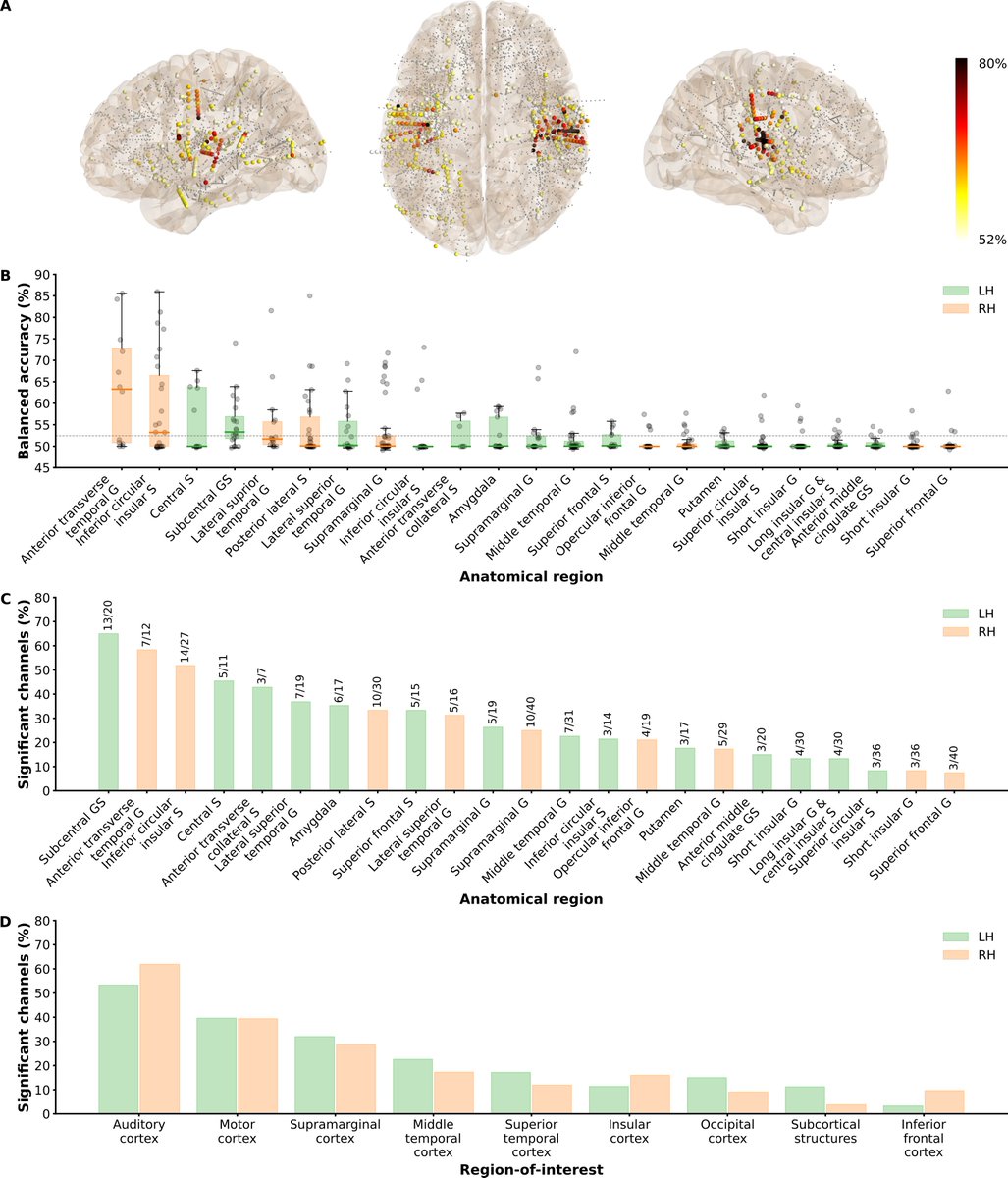
The most accurate and consistent results come from bilateral auditory regions, followed by motor regions ((sub)central sulcus), the supramarginal cortex and parts of the insula. These results highlight the potential of reaching the sulcal depth for speech neuroprostheses! 5/6
The motor representation of speech has gotten a lot of attention for speech BCIs lately, but what about non-motor speech representations? How are they all distributed across the brain? We've explored exactly that in our new preprint! https://t.co/vDXKpZIzye
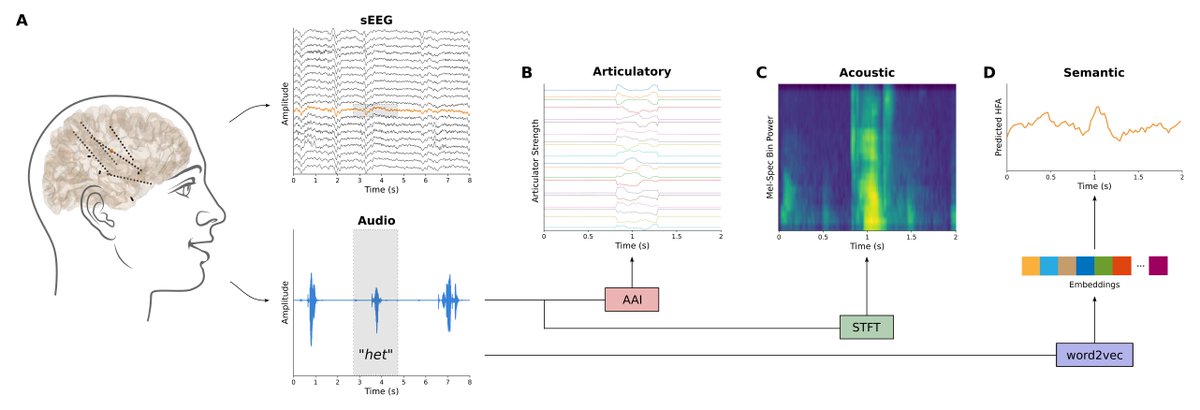
Speaking involves the coordination of searching for the right words, planning muscle movement and predicting the resulting sound. @maximeverwoert's new preprint explores how these speech representations—semantic, articulatory, and acoustic—are mapped across the entire brain. 1/5
🧠 Learn about stereo-electroencephalography, speech brain-computer interfaces, our open-source dataset, education, how to network, how to handle perfectionism and much more...
🎙 In this podcast episode together with Milena Korostenskaja
👂https://t.co/QT6gf5wRPV
New publication! We decode movement from non-motor brain areas using sEEG. We specifically removed all contact in the (sensori-)motor cortex and find no drop in performance. Read it here!
https://t.co/hMm4rHTNSO
New papers on intracranial electrode localization in humans from us and others!
1. SEEGAtlas, by @ZelmannRina https://t.co/haTQp64Uoz
2. A modular multi-software package protocol to localize electrodes in 100's of patients at MGH in the Cash lab!
https://t.co/mkGMbSeuYR
New preprint! We have identified global motor dynamics in humans, predictive of movement across tasks and across participants with non-overlapping electrodes. Here is what we did [1/🧵]: https://t.co/x9KY3a3XaS #bci#neuroscience#neurotech#science
New preprint! We have identified global motor dynamics in humans, predictive of movement across tasks and across participants with non-overlapping electrodes. Here is what we did [1/🧵]: https://t.co/x9KY3a3XaS #bci#neuroscience#neurotech#science