@chesscomsupport My https://t.co/hIQ6tLcl90 account (https://t.co/nVgPxvVmIf) was recently closed for “Abuse.” I’ve used it for 10 years without issues, was rated 2700, and didn’t receive any email explaining why. I’ve gone through the Chessica support steps, but any help explaining what happened and how I can reopen the account would be greatly appreciated. Thank you!
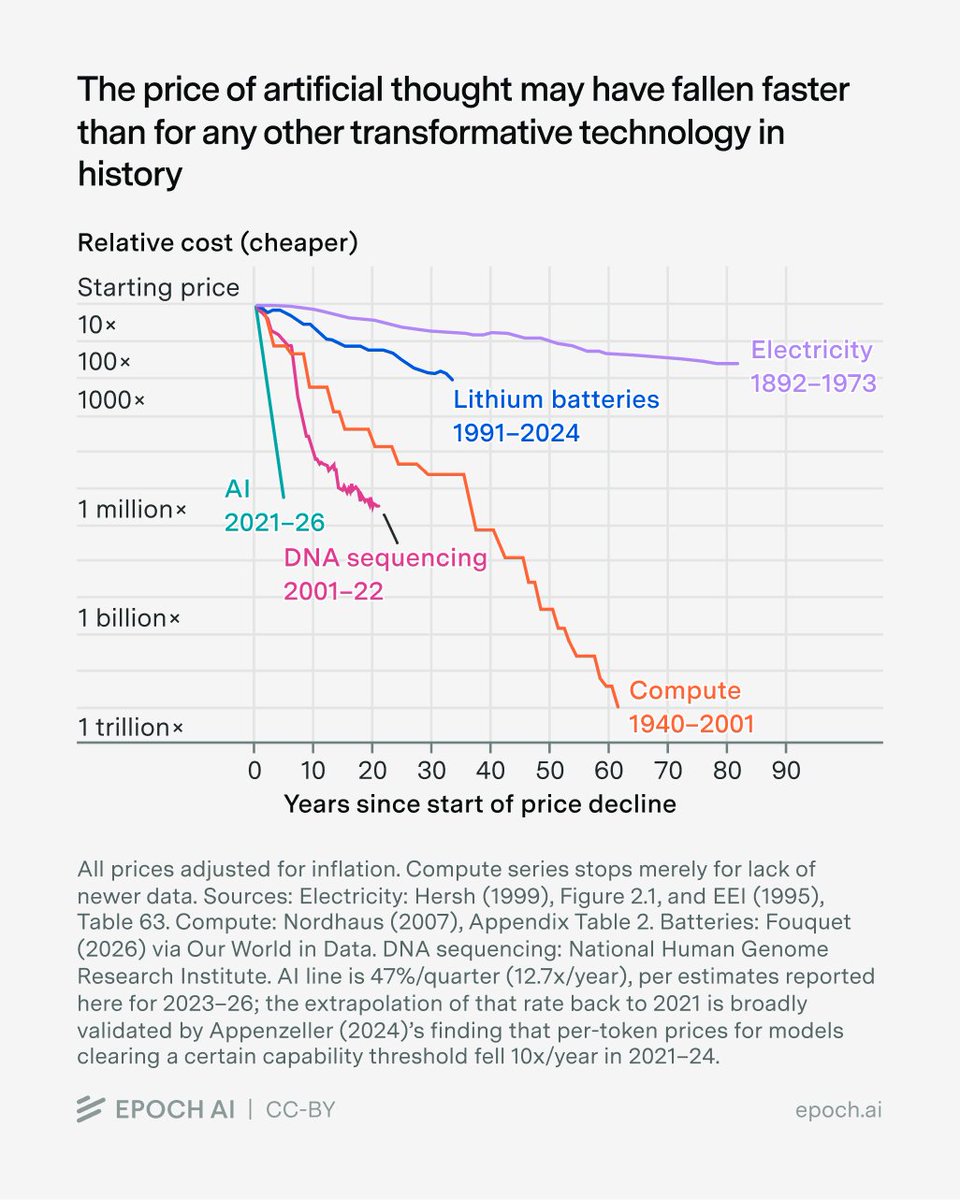
AI is getting cheaper more quickly than any other transformative tech in history. At a given level of performance, cost has fallen ~47%/quarter since 2023.
That’s 4× faster than DNA sequencing, 6× faster than compute, 18× faster than lithium batteries, and (up to 1973) 54× faster than electricity.
Calling the OpenAI solution a "dodge" because it solves 2 out of 4 eligible problems, yet only needed to solve *one* for the millennium prize is new levels of cope
Hello everyone! I am Maximilian, 23, based in Zürich :)
I defended my PhD in maths last year aged 21, making me one of the youngest PhDs in Switzerland. I now work in quantitative finance and make maths videos in German on the side for fun.
Looking to connect with people interested in maths, finance, and AI! Don’t be shy and say hi!
The Millennium Problems are a set of seven problems defined by the Clay Mathematics Institute in 2000, with a prize of one million dollars for solving each. Around 2003, a lone mathematician named Grigori Perelman published a proof of one of them, the Poincaré conjecture, by showing that any closed 3D shape without holes is the surface of a 4D ball. He was awarded the one million dollars in 2010, but declined it.
Since then, no other problem had been officially recognised as solved. Very recently, OpenAI announced a solution to another one. The Navier–Stokes existence and smoothness problem concerns whether water spontaneously explodes, at least mathematically. Here, 'explodes' means that the velocity becomes unbounded and the smooth mathematical description breaks down. I aim to provide a self-contained overview of the problem and the solution announced by OpenAI.
The Navier–Stokes equations are a result of Newton's second law and incompressibility, together with a model of viscous friction.
Newton's second law equates the acceleration along the trajectory of a fluid particle to the forces due to pressure, viscosity and external forcing. Incompressibility means that any region transported with the fluid preserves its volume.
Thus, these equations describe viscous, incompressible fluids, including water. Viscosity tends to smooth out differences in velocity. Ignoring viscosity gives the Euler equations, an idealised approximation.
A longstanding open problem in the field has been whether, given a smooth initial condition for a three-dimensional fluid, there exists a solution that remains smooth for all time, that is, whether there always is a solution that does not blow up.
The Millennium Prize is offered for proving one of four precisely formulated statements. Two concern a proof that water doesn't blow up, that is, proving global smoothness without external forcing, on either the whole space or a periodic domain. The other two concern an example of water blowup, but allow a smooth external force: you are allowed to push the water around, as long as your pushing stays smooth and doesn't itself become infinite. So forcing is allowed in a prize-winning counterexample, even though this would leave the unforced question open.
Alpöge and Buckmaster published a construction of finite-time blowup for the three-dimensional Euler equations with smooth forcing. Their solution develops unbounded vorticity, which measures local rotation in the fluid. OpenAI's announced result tackles Navier–Stokes: the fluid has to misbehave despite viscosity trying to smooth everything out.
The OpenAI approach draws on the programme of Diego Córdoba and Luis Martínez-Zoroa. It constructs a swirling flow that becomes infinitely fast in an ever smaller region. Carefully arranged wiggles around the vortex grow by drawing energy from the surrounding flow and transport the momentum that would otherwise require an exploding external force. Further corrections keep that force and all its derivatives smooth through the blowup.
In my masters thesis I studied non-uniqueness for the two-dimensional Euler equations, so I was especially intrigued by this remarkable result and I am very curious about the future mathematical problems that will be solved using AI!
@PalmerLuckey The problem is you’re wrong on the economics. Like if you think talented people are bad for the country because “job completion” you might as well become Bernie Sanders. It’s called the lump of labor fallacy.
In a new preprint published to arXiv, I prove a strengthening of this result, namely mod-Poisson convergence, for a larger class of probability distributions than just the uniform distribution.
The preprint is available at https://t.co/GyIlFctjhC
A classical result in probabilistic number theory, the Erdős--Kac Theorem, states that the number of distinct prime factors of a uniformly randomly chosen integer between 1 and n behaves asymptotically like a normal distribution if n is large.
Thrilled to share that this preprint has passed peer review and been accepted by the Journal of Theoretical Probability. If formatting is completed on schedule, it is expected to appear in Volume 1, Issue 3 of said journal this September.
Related to the SLLN is the Central Limit Theorem (CLT), which gives a more precise quantification of how the empirical mean deviates from the expected value.
In https://t.co/2sIqFksCYJ, T. Lehéricy and I explore quantitative versions of the CLT for partially dependent variables
In the new preprint uploaded to arXiv, I provide an alternative proof for an explicit formula of the expectation of this statistic for streak length one. https://t.co/MGGd1G34fD
New preprint! https://t.co/MGGd1G34fD
Consider repeatedly flipping a fair coin. The coin flips are, at least to good approximation, independent, so that even if a streak of multiple heads in a row occurs, this does not make it more likely that the next flip is also heads.
However, as pointed out by Miller and Sanjurjo in 2018, even in the case of independent coin flips, this statistic is biased, as its average value is strictly less than the probability of a coin flipping heads (which we use here as a substitute for success as above).