@supriya_sule Every politician in India is able to afford foreign education in expensive Colleges and Schools for his/her children.
This is a tragedy that continues to afflict our educational system in the country.
Stop wasting hours trying to learn AI.
I have already done it for you.
With one list. Zero confusion. And no fluff.
📹 Videos:
1. LLM Introduction: https://t.co/sfqLeUwf3W
2. LLMs from Scratch: https://t.co/GbnKbfvhcg
3. Agentic AI Overview (Stanford): https://t.co/EnqB4YMpeY
4. Building and Evaluating Agents: https://t.co/vp8RCDEoZP
5. Building Effective Agents: https://t.co/mngwlvMHna
6. Building Agents with MCP: https://t.co/TVk18pOf6Z
7. Building an Agent from Scratch: https://t.co/bfnRYfrFjd
8. Philo Agents: https://t.co/SQcGLseeM1
🗂️ Repos
1. GenAI Agents: https://t.co/cXJNVqPZqv
2. Microsoft's AI Agents for Beginners: https://t.co/WHiolowRZi
3. Prompt Engineering Guide: https://t.co/rVMK9vZfBJ
4. Hands-On Large Language Models: https://t.co/zpmaATDtdr
5. AI Agents for Beginners: https://t.co/WHiolowRZi
6. GenAI Agents: https://t.co/s9uA1N24PV
7. Made with ML: https://t.co/AKffs9HkUz
8. Hands-On AI Engineering: https://t.co/h9OVhJ3tWn
9. Awesome Generative AI Guide: https://t.co/lV1YMGL52R
10. Designing Machine Learning Systems: https://t.co/IUXQzlY97i
11. Machine Learning for Beginners from Microsoft: https://t.co/KrSHxdZMju
12. LLM Course: https://t.co/6U4Vww6Uyk
🗺️ Guides
1. Google's Agent Whitepaper: https://t.co/5Wpf7xvQqz
2. Google's Agent Companion: https://t.co/bVmjIK8Xam
3. Building Effective Agents by Anthropic: https://t.co/7SsNu6xr6Y
4. Claude Code Best Agentic Coding practices: https://t.co/X22UJOHlbC
5. OpenAI's Practical Guide to Building Agents: https://t.co/Bn5SYDT9KR
📚 Books:
1. Understanding Deep Learning: https://t.co/csAFkaw3Qp
2. Building an LLM from Scratch: https://t.co/72W4q5QV4z
3. The LLM Engineering Handbook: https://t.co/WgHM7dn8xq
4. AI Agents: The Definitive Guide - Nicole Koenigstein: https://t.co/2vXzCQXEqg
5. Building Applications with AI Agents - Michael Albada: https://t.co/MQAwMPbzQZ
6. AI Agents with MCP - Kyle Stratis: https://t.co/CcaNk01utK
7. AI Engineering: https://t.co/GD45IogK63
📜 Papers
1. ReAct: https://t.co/Nk77rLspmX
2. Generative Agents: https://t.co/CJEokZcGSw
3. Toolformer: https://t.co/GVKiIt2pj3
4. Chain-of-Thought Prompting: https://t.co/YyoEidCGMi
🧑🏫 Courses:
1. HuggingFace's Agent Course: https://t.co/288ifz8r9R
2. MCP with Anthropic: https://t.co/F07zf0lfXi
3. Building Vector Databases with Pinecone: https://t.co/6MFjlpTHab
4. Vector Databases from Embeddings to Apps: https://t.co/ngGDY3Rc7r
5. Agent Memory: https://t.co/BnlgGadL7o
Follow @iansh04_ for more!!
👇 Comment “AI” for more resources
Repost for your network ♻️
Bookmark for future.
This sentence by Dostoyevsky never fails to hit hard:
“You sensed that you should be following a different path, a more ambitious one, you felt that you were destined for other things but you had no idea how to achieve them and in your misery you began to hate everything around you.”
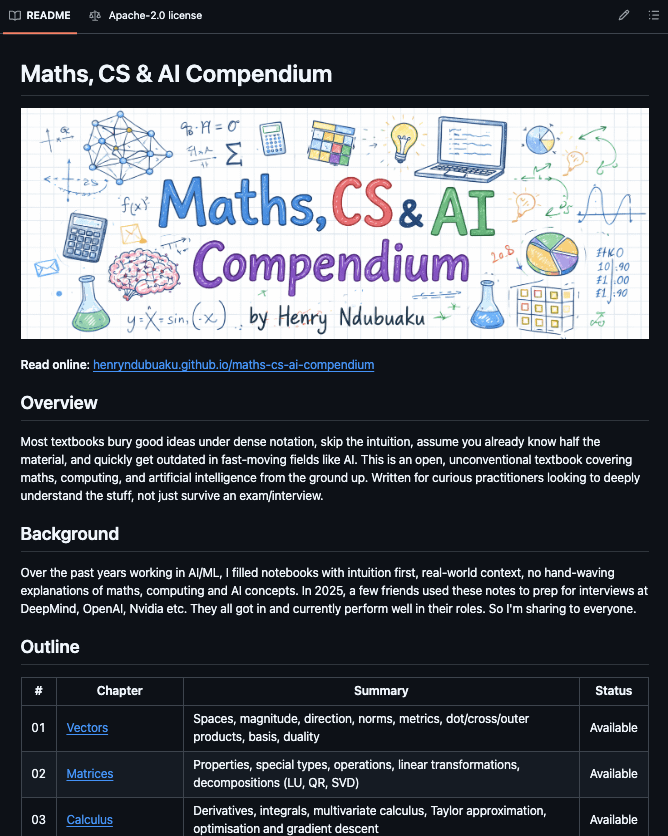
🚨 BREAKING: An AI engineer just compiled every maths, CS, and AI concept into one free open-source textbook. Built with intuition, not notation.
It covers vectors, calculus, machine learning, GPU programming, systems design, and AI inference. All explained the way nobody taught you in college.
It's called the Maths, CS & AI Compendium.
You open a chapter. It gives you the intuition first, then the math, then the real-world context. You come out actually understanding it. Not memorizing it. Not surviving an exam. Actually understanding the thing.
Not a course.
Not a YouTube playlist.
A full open-source textbook built by an AI engineer who filled notebooks for years working in AI, then watched his friends use those notes to get into DeepMind, OpenAI, and Nvidia.
Here's what's already inside:
→ Vectors and matrices from the ground up, spaces, transformations, SVD, all with clean intuition before the formulas
→ Calculus built for ML, derivatives, gradient descent, Taylor approximation, multivariate everything
→ Statistics and probability done right, Bayesian methods, information theory, distributions that actually make sense
→ Machine learning end to end, classical ML, deep learning, reinforcement learning, distributed training
→ GPU programming, SIMD, CUDA, Triton, ARM chips, TPUs, the low-level stuff most courses skip entirely
→ Systems design, inference, quantization, streaming LLMs, edge deployment, large scale infra
Here's how it's different:
Most textbooks bury the idea under 3 pages of notation. This one leads with the intuition. Why does this work. What does this actually mean. Where does this show up in the real world. Then the math. In that order. Every chapter.
Here's the wildest part:
A few friends used early drafts of these notes to prep for interviews at DeepMind, OpenAI, and Nvidia. They all got in. So he put the whole thing on GitHub for everyone. 18 chapters planned. 6 already live. The rest dropping soon.
Built by Henry Ndubuaku. 100% Open Source.
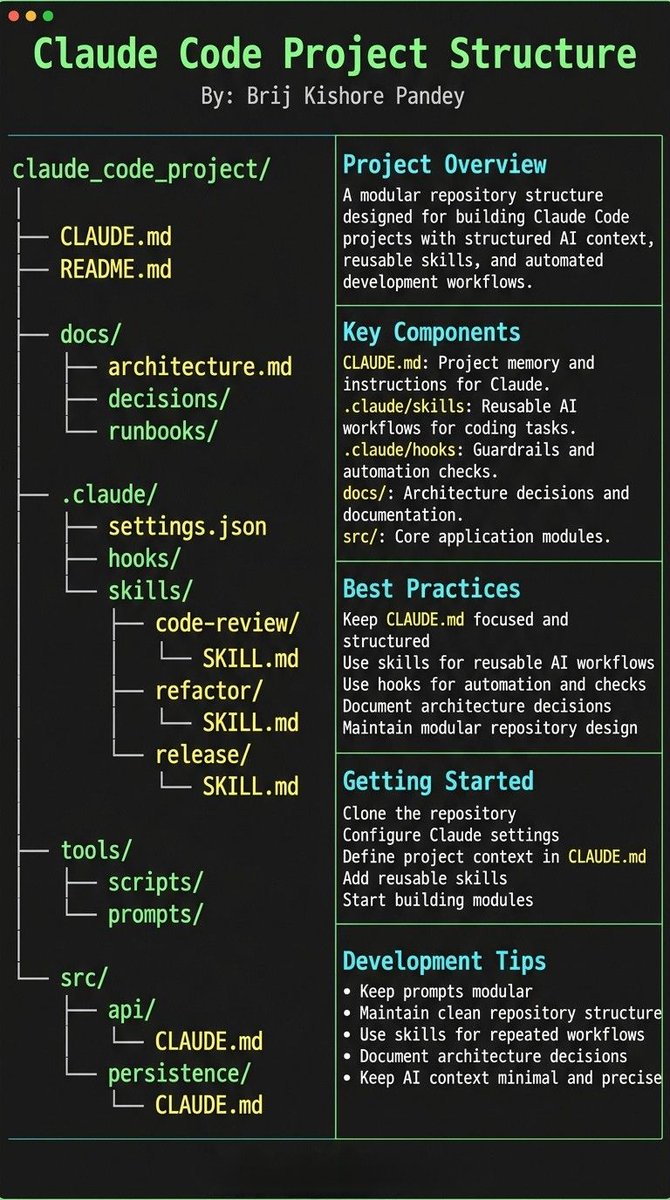
Most people treat CLAUDE.md like a prompt file.
That’s the mistake.
If you want Claude Code to feel like a senior engineer living inside your repo, your project needs structure.
Claude needs 4 things at all times:
• the why → what the system does
• the map → where things live
• the rules → what’s allowed / not allowed
• the workflows → how work gets done
I call this:
The Anatomy of a Claude Code Project 👇
━━━━━━━━━━━━━━━
1️⃣ CLAUDE.md = Repo Memory (keep it short)
This is the north star file.
Not a knowledge dump. Just:
• Purpose (WHY)
• Repo map (WHAT)
• Rules + commands (HOW)
If it gets too long, the model starts missing important context.
━━━━━━━━━━━━━━━
2️⃣ .claude/skills/ = Reusable Expert Modes
Stop rewriting instructions.
Turn common workflows into skills:
• code review checklist
• refactor playbook
• release procedure
• debugging flow
Result:
Consistency across sessions and teammates.
━━━━━━━━━━━━━━━
3️⃣ .claude/hooks/ = Guardrails
Models forget.
Hooks don’t.
Use them for things that must be deterministic:
• run formatter after edits
• run tests on core changes
• block unsafe directories (auth, billing, migrations)
━━━━━━━━━━━━━━━
4️⃣ docs/ = Progressive Context
Don’t bloat prompts.
Claude just needs to know where truth lives:
• architecture overview
• ADRs (engineering decisions)
• operational runbooks
━━━━━━━━━━━━━━━
5️⃣ Local CLAUDE.md for risky modules
Put small files near sharp edges:
src/auth/CLAUDE.md
src/persistence/CLAUDE.md
infra/CLAUDE.md
Now Claude sees the gotchas exactly when it works there.
━━━━━━━━━━━━━━━
Prompting is temporary.
Structure is permanent.
When your repo is organized this way, Claude stops behaving like a chatbot…
…and starts acting like a project-native engineer.
Most people try to learn ML randomly.
That’s why they quit.
Here’s the clean roadmap from 0 → AI Expert:
🟢 Beginner (0–4 Months)
1️⃣ Python + NumPy/Pandas
2️⃣ Linear Algebra + Probability
3️⃣ SQL + Data Pipelines
4️⃣ ML Fundamentals (Scikit-learn)
5️⃣ Ship 1 real project
At this point → You’re job-ready.
---
🔵 Advanced (5–12 Months)
6️⃣ Deep Learning (PyTorch)
7️⃣ Specialize (CV / NLP / Recsys)
8️⃣ MLOps (MLflow + Kubeflow)
Now you’re an ML Engineer.
---
🔴 Expert (12–18 Months)
9️⃣ Agentic AI systems
🔟 Production scale (Ray + Vertex AI)
Now you build AI systems — not just models.
---
Most people stop at Stage 4.
The top 1% finish all 10.
Save this.
Consistency > intelligence. 🚀
Most people use LLMs.
Very few actually understand how they work under the hood.
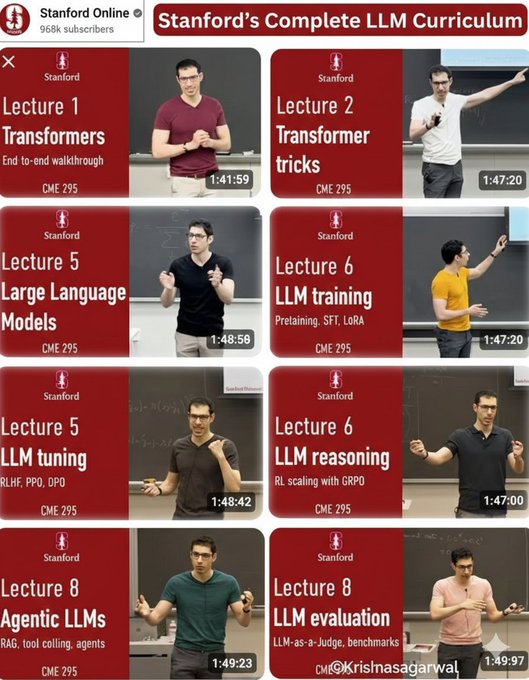
If you want to go from prompt user → real AI engineer, study these 9 concepts in order:
1️⃣ Transformers — attention, tokens, self-attention basics
https://t.co/LYdTQnAzCh
2️⃣ Transformer tricks — what makes them stable & scalable
https://t.co/sVYo1bGGHf
3️⃣ From Transformers → LLMs — how scale changes behavior
https://t.co/vDd3bulqhp
4️⃣ LLM training — where “intelligence” actually emerges
https://t.co/R8bVEHSuD1
5️⃣ Instruction tuning & alignment — why fine-tuning matters
https://t.co/FN5B95b4OJ
6️⃣ LLM reasoning — why models fail + what improves them
https://t.co/RxBu4atx2Z
7️⃣ Agentic LLMs — models that plan, call tools, and act
https://t.co/OFAUYgfOI4
8️⃣ LLM evaluation — measure beyond demos & vibes
https://t.co/MTzQax7qEL
9️⃣ What’s next — trends that actually matter
Bookmark this. Study step-by-step. Your prompts will level up — and so will your builds.
This framework is from the Nobel Prize-winning physicist, Richard Feynman.
Known as "The Great Explainer," Feynman could break down quantum mechanics for non-scientists.
His secret? He didn't just memorize—he TRULY understood.
This just arrived. Professors Kapur and Subramanian have written a magnificent book, which is rigorously researched, elegantly presented, and impeccably balanced in its judgements. As I say in my endorsement, every Indian who wishes to know their country better should read it.
The first bottleneck to anything isn't to do it well. It's to do it, period. What's the bottleneck to you writing a great book? Writing a book, period. What's the bottleneck to you writing a great piece of content? Creating 1 piece of content, period.
Just start.
A top student won’t judge you for asking basic questions.
A great teacher won’t mock your mistakes.
A true leader won’t laugh at your small start.
People on the path of growth and achievement know what it takes. The loudest doubts come from those who never tried.
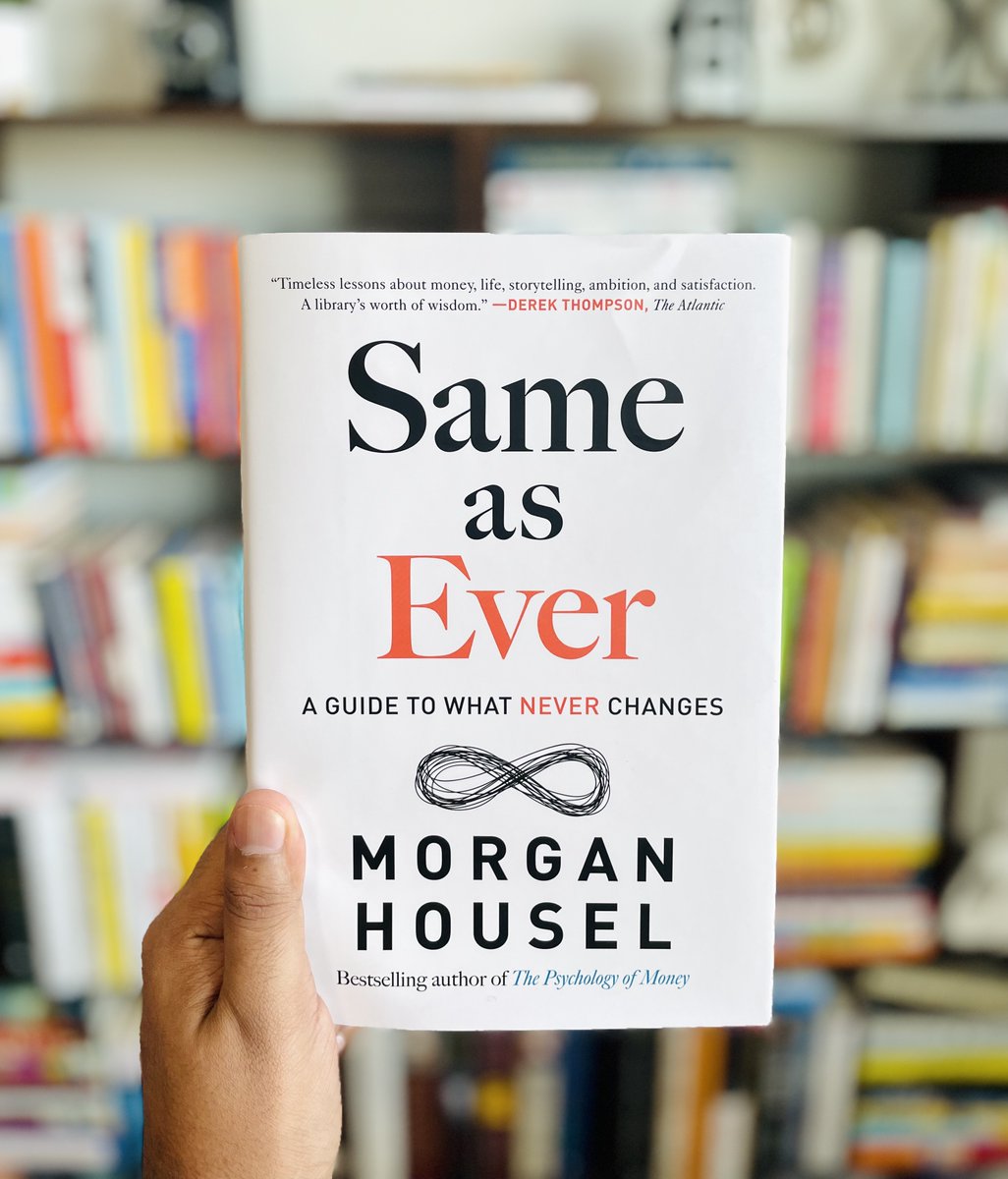
“Same As Ever by Morgan Housel”
A profoundly thoughtful and fascinating read. This is a book of stories about what never changes in a changing world. It has done more to change the way I see the world now. I would highly recommend it.
10 lessons from the book 🧵
Here are 15 Books and Resources for aspiring Investors:
5 Books:
- "One Up On Wall Street" by Peter Lynch
- "Margin of Safety" by Seth A. Klarman
- "The Intelligent Investor" by Benjamin Graham
- "You Can Be a Stock Market Genius" by Joel Greenblatt
- "Value Investing: From Graham to Buffett and Beyond" by Bruce Greenwald
5 Ressources:
- Joel Greenblatt Investing Letters
- Warren Buffett Shareholder Letters
- Bruce Greenwald Class Notes
- Compilation of Charlie Munger Speeches
- Gannon Compilation
5 X Accounts:
- @BrianFeroldi
- @StockMarketNerd
- @ideahive
- @borrowed_ideas
- @iancassel
Succession at Kotak Mahindra Bank has been foremost on my mind, since our Chairman, myself and Joint MD are all required to step down by year end. I am keen to ensure smooth transition by sequencing these departures. I initiate this process now and step down voluntarily as CEO.
The bank awaits RBI approval of the proposed successor. In the interim my dear colleague Dipak Gupta - currently Joint MD, will function as MD & CEO, subject to approvals.
As Founder, I am deeply attached to brand Kotak and will continue to serve the institution as Non-Executive Director and significant shareholder. We have an outstanding management team to carry the legacy forward. Founders go away, but the institution flourishes into perpetuity.
A long time ago, I saw names like JP Morgan and Goldman Sachs dominate the financial world and dreamed of creating such an institution in India. It is with this dream that I started Kotak Mahindra 38 years ago, with 3 employees in a 300 sqft office in Fort, Mumbai. I have deeply cherished every bit of this memorable journey, living my dream.
We are now a pre-eminent bank & financial institution, created on the basic tenets of trust and transparency. We have created value for our stakeholders and provide over 1 lakh direct jobs. An investment of ₹10,000 with us in 1985 would be worth around ₹ 300 cr today.
I am confident that this Indian owned institution will continue to play an even more important role in India’s transformation into a social and economic powerhouse.