If you want to learn
GO → devops-resources
Git → devops-resources
ELK → devops-resources
Docker → devops-resources
Jenkins → devops-resources
Kubernetes → devops-resources
AWS/GCP/Azure → devops-resources
One of the best resources that helped in my DevOps career. Link 👇
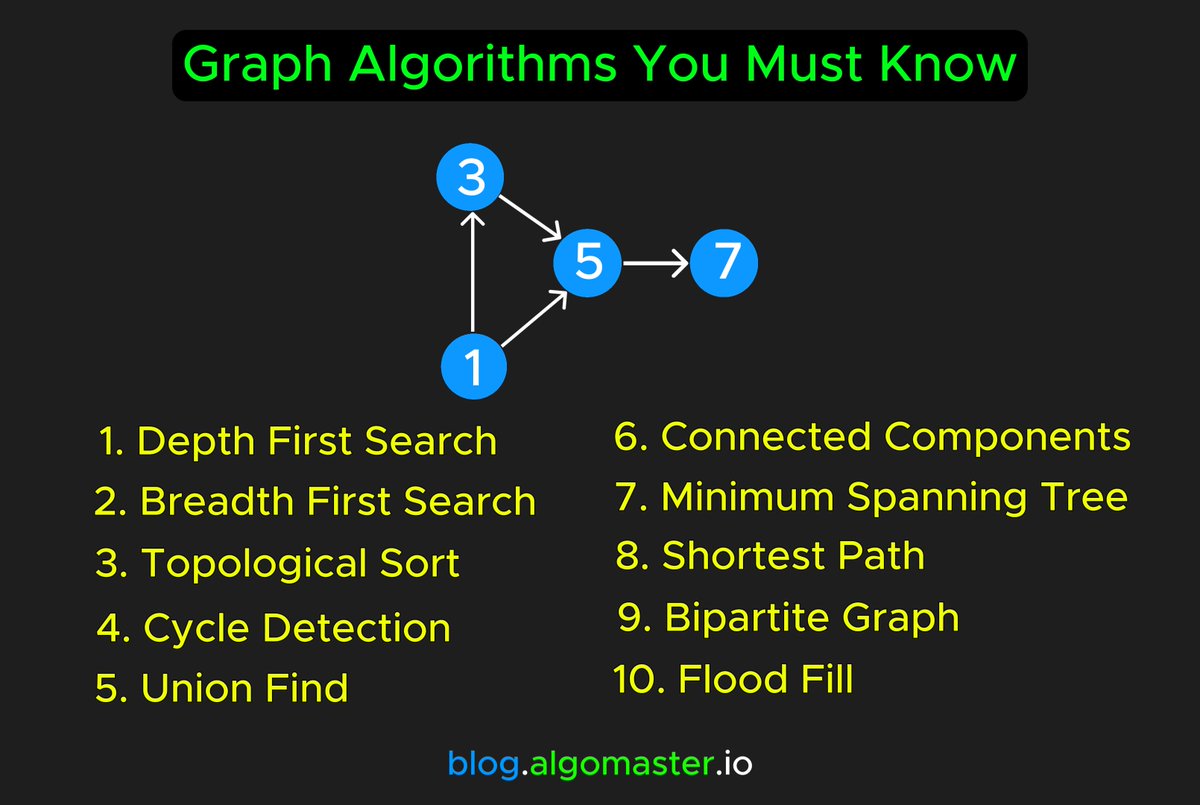
10 𝐈𝐦𝐩𝐨𝐫𝐭𝐚𝐧𝐭 𝐆𝐫𝐚𝐩𝐡 𝐀𝐥𝐠𝐨𝐫𝐢𝐭𝐡𝐦𝐬 𝐟𝐨𝐫 𝐂𝐨𝐝𝐢𝐧𝐠 𝐈𝐧𝐭𝐞𝐫𝐯𝐢𝐞𝐰𝐬:
1. 𝐃𝐞𝐩𝐭𝐡 𝐅𝐢𝐫𝐬𝐭 𝐒𝐞𝐚𝐫𝐜𝐡 (𝐃𝐅𝐒): Explores as far as possible along each branch of a node before backtracking. Useful to explore all possible paths, detecting cycles, and finding connected components.
2. 𝐁𝐫𝐞𝐚𝐝𝐭𝐡 𝐅𝐢𝐫𝐬𝐭 𝐒𝐞𝐚𝐫𝐜𝐡 (𝐁𝐅𝐒): Explores all neighbors at the present depth before moving to nodes at the next depth level. Perfect for finding the shortest path in unweighted graphs and solving problems that involve level-order traversal.
3. 𝐓𝐨𝐩𝐨𝐥𝐨𝐠𝐢𝐜𝐚𝐥 𝐒𝐨𝐫𝐭: Orders vertices in a directed acyclic graph (DAG) such that for every edge (u -> v), u comes before v. Useful for scheduling problems like course prerequisites or build orders.
4. 𝐂𝐲𝐜𝐥𝐞 𝐃𝐞𝐭𝐞𝐜𝐭𝐢𝐨𝐧: Uses DFS/BFS to identify cycles in a graph. Useful to avoid infinite loops and detecting deadlocks.
5. 𝐔𝐧𝐢𝐨𝐧 𝐅𝐢𝐧𝐝 (𝐃𝐢𝐬𝐣𝐨𝐢𝐧𝐭 𝐒𝐞𝐭): Tracks a set of elements partitioned into disjoint subsets. Useful for detecting cycles in undirected graphs and implementing other graph algorithms like Kruskal’s MST algorithm.
6. 𝐒𝐭𝐫𝐨𝐧𝐠𝐥𝐲 𝐂𝐨𝐧𝐧𝐞𝐜𝐭𝐞𝐝 𝐂𝐨𝐦𝐩𝐨𝐧𝐞𝐧𝐭𝐬: Used to identify subgraphs in a directed graph where every vertex is reachable from every other vertex. Tarjan's and Kosaraju's are two popular algorithms to find strongly connected components.
7. 𝐌𝐢𝐧𝐢𝐦𝐮𝐦 𝐒𝐩𝐚𝐧𝐧𝐢𝐧𝐠 𝐓𝐫𝐞𝐞 (𝐌𝐒𝐓): Used to find a subset of edges that connects all vertices with minimum total edge weight. Prim's and Kruskal's are two well-known algorithms for finding MST.
8. 𝐒𝐢𝐧𝐠𝐥𝐞 𝐒𝐨𝐮𝐫𝐜𝐞 𝐒𝐡𝐨𝐫𝐭𝐞𝐬𝐭 𝐏𝐚𝐭𝐡: Used to find the shortest path with minimum weight from one vertex to other vertices in a graph using algorithms like Dijkstra’s and Bellman-Ford. Use Dijkstra's for non-negative weights and Bellman-Ford for graphs with negative weights.
9. 𝐁𝐢𝐩𝐚𝐫𝐭𝐢𝐭𝐞 𝐆𝐫𝐚𝐩𝐡: Checks if a graph can be divided into two sets of vertices with no edges within the same set. Useful to solve problems that involve two-coloring, matching, and partitioning.
10. 𝐅𝐥𝐨𝐨𝐝 𝐅𝐢𝐥𝐥: Explores and colors connected cells in a 2D array. Useful to solve grid-based problems like finding the number of islands.
♻️ Repost to help others in your network.
Join 31,201+ readers of our free newsletter: https://t.co/kPG9KUwHIy
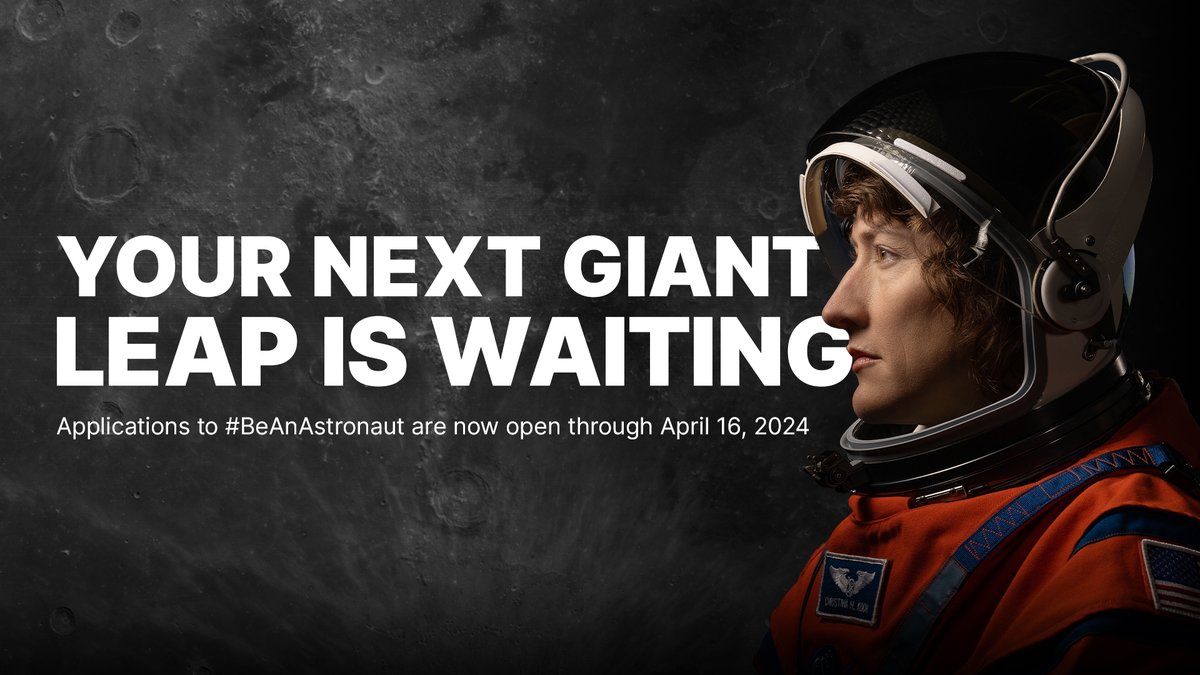
Do you know someone who should apply to #BeAnAstronaut? Here's their chance.
Get the details and learn more about the process: https://t.co/kIR2rmzurb
Ready to get started? Go straight to the application: https://t.co/oi6wNoZ5tF
If you really want it, you’ll make it happen, says Dr. Danielle May of @NASA_Langley.
Learn about her journey of perseverance: https://t.co/sXcYJFgyJC #WomensHistoryMonth
So, I totally flunked my Walmart exam. 90 mins. Could finish knapsack with unresolved errors but couldn't even touch graph. I'm embarrassed. So, here's my retribution: starting tomorrow, bright and early. 100 Days Of Code Big, small, doesn't matter, just do it.
Set your standards.
Stanard is a double-edged sword.
When on you, it may holds you back (imposter syndrome); when it's on your goal, it pushes you forward.
You set the standards. Embody it.
Seeking mentors
Kobe had Michael Jordan
Beethoven had Joseph Haydn
Leonardo Da Vinci had Andrea del Verrocchio
Mentors are people 2 steps ahead of who you want to become.
Some characteristics include humility, critical thinking, and understanding human psychology and EQ.
Patterns tell stories.
Success leaves clues. You don't have to reinvent the wheel. Seek people a few steps ahead, and shadow them.
Learn their:
• beliefs
• behaviours
• characteristics
• thought process
This is the quickest shortcut to 100s hrs of trial and errors.
Some of my favorite reflection questions:
• What were my expectations vs reality?
• How did I feel, what triggered this feeling?
• How do I tend to behave under ... situation, why so?
Go deep, be specific, and repeat multiple cycles.
Reflection is your free therapy session.
Have an eye for reflection:
"Insanity is doing the same thing over and over again and expecting different results" - Albert Einstein
Mistakes are useless without reflection.
When analyzing the process, find the hidden patterns, train of thoughts, and beliefs that control the outcome.
Embracing Failures
The fear of failure has ended more dreams than any alarm clock.
When tackling novelty, expect failure by default. It's not your fault; it is natural.
“Pain + reflection = progress”
Every mistake paired with reflection is a step closer to your goal.
Reward the effort not the outcome.
A study in 2018 showed kids rewarded based on outcome performed much worse when the difficulty increased.
But those rewarded for effort excelled.
Reframe: "You got an A+, great job!" → "I can tell you worked hard for that; great job!"
Inquiry-based learning
If curiosity is the GPS, your question is the car to navigate the journey.
Never fear looking dumb because of a question. Sooner or later, it will happen, so why wait, what is the risk?
This is your growth season.
Follow the curiosity rabbit.
Curiosity makes learning fun and memorable. It naturally creates "relevancy," which improves your memory.
Most will hop on the highest trends; dive into the deepest rabbit holes.
Zoom in and zoom out.
Your brain is a selfish forgotten machine. If something doesn't "make sense," it's cleared.
So focus on details but DON'T forget the bigger picture.
Big picture = "it make sense"
Small details = "dense knowledge web"
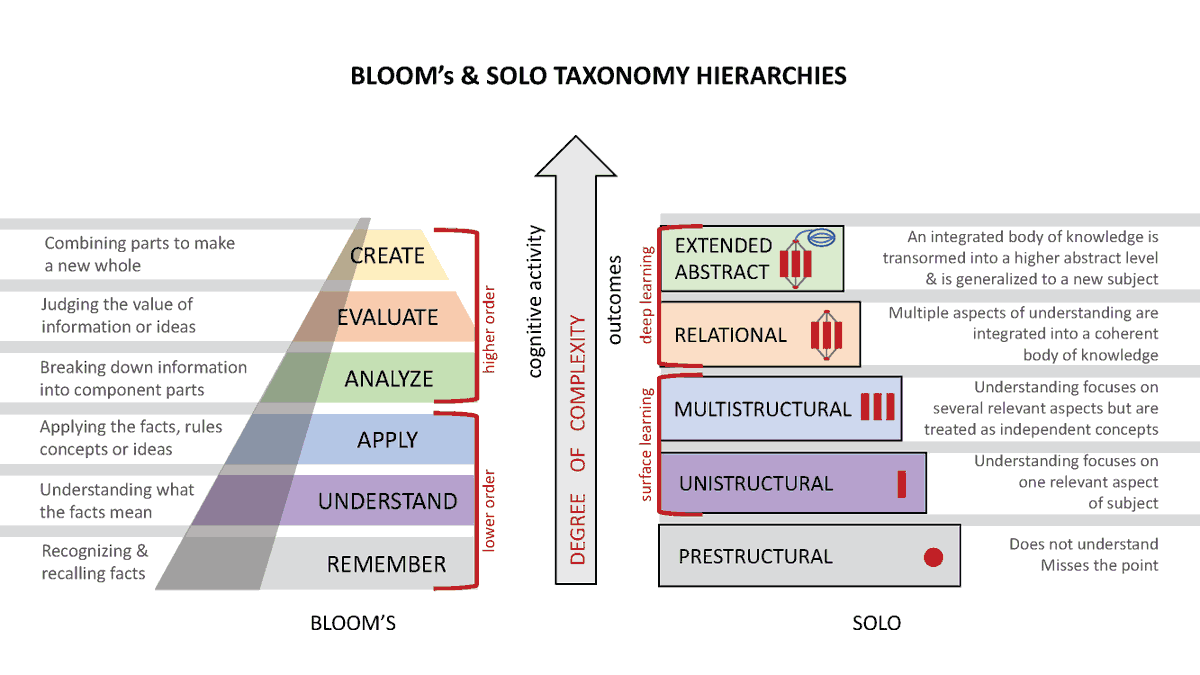
When focused on higher-order thinking, we automatically fill the lower order.
Instead of:
• rereading → use more analogy
• flashcards → map out the big picture
• rote memorization → teach it to an imaginary friend
Never confuse studying with real learning.