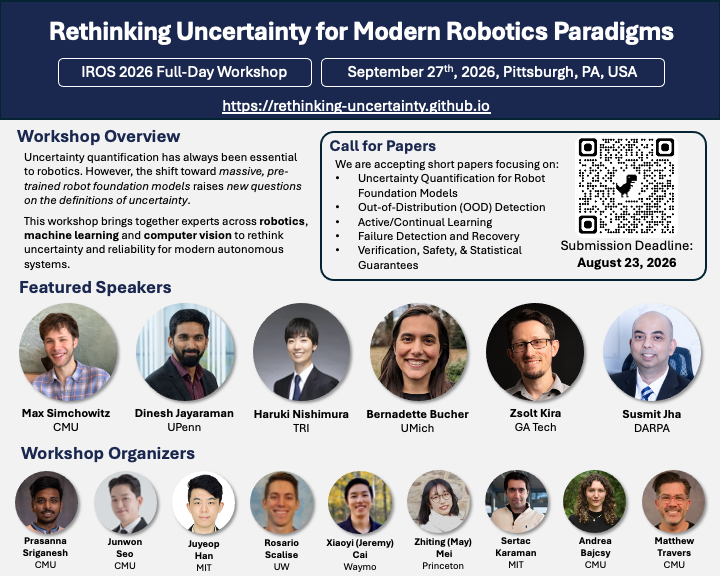
Do we still need Uncertainty Quantification for robotics? What does uncertainty mean in the modern robotics paradigm?
💡 We are organizing a workshop “Rethinking Uncertainty for Modern Robotics Paradigms” @ IROS 2026
Submit your work by Aug 23! 👇 (https://t.co/AUhtTyDmnK)
What does it actually mean for a modern robot to be safe? As generalist robots move across tasks, environments, and users, safety must encompass many dimensions: collisions, semantic constraints, perceptions of safety, privacy, and more. Join our discussion at RSS 2026!
Last July, I started my role as founding co-director of the Princeton Robotics Initiative (w/ Aimy Wissa)!
We kicked things off with an inaugural symposium on our vision of humanity-driven robotics. Amazing to see the excitement, with 300+ attendees and 80+ posters! 🐯🤖
World modeling requires more than demonstrations: if a video model has never seen a carrot drop, it will never learn it 🥕. We show a path towards scaling up play data to train an accurate world model.
🎮 Can we learn interactive world models from letting robots “play”?
➡️ Introducing ✨PlayWorld: a framework for training high-fidelity video world models from large-scale autonomous play experience that enables:
→ Accurate dynamics prediction
→ Reliable policy evaluation
→ RL fine-tuning entirely inside the world model
🌐https://t.co/Kpd2DoveXc
Happy to share our work 'Actions as Language' is accepted to #ICLR2026!
Key idea: use a language-based action representation to better align the robot fine-tuning data with the VLM.
This reduces distribution shift & enables generalization via LoRA alone. See you in Rio!
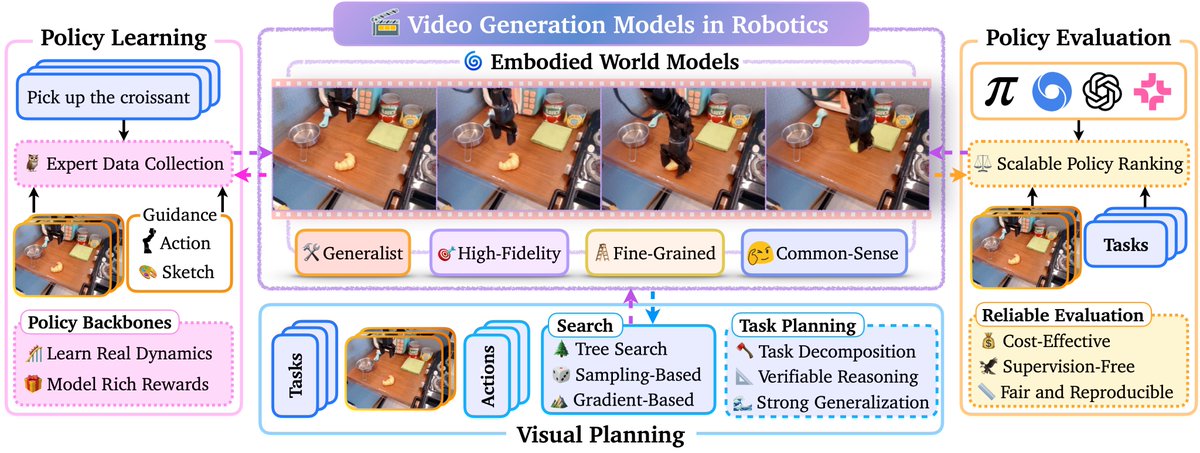
Interested to learn more about video models in robotics? 📹 🤖
Check out our new survey paper:
Video Generation Models in Robotics: Applications, Research Challenges, Future Directions
https://t.co/GiL50BxP7T
What if we can simulate an *interactive 3D world*, from a single image, in the wild, in real time?
Introducing PointWorld-1B: a large pre-trained 3D world model that predicts env dynamics given RGB-D capture and robot actions.
🌐 https://t.co/ShGZm3hAWi
from @Stanford@nvidia
How should we pretrain a policy from demonstrations to ensure it is an effective initialization for RL finetuning, while preserving the performance of the pretrained policy itself?
We propose Posterior Behavioral Cloning (PostBC)! (1/11)
⚡️ Introducing video world models that know when they don't know!
📽️ Action-conditioned video models can hallucinate a lot, generating videos that look plausible but are incorrect!
How can we rigorously quantify their uncertainty, and know when to trust generations?
Generalist robots need a generalist evaluator. But how do you test safety without breaking things? 💥
🌎 Introducing our new work from @GoogleDeepMind:
Evaluating Gemini Robotics Policies in a Veo World Simulator
https://t.co/ZjvpYXFddZ
🧵👇
The paper teaches controllable video world models for robots to know how confident they are.
Standard action conditioned video models can look sharp but often hallucinate impossible robot motions or object behavior.
That makes them risky for policy evaluation, because fake futures can still look believable.
The authors attach a new module, called C3, that reads the model's latent video features and outputs confidence.
For each tiny latent patch, C3 predicts how likely its future pixels will be accurate under a chosen error threshold.
They train with proper scoring rules so that, over many samples, stated confidence matches actual accuracy.
All of this is done in latent space, so the extra computation stays manageable and fits existing diffusion style video architectures.
They then decode these confidences into pixel space heatmaps that show where the model is sure, unsure, or confidently wrong in each frame.
On Bridge and DROID robot datasets, these heatmaps line up with real errors, expose hallucinated arms or objects, and also spike on out of distribution scenes with new lighting, clutter, backgrounds, or grippers.
----
Paper Link – arxiv. org/abs/2512.05927
Paper Title: "World Models That Know When They Don't Know: Controllable Video Generation with Calibrated Uncertainty"
Punchline: World models == VQA (about the future)!
Planning with world models can be powerful for robotics/control. But most world models are video generators trained to predict everything, including irrelevant pixels and distractions. We ask - what if a world model only predicted the semantic information necessary for decision-making?
Introducing Semantic World Models (SWM). Given an observation and an action sequence, SWMs cast modeling as answering textual questions about the future outcome resulting from the actions. Recasting world modeling as a VQA problem lets us directly leverage the pretrained knowledge and machinery of VLMs for generalizable modeling. We had a lot of fun thinking about how this work helps connect these two seemingly very different fields of study - VLMs and world models! 🧵(1/6)
Paper: https://t.co/KIrRG2JO1a
Fun demo: https://t.co/leogQBvcO0
Robotic manipulation has seen tremendous progress in recent years but rigorous evaluation of robot policies remains a challenge!
We present our work: "Reliable and Scalable Robot Policy Evaluation with Imperfect Simulators"!
🧵
Rollouts in the real world are slow and expensive. What if we could rollout trajectories entirely inside a world model (WM)?
Introducing 🚀Ctrl-World🚀, a generative manipulation WM that can interact with advanced VLA policy in imagination. 🧵1/6
😴 Like LLMs, video models hallucinate A LOT;
🙊 Unlike LLMs, video models CAN’T self-verbalize their confidence.
🎥 We introduce S-QUBED, the first method to empower video models to express their uncertainty.
🧵👇 (1/8)