I'm not a fan of $META diluting here.
$GOOGL makes more sense because their stock had gotten fairly expensive. They are diluting at 26x OCF while $META would be diluting around 12x OCF.
That's a pretty big difference...
I think they will probably do just fine with the money (if they choose to do it), but at first glance I don't like this idea.
Why not cut the dividend and take FCF to zero first?
This could send $META below $500 if it happens.
The only reason $META is cheap right now is because investors are fearful that Meta is lighting money on fire, without a clear ROI in the near term.
This would substantially increase that fear...
During the dot com melt-up of 1995-2000, Nasdaq put up gains of 572%.
To date, from the 10/13/22 bear market lows, Nasdaq is up just 162%.
Listening to bears calling this a bubble top could cost you a lot of money.
Imagine you spent 40 years doing the boring, responsible thing.
You opened a 401k at 23. You contributed every paycheck. You ignored the noise. You bought the index because Bogle told you to, because Buffett told you to, because every honest piece of financial advice for 30 years told you the index was the safest, most diversified, most rules-based way to own America.
The whole point was the rules.
The rules said: a company must trade for 12 months before joining the S&P 500. The rules said: it must show four consecutive quarters of GAAP profitability. The rules existed because in 1999 the index quietly bought a lot of stocks at the top, and pensioners paid the bill.
After the dot-com crash, S&P tightened the rules. Nasdaq tightened the rules. FTSE Russell tightened the rules.
For 23 years, those rules held.
Then SpaceX filed for IPO.
And the rules changed.
The S&P 500 waived the profitability requirement. Nasdaq cut its trading-history window from 90 days to 15. FTSE Russell cut its to 5.
Bloomberg Intelligence estimates the major index funds will absorb between 19% and 24% of SpaceX's float within six months. That's over $30 trillion of passive 401k and retirement money, mechanically buying a single newly public company at IPO valuations, because the rules said they had to.
Except the rules used to say they didn't.
Here's the thought exercise:
If you spend 40 years building a system designed to protect ordinary savers from buying overpriced stocks, and then you waive the protections the moment a sufficiently large stock asks you to, what was the system actually protecting?
Most of investing is about understanding what's a rule and what's a guideline.
A rule binds the rule-maker.
A guideline binds the saver.
You're allowed to find out which is which only after the fact.
🚨 BREAKING: Japan’s bond yields are surging!
10Y yield: 2.59%, highest since 1997
30Y yield: 3.82%, near record highs
40Y yield: 4.08%, near record highs
The long end of Japan’s yield curve is now above 4%, marking a major shift after decades of ultra-low rates.
Reform Latest
2 councillors died before election
Several now suspended for various bits of bigotry
At least 1 doesn’t exist
Others want to stand down cos they didn’t know it’s unpaid
1 thought he would be in Parliament
They don’t need a Whip, they need a Missing Persons Officer
The IPO system is broken. You don’t go public to raise growth capital anymore. You do it to dump equity on retail.
NVIDIA went public at ~$600mn in 1999. Microsoft at 780mn. Oracle at ~270mn. Intel at 58mn!
Today you won’t IPO even at $60 billion.
At a $600 million valuation if you hit the jackpot and become a $60 billion company in public markets that’s a 100x return.
Investing $10k as retail makes you a millionaire. This is wealth creation.
At $60 billion there’s very little chance you get to $600 billion let alone 100x from there. You will certainly lose money as retail.
Mathematically if you only allow $100 billion IPOs you’re basically capping upside at maybe 10-20x. There’s no more 100x or 1000x potential. And even 10x is extremely unlikely.
Airbnb, Uber DoorDash are maybe 10x outcomes at best for retail investors. These are supposed be success stories of last decade.
Apple Microsoft Tesla Google were all 100x opportunities for retail.
So you’ve basically cut the average middle class investor out of the upside while private markets and insiders keep most of it for themselves.
@CarioCapital@PronkDaniel Berkshire is an attractive very safe bet, markets are toppy, if they crash 30% Berkshire probably drops less than 10% and then they have almost 400 billion to deploy
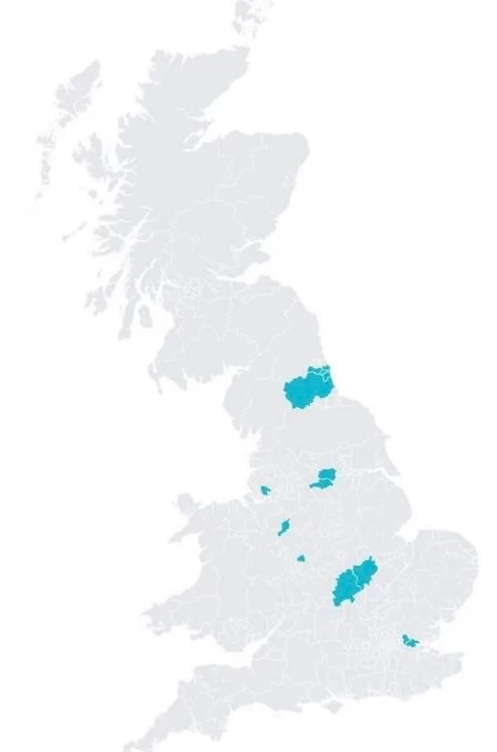
Many of the places with the highest number of people claiming benefits and pensions voted Reform yesterday.
Nigel Farage has pledged to cut all benefit spending by 1/3rd, far more than any other party.
To do this he will have to slash and freeze ALL benefits including pensions.