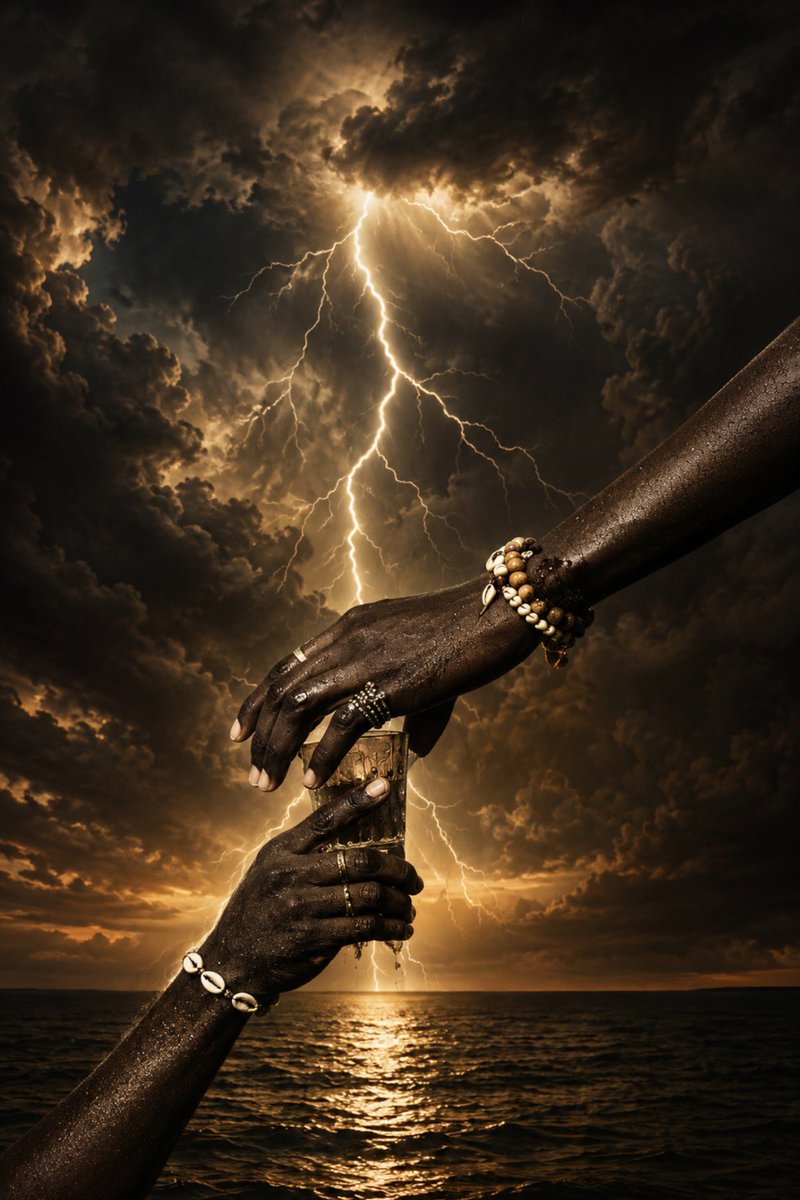
You cannot spend your productive hours inside a place of worship asking God to open doors when you should be walking the streets where those doors exist.
Religious leaders need to start preaching this truth.
When people cannot afford food, and other basic necessities, not every problem should be turned into a spiritual battle... 99% of the time, it is simply bad governance.
Teach your congregation to demand a better life from their government instead of taking advantage of the suffering created by that government.
The purpose of spiritual leadership should be to empower people… not manufacture permanent customers.
If you are looking for activities to engage your kids with, help them learn CHESS.
You may think you are teaching them a game… but you are helping them understand life before life introduces itself to them fully.
1. Chess teaches a child that every move has a consequence.
You are free to make your move… but you are not free from what comes after it.
2. Chess teaches them to think before they act.
It helps them learn to analyse situations, think more deeply, and understand that the first move that comes to mind may not always be the best.
3. Chess teaches patience.
Sometimes the right move is to wait, strengthen your position, and allow the game to develop.
4. Chess teaches sacrifice.
It helps them understand that sometimes you have to give up something valuable today because you understand what it can create for you tomorrow.
5. Chess teaches children how to lose without excuses or blaming anybody.
You made some wrong moves. Your opponent made better ones.
It helps them learn how to study patterns and come back stronger.
6. Chess helps them understand that being powerful is not enough, you must learn to choose your battles wisely.
The Queen is the most powerful piece on the board, yet she can still be trapped by pieces far weaker than her.
Chess is the game of life... almost everything on the board has a real-life equivalent:
•You have limited moves.
•Every decision has consequences.
•You cannot protect everything.
•Sometimes you sacrifice to advance.
•Power means little without positioning.
•Patience can defeat aggression.
•You have to anticipate other people’s moves.
•One careless decision can destroy years of good positioning.
•Losing does not really mean you are weak… sometimes you were simply outplayed.
•Just like life, Chess rewards the person who understands the board, not the person with the most power.
Chess is not just a game… It is one of the simplest ways to understand how life moves.
And almost all of the mistakes we make as adults can be interpreted with CHESS.
If you need a case study, use the Adeleke family.
Davido’s father was already an extraordinarily successful man before Davido became DAVIDO.
@davido could simply have inherited his father’s world, enjoyed the wealth and lived comfortably within what had already been built.
But he met spirits his father did not meet.
His father conquered the world available to him through business, but Davido entered another world entirely and built his own name there.
That is the difference.
Your father’s wealth can give you a platform, but it cannot give you your own greatness.
Davido inherited access, but he encountered opportunities, people, technology, culture and a global music industry that his father did not encounter in the same way.
Those were some of the “spirits” of his generation and he recognised them.
Today, when you hear Adeleke, you may think of Davido before you think of his billionaire father.
That is powerful... Not because he ignored what his father built, but because he took the baton and entered a territory where his own name could become powerful.
And for that reason, he has accomplished a generational mission.
There was a time when human beings could read the Earth.
I grew up with my grandfather, and I witnessed many things that felt like magic to me back then.
The wind meant something.
The behaviour of animals meant something. A dog barking strangely throughout the night could mean something.
The position of the sun meant something.
The seasons spoke.
The rivers spoke.
The trees spoke.
And they paid attention.
My grandfather could look at the sky, observe insects, feel the wind, watch certain animals behave differently, and tell you rain was coming.
As a child, you think these people are performing magic.
Then you grow older and realise they had spent their entire lives studying a language you were never taught to speak.
The language of Mother Earth.
Modern civilisation gave us incredible intelligence, but somehow we became strangers to the intelligence beneath our feet.
We know when our phone battery is at 10%… but many of us cannot tell when our own spirit is exhausted.
Weeks can pass without our bare feet touching the soil that produces almost everything keeping us alive.
My grandfather would sometimes tell me to go outside, walk barefoot and communicate my heart’s desires.
It wasn’t always about begging God for something.
For them, there was power in declaration.
They spoke.
They decreed.
They believed there was a relationship between man, the Creator, the ancestors, the land, and the unseen world around him.
Africans were deeply connected to their roots and one of the tragedies of Africa is not that we had no knowledge…
It is that much of what we knew was dismissed as bad, evil or primitive before the world learned how to describe similar ideas in another language.
Long before many things had modern names, our ancestors had encountered them through observation, spirituality, nature and generations of accumulated knowledge.
They studied plants without calling it pharmacology.
They understood seasons without calling it meteorology.
They studied human behaviour without calling it psychology.
Knowledge existed before the vocabulary we use today and the big big grammer we use today.
Africa had spiritual traditions.
Divination.
Ancestral communication.
Ritual healing.
Dream interpretation.
Africans developed different ways of understanding the invisible dimensions of existence.
Then many of us were taught to become ashamed of indigenous names, medicines, and spiritual traditions.
Imagine someone choosing Amber over her native name “IHEOMA or ADUNNIADE” just to feel among?
What belonged to our ancestors became “backward.”
What arrived from elsewhere became “civilised.”
We can honour the dead of other cultures as saints…
Saint Peter.
Saint Jude.
Saint Augustine.
We ask for their guidance and yet the moment an African speaks about honouring his ancestors, we become uncomfortable.
Somehow their dead became holy… and ours became a subject to cast & bind.
But here is the funny thing, modern world is becoming fascinated again with meditation, plant medicine, ancestral healing, holistic wellbeing, etc.
And none of this is new to Africans.
But I must also say this… not everything our ancestors believed was correct.
Some traditions deserve preservation while some deserve evolution and some deserve abandonment.
But throwing away an entire civilisation’s knowledge because it was not written in European scientific vocabulary was a BIG MESS-UP.
Today, there are things your ancestors knew that you may never know because nobody remembered to teach your father and there are things your father cannot teach you because nobody was allowed to teach his father.
There are libraries walking around African villages with grey hair right now and every time one of them dies without transferring what they know… a library burns.
We will continue paying for our mistakes until we all wake up to the realization that we used to be a world power with powerful kingdoms, controlled major trade routes, etc.
There are people who discuss their plans with others and immediately feel something shift inside them.
Before the conversation, they were excited... Then they talk about it, and suddenly the energy disappears.
If you are one of those people, learn to recognise that signal.
Some people are not built to announce what they are building.
Your spirit operates better in silence... You are a silent goal-getter and must understand that some things need darkness before they need light.
People like this feel strangely empty and exposed after revealing their plans.
Pay attention to that feeling... It is teaching you how you are designed to move and operate.
If you repeatedly notice that your plans lose momentum after you announce them, stop treating silence like secrecy, embrace silence as part of your strategy.
Build first then speak when necessary.
Sometimes people should discover what you were doing when it is already too late to discourage you.
Not everything happening in your life requires witnesses because there are victories that need no announcement before manifestation.
Move quietly.
Learn quietly.
Build quietly.
Fail quietly.
Correct yourself quietly.
Some destinies speak better after they have manifested.
Every man is being led by a spirit... Know yourself and understand yourself.
Self-knowledge is spiritual intelligence.
I created an AI Smart Glass to help blind people walk without a cane or a guide 👓
But this is not like the smart glasses people are used to seeing
Because this Glass combines AI, sensors, and GPS to help the user detect things in front of them, avoid obstacles, and know their location
But the most amazing thing is if the user gets lost, the GPS tracking system can help locate where they are from anywhere, and then send the location to the phone of the person taking care of them via WhatsApp or Email 📲
And now I am further developing it to a new level of AI + Voice, so it can speak with the user and also help them understand their surroundings
I have put the video showing how it works completely in the comment. 🎥
SHARE this project 🤝🔥
Let the world see what a young Nigerian can build
I have been thinking about something lately, and the more I think about it, the more disturbing it becomes.
A lot of Nigerians became poor without doing anything wrong.
They didn’t stop working. They didn’t become lazy. They didn’t suddenly become irresponsible.
They simply woke up one day and realised that the money they had worked for could no longer buy the things it used to buy.
Think about someone earning ₦100,000 a month.
The person still wakes up early every morning, goes to work, puts in the same hours, probably works even harder, gets promoted occasionally and does everything society says a responsible person should do.
Yet every year, that person seems to be able to afford less.
At some point, ₦50,000 could buy a reasonable amount of food for the house. Today, you can enter the market with the same ₦50,000 and genuinely wonder where the money went.
Nothing happened to you.
The economy happened to you.
And I think this is something we don’t talk about enough.
Imagine working hard for years, only for circumstances completely outside your control to quietly reduce the value of everything you have worked for.
You didn’t lose your job.
You didn’t lose your salary.
But somehow, you lost your standard of living.
That is poverty too.
And this is why I struggle with the way we sometimes discuss palliatives.
Of course, when people are hungry, you must find ways to help them immediately. There is nothing wrong with providing temporary relief.
But surely, the bigger question should be:
Why did millions of working Nigerians suddenly need palliatives in the first place?
If a man could comfortably buy a bag of rice from his salary a few years ago and today he needs government assistance to buy that same bag of rice, giving him rice may solve today’s hunger.
But it has not solved the actual problem.
The real problem is that his labour has lost value.
And perhaps that is what we should be obsessed with fixing.
How do we make the Nigerian worker’s income valuable again?
How do we make ₦100,000 buy more next year, rather than less?
How do we make food cheaper by producing more?
How do we reduce the cost of energy and transportation?
How do we build an economy where salaries can actually keep up with the cost of living?
Because when I think deeply about it, perhaps one of the greatest things a government can do for its people is not to keep giving them money.
It is to build an economy where the money they earn has value.
There is dignity in being able to take care of yourself from the product of your own labour.
There is dignity in a teacher being able to feed a family from teaching.
There is dignity in a nurse being able to pay rent from nursing.
There is dignity in a young person working an honest job and gradually seeing life improve.
People should be able to look back after five years of hard work and say, “My life has become better.”
Not, “I earn more money today, but somehow I can afford less.”
That is the part that keeps bothering me.
Millions of Nigerians are not asking to become millionaires overnight.
They just want hard work to make sense again.
And maybe that should be one of the simplest ways we measure whether our economy is actually working:
Is the ordinary Nigerian who works hard becoming progressively better off, or progressively poorer?
Everything else is secondary.
They hate Ibrahim Traore. They hate Assimi Goita. They hate General Tchiani. They hate the AES. But they love Bola Tinubu. They love Paul Biya. They hate every revolutionary and love the sellouts.
1988, Arsène Wenger discovered George Weah while he was playing for Tonnerre Yaoundé in Cameroon 🇨🇲 and arranged his £12,000 transfer to Monaco.
At the time, Paul Biya was the president of Cameroon.
Years later, George Weah became the president of Liberia 🇱🇷, left office, while Paul Biya is still the president of Cameroon.