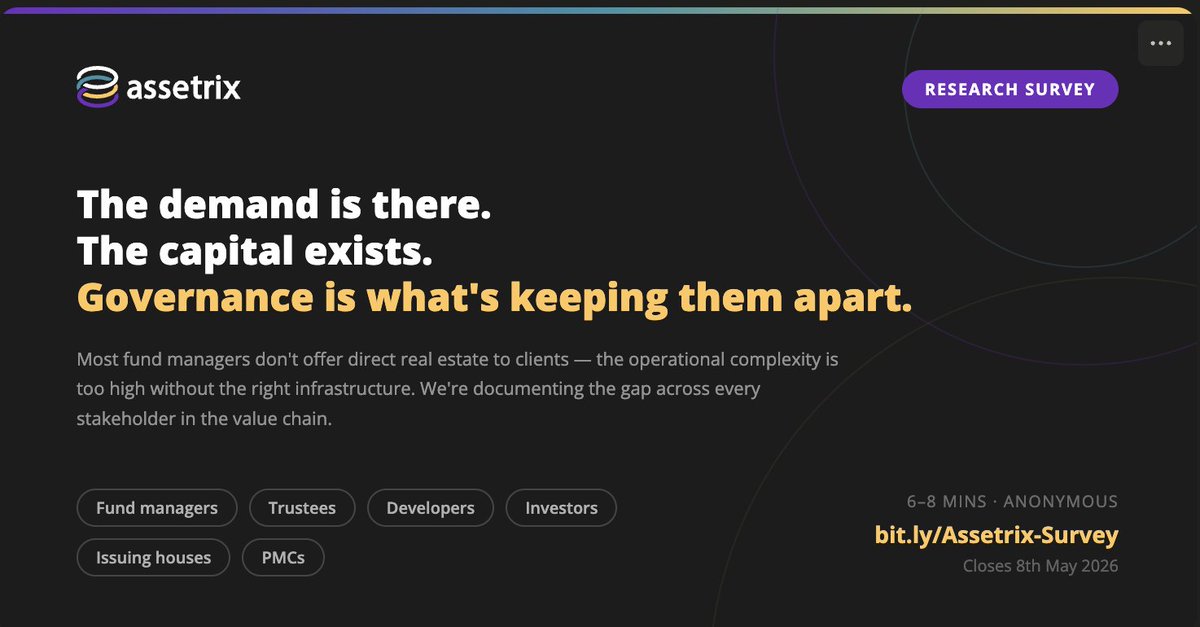
Most Nigerian fund managers do not offer clients direct real estate exposure.
Not because the demand isn't there. It clearly is. But because the operational reality of a direct real estate mandate is a different kind of work entirely. Setting up and verifying an SPV. Coordinating developers, quantity surveyors, and property management companies. Tracking milestone evidence before capital moves. Building a record that holds together when a trustee or investor asks a hard question six months later.
That is not what a typical fund manager's infrastructure is built for. So most of them don't do it.
Which means the average Nigerian investor who wants real estate exposure has two options. A REIT — pooled, regulated, and abstracted far from the underlying asset. Or direct investment, which means taking on all of that coordination and complexity themselves.
Both routes exclude a large group of local and diaspora investors who have the interest and the capital, but not the bandwidth or the minimum ticket that direct ownership requires.
Governance shows up as the consistent pain point at every level of this conversation. For developers trying to raise capital. For fund managers trying to scale. For investors trying to understand what is actually happening inside a structure they have committed to. When it is in place from the beginning, it compounds positively. When it has to be reconstructed mid-mandate, the cost is significant — in time, in trust, and in what becomes possible next.
Assetrix is running a short anonymous survey to document this properly — not from assumption, but from the ground level observations of people working inside these structures every day.
Fund managers. Trustees. Issuing houses. Developers. Institutional investors. Property management companies. If you operate anywhere in Nigerian real estate capital, your perspective belongs in this.
Findings go into a published institutional report shared with every participant who opts in before it goes wider.
6 to 8 minutes. Fully anonymous. Closes 8th May.
https://t.co/6uqtvwBMxo
If you know someone who should be in this conversation, please repost.
A milestone for Assetrica! 🎉
Our proposal for independent verification of construction milestones before funds are released has been adopted by Nigeria’s National Housing Council.
A step forward for transparency and accountability.
Read here: https://t.co/wv8VHmR2Ty
Aliko Dangote's name alone could raise billions on a handshake.
So why did Africa's biggest-ever IPO need a 194-page prospectus?
Because capital markets do not price reputation. They price records.
Look at what opened today. Not just a share offer, but a machine of verification. Audited financials any stranger can read. Twenty-two pages of named risks: the single site, the crude supply, the tax exemption that ends in 2028. A board personally liable, under a law that makes a false prospectus a criminal offence. It admits the refinery took seven years, far longer than planned. Disclosure against interest is what makes a record believable.
That machinery was built to satisfy institutional investors. Yet once the standard is met, everyone reads the same pages. The trader buying ten shares for ₦5,250 this morning gets the same scrutiny a pension fund would insist on. That is the quiet genius of a public market: institutional-grade verification, handed to everyone.
Even Saudi Aramco submitted. The most profitable company on earth spent four years building a public record, and the market still discounted what it could not verify: a $2 trillion ambition became a $1.7 trillion listing, at home only.
Reputation gets you to the door. The record sets the price.
Now hold that against African real assets. Nigeria imported fuel for decades because nobody had built at this scale. Housing, energy, agriculture, infrastructure, data centres: each is still waiting for its own Dangote. On calls with developers and operators, I keep meeting the reverse ambition: institutional capital raised on retail-grade disclosure. A brochure, some 3D renders, a trusted network, little paperwork. It works, a hundred million Naira at a time, sometimes a billion. But raising institutional money on marketing material is an impossibility, and anyone promising you otherwise is disguising facts.
The capital that builds refineries does not read brochures. It reads records. Who approved what. Whether the milestone was met. Where the money went. Whether the title is clean, and if not, the plan to perfect it and by when. Seasoned founders know that naming your risks proves you understand your market. Leaning into it shows maturity. Nobody expects zero risk. Everybody expects it named, priced, and answered with a plan.
Here is the inversion: today the smallest retail investor gets more verified information about this refinery than our largest institutions get about most real asset projects. Today pension funds may place 20% of their assets in real estate. Yet, actual allocation: 2 to 3%. A lack of records causes serious money to pause.
We may only have one Dangote. But what this IPO proves is available to every builder and operator: a verifiable record compounds beyond your name, and defends you in rooms you will never enter.
What would it take for a housing estate, a solar plant, or a farm scheme to offer investors the scrutiny this refinery did today?
Nigeria's pension pool has crossed ₦31 trillion. Up to 20% of it is allowed to go into real estate. Actual direct investment: about ₦170 billion, barely half of one percent.
That gap is a trust problem. It's what I'm speaking on at #APPTSUMMIT2026, Lagos, October 13.
Escrow tells you where the money is. Governance tells you what happened to it.
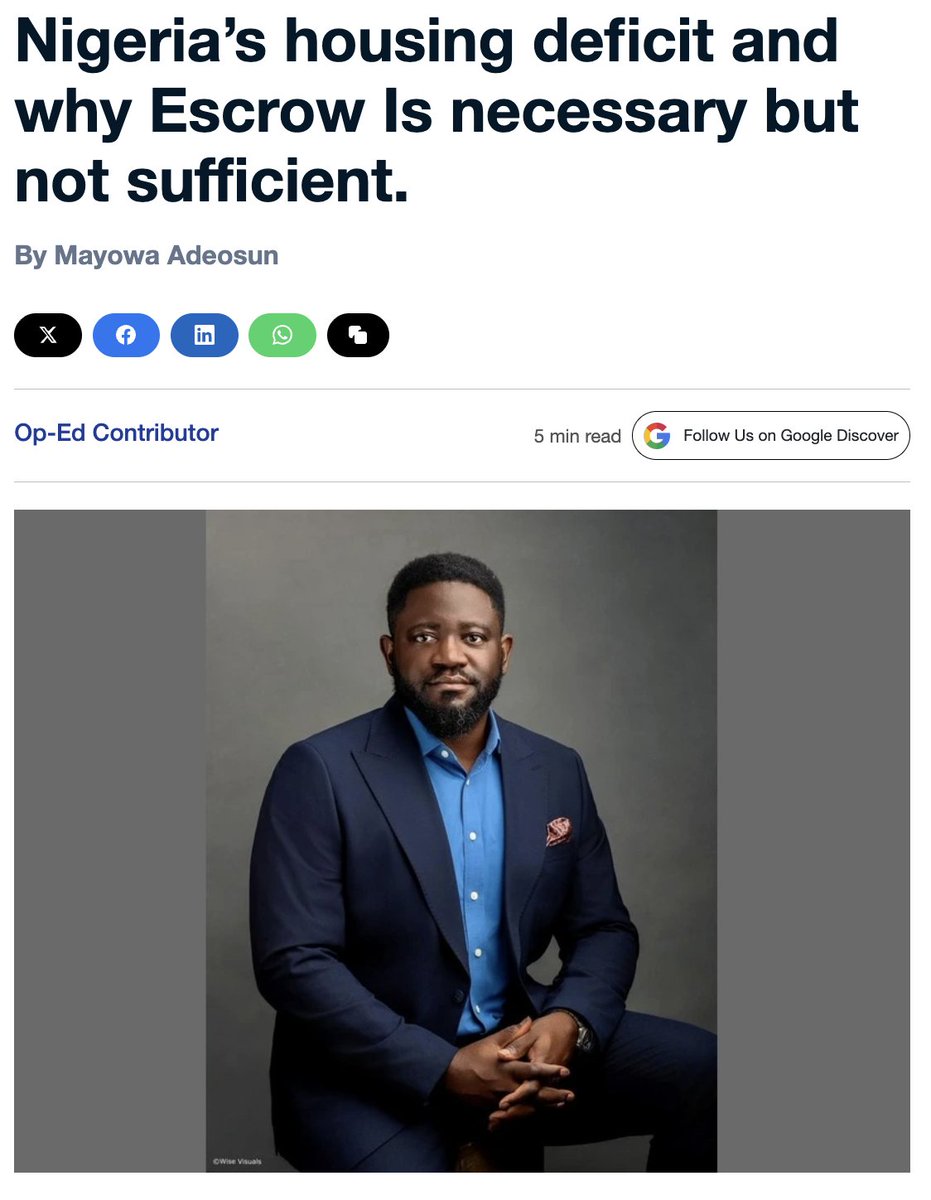
@nairametrics published my op-ed this week on Nigeria's proposed housing policy: licensing for developers, escrow for off-plan payments.
It's a real step forward. But the entire protection rests on one phrase: "released against agreed project milestones."
Who verifies the milestone?
If the answer is the developer's own progress report, the risk hasn't been removed. It's just moved from the bank account into the paperwork.
Three things would close the gap:
→ Independent, licensed verifiers
→ Releases tied to verified certification, not claims
→ An audit trail no single party can alter
Get that right and it protects more than homebuyers. It gives pension funds the governance they need to fund housing at scale.
Solve trust once, and capital moves twice.
Full article link: https://t.co/WDboa2u19x
Spent the weekend on a panel about technology, trust, and the future of African real estate investment, alongside Honourable Devin Phillips, Dr Sunday Aderibigbe, moderated by Francis Njoku, and hosted by Olatunde Badmus, from EBTeam.
At one point, the conversation turned to where the opportunity is. Which markets. Which asset classes. Where the returns are strongest. It was tempting to talk about location and yield from a demand perspective. I decided to give a different answer and focus on capital supply.
The real opportunity isn't picking the right city. It's unlocking institutional capital as a source of patient capital for this region. To do that, you have to understand why institutions haven't yet deployed at scale here.
Institutional capital isn't simply cautious by choice. It's bound by rules. Pension funds, DFIs, and regulated asset managers have fiduciary duties that require verifiable, auditable evidence before they can move money. This isn't a nice-to-have. It's a compliance requirement. These institutions cannot deploy capital at scale into a market where reporting is informal, counterparties are unverified, and there's no audit trail. It's not that they don't want to invest in African real estate. Their mandates simply won't let them, not without the right infrastructure in place.
That's the real gap. And it's a gap we can close, which is the exciting part.
This is also where the AI conversation got more honest than I expected. My view is simple: AI cannot yet add real value in underdeveloped real estate markets. Not because the models are weak, but simply because these markets don't have the verified data those models need to learn from. You can't ask a language model for smart direction on a deal if there's no structured transaction history behind it. This is a sequencing problem, not a capability problem. The data and governance layer has to come first, before the intelligent layer can deliver anything useful. That's true for AI, and it's true for institutional capital too.
This is exactly what Assetrica is built around. We work directly with regulated institutions deploying capital into real estate. We provide end-to-end lifecycle tracking, full visibility into evidence, approvals, delays, and verifications, plus an independent source of truth with no stake in the outcome, only in accurate reporting. This isn't about trust as a feeling. This is risk and compliance infrastructure, measurable and uniform, that lets capital that already wants to move finally move.
Grateful to co-panellists for a conversation that went past the easy answers, and to a room that asked hard questions.
#RealEstate #Africa #Governance #Assetrica #InstitutionalCapital #PatientCapital
Copying innovation is easy. Rebuilding institutional scaffolding is not.
Many modern business models were shaped in environments with deep institutional backstops. Reliable enforcement. Predictable regulation. Mature reporting norms. Clear separation of roles.
When those assumptions are imported without adjustment, risk changes shape.
This isn’t a failure of founders or ambition. It’s a structural gap. Capital notices it immediately, even when users don’t.
Institutional allocators look for signals that systems can absorb stress. They watch how disputes are resolved, how exceptions are documented, and how accountability holds up under pressure.
Without that scaffolding, innovation remains exposed. Not unusable, just difficult to underwrite at scale.
Innovation travels faster than infrastructure. Capital does not.
Many markets experienced a surge of innovation over the last decade. New products, new platforms, new business models.
What often arrived more slowly were the institutional layers that allow capital to move with confidence. Legal enforcement. Governance standards. Reporting consistency. Audit and oversight systems that scale.
Innovation can tolerate gaps. Capital struggles with them.
This disconnect explains why some environments feel vibrant but still struggle to attract durable allocation. Energy is visible. Structure is harder to see.
This week is about that mismatch, and why solving it matters more than shipping the next feature.
Capital is not scarce. Defensible decision-making is.
When people talk about the difficulty of raising long-term capital, they often blame market conditions, risk appetite, or investor sentiment.
That diagnosis is usually incomplete.
Across institutional and family office portfolios, capital is deployed every day. What limits deployment is not a shortage of money, but a shortage of environments where decisions can be made, documented, reviewed, and defended over time.
This applies far beyond any single sector. Whether capital is backing operating companies, private credit, infrastructure, or other long-cycle businesses, the same constraint appears.
Institutions do not avoid complexity.
They avoid ambiguity.
This week is about a simple shift in perspective: opportunity attracts interest, but governance earns commitment.
Here’s an unpopular truth: due diligence often becomes theatre when the system of record is weak.
Most people assume diligence is how institutions manage risk.
That assumption doesn’t hold up.
Diligence is a moment in time.
Risk unfolds over time.
When governance and reporting systems are fragile, diligence turns into a confidence exercise, even when everyone involved is acting in good faith. Documents can be polished. Site visits can be staged. Spreadsheets can be curated. None of this guarantees that an asset remains governable six, twelve, or twenty-four months later.
What institutions actually need is not more diligence.
They need a live, auditable governance record that can answer hard questions without reconstruction:
» Who approved what, and when?
» What evidence justified that approval?
» What exceptions occurred, how severe were they, and how were they resolved?
» Which obligations were met, missed, waived, or disputed?
» Can an auditor reproduce the full decision trail without relying on memory, emails, or recreated packs?
Without this, an allocator is not underwriting an asset.
They are underwriting trust in human memory and informal coordination.
That is fragile capital.
The uncomfortable implication is simple: many so-called “high return” opportunities are not rejected because the returns are weak. They are rejected because the truth cannot survive over time.
Capital that looks risky from the outside is often tightly governed on the inside.
From a distance, institutional and family office allocations can appear bold, even aggressive. Large ticket sizes, long time horizons, complex assets, and unfamiliar markets create the impression of high risk.
In reality, these decisions are rarely driven by appetite for uncertainty. They are driven by confidence in governance.
What makes this capital durable is not the promise of upside, but the presence of clear authority, defined decision rights, enforceable oversight, and reporting systems that can withstand scrutiny long after the investment is made.
This is why many opportunities that look attractive on paper never receive long-term capital. Not because the economics are weak, but because the governance environment is not strong enough to support accountable decision-making over time.
Many investment problems don’t start with a lack of information.
They start with uncertainty about what should happen when that information surfaces.
Information may exist, but there is often no clarity on what should happen when something looks off.
Seeing activity on its own is not enough. Rules matter. Thresholds matter. Knowing who is responsible for acting matters just as much.
Visibility helps people notice problems. Governance is what determines how those problems are addressed.
More visibility can always be added later. Clear rules and accountability need to be in place from the start.
Transparency is often treated as a solution to risk.
In many cases, it’s part of the problem.
When everyone can see what’s happening, responsibility tends to blur. Information circulates, meetings happen, reports get shared, and risk feels managed, even when no one is clearly accountable for acting.
Visibility creates comfort before it creates control.
Photos, dashboards, updates, and spreadsheets can show constant activity. They rarely answer the harder question: who intervenes, at what point, and with what authority.
That’s why some of the most transparent systems still fail under stress. They reveal activity but leave decisions unresolved.
Transparency doesn’t reduce risk by itself.
Governance is what forces choices to be made.
Most efforts to de-risk capital markets start with visibility.
More data.
More dashboards.
More reporting.
That usually feels like control, especially when everything looks busy and well-documented.
But visibility is not the same as governance.
Think about a construction project where everyone can see the site, the photos, the updates, and the timelines. Progress is visible. Activity is constant. Yet without clear rules on approvals, escalation, and consequences, delays and overruns still happen. Nothing intervenes until the problem is already expensive.
The same pattern shows up in capital markets.
Information can be abundant and still ineffective. Risk remains mispriced when no one is clearly responsible for acting on what the data reveals.
Visibility is a starting point. But it is incomplete by itself.
Control comes from how information is interpreted, when it triggers action, and who is accountable for the outcome.
That difference is easy to miss.
It is also where real de-risking actually happens.
Africa’s Infrastructure Problem Is a Capital Markets Problem, Not a Construction Problem.
People often say Africa’s biggest challenge is building roads, homes or power plants. I do not believe that is the real issue. We have builders. We have land. We have demand. What we do not have is a smooth way for money to flow into and out of real projects.
Think of it like buying a car. If the papers are missing, the history is unclear, and the payment process is messy, even a good car starts to feel risky. Most people will walk away. Not because the car is bad, but because the process is confusing.
This is what happens with many projects in Africa. Developers are capable, and investors are interested, but the process in the middle is stressful. Documents are scattered. Ownership is unclear. Verification takes too long. Regulators cannot track anything easily. When the process feels risky, money slows down.
Africa does not lack opportunity. It lacks the trusted systems that make investment straightforward.
If we want more roads, more power and more housing, we need to fix the rails that support investment. Clear information. Easy verification. Transparent tracking. Smooth settlement. These things make investors confident, and as you might guess, confident investors build economies.
The future belongs to the platforms that make investing in real projects simple, safe and trustworthy. That is the direction Africa needs to move toward.
Let’s build the systems that move Africa forward.💜
Web2 vs Web3: What’s the Difference and Why It Matters
Technology keeps evolving, but not every leap forward is ready for the real world.
Web2 is the internet most of us know. It gave us global communication, online shopping, social media, digital banking, and instant access to everything. It made life faster and more connected, but also concentrated power in the hands of a few. We created the value, yet rarely owned it.
Then came Web3, built on decentralization and ownership. In this world, users control their data, assets, and identity. Transactions are transparent, verifiable, and permanent. It’s a powerful vision — a freer, fairer internet where users are participants, not just customers.
But here’s the reality: going fully Web3 isn’t always practical. Not yet.
Managing private keys and wallets can be complicated.
Regulation is still catching up, especially in emerging markets.
Network fees and speeds can make everyday use difficult.
And user experience often suffers when everything happens entirely on-chain.
That’s why the smartest builders are focusing on Web2.5 — the bridge between what we know and what’s next.
Web2.5 keeps the simplicity and accessibility of traditional platforms, while using blockchain behind the scenes to create transparency, accountability, and trust. You can still log in with your email, but ownership is recorded, verified, and protected on-chain.
For industries like real estate, this balance is crucial. People need trust and liquidity, but they also need ease and clarity. Web2.5 provides both: the innovation of the future, delivered in the comfort of today.
The internet started by giving us access to information.
Now it’s giving us access to ownership.
The future belongs to those who make that ownership simple.
✨
Transparency builds trust, and that’s why we go beyond the spreadsheets to show you the process.
Today, we visited one of our partner developers on-site to better understand their progress, challenges, and the realities behind every brick laid.
These visits help us share accurate updates with our investors, ensure accountability, and strengthen our commitment to building trust through transparency.
Visit our website https://t.co/nSbIsD92u6 to start your real estate investment journey today! 💜
Assetrix says its new platform will let Nigerians and diaspora investors participate in verified property projects.
Read more https://t.co/qYOx04RHsm
- Brand Press
🚨 New video!
10 lessons from my founder journey – especially for those in the diaspora thinking of starting a business in Africa.
Honest, practical insights from building Sycamore.
🎥 https://t.co/vB9XzsRdZe
#Entrepreneurship#Startups#Diaspora#ReadySteadyGoals