$SPCXX pre-IPO perpetual futures now live with up to 5x leverage 🚀
☑️ Long or short
☑️ Hedge an existing SpaceX position
☑️ Multi-collateral margin
☑️ No expiry
Start trading the $SPCXX pre-IPO perp 👇 https://t.co/F0i0YCEJeR
*Geo restrictions apply
We’re kicking off IPO Access on Kraken with one of the biggest IPOs ever.
SpaceX available on xStocks (SPCXx).
See the price range, review the details, and submit your interest in the Kraken app before the window closes.
👉 https://t.co/wKnib4oiqM
Claude Code creator:
"I don't prompt Claude anymore. I write loops - and the loops do the work. My job is to write loops."
in 30 minutes Boris reveals his actual daily Claude Code setup.
Claude Code + loops + dynamic workflow
Worth more than a $500 vibe-coding course
Incrementality in Marketing tells you what worked
Marginal efficiency tells you what to do next
Its not the same. Incrementality matters but what moves the dial, esp in an AI native world where speed matters more than precision, its finding the "marginal efficiency" of the next $100
The most efficient place for your next $100 isn't where your best campaigns are
It's where the marginal return on the next dollar is still above your threshold — and that threshold keeps moving, and will move EVEN faster as your competitions uses agents too to optimize
Moves by geo. by product. by client segment. by platform. by day
The pace of optimization has been hard historically (hard = hourly), and this is exactly where AI changes the equation — not by replacing the judgment call, but by running the iterations fast enough to find the shifting threshold before you've already spent 90 days at the wrong rate.
The teams building that capability now aren't just being efficient. They're building a compounding advantage that's very hard to replicate.
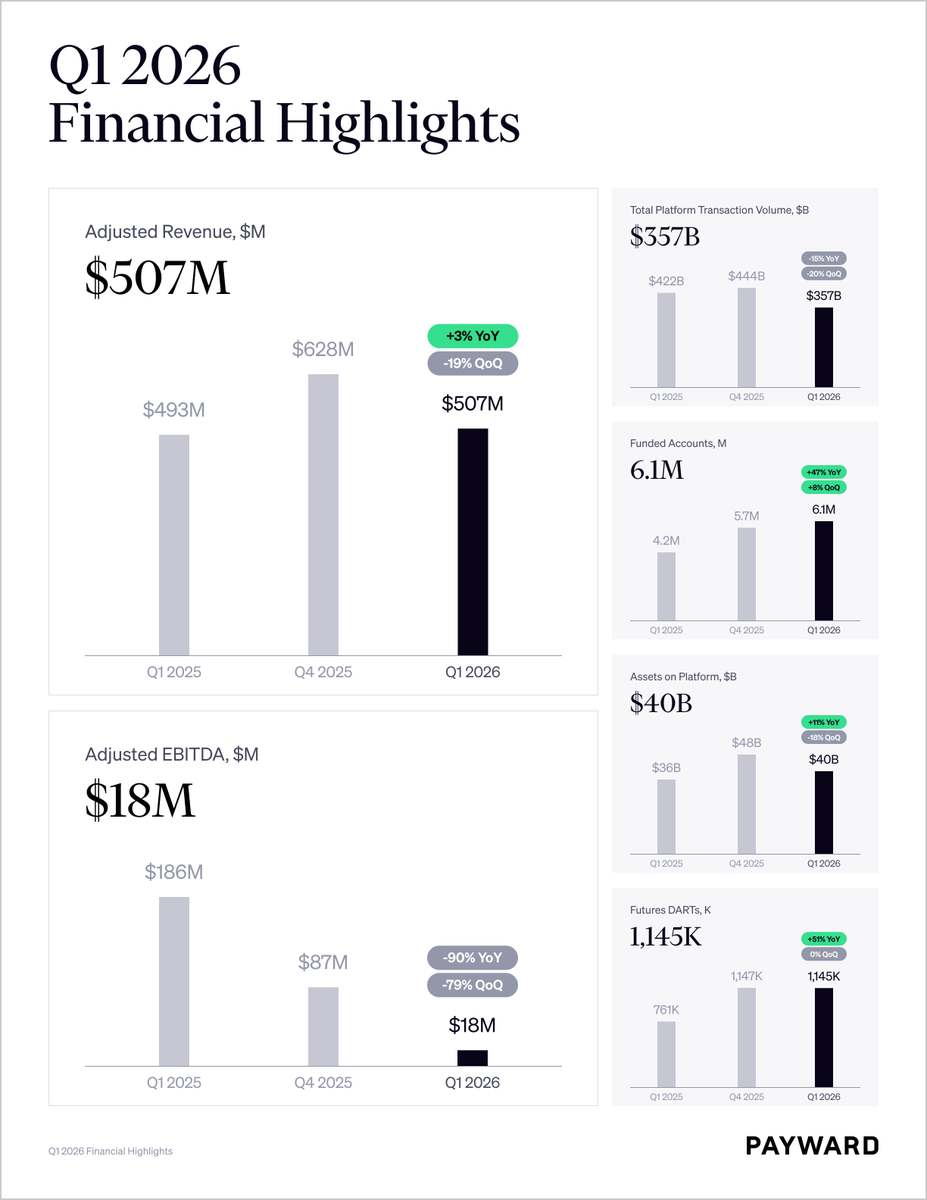
Q1 2026: Payward Financial Highlights live.
Q1 was a solid quarter against a genuinely tough backdrop.
✔️ Adjusted Revenue of $507 million, up 3% year-over-year
✔️ Assets on Platform: $40 billion, up 11% year-over-year
✔️ Funded Accounts: 6.1 million, up 47% year-over-year
✔️ Futures DARTs: Up 51% year-over-year
✔️ Adjusted EBITDA: $18 million — profitable, and still investing
We grew revenue. We grew our asset base. We grew our client count. We remained profitable.
We continued investing in strategic M&A, as well as in the products and infrastructure that drive the business forward.
Kraken is deprecating its existing cross-chain provider and migrating to @Chainlink CCIP as its exclusive cross-chain infra to secure Kraken Wrapped Bitcoin (kBTC) & all future Kraken Wrapped Assets.
Kraken chose Chainlink CCIP because it offers enterprise-grade infrastructure with strict security & risk management requirements, including:
• ISO 27001 and SOC 2 Type 2 certifications
• Secure by default architecture
• 16 independent nodes
• Native rate limits, and more.
Together, Chainlink and Kraken can help accelerate the global adoption of crypto by unlocking utility and distribution for all Kraken Wrapped Assets across DeFi.
For kBTC customers, no action is required. More details on the migration process to follow on official Kraken channels.
Average ROI tells you how you're doing.
|
Marginal ROI tells you what to do next.
Most teams only measure one.
The average always flatters you. Your best channels subsidize your worst inside a blended number that feels healthy. A 4x portfolio return can hide $3M in spend returning 1x.
Hard payback constraint > headline ROAS target.
At @krakenfx , the question isn't "what's our average CAC payback?"
It's: what does the next dollar pay back? The moment your marginal dollar misses the constraint, the average is lying to you.
AI finally makes the marginal return curve live — by channel, creative, geo, cohort — instead of a quarterly post-mortem.
Incrementality was the right question. Marginal efficiency is the right precision.
US retail spot margin is live on Kraken Pro.
Go long or short. Up to 10x leverage.
Use your crypto as collateral.
Every number visible on your open position.
CFTC-regulated.
👉 https://t.co/WNmcaF1mzX
*Eligibility restrictions apply
There are 3 broad phases of AI adoption - the biggest leap is from Phase 2 to Phase 3... Phase 1 to Phase 2 is easy.
But, most teams will mistake Phase 2 for the finish line, it isn't.
Phase 1 — AI as tools. Most have been here for roughly 12-18 months. ChatGPT, Copilot, Claude, the assistants, tons of other niche platforms. Productivity gains. Individual leverage. Easy to start, easy to stop.
Phase 2 — AI as the engine. Live data -- biggest difference from Phase 1. Core strategy. Analysis at speed. Execution across the org. Efficiency gains everywhere. This is where most teams are already or headed towards.
Phase 3 — Agents in the driver's seat. Humans setting guardrails, strategy, and the knowledge base. Agents executing, optimizing, distributing — at scale, autonomously.
"autonomously" ---- this is the big leap
agents in the driver seat while humans guide ---- this is the big step fwd
Phase 2 is cruise control — you're still in the car, hands near the wheel, ready to take over.
Phase 3 is the driverless car. You set the destination. You don't touch the wheel.
That transition requires :
end to end systems architecture
agents hierrachy, orchestration
rigorous QA & validation
governance & rules
Experimentation frameworks
In Phase 2, a human catches the mistake before it ships.
In Phase 3, an agent has already distributed that creative to 10 million people before anyone noticed the error.
The teams that will win Phase 3 aren't the ones moving fastest. They're the ones that built the right guardrails before they handed over the wheel.
This is a whole new world of growth and architecting systems and engines that compound.
#aiNativeGrowth #growth #marketing
Agents can build, optimize, and scale in ways humans can't.
But the things that make a brand actually resonate, serendipity, intuition, human connection, those still belong to people.
Kraken’s Chief Growth & Marketing Officer @mayurgupta77 and former Mastercard CMO @RajaRajamannar on AI and the future of brands at @consensus2026.
41 kidnappings of crypto holders in France in 3.5 months of 2026.
Why?
🥖 French tax officials selling crypto owners' data to criminals (Ghalia C.) + massive tax database leaks.
Now the state also wants IDs and private messages of social media users.
More data = More victims.
The biggest dichotomy in marketing - you want to measure all of it to make it great, but if all of marketing is measurable, its not great marketing!!!
The serendipity of marketing is what makes it great. But without measurable growth, you don't have the luxury to drive that serendipity that builds the emotional connection.
You have to earn that right. That balance between your attributable and unattributable effort and spend is the holy grail.
Here is how i think about it - figuring out the distribution of negotiables vs non-negotiables with your CEO & CFO:
-- you need to have enough tangible outcome & proof point aka your attributable impact from your spend -- this is NON negotiable
-- you don't have this, and closer to the targets you need to hit -- you don't stand a chance
-- so you conquer this first ..
This gives you a potential chance to focus on the irrational, serendipitous, tough to measure part of your efforts & spend ...
The part that needs longer to prove but is essential
The part that you know works but takes time to measure
The part that end users care about and feel but is not binary or easily quanitified
That's the growth engine we all need .. and its a constant pull & push between these 2 flywheels..
Here's where AI changes this equation:
it compresses the time it takes to win the non-negotiable side
Faster attribution
Tighter payback periods
Sharper cohort intelligence
The measurable flywheel spins faster — which means you earn the right to serendipity sooner, and with more conviction
But it also raises the stakes ---- this is where honest, resilient brand building will SHINE
The more AI optimizes the measurable, the more the irrational becomes the last true differentiator
The growth teams who use AI to dominate performance but still protect space for the unmeasurable will scale both Distribution x Attention.
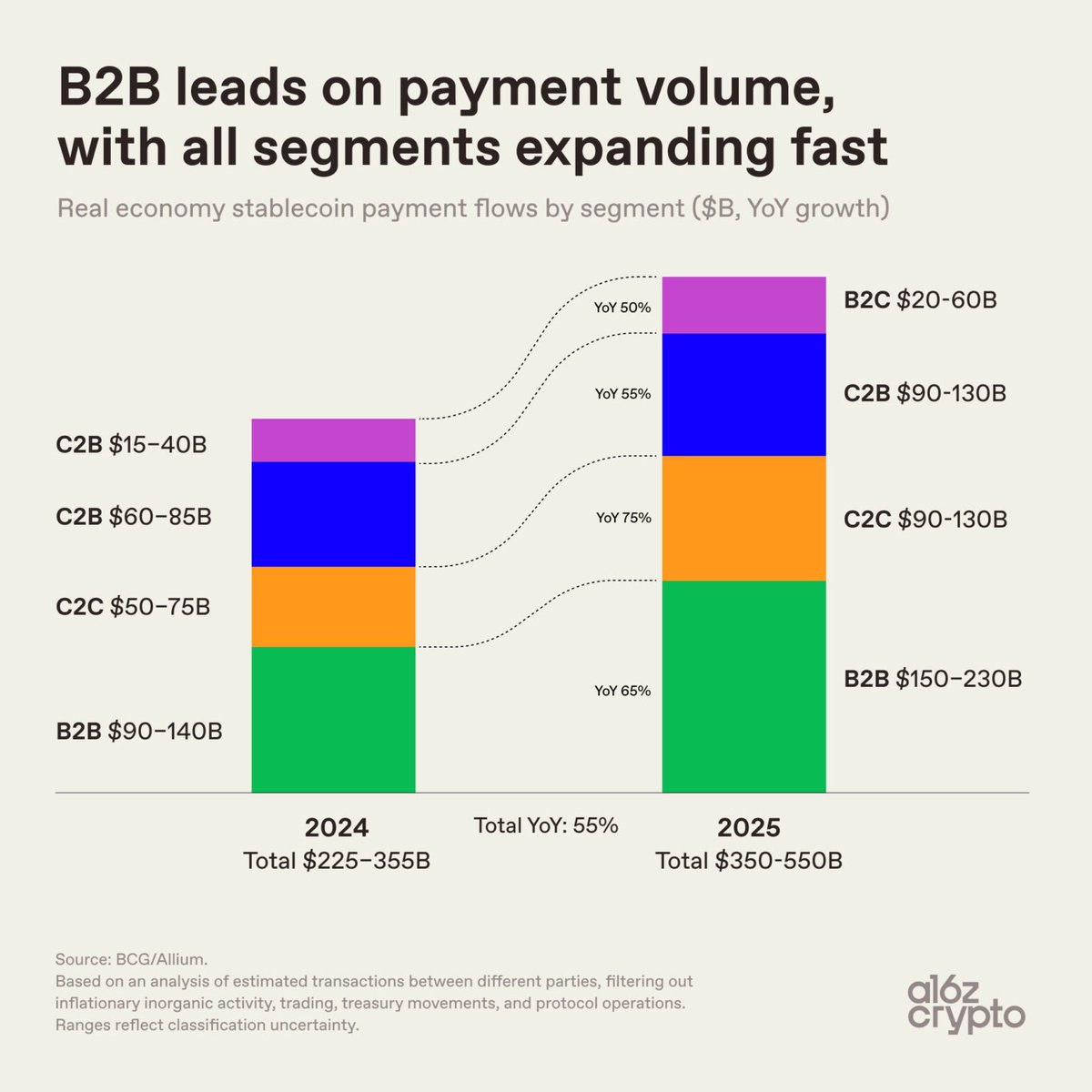
Strip out trading, treasury flows, and exchange mechanics and you're left with $350–550B in real stablecoin payments last year.
B2B leads on volume, but every segment is expanding fast.
My biggest takeaways from Claude Code's Head of Product @_catwu:
1. Anthropic’s product development timelines have gone from six months to one month, sometimes one week, sometimes one day. Part of this acceleration is access to the latest models (i.e. Mythos). Another is shipping new products into “research preview,” making clear it's early, experimental, and might not be supported forever. Another is an evergreen "launch room "where engineers post ready features and marketing turns around announcements the next day.
2. The PM role is shifting from coordinating multi-month roadmaps to enabling teams to ship daily. As Cat puts it, “There should be less emphasis on making sure you are aligning your multi-quarter roadmaps with your partner teams and more emphasis on, OK, how can we figure out the fastest way to get something out the door?”
3. The most efficient shipping unit is an engineer with great product taste. On Cat’s team, many engineers go end-to-end—from seeing user feedback on Twitter to shipping a product by the end of the week—without a PM involved. Also, almost all the PMs on the Claude Code team have either been engineers or ship code themselves, and the designers have been front-end engineers. The roles are merging, and the most valuable skill is product taste, not job title.
4. Build products that are on the edge of working. Claude Code’s code review product failed multiple times because earlier models weren’t accurate enough. But because the prototype was already built, they could swap in Opus 4.5 and 4.6 and immediately test whether the gap was closed. Teams that wait for the model to be ready will always be a cycle behind.
5. The most underrated skill for building AI products is asking the model to introspect on its own mistakes. Cat regularly asks the model why it made an unexpected decision. The model will explain that something in the system prompt was confusing, or that it delegated verification to a subagent that didn’t check its work. This reveals what misled the model so the team can fix the harness.
6. Every model release forces their team to revisit existing products and audit their system prompt to remove features the model no longer needs. Claude Code’s to-do list was a crutch for earlier models that couldn’t track their own work. With Opus 4, the model handles it natively. Features built as scaffolding for weaker models become debt when the model catches up—so the team actively strips them.
7. Anthropic employees build custom internal tools instead of buying SaaS products. A sales team member built a web app that pulls from Salesforce, Gong, and call notes to auto-customize pitch decks—work that used to take 20 to 30 minutes now takes seconds. Their core stack is Claude Code, Cowork, and Slack. No Notion, no Linear, no Figma.
8. People underestimate how much Claude’s personality contributes to its success. As Cat describes it, “When you reflect on everyone you’ve worked with, there’s just some people where you’re like, I really like their energy, their vibe.” Claude is designed to be low-ego, positive, competent, and earnest—qualities that make it feel like a great coworker, not just a tool. This isn’t cosmetic; it’s what makes people want to use Claude for hours every day. The team has a dedicated person, Amanda, who “molds Claude’s character,” and it’s one of the hardest roles at the company because success is so subjective.
9. The future of work is managing fleets of AI agents, not doing the work yourself. Cat sees a clear progression: first, individual tasks become successful. Then people start running multiple tasks at the same time (multi-Clauding). Next, people will run 50 or 100 tasks simultaneously, which will require new infrastructure—remote execution, better interfaces for managing tasks, agents that fully verify their work, and self-improving systems that incorporate feedback. The human role shifts from doing the work to knowing which tasks to look into, verifying outputs, and giving feedback that makes the system better over time.
10. Hire people who lean into chaos and face every challenge with a smile. At Anthropic, there are weeks when a P0 on Sunday becomes a P00 by Monday and a P000 by Monday afternoon. If you get too stressed about any one thing, you’ll burn out. Their team looks for people who can look at a hard challenge and say, “Wow, that’s gonna be hard. But I’m excited to tackle it and I’m gonna do the best that I possibly can.” This mindset—optimism, resilience, and comfort with constant change—is increasingly essential as the pace of AI development accelerates.
Don't miss the full conversation: https://t.co/1wOUHcdYQN
The orgs that figure this out will pull away.
The ones still presenting efficiency-first AI roadmaps will wonder what happened.
We're learning this in real time at Kraken. Start with outcomes. Efficiency is the byproduct.
One question changes everything.
Wrong: How do we do the same things faster?
Right: What outcomes were impossible before?
That's the reframe. Everything else follows.
When you orient around outcomes, efficiency follows automatically.
You can't achieve outcome-level results without fundamentally changing how you operate. That's where the real efficiency gain lives.