The latest JAMA study estimates that the original 19 affected countries contributed nearly 24,000 physicians and 56,000 nurses to the U.S. healthcare workforce in 2023, many serving shortage areas.
And that analysis does not even include major physician-source countries such as Nigeria, Venezuela, and Syria that were later swept into related restrictions.
If the physician exemption remains only on paper and is not operationalized before July 1, the consequences will not be abstract. Hospitals, training programs, and patients may feel the impact directly.
#PhysicianWorkforce #HealthcareWorkforce #PatientCare #IMGs #GME #MedTwitter
Most people from the 39 countries affected by the @USCIS pause came here legally, worked hard, respected the law, contributed, and built honest lives. Freezing their futures without cause is not justice or security. @DHSgov#LiftTheHold#USCISpause
@repdeliaramirez The government has effectively suspended all immigration benefits to people from 39 countries, including work permits. This is affecting 2MM+ LEGAL immigrants that are suffering in silence being pushed out to joblessness. We need your voice #PressUnpause#LiftTheHold#USCISpause
Reminder that under Trump, Venezuelans abroad are subject to a travel ban with no waivers (PP 10949), and Venezuelans within the US can’t get work permits, green cards or even naturalize due to USCIS hold (PM-602-0192).
This #WorldVaccineDay, we recognize the vital role you play in keeping communities healthy. Patients trust you for accurate vaccine information and guidance. Our 2026 immunization schedules help you stay up to date on vaccine recommendations, so your patients can stay up to date on their health: https://t.co/77AcimOjhj
Dr. Rubeliz Bolivar Barrios has been released! She should never have been locked away by ICE. As an emergency and trauma doctor, she served patients in South Texas with dedication. I am grateful that she will be reunited with her 5 year-old daughter Milena and husband.
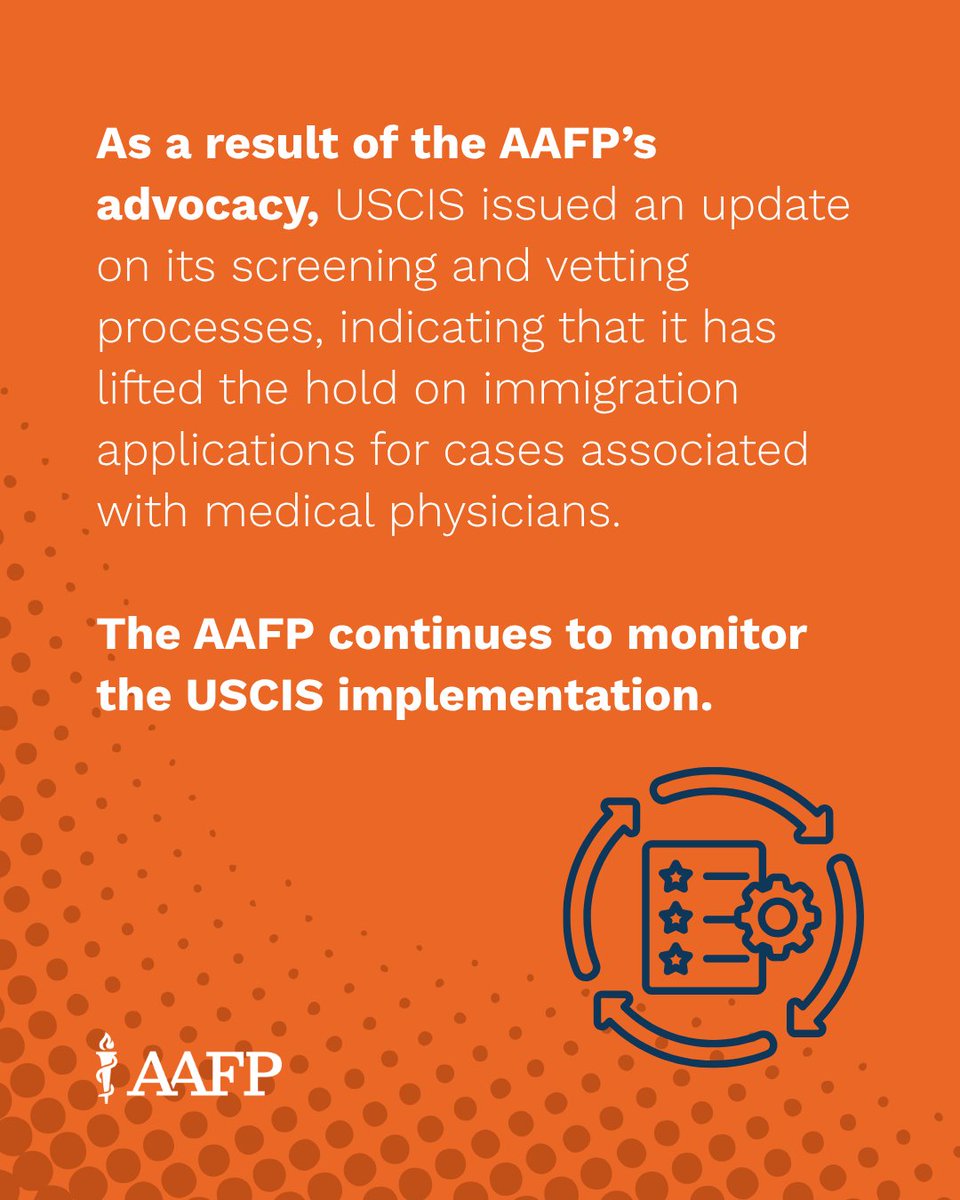
Proof that advocacy works! After 6 months of fighting against an unfair policy that left hundreds of physicians out of work, we are finally seeing progress. This issue impacted not only our personal lives and careers, but also patient care and access to healthcare.
AAFP members affected by USCIS screening and vetting procedures: Have you experienced delays in processing? We want to hear from you. Share your stories here: https://t.co/qYnGaanOon
AAFP members affected by USCIS screening and vetting procedures: Have you experienced delays in processing? We want to hear from you. Share your stories here: https://t.co/qYnGaanOon
A powerful article and important read for every physician in the U.S. and every IMG hoping to train here.
This Bloomberg piece captures the reality many physicians are living through right now: months-long uncertainty, stalled visa and work authorization processing, missed board eligibility deadlines, disrupted fellowships, lost income, canceled licenses, inability to travel, and fear of falling out of the U.S. medical system entirely after dedicating years to it.
These are not abstract immigration debates. These are licensed physicians already serving patients in American hospitals, many in underserved communities, suddenly trapped in administrative limbo despite no criminal history, no violations, and years of prior vetting.
The U.S. is projected to face a shortage of more than 113,000 physicians by 2028, yet the current system is sidelining doctors in the middle of residency, fellowship, and workforce transition cycles tied to July 1 hospital staffing schedules.
For many physicians, this is no longer just about immigration paperwork. It is about career collapse, financial ruin, family instability, and whether they can continue practicing medicine at all after sacrificing more than a decade of training.
A system built on uncertainty eventually drives talent elsewhere. Some physicians are already exploring Australia, Canada, and other countries after losing faith in the predictability of the U.S. pathway.
#PhysicianShortage #IMGs #ForeignBornPhysicians #MedicalResidency #HealthcareWorkforce #LiftTheHold #USCISPause #PhysiciansOnPause #HealthcareCrisis #RuralHealthcare #MedicalTraining #July1Transition #ProtectPhysicians #PatientCare #ImmigrationPolicy
https://t.co/XTMyMXViow
In tandem with what many physicians have been reporting for days, POLITICO today independently confirmed the same reality from multiple sources:
The physician hold largely remains in effect operationally, and no clear implementation pathway appears to exist yet.
According to the report, affected physicians and attorneys continue to receive responses indicating cases remain on hold, field offices appear unaware of any exemption guidance, and physicians are still not seeing meaningful adjudications.
Meanwhile, hospitals continue facing disrupted staffing, cancelled procedures, and growing workforce strain as July 1 approaches.
Policy announcements alone do not stabilize healthcare systems. Operational execution does.
#LiftTheHold #USCISPause #PhysiciansOnPause #HealthcareWorkforce #PatientCare #PhysicianShortage #IMGs #HospitalStaffing #HealthcarePolicy #July1Transition #PM6020192 #Pam6020194
https://t.co/QfrKfimRa7
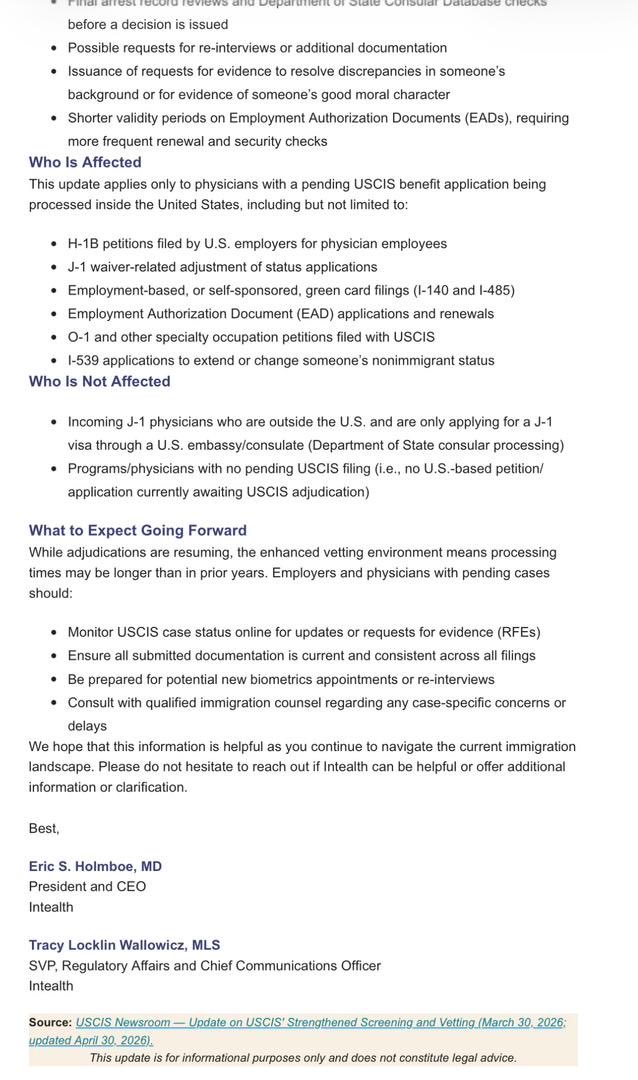
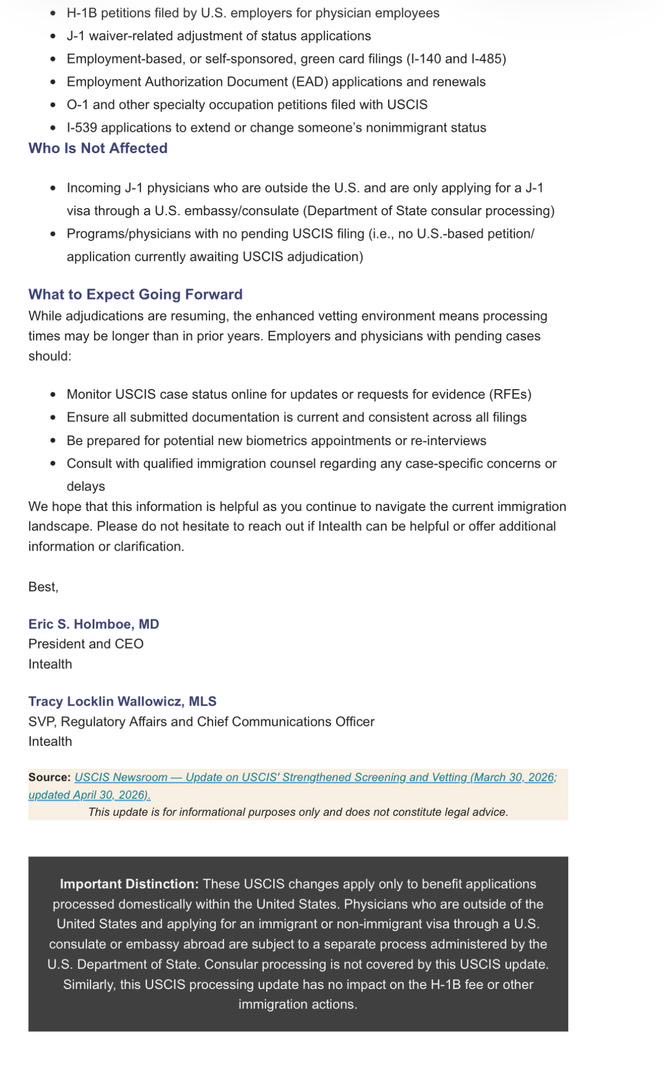
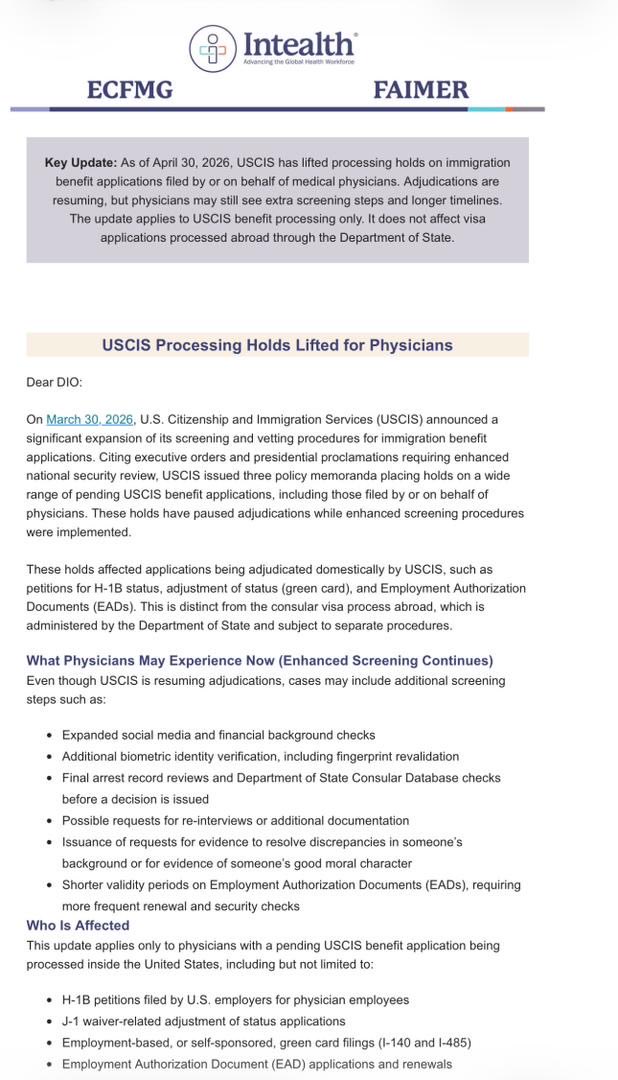
🚨 IMPORTANT UPDATE: Physician Exemption Confirmed by ECFMG
ECFMG / Intealth, the organization that certifies international medical graduates and enables entry into U.S. residency and fellowship training, has confirmed that USCIS has lifted the processing hold for physicians already inside the United States.
This is a meaningful step forward. But policy language alone does not fix what is happening on the ground.
🔴 What this actually covers (inside the U.S.)
USCIS is expected to resume processing for:
• I-485 (Adjustment of Status / Green Card)
• I-765 (Work Authorization, including C(9) and renewals)
• H-1B petitions filed by U.S. hospitals
• O-1 and similar specialty petitions
• I-539 (change or extension of status)
👉 These physician cases are now eligible to move again.
⛔️ What it does NOT cover
This update appears to apply only to physicians already inside the U.S. It does not clearly extend to:
• Incoming residents starting July 1
• Physicians outside the U.S. with signed job offers
• J-1 consular processing
• H-1B visa stamping abroad
👉 For these groups, the bottleneck effectively remains.
⛔️ Reality on the ground
• No defined timeline for adjudication
• No consistent operational guidance to USCIS field offices yet
• Expedite requests continue to be denied
• Across large physician groups, no confirmed approvals yet since the exemption announcement
So yes, the policy has shifted.
But it has not yet been operationalized.
⚠️ Why timing matters: July 1
July 1 is when U.S. healthcare resets:
• Residency and fellowship programs begin
• Physicians graduate and relocate
• Hospitals rebuild staffing schedules nationwide
It is the single largest coordinated workforce transition in American medicine.
⁉️ The real question
Can USCIS implement a pathway fast enough to process a year-long physician backlog before July 1?
If not, the consequences are immediate:
• Physicians unable to start scheduled roles
• Disrupted call schedules
• Increased burden on already stretched staff
• Delayed or fragmented patient care
• System-wide operational strain across hospitals
This is not theoretical.
This is operational.
🔴 What implementation actually requires
• Clear internal guidance to adjudicators
• Prioritization of physician cases tied to July 1 start dates
• Active processing of EADs and green cards
• Decisions delivered in weeks, not months
✅ Bottom line
This exemption is necessary. But without rapid execution, it will come too late to prevent disruption.
Policy is step one. Operationalization is everything.
In the end, this is a real test of USCIS operational efficiency, whether the system can move with the urgency healthcare demands and deliver decisions before July 1.
#LiftTheHold #PhysiciansOnPause #USCIS #ECFMG #IMG #HealthcareWorkforce #USCISPa
Important statement from the American Academy of Pediatrics in response to USCIS’s recent update exempting licensed physicians inside the U.S. from 39 affected countries from the hold:
“At present, there is no clear practical pathway for physicians or hospitals to act on this update… Bridging the gap between policy language and implementation is critical to secure consistent lifting of the hold, timely adjudication, and prevention of patient-care disruptions.”
The AAP recognizes the gravity of what is at risk for millions of Americans in rural and underserved communities.
Hospitals and physicians need reliable, actionable systems they can depend on to prevent disruption to patient care and hospital operations.
Various medical groups are also pushing for clear, dependable, and expedited pathways to address ongoing barriers facing licensed physicians already serving in U.S. hospitals.
For five months, routine renewals and work permit processing for licensed physicians were disrupted, creating widespread operational disarray across U.S. hospitals: sidelined physicians, cancelled clinics, delayed surgeries, disrupted schedules, and patients left waiting.
Per the AAP’s assessment: this USCIS update is a step forward, but far from resolved.
#LiftTheHold #PhysiciansOnPause #UscisPause #PM6020192 #PM6020194 #HealthcareCrisis #PatientCare #IMGs #ExpediteNow #PhysicianShortage #RuralHealth #UnderservedAreas #HealthcareAccess #SavePatientCare
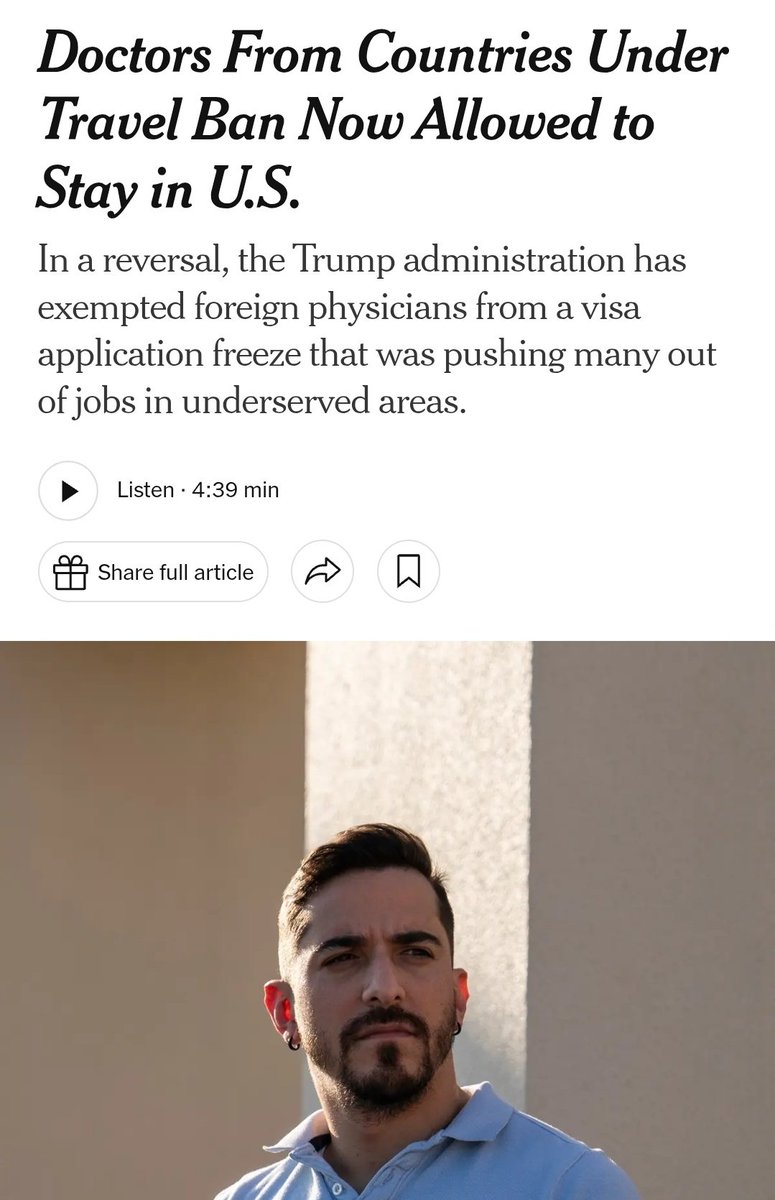
𝗗𝗼𝗰𝘁𝗼𝗿𝘀 𝗙𝗿𝗼𝗺 𝗖𝗼𝘂𝗻𝘁𝗿𝗶𝗲𝘀 𝗨𝗻𝗱𝗲𝗿 𝗧𝗿𝗮𝘃𝗲𝗹 𝗕𝗮𝗻 𝗡𝗼𝘄 𝗔𝗹𝗹𝗼𝘄𝗲𝗱 𝘁𝗼 𝗦𝘁𝗮𝘆 𝗶𝗻 𝗨.𝗦:
From "High Risk" to High Priority: A Critical Reversal for U.S. Healthcare.
In a significant policy shift, the administration has quietly moved to exempt foreign physicians from a visa processing freeze that had left thousands of healthcare providers in a state of legal and professional limbo.
The freeze, which stemmed from a January travel ban affecting citizens of 39 countries, had effectively halted decisions on visa extensions, work permits, and green cards. For many doctors already working on the front lines in the U.S., this meant being forced off the schedule, or worse.
The Human Cost: Dr. Ezequiel Veliz
The stakes of this policy were made clear by the story of Dr. Ezequiel Veliz, a family physician from Venezuela. Despite serving an underserved community in South Texas, Dr. Veliz was detained at a federal checkpoint on April 6 due to his pending visa status. After 10 days in detention, his release has become a symbol of the urgent need for clearer protections for international medical graduates (IMGs).
🩺 Why This Matters for the U.S.
The U.S. healthcare system is currently facing a "perfect storm" of staffing challenges:
A Growing Deficit:
The Association of American Medical Colleges (AAMC) reports a shortage of roughly 65,000 physicians, a gap expected to widen as the population ages and more doctors retire.
The IMG Backbone: International doctors make up 25% of the total physician workforce. Without them, many hospitals—particularly in rural and federally designated "underserved" areas—would be forced to close departments.
Primary Care Crisis:
Over 60% of foreign physicians** practice in primary care (Internal Medicine, Pediatrics, and Family Medicine), areas that many U.S. medical graduates avoid due to lower pay and higher workloads.
📈 What’s Next?
While the Department of Homeland Security (DHS)*has confirmed that "applications associated with medical physicians will continue processing," many remain cautious.
Dr.@sebas_arruarana , founder of Project IMG, noted that while the update is hopeful, roughly **1,000 doctors** finishing residencies next month are still racing against the clock to secure placements in underserved areas.
"We need to recruit the most skilled doctors no matter where they are from." — Dr. Rebecca Andrews**, Chair of the Board of Regents, American College of Physicians.
This reversal ensures that qualified, vetted physicians can continue their work where it’s needed most: in our communities.
https://t.co/sa4TssvYDd
#PhysicianShortage #HealthcarePolicy #IMG #MedicalNews #USCISPause #DoctorShortage