We have all made mistakes. But the key is to learn where you went wrong and come up with a solution. Eventually you will find that the solution ALWAYS boils down to two words: risk management.
Improvement is a battle that must be fought each day anew.
Your next workout doesn't care how strong your last one was.
Your next essay doesn't care how popular your last one was.
Your next investment doesn't care how smart your last one was.
Your best effort, again.
Just read the following Para carefully from Nephrocare's concall and understand why Dialysis is a difficult business to be profitable at.
Dialysis looks like a wonderful business on paper i.e. recurring revenue, non-discretionary demand, a patient who comes back three times a week for years. NephroPlus is the cleanest Indian case study for why it isn't, and the numbers are unusually honest about it.
1. You don't set the price. The payer does.
This is the root problem. Dialysis pricing in India runs around $22–25 per session, while the Philippines operates at roughly $110 per treatment for the identical clinical procedure, same machine, same consumables, 4–5x the realisation. That gap has nothing to do with cost or quality; it reflects what the payer can afford. In India the payer is largely the government (PPP tenders), insurance schemes, or a price-sensitive self-payer. You bid for volume in a tender; you don't price to value.
Watch how NephroPlus actually improved its realisation: blended RPT rose 13.3% in FY26 to ₹2,598, and 9.2% in Q1FY27 to ₹2,733. But that's mix, not pricing power as international went from 12% of revenue in FY23 to ~41% in 9MFY26 and 45% by Q1FY27. The company fixed its unit economics by leaving India, not by winning in it.
2. Cost per session is fixed, imported, and non-negotiable.
Dialyzer, tubing, dialysate, needles, EPO, plus nurse and technician time, every session consumes roughly the same basket. Machines and RO plants are largely imported. So you have a capped price and a floor on variable cost. Gross margin per session is structurally thin, and the only lever left is utilisation.
3. Utilisation is the whole game, but geography fights you.
Management says it plainly: dialysis is fundamentally a scale-driven business where higher volume drives operating leverage, asset utilisation and ROCE. But dialysis is a four-hour treatment required multiple times a week, which makes proximity critical as over 75% of NephroPlus's Indian clinics sit in tier-2 and tier-3 cities. Patients won't travel, so you must build small clinics close to them. Small clinics mean few machines, and a machine either runs its three shifts or it doesn't. Breakeven is a step function, not a curve. A greenfield clinic takes about 12 months to reach operational breakeven versus 3–4 months for an acquired one — so every year of expansion carries a drag cohort.
4. The financial history is the evidence.
Founded 2009–10. Raised roughly $205M across 13 rounds from 33 investors. For first 11 years of its life, Nephro was EBITDA negative and for 13 years it was PAT negative. High fixed cost businesses need massive scale to generate margins.
Disclaimer: no recommendation to buy or sell. Concall summary from @stockscansin
New blog!
Pyramiding.
An in-depth guide and strategy from a market wizard.
The #1 topic I get asked about, and one of the most mischaracterized approaches in trading.
The full approach: entry sequences, dynamic EV, sizing, exits, and the math behind it all.
It took me a while to finish but we got it done.
I look froward to all the comments and the discussions!
https://t.co/MuBOPuRE7e
I am reminded time and time again that the best commitments show a profit nearly right from the start, whether it's a breakout, a catalyst gap, a pullback buy, or a mean-reversion setup.
It means you are trading in the right environment, in the right theme, in the right stock or instrument, and at the right time.
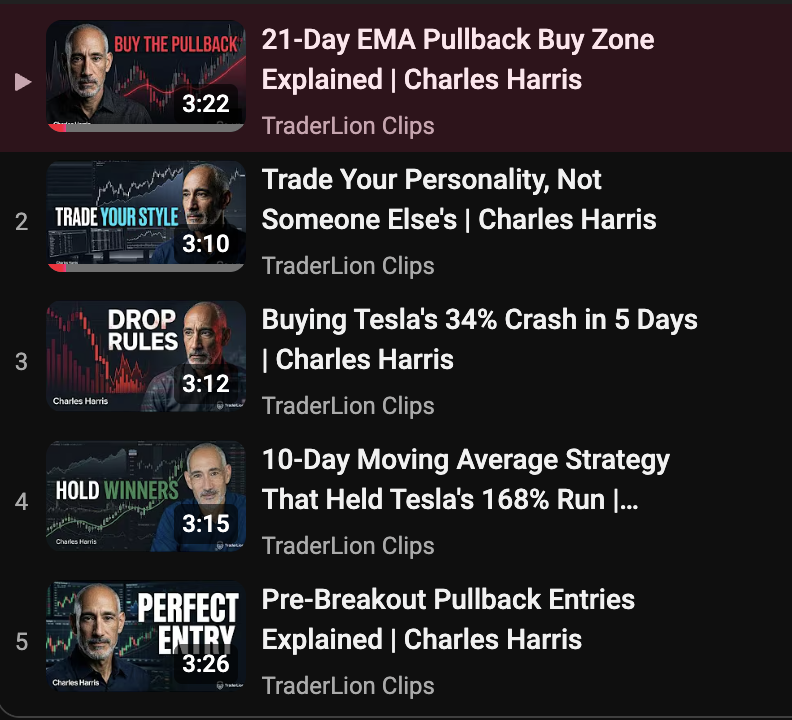
Charles Harris presentation from the 2021 TraderLion Conference is one of my favorites of all time.
Here are a few clips from his presentation on the @TraderLion Clips channel.
https://t.co/zMLMJI7VHS
6/7
I'm sharing this not out of bitterness — but out of responsibility.
To every candidate who deserves honest information before making a career decision.
A reputed brand on your resume means nothing if the environment compromises who you are as a professional.