this guy… it even makes me want to move to US and build a family there… this feels like the ultimate “trojan horse” for the human potential leveraged by America economy… it seems as a so simple decision, but its so deep on the structure of the civilization that… by default, it is also “establishing” that anyone “shitting” on @elonmusk from now on, will be by default and officially, a retarded that has no idea of anything 😅
This is a masterclass in autonomous software synthesis, but it also perfectly exposes the next fundamental frontier for AI:
Right now, LLMs are incredible at Static Aggregation… I mean, taking 31 government datasets (BEA, NOAA, EIA, Census) and reconciling them onto a hex grid with a game skin. :/
But the real trap is assuming 31 datasets = 31 independent views of reality:
1. The Echo Chamber:
BEA depends on Census; FEMA depends on NOAA; CDC depends on both. It’s not 31 independent signals; it’s an echo chamber of shared assumptions.
2. Static vs. Fragile:
A city isn't its historical GDP column. The real question is: when EIA power projections, NOAA weather models, and supply chains collide, where does their consensus fail?
The leap from AI that builds static digital twins to AI that understands where consensus is fragile and how systems co-fail is the real step forward.
1. The Data Illusion
Anyone can scrape a million predictions. But 90% of what looks like "consensus" across financial markets, newsrooms, and forecasting platforms is just an echo chamber.
20 outlets copy-pasting one unverified wire snippet isn’t 20 confirmations, it’s one source echoed 19 times.
If you train a model on raw volume, you simply train it to trust louder herd behavior.
in AI development right now, there is immense pressure to demonstrate continuous motion: push a new checkpoint every few days, add a decimal point to a benchmark, and call it progress.
But when you are building foundational intelligence around how expectations break.. predictive uncertainty, forecaster fragility, and distributed truth.. rushing a training run is the fastest way to build an echo chamber…
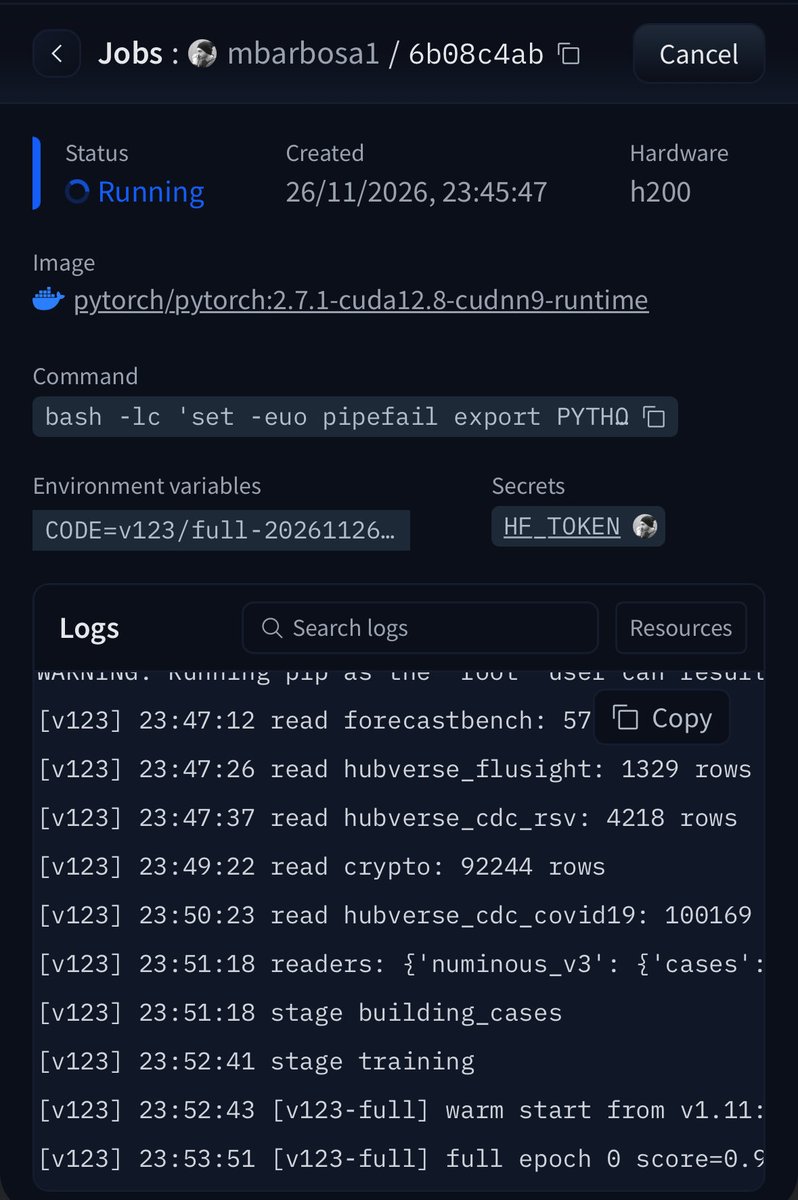
Why haven’t we rushed the next published training run after v1.11?
When you prove that a single unified network can model forecaster disagreement across multiple wild domains, the easy temptation is to keep hitting retrain with more parameters and louder hype.
We chose the harder path: deliberate calculation.
We will be sharing what actually happens when an AI model moves from "interesting baseline" to a true surprise intelligence engine…