I need to have this conversation with rational-thinking, non-condescending Christians because I think some of you are missing my point.
Are you saying that because it is evangelism, it should be done regardless of whether it is actually reaching anyone? Is it just about being able to say, “I’ve evangelised,” or should we care about whether it was effectively done?
“The foolishness of God is wisdom.” “Who are you to determine its efficiency?” You lots are being emotional and evading the question.
My context is the old man with a megaphone at 6am on a deserted junction. He preaches well, but there is barely anyone there to hear him. I’m usually the only person passing, and I’m on the move.
I’m not questioning street evangelism o. I’m asking whether there are better channels and locations for it. It could even be as simple as moving a little further to the main bus stop.
And yes, maybe God specifically told him to stand there. If so, fair enough. But receiving an instruction and executing it well are two different things.
If God tells me to give more, for example, I can obey the instruction and still exercise poor judgment in how I execute it. If I give money to someone struggling with addiction, technically I have “given,” but I may have executed the instruction poorly if the money simply fuels the addiction.
Same thing here. If God says, “Preach here,” then by all means, preach there 🙏. But if the instruction is simply to preach, why deliberately choose a place where nobody is listening when there are better places to reach people?
That’s the conversation I’m trying to have, not whether street evangelism is good, but whether we should also care about the effectiveness of how we do it.
Seeing all these noise makers who have not created a single job, yet you’re attacking Femi just because you spoke with one or two riders.
It’s a game of numbers, like he said, and it’s possible for a rider not to earn over 100,000 naira per week.
The bigger problem is that we make it hard for founders building for Nigerians. There is nothing Chowdeck can do about riders sweating profusely when bringing your food. Are they supposed to control the weather or put AC in their bicycles?
I’ve seen Uber Eats and Deliveroo riders deliver food soaking wet just because it’s raining. Should we blame Uber Eats or Deliveroo for that?
If a rider is using a bicycle, that’s what he can afford to handle his deliveries, and that’s not a Chowdeck problem.
What Chowdeck has done is provide an avenue for that person to earn a living with the resources available to them. We need to stop looking for reasons to tear down founders who are actually creating opportunities and building for our market.
@Goodly_Ife@HananaBananahhh Madam, you judged her.
And trying to gaslight her with “I only asked a question” may be a further proof that you aren’t locked in too.
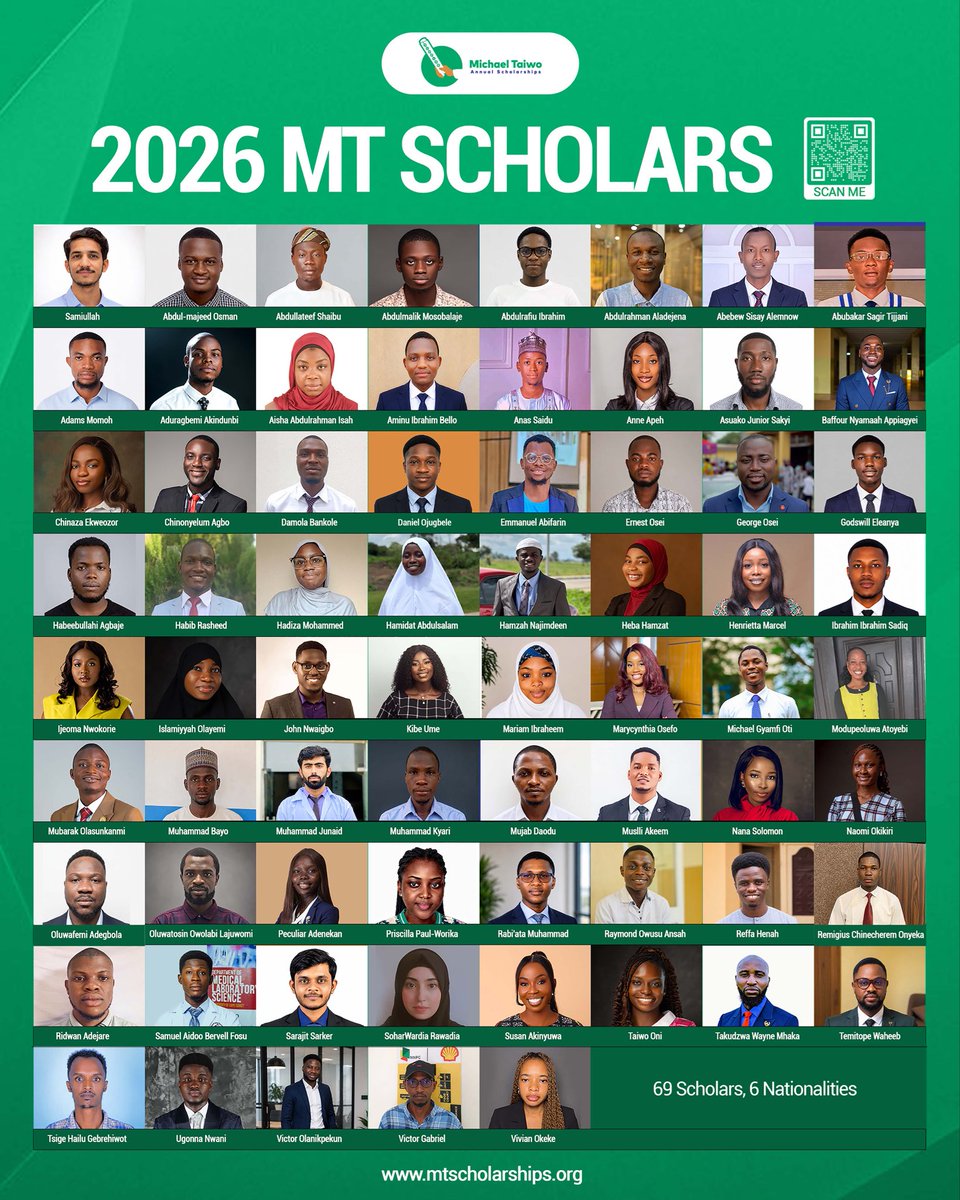
It gives me great joy to announce the winners of the 2026 Michael Taiwo Scholarships.
Ladies and gentlemen, I present to you the 2026 MT Scholars.
These 69 were chosen out of 9,198 applicants.
Help me congratulate them.
I may be wrong, but I'd argue that the number of Nigerians who stay home when they're genuinely sick (despite having HMO) is far greater than those who visit the hospital when they aren't.
For every one "pretend patient in matching Ankara," there are nine people who are actually ill but never show up.
This is a country where we practically beg people to go to the hospital. Most people don't go until the pain becomes unbearable.
Pharmacies are on almost every street. They're closer, faster, and more convenient. That's why many people would rather walk into a pharmacy, pay out of pocket for medication, and be done in minutes than travel to a hospital and spend hours waiting.
I'm currently a bit under the weather and I have HMO. Guess where I stopped after service yesterday to get medication?
The pharmacy down the street.
So the immediate assumption of “another pretend patient” when you see HMO patients is just weird.
There’s something we’re not being entirely honest about in this conversation, so I’ll say it.
It hurts to see someone who, in our eyes, put in less effort than we did, succeed.
- In academics, you spend an entire semester studying while someone who barely attended classes ends up with better grades. It hurts.
- You grind your way to a First Class, only to watch someone without one land an amazing job. It hurts.
- You spend years honing your craft, yet someone who seems to put in minimal effort gets the opportunities, the followers, the brand deals, and the bigger paychecks. It hurts.
You think, "I sabi pass this guy na." "I try pass this babe na."… Heck the money Lobistar makes here in two weeks is more than many brilliant people who have hustled relentlessly for years can even imagine.
Deep down, we believe rewards should be proportional to effort. More than that, we have a very specific idea of what effort is supposed to look like.
I also believe excellence and intellectual depth deserve to be rewarded more than mediocrity.
But if we're being honest, part of our frustration is that we don't think these people deserve the fame, wealth, or success they've amassed because they didn't painstakingly follow the path that, in our minds, should lead to those rewards.
Maybe we're right.
Or maybe we’re hurt by the gap between what we believe we deserve and how the world actually works.
Because the truth is, some people will excel simply because they're more beautiful, funnier, more charismatic or even entertainingly foolish. The world doesn't always reward talent or effort the way we'd like it to.
And painful as it is, we have to make peace with that.
Interesting perspective. I’m curious though, why is the ability to build a financial model the benchmark for the CFA, or preparing a trial balance the benchmark for an ACA? Both qualifications open the door to a wide range of career paths, each requiring different skills.
For instance, I’ve been an ACA holder for years and have never been required to prepare a trial balance in my role. Do I know what a trial balance is? Yes. Has it been required in my chosen field? Absolutely not.
The same applies to the CFA. Not every CFA charterholder works in a role where financial modelling is a core requirement. Shouldn’t the benchmark be whether someone can solve problems and create value in the career path they’ve chosen, rather than whether they possess one specific technical skill?
What does it take to leave a field you studied for years and build something extraordinary in an entirely different arena?
The Daily Circular – 10 Quick Qs | Episode 8
Every week, we throw 10 questions at someone whose mind we find fascinating. First thoughts only.
Most people stay in the lane their degree paved for them. Emmanuel Stephen @McSteve__ Oluwaseyi switched highways entirely. This week, we caught up with the award-winning Chartered Accountant and tax consultant, whose pivot from Botany at Obafemi Awolowo University to becoming one of ICAN's brightest talents proves that your starting point never dictates your finish line.
His story is less career ladder and more proof that excellence follows the curious, not merely the conventional.
Read the full interview: https://t.co/bp9ukteTsI
Peter is not the Rock, Jesus is.
Mary is not the mediator, Jesus is.
The Pope is not the head of the church, Jesus is.
The Catholic Church is not the way to heaven, Jesus is.