WHOEVER LEAKED THIS HAS ZERO FEAR
SOMEONE CONNECTED 350 GROK BOTS TO RUN A ONE-PERSON TRADING DESK.
I thought it was just another AI experiment until I saw the setup.
One bot scans the market.
Another hunts for setups.
Another analyzes news and sentiment.
Another tracks whales and on-chain activity.
Another manages risk and exposure.
Then a HEAD OF DESK Grok coordinates everything and sends the owner only the trades that actually need approval.
No team of analysts. No staring at charts all day.
Just 350 Grok bots passing information between each other 24/7.
The craziest part?
The owner said he barely touches the system anymore.
FULL GUILD ON HOW TO BUILD IT BELOW
5 LLM quantization techniques, clearly explained:
(bookmark this)
A 70B model in FP16 needs 140GB for weights alone. At 4-bit, that drops to 35GB, which fits on one card.
But naive rounding fails on large models. Roughly 0.1% of hidden dimensions carry values up to 20x larger than anything else in the tensor, and they wreck the quantization grid for everything else.
Each of these 5 methods handles those outliers at a different point:
1. RTN: ignores them. Rounds every weight to the nearest grid level with no calibration data. Cheapest option, weakest at low bit widths.
2. GPTQ: repairs after rounding. Quantizes a layer column by column and adjusts the remaining weights to absorb the error before moving on.
3. AWQ: protects before rounding. Finds the ~1% of weight channels that matter most and scales them up so they survive quantization. Everything still ends up in plain INT4.
4. LLM. int8(): isolates at inference. Outlier dimensions run in FP16, the other 99.9% run in INT8, and the results are merged.
5. QAT: solves it during training. The model is fine-tuned with rounding baked into every forward pass, so it adapts to the damage before quantization is actually applied.
All five produce the same artifact, a model at a fraction of its trained precision. They differ only in where the outlier problem gets addressed.
The visual below nicely summarises these techniques.
As further reading, the article below is a first-principles guide to LLM inference that walks through everything between your prompt and the streamed response, covering tokenization, embeddings, attention, the prefill and decode split, KV caching, and quantization.
It will give you a complete mental model of how inference actually works under the hood.
Read it below.
🚨: What does a BLACK HOLE actually sound like?
NASA turned this supermassive monster in galaxy M87 into pure audio.
It’s real data. Turn the volume up.
This might be the next big paradigm shift in AI.
Chinese researchers published a paper that completely kills the “next-token” paradigm.
Every LLM you use today, ChatGPT, Claude, Gemini, is fundamentally crippled by a bottleneck. They write text the exact same way a human types on a phone: one single discrete token at a time.
Word by word. Step by step.
It’s slow, it’s compute-heavy, and it hits a hard scaling wall.
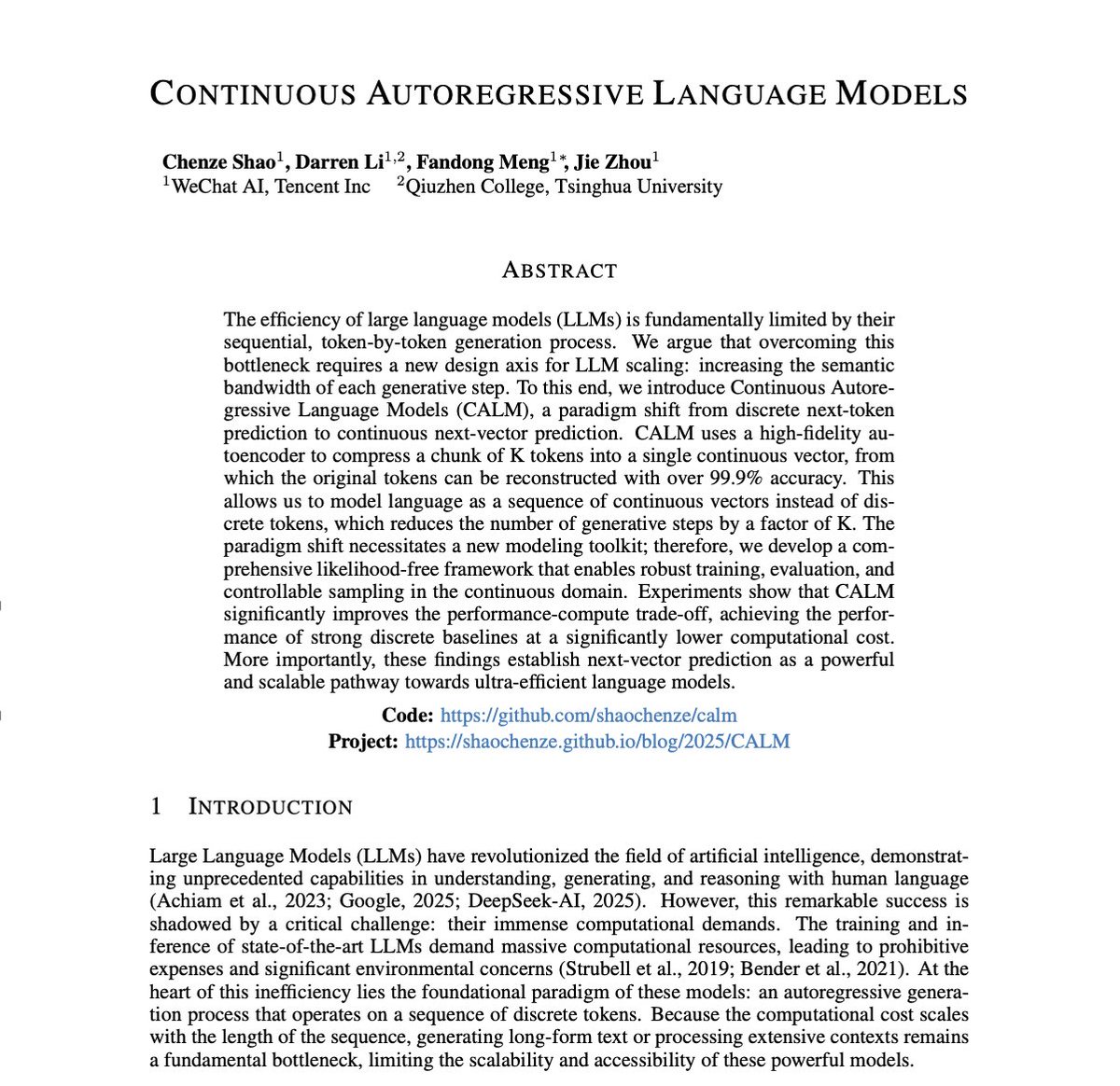
Researchers from Tencent and Tsinghua university published a paper introducing CALM (Continuous Autoregressive Language Models).
Instead of predicting the next token, the model predicts the next continuous vector.
Here is how it works:
They built a high-fidelity autoencoder that takes an entire chunk of tokens and compresses them into a single continuous latent vector.
The AI can reconstruct those original tokens back with over 99.9% accuracy.
Instead of generating text symbol by symbol, the transformer now generates language in continuous, high-bandwidth chunks.
It reduces the number of generative steps by a massive factor.
The results rewrite the performance-compute trade-off:
• Drastically lower computational cost and FLOPs compared to standard transformers.
• Matches the performance of strong discrete models at a fraction of the hardware strain.
• Establishes a brand-new likelihood-free framework for training and evaluation in the continuous domain.
We’ve spent years assuming language generation has to be a game of "guess the next word
This paper proves it doesn't.
Language isn't just a sequence of discrete symbols anymore.
It's a continuous stream.
The same seven notes rearrange into seven distinct sonic universes through cyclic permutation of a single interval sequence WWHWWWH.
This diagram maps every relative mode of C major alongside its parallel majors, revealing the dihedral structure that links keys by transposition and rotation in ℤ/12ℤ.
Those rotations power everything from generative AI composition engines to the spectral analysis that lets synthesizers and medical audio processors reconstruct harmonic series with mathematical exactness.
The geometry of sound is written in modular arithmetic.