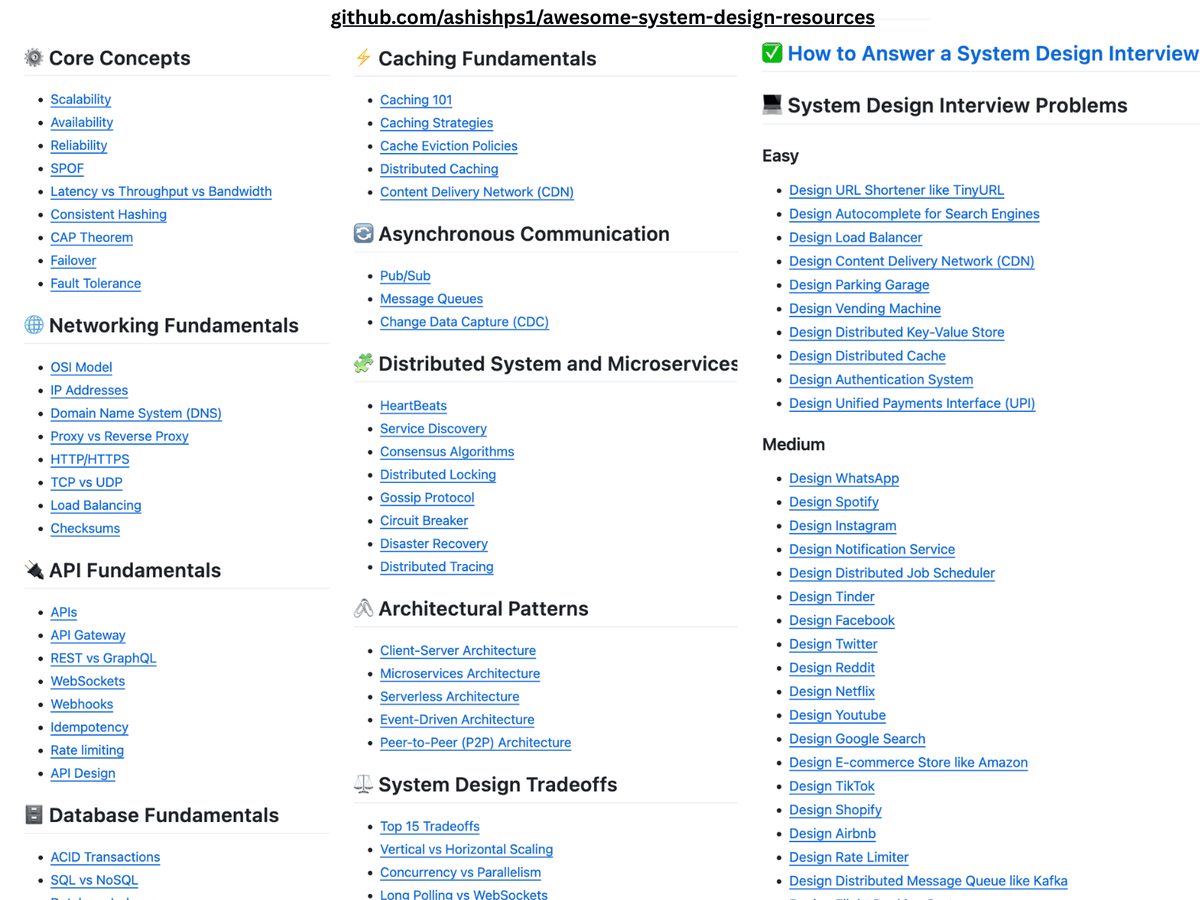
10 GitHub Repositories to Master System Design!
1. System Design Primer - https://t.co/pCptYobyBL
2. System Design 101 - https://t.co/BNsXmyH2PE
3. System Design at Scale - https://t.co/6Dmu3e05KR
4. Best System Design Resources - https://t.co/t2dCo3ZcEe
5. System Design Interview Handbook - https://t.co/G2lzMrIk6H
6. System Design Academy - https://t.co/i29k4Fj86K
7. Top System Design Interview Resources - https://t.co/sQBu5HJS5N
8. Machine Learning Systems Design - https://t.co/A7ZTXQtvHr
9. Agentic System Design Patterns - https://t.co/oNwcdrPjrL
10. Scalability Engineering - https://t.co/wTWsl8OQnK
Bookmark it!
Which topic GitHub resources do you need ?
🚨 BREAKING: Claude has a feature called Reading & Learning Mode. You can use it to learn anything faster than 99% of people. Here are 5 prompts to access it:
Before you launch your vibe coded project, run this prompt first:
“Perform a comprehensive audit of the application, covering security, reliability, concurrency, accessibility, and UI consistency.
Review the relevant codebase, architecture, data flows, API interactions, authentication and authorization logic, state management, async operations, error handling, and user-facing interfaces. Trace important flows end-to-end rather than reviewing files in isolation.
Specifically investigate:
Security vulnerabilities and data exposure
- Authentication and authorization flaws, including missing server-side permission checks, privilege escalation, insecure direct object references, and cross-tenant data access.
- Sensitive information exposed through client-side code, environment variables, API responses, logs, analytics, URLs, local storage, session storage, cookies, error messages, or source maps.
- Injection risks, including SQL, command, template, prompt, HTML, and script injection where applicable.
XSS, CSRF, SSRF, insecure redirects, unsafe file uploads, path traversal, weak session handling, insecure token storage, and missing security boundaries.
- Overly permissive database rules, API endpoints, CORS policies, storage buckets, webhook handlers, or third-party integrations.
- Secrets, API keys, credentials, internal endpoints, personal data, or implementation details that could be unintentionally exposed.
- Missing validation and sanitisation at trust boundaries. Do not assume client-side validation is sufficient.
Race conditions, concurrency, and state integrity
- Duplicate submissions caused by repeated clicks, retries, refreshes, or concurrent requests.
- Non-idempotent operations that can create duplicate records, payments, messages, bookings, jobs, or side effects.
- Stale state, optimistic update failures, lost updates, conflicting writes, and out-of-order async responses.
- Effects, subscriptions, listeners, timers, and requests that are not correctly cleaned up.
- UI states where actions remain available while an operation is already in progress.
- Cache invalidation problems and inconsistencies between client state, server state, and persisted data.
- Multi-tab, multi-device, and poor-network scenarios where relevant.
Reliability and failure handling
- Unhandled promise rejections, swallowed errors, silent failures, infinite loading states, broken retry loops, and incomplete rollback behaviour.
- Missing loading, empty, error, offline, timeout, and partial-success states.
- Failure paths that leave data or the UI in an inconsistent state.
- Assumptions about API responses, nullability, ordering, timing, or network availability that could cause production failures.
- Memory leaks, unnecessary rerenders, expensive operations, and obvious performance bottlenecks that materially affect the user experience.
Accessibility
- Semantic HTML and correct use of landmarks, headings, labels, lists, tables, buttons, and links.
- Keyboard navigation, logical tab order, focus visibility, focus trapping, and focus restoration.
- Missing or incorrect accessible names, labels, descriptions, and ARIA attributes.
- Colour contrast, text legibility, touch-target sizes, zoom behaviour, reduced-motion support, and reliance on colour alone to communicate meaning.
- Screen-reader behaviour for modals, menus, dropdowns, tabs, toasts, validation errors, loading states, and dynamically updated content.
- Forms with unclear instructions, inaccessible validation, missing autocomplete attributes, or poor error recovery.
- Test against WCAG 2.2 AA expectations where applicable.
Visual and interaction consistency
- Inconsistent spacing, typography, colour usage, border radii, shadows, icon sizing, alignment, component dimensions, and responsive behaviour.
- Components that visually appear identical but behave differently, or behave identically but are implemented inconsistently.
1/2
Andrew Ng just dropped a 3-hour course on how to become an AI Engineer in 2026:
• 00:00 - How to build agentic AI systems
• 04:25 - Future of AI engineering
• 23:38 - AI Prompting full course
• 2:52:17 - Creating an app with AI in 30 minutes
This 3-hour watch could replace 10 AI engineering courses on the internet.
Watch it today, then read how to run a self-improving system in the article below.
WHAT IS gRPC?
DEFINITION
-> gRPC (Google Remote Procedure Call) is a high-performance, open-source framework for communication between distributed applications
-> It enables clients and servers to communicate efficiently using Remote Procedure Calls (RPCs)
-> Uses HTTP/2 for transport and Protocol Buffers (Protobuf) for data serialization
CORE FEATURES
HIGH PERFORMANCE
-> Uses binary serialization with Protocol Buffers
-> Faster and more efficient than text-based APIs like JSON
HTTP/2 SUPPORT
-> Multiplexes multiple requests over a single connection
-> Supports header compression and bidirectional streaming
CODE GENERATION
-> Automatically generates client and server code
-> Supports many programming languages
CROSS-PLATFORM
-> Works across different operating systems and programming languages
-> Ideal for distributed systems and microservices
HOW gRPC WORKS
-> Client calls a remote method (RPC)
-> Request is serialized using Protocol Buffers
-> Request is sent over HTTP/2
-> Server receives and processes the request
-> Server executes business logic
-> Response is serialized using Protocol Buffers
-> Response is returned to the client
RPC TYPES
UNARY RPC
-> Client sends one request and receives one response
SERVER STREAMING RPC
-> Client sends one request and receives multiple responses
CLIENT STREAMING RPC
-> Client sends multiple requests and receives one response
BIDIRECTIONAL STREAMING RPC
-> Client and server exchange multiple messages simultaneously
KEY COMPONENTS
PROTOBUF (.proto) FILE
-> Defines services and message structures
-> Acts as the contract between client and server
SERVICE
-> Collection of remote procedures (methods)
MESSAGE
-> Structured data sent between client and server
STUBS
-> Auto-generated client and server code used for communication
KEY CHARACTERISTICS
-> HIGH PERFORMANCE
-> Optimized for low latency and high throughput
-> STRONGLY TYPED
-> Uses Protocol Buffers for strict data structures
-> LANGUAGE AGNOSTIC
-> Supports Java, Go, Python, C#, Node.js, Rust, and many others
-> SCALABLE
-> Ideal for microservices and cloud-native applications
ADVANTAGES
-> Very fast and efficient communication
-> Smaller payload sizes than JSON APIs
-> Automatic code generation
-> Supports streaming communication
-> Excellent for microservices architecture
DISADVANTAGES
-> Harder to debug than REST APIs
-> Less human-readable because it uses binary data
-> Browser support requires gRPC-Web
-> Learning Protocol Buffers adds complexity
REAL-WORLD USE CASES
-> Communication between microservices
-> Cloud-native applications
-> Real-time streaming systems
-> IoT platforms
-> Machine learning services
-> Internal APIs for large-scale systems
gRPC VS REST
-> gRPC uses HTTP/2, while REST commonly uses HTTP/1.1 or HTTP/2
-> gRPC uses Protocol Buffers, while REST commonly uses JSON
-> gRPC is optimized for speed and low latency, while REST prioritizes simplicity and broad compatibility
-> gRPC supports bidirectional streaming, while REST typically follows a request-response model
BEST PRACTICES
-> Design clear and reusable .proto files
-> Use streaming only when necessary
-> Implement authentication using TLS and tokens
-> Handle deadlines and request timeouts
-> Enable logging and monitoring for RPC calls
-> Version APIs to maintain backward compatibility
BACKEND ENGINEERING HANDBOOK
-> Grab Backend Engineering Handbook
-> https://t.co/t9mqUuRbjx
Stop wasting hours trying to learn AI. 📘📚
I have already done it for you.
With one list. Zero confusion. And no fluff
📹 Videos:
1. LLM Introduction: https://t.co/OBfDwz8tQm
2. LLMs from Scratch: https://t.co/oeOci6OcH6
3. Agentic AI Overview (Stanford): https://t.co/5POKytuEyb
4. Building and Evaluating Agents: https://t.co/E5FFlGVbq6
5. Building Effective Agents: https://t.co/kusHO3ejnN
6. Building Agents with MCP: https://t.co/cCEsddKJe2
7. Building an Agent from Scratch: https://t.co/8xWp3Cnd1P
8. Philo Agents: https://t.co/D4CENuhsrv
🗂️ Repos
1. GenAI Agents: https://t.co/4KZ9sJnjs0
2. Microsoft's AI Agents for Beginners: https://t.co/vPvgZwjZub
3. Prompt Engineering Guide: https://t.co/ZJPx57o4vn
4. Hands-On Large Language Models: https://t.co/awbIDVAPLM
5. AI Agents for Beginners: https://t.co/vPvgZwjZub
6. GenAI Agentshttps://lnkd.in/dEt72MEy
7. Made with ML: https://t.co/rvYry90bld
8. Hands-On AI Engineering:https://t.co/HjMTW5o3Lz
9. Awesome Generative AI Guide: https://t.co/qGocn6dMRt
10. Designing Machine Learning Systems: https://t.co/zZC31Io7QY
11. Machine Learning for Beginners from Microsoft: https://t.co/SBVf1FQeVN
12. LLM Course: https://t.co/OCAvim3QZP
🗺️ Guides
1. Google's Agent Whitepaper: https://t.co/VYeTNLSntH
2. Google's Agent Companion: https://t.co/4gy8NGQLUB
3. Building Effective Agents by Anthropic: https://t.co/WcMyxPSQCy.
4. Claude Code Best Agentic Coding practices: https://t.co/d01rxIEUhf
5. OpenAI's Practical Guide to Building Agents: https://t.co/fsQrbj2oKo
📚Books:
1. Understanding Deep Learning: https://t.co/zf0RZ1gIDC
2. Building an LLM from Scratch: https://t.co/rCEkYCdF3Q
3. The LLM Engineering Handbook: https://t.co/cHxt9qbNdj
4. AI Agents: The Definitive Guide - Nicole Koenigstein: https://t.co/No7Gopfa7H
5. Building Applications with AI Agents - Michael Albada: https://t.co/KxDWj7pGsU
6. AI Agents with MCP - Kyle Stratis: https://t.co/Pdaw6hnTCP
7. AI Engineering: https://t.co/kqEMbAYttm
📜 Papers
1. ReAct: https://t.co/gU23m8zAy4
2. Generative Agents: https://t.co/5CCFoHVkIB.
3. Toolformer: https://t.co/ux2vgBMozu
4. Chain-of-Thought Prompting: https://t.co/v6iOKX2GGr.
🧑🏫 Courses:
1. HuggingFace's Agent Course: https://t.co/njL6khAaM7
2. MCP with Anthropic: https://t.co/TWp2H7m1i7
3. Building Vector Databases with Pinecone: https://t.co/bPCar17oz2
4. Vector Databases from Embeddings to Apps: https://t.co/6AwTQ3YycN
5. Agent Memory: https://t.co/EZSaCFbftc
Repost for your network ♻️
Harvard, Andrew Ng, and Karpathy will teach you AI engineering for free. Most people just do it in the wrong order:
Almost all of it is free, and the order matters as much as the resources.
1. Start with Python. It's the language the AI field runs on, and Harvard's CS50P teaches it better than most paid bootcamps.
2. Once the basics click, learn how Python is used in AI. Andrew Ng's "AI Python for Beginners" is a free four-part course that bridges writing code and building with models.
3. From there, get a feel for how LLMs work under the hood. 3Blue1Brown's visual explainers make transformers and attention click.
4. When you want to go deeper, build a small model yourself. Andrej Karpathy's "Zero to Hero" series takes you from one neuron to a working model, line by line.
5. Next, learn how AI agents actually work. Anthropic's "Building Effective Agents" is the most grounded guide, and its lesson is to use composable patterns, not heavy frameworks.
6. For hands-on practice, take the CrewAI short course. It teaches you to treat agents like a team of people working together.
7. After that, connect your agents to the real world. That's what MCP does, wiring models to tools, APIs, and databases, and the official docs are the cleanest place to start.
8. Now build real projects. The open-source ai-engineering-hub repo has dozens of working examples across LLMs, RAG, and agents you can adapt into your own work.
9. Finally, read one book instead of ten. Chip Huyen's "AI Engineering" covers what you need to ship real applications.
The throughline is simple. Frameworks come and go, so don't build your skills around them. Master the fundamentals once, and everything on top gets easier, and you'll stay ahead of the people chasing the framework of the week.
MIT's Books on AI & ML (FREE DOWNLOAD):
1. Foundations of Machine Learning
https://t.co/78p57EBbL8
2. Understanding Deep Learning
https://t.co/D2oyRrXqcE
3. Introduction to Machine Learning Systems
❯ Vol 1: https://t.co/IezLFJdhDV
❯ Vol 2: https://t.co/NYP3xAPZ6u
4. Algorithms for ML
https://t.co/lntuD4Q19H
5. Deep Learning
https://t.co/vCHVIZQYTI
6. Reinforcement Learning
https://t.co/JNWhFCuCkH
7. Distributional Reinforcement Learning
https://t.co/GXpkV4BDZi
8. Multi Agent Reinforcement Learning
https://t.co/T8zVmQVutO
9. Agents in the Long Game of AI
https://t.co/HeD3Nsm5zz
10. Fairness and Machine Learning
https://t.co/csAjhdf7Lb
11. Probabilistic Machine Learning
❯ Part 1 : https://t.co/5Leef9ypGj
❯ Part 2 : https://t.co/vRbF0rEIuh
Best YouTube Channels To Crack Tech Interviews (2026)
1. DSA – NeetCode
2. LeetCode Patterns – Abdul Bari
3. System Design – Gaurav Sen
4. Mock Interviews – Pramp
5. FAANG Prep – Tech Dummies
6. Coding Rounds – Nick White
7. Behavioral – Jeff H Sipe
8. Problem Solving – Back To Back SWE
9. Deep DSA – Errichto
10. Interview Strategy – Exponent
11. Resume + Career – Self Made Millennial
12. Real Interview Qs – Clément Mihailescu
13. Advanced DSA – William Lin
14. CS Basics – MIT OpenCourseWare
🚨Anthropic just showed a 24-minute workshop on how to actually do prompts for Claude.
Taught by the people who built it.
Free. No registration. No paywall.
I've seen $300 courses that don't cover what they teach in the first 8 minutes.
Watch it and bookmark it now.
“design a RAG pipeline for 10M docs with zero hallucination”
apparently this was asked in a Google L5 interview round. came across it somewhere on the internet and honestly it’s a way more interesting system design problem than most classic distributed systems questions
1. ingest + normalize docs
- remove duplicates, standardize formats, extract metadata, maintain version history
2. hybrid retrieval (BM25 + embeddings)
- BM25 handles exact keyword matching while embeddings capture semantic meaning
- semantic search alone usually struggles with precision at massive scale
3. ANN retrieval + reranking
- ANN (Approximate nearest neighbor ) quickly pulls top candidate chunks from millions of docs
- then a reranker rescoring step improves relevance by deeply comparing query vs retrieved chunks
4. source confidence scoring
- every retrieved chunk gets scored based on freshness, trust level, overlap and retrieval consistency
- low-confidence context should never heavily influence generation
5. constrained generation
- the model is only allowed to answer using retrieved context (nothing new to be invented outside of the retrieved context)
6. citation-backed responses
- every major claim links back to exact chunks, documents or timestamps
7. hallucination fallback layer
- if retrieval confidence drops below a threshold: “insufficient evidence found”
8. continuous evals
- run adversarial queries, retrieval recall benchmarks and hallucination tests continuously
9. caching + memory layer
- cache high-frequency enterprise queries and retrieval paths (improves latency and output)
10. observability everywhere
- trace retrieval paths, chunk rankings, token attribution and failure points
Also at 10M docs, retrieval quality matters more than the frontier model itself.
4 GitHub Repositories to Prepare for 4 Different Types of Software Engineering Interviews:
1. System Design Interviews: https://t.co/pkVpi6LxSV
2. Low Level Design Interviews: https://t.co/ewnEgFdlfF
3. Coding Interviews: https://t.co/oTez9H4sGh
4. Behavioral Interviews: https://t.co/NsN4Ki0wlz
♻️ Repost to help others in you network