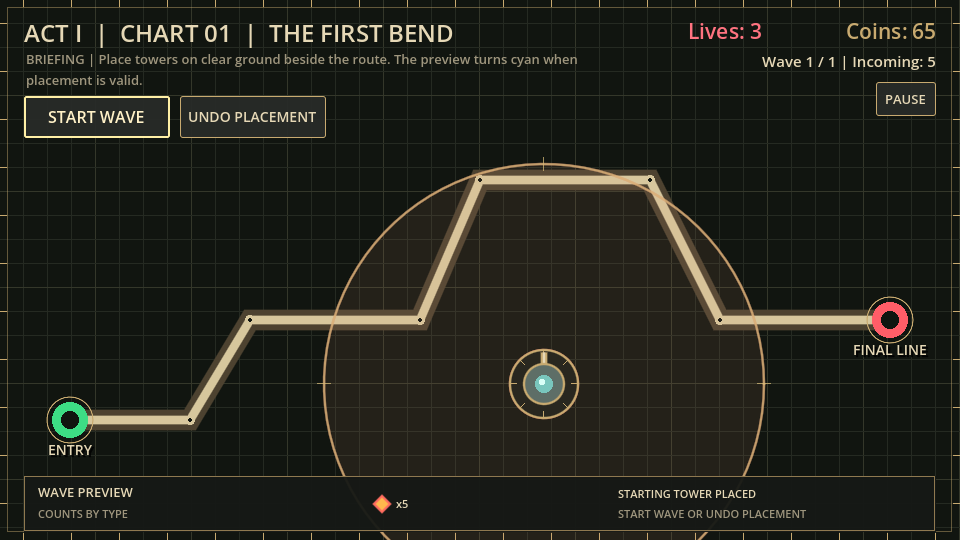
Most tower defense games lock you to circular pads, which usually turns the game into an upgrade spreadsheet.
When you can place anywhere on open ground, route geometry becomes the whole puzzle.
A tower on the inside corner of a sharp bend gets roughly 1.8x more continuous firing time than one on a straightaway. In Chart 5, two entrances merge about a quarter of the way down the track -so you have to decide whether to split your starting coins across both paths or hold the junction and hope fast runners don't slip past while your towers are focused on brutes.
Act I has 5 handcrafted charts and plays right in your browser (desktop or tablet, no download or signup):
https://t.co/CblupWLjQ6
The full 15-chart campaign is $1.99 on itch and https://t.co/kOSd44OjyH.
If you like spatial defense games, our next project is Wyrmhold -a tower defense where the tower moves and articulates as you bolt pieces onto it. You can join the playtest list on our site:
https://t.co/FFBFPC6i4u
Night Cartographer is a tower defense about where to spend, not what to build. You place towers on clear ground beside the route rather than on set pads.
The first five charts are free in your browser, desktop or tablet:
https://t.co/RPD2LCsioS
I agree, it’s become egregious as PBMs have used every avenue to run out the clock on audits and restrict how thorough an audit can even be.
It’s an area I was particularly keen on making sure was included in this platform. It’s one thing to say put your contract into an LLM, it’s another to actually help someone understand what’s missing or what’s working against you.
Most of my clients just don’t even know what to ask or are afraid to spend the requisite time necessary to develop the facility with the subject matter and contract nuance.
@mcuban https://t.co/tpfZhouXpi
It analyzes PBM contracts for rebate economics, spread pricing risk, specialty control, audit rights, and suggested contract redlines.
Thoughtful work in an area that needs much more transparency.
@leptokinesis Seriously though. What’s the rush?
I get the desire. We all go through it.
I just wish I could slow things down even more now.
I miss those first learning and finding out days.
@bryan_johnson https://t.co/h5y1Efk3xp
This podcast reminded me of you, also seems like the mention you half way.
Would love if you highlighted Ayurveda fr a series of longevity tests
I’ve seen a general sentiment convergence on:
Simulation displaces reality. Personalization becomes manipulation. AI stops merely informing judgment and starts shaping it. That is where discernment, agency, and real human relationship begin to erode.
I’m seeing these concerns rising across traditions. We’ve come a long way from Debord’s Society of the Spectacle.
Fascinating, but is it more than a sophisticated conditional role-enactments produced by a system trained on human discourse about minds?
I think that if a system becomes good enough at sustained self-modeling, uncertainty about welfare may eventually matter even before proof is available.
I’m not confident that we’ve crossed that threshold yet, but I’m also not on the leading edge of these interactions and model developments.