Medical Education is a global peer-reviewed journal in health care professionals' education. Its papers advance understanding of educationally relevant issues.
What should we be researching in feedback? This commentary recommends revisiting problematisations of feedback and their assumptions to shed new light on a perpetually interesting topic.
@ASMEofficial#MedEd https://t.co/LYI6ZMoOPB
What if academic freedom was never truly free? This new article explores how the 'undercommons' offers a radical reimagining of intellectual liberation beyond institutional constraints.@asmeofficial#MedEd https://t.co/XZ1ykShyvV
How to conceptualise & operationalise imposter phenomenon in practice?
Instead of obsessing over measuring or fixing people, we should examine the environments, expectations & inequities that create these experiences.
@ASMEofficial#MedEd@MGottliebMD
https://t.co/PNpQEG0Qvc
Medical students observing a US court uncovered the stark healthcare realities facing justice-involved patients. This course challenged students to consider holistic healthcare approaches and reflect upon their elective experience. @ASMEofficial#MedEd
https://t.co/CNuAFkod8r
Physician assistant students at this institution had never encountered AI scribe tools in training. A three-part scaffolded curriculum changed that, building confidence and ethical awareness around AI-assisted documentation. @ASMEofficial#MedEd https://t.co/2VxoeBUmu8
Integrating the history of medicine into traditional medical curricula remains challenging. A student-led thoracic trauma skills night showed how medical history can be woven meaningfully into hands-on clinical training. @ASMEofficial#MedEd https://t.co/FS1Go8Rljz
Short-form videos styled after TikToks helped medical students develop clinical skills and build empathy in a new method. Authors suggest we should engage in more social media to determine how it could enhance learning. @ASMEofficial#MedEd https://t.co/8Mcya1GEh5
Check out a new #MedEd paper on a critical topic in today's society: mental health disclosure.
Some reports suggest that >50% of medical students experience mental health challenges. This systematic review illustrates the work we still have to do: https://t.co/LkxRuVKFjM
Faculty development in South Africa that centred identity, storytelling and locally rooted metaphors helped educators navigate the tensions of juggling roles. Whilst focusing on implications, learn what problems authors addressed! @ASMEofficial#MedEd https://t.co/dMwAwQVyws
Humour on ward rounds is part of the hidden curriculum - a simple two-minute structured reflection at the end of rounds could make it visible, teachable and safe for both students and attending physicians.
@ASMEofficial#MedEd https://t.co/ScQ2UFrH9D
A resident-led surgical curriculum bridging academic development time kept surgery-bound medical students connected to clinical skills, mentorship and professional community. Learn what was tried and what lessons were learned for @ASMEofficial#MedEd https://t.co/JLEJinwcti
Scaffolding in the operating room: baby steps or giant leaps? Understanding how attendings adjust their support can improve alignment with residents' learning needs and foster discussions about shared goals.
#SurgicalEducation#MedEd@asmeofficial https://t.co/es0m3Q3Knr
Stress can hinder learning, but in the right balance, authors suggest it can enhance it. Our study explores how clinical supervisors leverage and modulate stress to support trainee learning.
#ClinicalTeaching#MedEd@asmeofficial https://t.co/OoR3FhUp26
Emotions matter in medicine. Our study shows how a music-based pedagogy can support medical students’ emotional development and challenge the culture of emotional detachment.#ArtsInMedicine#MedEd@asmeofficial https://t.co/sg9kRpSrQ8
Does locum working hinder or enhance doctors’ learning and professional development? Our latest study explores how locum roles shape opportunities for growth, experience, and career development.
#Workforce#MedEd@asmeofficial@janefergo https://t.co/cN3LFdmXtn
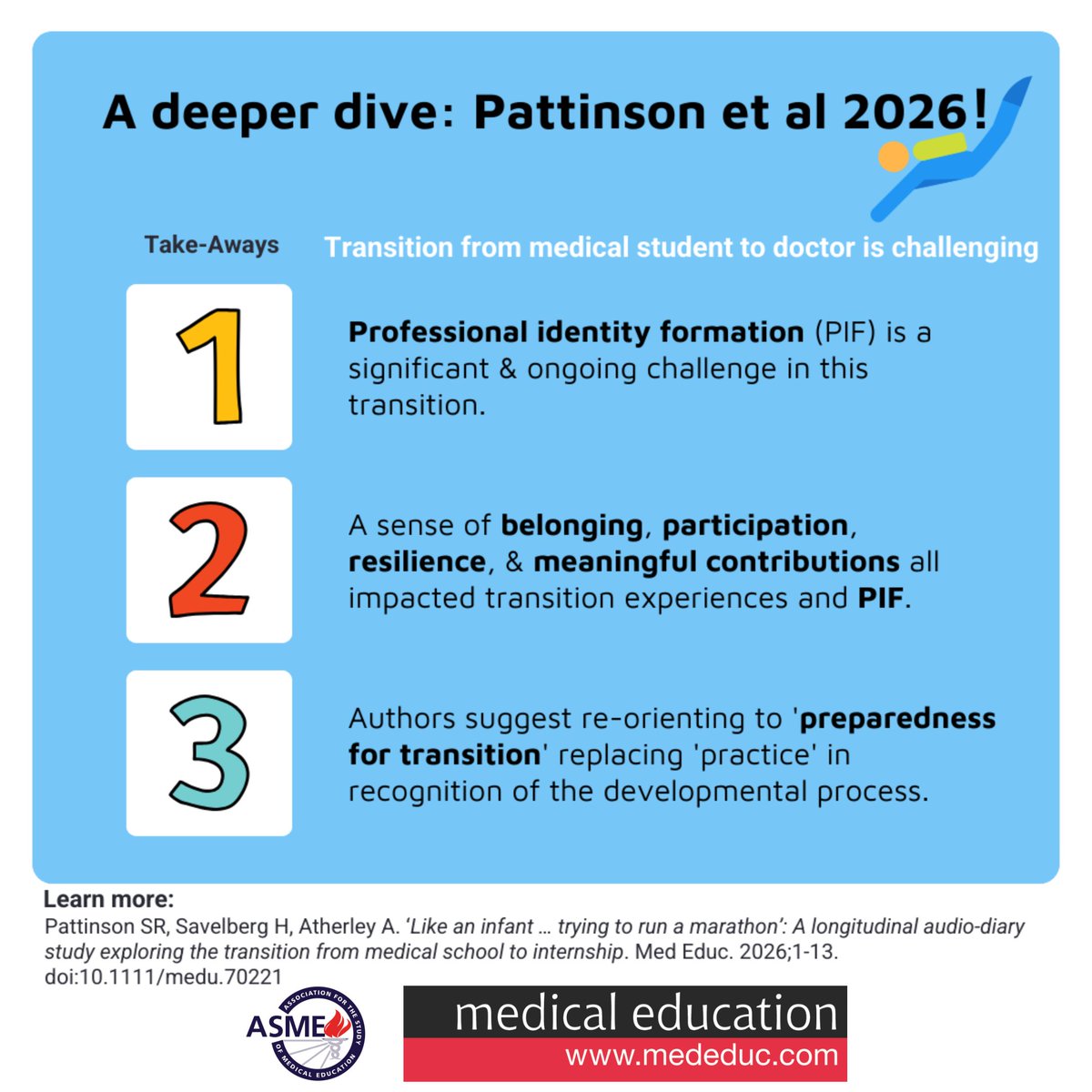
Check out a new Medical Education paper exploring 'preparedness for transition' exploring how medical students experience transition to practice, and the factors influencing this experience.
Read more here: https://t.co/bceswBnH03
What did redeployment during COVID-19 teach us? Reflecting on these experiences offers important lessons for leaders and new perspectives on professional identity formation.
#Leadership#MedEd@asmeofficial https://t.co/rkySz2Bxht
Healthcare is complex, blurring lines of expertise and responsibility. Our latest review highlights the importance of teaching physicians to engage in boundary work actively navigating roles and shaping the future. #HealthSystems#MedEd@asmeofficial
https://t.co/8Rp6G7LKeq
AI is transforming medicine, but are global medical education systems ready? Our review examines how students and faculty perceive AI integration, and what needs to change in medical education with ethics in mind. #AIinMedicine#MedEd@asmeofficial https://t.co/0d0mYvA4Xb