Gaza’s Catastrophe: A Post-Modern Holocaust To Take Their Lands
What is happening in Gaza cannot be morally sanitised by repeating the vocabulary of “self-defence” while civilians are killed, hospitals shattered, neighbourhoods erased and children forced to grow up beneath drones, bombardment and bereavement. After nearly three years of devastation, the fundamental question is no longer whether Israel possesses legitimate security concerns. Every state does. The question is whether those concerns can justify the systematic destruction of the conditions required for an entire civilian population to live.
They cannot.
Emine Erdoğan, the current First Lady of Türkiye, describes the assault on Gaza as a “post-modern Holocaust”, arguing that the scale of killing, destruction and collective suffering has exceeded anything that can plausibly be defended as ordinary warfare. The moral warning behind such language cannot simply be dismissed: when human beings are reduced to categories rather than regarded as individuals possessing equal dignity, the foundations of atrocity are already being laid.
That danger is particularly acute when political and military leaders employ dehumanising rhetoric.
Israel’s own Defence Minister Yoav Gallant notoriously spoke in October 2023 of fighting “human animals” when announcing a complete siege of Gaza. Other Israeli politicians and public figures have subsequently used language advocating destruction, displacement or the permanent devastation of Palestinian society. Dehumanisation matters because history repeatedly demonstrates what happens when a population is rhetorically transformed from neighbours, civilians and children into an undifferentiated enemy.
Once humanity is removed from the victim, almost anything becomes imaginable.
The present catastrophe should be placed within a broader ideological framework associated with Finance Minister Bezalel Smotrich. The so-called Smotrich Doctrine is offering Palestinians three alternatives: leave, submit to permanent Jewish sovereignty, or resist and be defeated, thus situating that doctrine within longstanding policies of displacement, settlement expansion and territorial domination in the occupied Palestinian territory.
That context matters.
If military devastation is accompanied by political projects seeking permanent territorial control, settlement expansion and Palestinian emigration, then the destruction of Gaza cannot be evaluated only bomb by bomb. The cumulative pattern becomes essential: homes destroyed; hospitals incapacitated; universities demolished; agricultural land devastated; water and sanitation systems crippled; hundreds of thousands repeatedly displaced; access to food and medicine restricted; and large sections of territory rendered uninhabitable.
This is why accusations of genocide cannot simply be brushed aside as political rhetoric. Genocide is a specific legal crime requiring an intent to destroy, in whole or in substantial part, a protected group. Statements suggesting that Gaza should remain destroyed for generations, advocating mass displacement, denying Palestinians an equal right to exist on their land, or treating civilian death as acceptable are plainly relevant when investigators assess intent alongside patterns of conduct.
And there is another profound asymmetry that cannot be ignored.
This has never been a confrontation between two remotely comparable military powers. Israel possesses one of the world's most technologically sophisticated armed forces, with advanced aircraft, precision-guided weapons, drones, satellite intelligence, extensive surveillance capabilities and AI-assisted targeting systems. It receives enormous military, diplomatic and technological support from powerful allies.
Against that machinery stand more than two million Palestinians trapped in an extraordinarily small territory, including enormous numbers of children.
That imbalance imposes greater responsibility, not less.
International Humanitarian Law (IHL) does not disappear because Hamas attacked on 7 October 2023. Those crimes cannot lawfully transform every Palestinian into a combatant. They cannot make apartment blocks military targets by default. They cannot extinguish the rights of newborn infants, hospital patients, journalists, aid workers, doctors or displaced families. Collective punishment is prohibited precisely because responsibility is individual.
A Palestinian child born in Gaza did not attack Israel on 7 October.
A mother searching for drinking water did not attack Israel on 7 October.
A premature baby inside an incubator did not attack Israel on 7 October.
No invocation of Hamas can erase those elementary truths.
Perhaps the most damning indictment of this entire period is therefore not merely the number of people killed. It is how rapidly Palestinian suffering became normalised.
A destroyed hospital becomes yesterday’s headline.
A family erased beneath an apartment building becomes another statistic.
A child carrying the remains of a sibling becomes another photograph scrolling past on a telephone screen.
Then another bombing begins.
Then another statement of “concern”.
Then another shipment of weapons arrives.
And the machinery continues.
The failure therefore extends far beyond Israel. Governments that loudly invoke international law elsewhere while continuing to arm, finance or diplomatically shield Israel despite mounting evidence of catastrophic civilian harm have helped turn legal principles into instruments of selective enforcement. If international humanitarian law applies only to geopolitical adversaries, it is not law in any meaningful universal sense. It becomes political theatre.
Palestinian life cannot be worth less because the government causing the destruction is an ally of powerful Western states.
Nor does condemning Israel’s conduct constitute hostility toward Jews or Judaism. On the contrary, collapsing Judaism, Jewish people worldwide and the policies of one state into a single entity is itself profoundly wrong. The responsibility belongs to governments, officials, commanders and individuals whose decisions must be judged according to their actions—not according to ethnicity or religion.
The strongest condemnation should therefore be directed precisely where responsibility lies.
Israel must end attacks that unlawfully harm civilians. It must allow unrestricted humanitarian relief consistent with international law. It must protect medical facilities and personnel. It must abandon policies of permanent displacement and territorial acquisition. Allegations of grave international crimes must be independently investigated, evidence preserved and those responsible—regardless of rank—held accountable through lawful judicial processes.
And Israel’s allies must finally understand that endless expressions of “deep concern” while weapons continue flowing are no longer credible.
There comes a point when neutrality in the face of systematic civilian destruction ceases to resemble prudence and begins to resemble permission.
The Palestinians of Gaza do not need another declaration explaining how tragic their suffering is.
They need the suffering to stop.
They need bombs not to fall.
They need children not to die.
They need hospitals to function.
They need food and clean water.
They need the right to remain on their land.
They need accountability powerful enough to make international law something more than words recited over the ruins.
If nearly three years of devastated neighbourhoods, orphaned children, amputated limbs, mass graves and generations psychologically scarred have not yet produced that determination, then Gaza has exposed something profoundly disturbing not only about Israel’s conduct, but about the international order itself.
The question history will ask is painfully simple:
How much Palestinian life did the world decide was expendable before it finally said: enough?
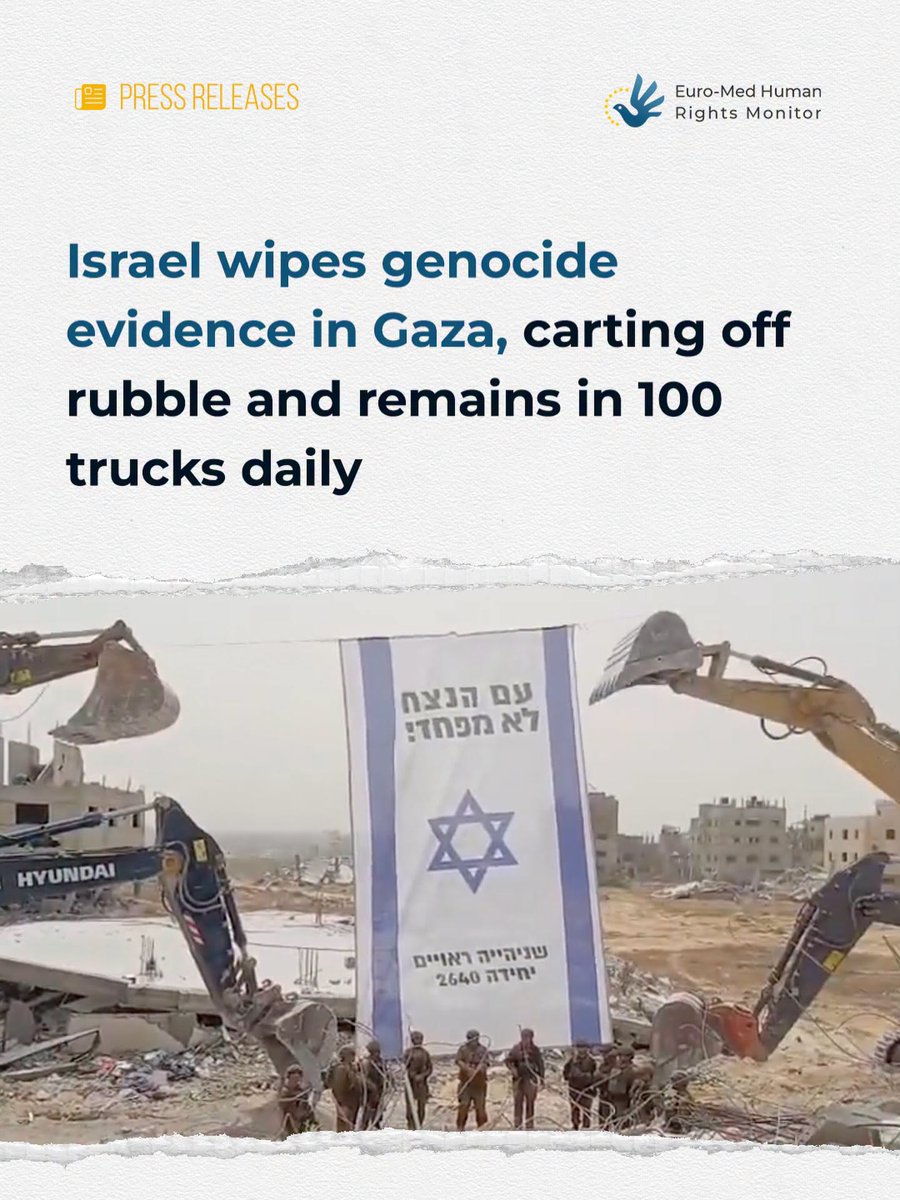
Erasing the Crime Scene: Gaza’s Rubble, the Missing Dead, and the Destruction of Evidence
Euro-Med Human Rights Monitor has accused Israeli forces and civilian contractors of carrying out a large-scale, organised operation to remove, crush and relocate rubble from areas of Gaza under Israeli military control, warning that the process risks destroying evidence of genocide, unlawful killings and other international crimes before independent investigators can examine the sites.
According to the organisation, at least 10 million tonnes of debris have already been removed, crushed or displaced from their original locations within zones under Israeli control, which it estimates now cover roughly 66 percent of the Gaza Strip. Around 400 pieces of heavy machinery, operated by Israeli civilian companies under military protection, are reportedly active across eastern and southern Gaza, demolishing remaining structures, crushing the ruins of entire neighbourhoods and loading the debris onto trucks. Euro-Med Monitor says it has recently tracked close to 100 trucks leaving Gaza each day, carrying rubble to undisclosed locations in Israel and the southern occupied West Bank.
The organisation stresses that these operations are not being conducted as part of a transparent humanitarian programme to rescue the missing, clear roads or prepare Palestinian-led reconstruction. Instead, rubble is being mixed and transported before forensic specialists, unexploded-ordnance teams and criminal investigators can survey the sites. Such actions may erase shell fragments, cartridges, biological traces, personal belongings, attack patterns and other physical evidence needed to reconstruct what occurred and establish legal responsibility.
The danger is especially grave for the families of the missing. Gaza’s Civil Defence estimated in July 2026 that approximately 8,500 people remained unaccounted for beneath the ruins. Heavy crushers and excavators could fragment or scatter human remains, separate them from identifying documents and move them to inaccessible locations, making recovery and identification impossible. This violates families’ right to know the fate of their relatives and undermines internationally recognised standards for investigating potentially unlawful deaths.
The rubble also contains property, recyclable building materials, land records and physical markers of homes, streets and neighbourhood boundaries. Removing or commercially exploiting these materials without consent or compensation may, depending on the circumstances, amount to unlawful confiscation or pillage. The levelling of depopulated areas also risks erasing the material basis for Palestinian return and reconstruction.
Euro-Med has called for an immediate halt to the removals, full disclosure of truck routes, contractors and destinations, and urgent access for independent forensic and criminal investigators. Its central warning is stark: reconstruction cannot become a pretext for eliminating evidence, human remains, property rights and the physical memory of Palestinian life in Gaza. https://t.co/hs7Ry7KofP
PERCHE’ CI ODIANO presentazione
Cari amici,
nella primavera del 2006 ho pubblicato un libro dal titolo “Perché ci Odiano”, edito dalla Rizzoli BUR, collana Futuro Passato. Rispetto al mio pezzo televisivo “L’Altro Terrorismo” (Report, 2003) esso è molto più documentato e soprattutto contiene una critica a Israele forse senza precedenti nell’editoria italiana importante, poiché Israele viene da me annoverato fra gli Stati terroristi e accusato da fonti ebraiche autorevoli di aver imposto “54 anni di ‘nazismo’ in Palestina”.
Ve lo segnalo per alcuni importanti motivi:
E’ probabilmente il libro oggi più censurato nella saggistica italiana. Praticamente nessun media televisivo né cartaceo ha voluto recensirlo, dunque né RAI, né Mediaset o La7, o alcuna radio pubblica o privata mainstream. Neppure L’Unità, Liberazione, Diario o La Repubblica (che ha letteralmente tolto una recensione dalle pagine sia del quotidiano che del Venerdì). Uniche eccezioni, Odeon Tv e il Manifesto. La Rizzoli lo propose a 102 contatti affinché fosse recensito, e fu ignorato da 101 di essi. Sappiamo che la censura è politica e viene dall’alto, e credo che la critica a Israele ne sia alla base.
La documentazione che lo rafforza conta quasi 240 documenti ufficiali, spesso Top Secret, ed è perciò talmente inattaccabile, e scioccante, da costituire lo strumento definitivo per demolire la Guerra al Terrorismo di Bush/Blair/Putin/Olmert senza possibilità di smentite. E’ dunque uno strumento essenziale per controbattere efficacemente alle destre, o semplicemente per ogni cittadino che vuole capire la realtà di questa immane crisi internazionale.
Il libro è scritto per poter essere capito da tutti, e contiene una spiegazione fruibile da chiunque di tutto ciò che è essenziale sapere per comprendere le crisi mediorientali e la criminosità della Guerra al Terrorismo.
Israele viene svelato per ciò che è senza mezzi temini o tentennamenti: il più grande Stato terrorista della Storia mediorientale contemporanea, con prove alla mano che smontano pezzo su pezzo la narrativa che oggi permette a Tel Aviv di agire con impunità assoluta di fronte al mondo intero. Le fonti sono solo ebraiche, proprio per essere ‘blindate’.
In ultimo, oggi che la Guerra al Terrorismo ci sta portando sull’orlo di una deflagrazione senza precedenti, ritengo vitale che sia divulgato al pubblico il senso ultimo del libro, che è: “Quasi tutto ciò che sappiamo sul Terrorismo islamico è falso, e ci può uccidere. Smettiamo di crederci. Se non ci racconteranno la verità sulle radici dell’odio contro di noi, quell’odio non si fermerà mai, perché mai sapremo affrontarlo. Vi offro gli strumenti per capire l’odio, per affrontarlo e per fermarlo. Ne va della nostra vita, come di quella di tanti cittadini del mondo”.
Mi affido direttamente a voi affinché ne prendiate visione e, se lo condividete, lo divulghiate, perché non mi è concessa altra voce. Vengo zittito dalle censure poiché né la verità, né la libertà di pensiero sono tollerate. Mai.
Paolo Barnard
ISRAELE E’ IL PIU’ IGNOBILE INSULTO ALLA MEMORIA DI SEI MILIONI DI EBREI STERMINATI IN GERMANIA.
(2014-07-14)
CHAIM WEIZMANN, FUTURO PRESIDENTE D’ISRAELE:
"Gli inglesi ci hanno detto che ci sono dei negri in Palestina, gente di nessun valore”. (Nur-eldeen Masalha, Towards the Palestinian refugees, 08/2000)
_________________
IL SIONISTA YOSSEF WEITZ AVEVA PREPARATO UNA LISTA DETTAGLIATA DEI VILLAGGI PALESTINESI DA DISTRUGGERE, CON NOMI E COGNOMI DI UOMINI DONNE E BAMBINI DISARMATI, E QUESTO ANNI PRIMA DEI PROTOCOLLI DI WANNESEE COMPILATI DAI NAZISTI PER STERMINARE GLI EBREI IN EUROPA.
_____________
AHARON CIZLING, MINISTRO DEL PRIMO GOVERNO D’ISRAELE NEL 1948:
“Adesso anche gli ebrei si sono comportati (contro i palestinesi) come i nazisti, e tutta la mia anima ne è turbata." (Minutes of Israeli cabinet meeting, 17 nov. 1948, Kibbutz Meuhad Archive, section 9 container 9 file 1)
_____________
I PRINCIPI ISPIRATORI DEL SIONISMO CONTRO I PALESTINESI:
“C’è bisogno di una reazione brutale. Dobbiamo essere precisi su coloro che colpiamo. Se accusiamo una famiglia palestinese non c’è bisogno di distinguere fra colpevoli e innocenti. Dobbiamo fargli del male senza pietà, altrimenti non sarebbe un’azione efficace”. (Ben Gurion’s Diary, 1 Jan. 1948)
_____________
MOSHE DAYAN 1967:
“Dobbiamo dire ai palestinesi dei territori occupati che non esiste soluzione per loro, continueranno a vivere come cani, e se vogliono possono andarsene”. (RAFI secretariat meeting in September of 1967, Yossi Beilin, Mehiro shel Ihud)
____________
Paolo Barnard: il ‘nazismo’ sionista precede quello tedesco di 30 anni. Il Sionismo è un’aberrazione dell’umanità. Israele è il più ignobile insulto esistente alla memoria di sei milioni di ebrei sterminati in Germania.
Uno strumento per la Palestina: facile, pronto, usatelo
(2009-02-03)
Ho già scritto, da anni, che:
Solo quando l'opinione pubblica occidentale saprà cosa è accaduto in Palestina dal 1897 al 1951, capirà di chi è il grande torto nel conflitto - capirà che il Grande Terrorismo è israeliano, e che il terrorismo palestinese è REAZIONE a decenni di orrori sionisti - capirà che i palestinesi hanno RAGIONE, e che la loro reazione di violenza è oggi solo esasperazione convulsa per tanta indicibile ingiustizia. E l'opinione pubblica occidentale a quel punto fermerà il conflitto.
Ma all'opinione pubblica occidentale nessuno mai racconta cosa è accaduto in Palestina dal 1897 al 1951. Dobbiamo farlo noi, voi. Come?
Ascoltate il mio racconto in sette parti su Youtube , dal titolo 'Palestina: capire il torto' (https://t.co/abwUqfXasZ). E DIVULGATELO, con ogni mezzo, anche solo fornendo il link. Fatelo però con le persone comuni, più che potete, con il popolo del TG1, del TG4, per intenderci. Sarà l'inizio della salvezza della Palestina, perché
"... oggi la gente non tollera più la barbarie, e la Storia ci dimostra che quando la scopre si attiva per porle fine" — Noam Chomsky
Paolo Barnard
Salvare Gaza?
(2009-01-03)
ECCO QUELLO CHE IL 99% DEI CITTADINI COMUNI SA DEL CONFLITTO ISRAELO-PALESTINESE:
“Gli ebrei sopravvissuti all’Olocausto nazista e a persecuzioni storiche, tentarono di ottenere una loro terra sicura nella biblica Palestina, dove fondarono comunità pacifiche e religiose. Ma gli arabi ostili tentarono subito di annientarli con la guerra del 1948. Gli ebrei combatterono un’eroica guerra partigiana che li vide vittoriosi e salvi da un secondo Olocausto. Fondarono Israele nel maggio di quell’anno, unico Stato democratico e moderno in medioriente, baluardo di civiltà fra nazioni arabe di re e dittatori corrotti e sanguinari. I quali tentarono di nuovo nel 1967 di distruggere la pacifica Israele, che li sconfisse brillantemente ancora una volta. Da allora Israele vive circondata da arabi-palestinesi fanatici, irragionevoli e brutali, che la attaccano col terrorismo in continuazione, senza farsi scrupolo di massacrare i civili ebrei, inclusi i bambini. Quei terroristi islamici sono certamente collegati oggi ad Al Qaida, e quindi Israele combatte una guerra al terrorismo anche per nostro conto. Inoltre, gli Stati canaglia come Siria e Iran appoggiano le fazioni armate arabe-palestinesi, per cui il pericolo per Israele è particolarmente insidioso. Essa deve difendersi, è un suo diritto, e nel farlo capita che ahimè ci vadano di mezzo anche alcuni civili arabi-palestinesi, ma la colpa di ciò è dei terroristi islamici che costringono Israele a combattere in zone popolate. Israele ha fatto di tutto per arrivare alla pace, ma si scontra sempre con l’ottusità e la ferocia dei leader arabi-palestinesi, corrotti e impietosi persino coi loro cittadini, che hanno sempre rovinato ogni accordo possibile. Non ci sarà pace finché la parte araba non accetterà il diritto di Israele di esistere e non cesserà di aggredirlo.”
Ogni parola di quella narrativa è falsa, grottesca persino. Ma finché essa rimarrà la narrativa della maggioranza dell’opinione pubblica italiana e occidentale, voi potrete fare tutte le manifestazioni che volete, tutte le proteste che volete, e non otterrete nulla, nulla di nulla, come nei passati 40 anni. Va fatto altro, VA RI-RACCONTATA ALLA GENTE LA VERA NARRATIVA SU COSA VERAMENTE ACCADDE LAGGIU’. E’ l’unica speranza per terminare il conflitto, l’unica.
Serve urgentemente la fase operativa della creazione del consenso fra gli italiani sulla VERITA’ STORICA di quanto realmente accaduto in Palestina, secondo le seguenti linee:
1) La creazione di una compagine italiana superpartes (no palestinesi in essa) che esuli del tutto da qualsiasi affiliazione politica in Italia, che annulli ogni individualismo di lotta e si unisca attorno a un'unica meta.
2) L’unica meta sarà di RIBALTARE LA NARRATIVA sulla Storia del conflitto arabo-ebraico, raccontando agli italiani SOLO ciò che accadde in Palestina a partire dal 1897 fino al 1951. Con un unica fede: SENZA LA VERITA' STORICA NON CI SARA' MAI LA PACE.
3) Rifiutarsi quindi di dialogare su qualsiasi avvenimento successivo, se non dopo una esaustiva rappresentazione del 1897-1951. Rifiutarsi di esprimersi su Hamas o Fatah se non dopo una esaustiva rappresentazione del 1897-1951. Rifiutarsi di esprimersi sul terrorismo palestinese se non dopo una esaustiva rappresentazione del terrore sionista dal 1944 in poi.
Questo perché nessuno può comprendere l’entità della MENZOGNA che ci hanno raccontato sul conflitto israelo-palestinese se non conosce cosa accadde in Palestina a partire dal 1897 fino al 1951. Ho piena fiducia nel fatto che se le opinioni pubbliche venissero a conoscenza di quegli avvenimenti, i mendaci tavoli del dibattito odierno sul processo di pace salterebbero in aria all’istante, e vi sarebbe una inarrestabile pressione verso una giustizia vera in Medioriente. Finalmente la pace.
4) Creare dunque materiale divulgativo chiaro e fruibile, film, dvd, animazioni, libretti di 40 pagine al massimo, tutto centrato SOLO ciò che accadde in Palestina a partire dal 1897 fino al 1951. Poi fare conferenze in scuole (soprattutto), parlare nei circoli ricreativi, ospedali, posti pubblici, fare tavoli per strada, negli ipermercati, nei dopolavoro ecc. Essere ferratissimi contro l’accusa di antisemitismo (vedi mio libro e altri) e ribadire sempre la sopraccitata fede.
5) Essere uniti e disciplinati attorno a questi semplici punti, da Torino a Palermo, e rivolgersi per il 99% agli italiani semplici.
Questo cambierebbe la Storia e cesserebbe l’orrore. Perché la gente verrebbe a sapere delle pratiche neonaziste storiche degli ebrei in Palestina contro i palestinesi prima e dopo la nascita d’Israele; saprebbe l’indicibile e fredda ferocia con cui il Sionismo aveva pianificato la distruzione dei palestinesi 40 anni PRIMA dell’Olocausto; capirebbe perché, accidenti, un popolo torturato e massacrato da 60 anni con un sadismo che raggiunge il grottesco, oggi lancia razzi alla disperata e si fa saltare in aria. Perché nessun palestinese può rimanere 'civile' dopo 60 anni di ferocia neonazista israeliana in Palestina, impunita e assistita con zelo dal ‘mondo civile’. E se la gente venisse a conoscenza di tutto ciò, la gente porrebbe fine a quell’inferno, perché, come disse Noam Chomsky “quando il pubblico scopre l’esistenza della barbarie, si mobilita per porle fine”.
Ma c’è qualcuno in questa Italia antagonista perennemente manifestante e indignata perenne che sia disposto a lavorare in quel senso? C’è? Ci siete?
Paolo Barnard
Neonazismo in Palestina
(2008-12-29)
Qui non si tratta di terrorismo, ma di neonazismo. Gaza è un campo di concentramento a lento rilascio di orrore, dove invece di sterminare innocenti sulla catena di montaggio dei forni, si tortura un popolo fino al parossismo. Il ribaltamento dei ruoli di vittima e carnefice è totale e orripilante, il mondo assiste immobile. Israele compie crimini contro l'umanità da 60 anni in Palestina. Ma se i palestinesi torturati, puliti etnicamente e massacrati con sadismo inaudito osano reagire scomposti dopo 60 anni di inferno in terra, allora la logica israeliana e occidentale dice che meritano ancor più tortura, pulizia etnica e massacri.
Ricordo le parole dell'intellettuale ebreo Norman G. Finkelstein: "Ma se gli israeliani non vogliono essere accusati di essere come i nazisti, devono semplicemente smettere di comportarsi da nazisti."
Paolo Barnard
COME ‘ASFALTARE’ CHI DIFENDE ISRAELE CON 10 AUTOREVOLI RISPOSTE.
di PAOLO BARNARD
Aprile 2015
In ricordo di Vik Arrigoni
“ATTENZIONE: Anti-Sionismo NON significa Antisemitismo. Sionisti = Elite ebrea criminale genocida dominante in Palestina dall'800 a oggi. Semiti sono i normali ebrei e palestinesi, d'Israele, della Palestina o del mondo. Solo gli ignoranti, o i falsari amici dei Sionisti, spacciano un anti-sionista per antisemita.”
https://t.co/DvMQ7a6Ph5
[Palestine & Israel]
“The picture that emerges is of an Israel wantonly inflicting every possible measure of death and anguish on civilian populations in a mood reminiscent of regimes which neither Mr. Begin nor I would dare to mention by name.”
These are the clear words of unreserved condemnation of Tel Aviv's military conduct, spoken by former Israeli ambassador to the UN, Abba Eban, and reported by the Jerusalem Post. However, they weren't uttered today, but on August 16, 1981. Twenty-five years have passed, and they could not be more relevant.
Today, let us also call Israel's war conduct in Lebanon and Gaza by its real names: Supreme Crime, War Crime, Terrorism. And before proceeding, it must be reminded to Israel's apologists that barbarism can never be justified by the barbarism of others.
In August 1945, the International Military Tribunal in Nuremberg established that "Supreme Crimes" in wartime conduct were to be considered “...planning, preparation, initiation or waging of a war of aggression, or a war in violation of international treaties, agreements or assurances, or participation in a Common Plan or Conspiracy for the accomplishment of the foregoing... Violations of the laws of war conduct, and such violations include, among others, the killing of civilians in occupied territories... the devastation of cities, towns, and villages...”
In August 1949, the Fourth Geneva Convention, along with the two additional Protocols of June 1977, decreed that civilians must not be subjected to attacks, including direct attacks against them or indiscriminate attacks on their residential areas. Specifically, indiscriminate large-scale destruction and the devastation of their properties are prohibited unless justified by precise military reasons. Devastation of state or socially beneficial public or cooperative property is also forbidden, as are forced mass or individual evacuations of citizens, regardless of the motives. Additionally, the absolute prohibition of collective punishment is enshrined, according to the principle that no one can be punished for a crime they have not personally committed. (Articles 33, 49, 53, 147, and Article 51 of Protocol 1)
Finally, Protocol 1 of June 1977 unequivocally establishes that “...Serious violations (of the Fourth Geneva Convention and its Additional Protocols) are to be considered war crimes...” (Article 85)
The current definition of terrorism by the American FBI reads: “the unlawful use of force and violence against persons or property to intimidate or coerce a government, the civilian population, or any segment thereof, in furtherance of political or social objectives.”
It takes just a simple and honest comparison of the three previous quotes with what is visible to all at this time to reach the only possible conclusion: Israel's war conduct in Lebanon and Gaza is a supreme crime, a war crime, and an act of terrorism.
Israel is a terrorist state, to the point that in recent history, the UN Human Rights Commission, on three occasions, defined the actions of the Israeli army in Palestine as “war crimes and an insult to humanity” (12/1977 - 02/1985 - 10/2000). Israel has been led by leaders convicted of terrorism by the British Mandate in Palestine, by the United Nations, and finally by its own investigative bodies, among whom are the names of Abraham Stern, Menachem Begin, and Ariel Sharon. The latter was judged by the Israeli Kahan inquiry commission as "personally responsible" for the massacre of 1,700 Arab civilians in September 1982, after already being condemned for terrorism by the UN Security Council in Resolution 101 of 1953.
The list of evidence against Israeli terrorism is long and overwhelming. It includes crimes of ethnic cleansing, the murders of senior international officials, massacres of civilians, extrajudicial killings, the use of human shields, torture, and much more. Here, two things are worth remembering: First, perpetuating a Western system of double standards, where Arab violence is always terrorism, but Israeli violence is never considered so, is immoral and will only bring us more hatred from those who endure such a system at unbearable human costs. Second, the brutal conduct of Zionist (and later Israeli) forces in the Middle East was already known fifty-eight years ago, as evidenced by the following words:
“Now even the Jews have behaved like Nazis, and my whole soul is shaken... Of course, we must hide these facts from the public... But they must be investigated.” These were the words of Israeli Agriculture Minister Aharon Cizling in 1948.
Paolo Barnard
Yoav Gallant’s appearance in New York City is an affront not only to the rule of law in the U.S., but the rule of law everywhere. Gallant has faced an ICC arrest warrant since November 2024. Yet U.S. law restricts cooperation with the ICC over Palestine. Congress amended that law to allow support for the ICC’s Ukraine investigation, it must do the same for Palestine.
Regardless of Washington’s refusal to cooperate with the ICC, the U.S. has the ability and the international legal obligation to prosecute Gallant for his crimes.
🚨 The Hind Rajab Foundation (HRF) has filed a request for prosecution with the 🇺🇸 U.S. Department of Justice against former Israeli Minister of Defense Yoav Gallant for authorizing 𝚠𝚊𝚛 𝚌𝚛𝚒𝚖𝚎𝚜 in Gaza and Lebanon between October 2023 and November 2024, as well as for the crime of 𝚐𝚎𝚗𝚘𝚌𝚒𝚍𝚎 in Gaza.
Gallant is scheduled to deliver the keynote address at the annual summit of the MirYam Institute, a New York-based pro-Israel nonprofit, in New York City on 18 November.
Although Gallant himself never pulled a trigger or dropped a bomb as Israel’s Minister of Defense, he bears responsibility for aiding, abetting, counseling, or commanding his subordinates to commit these crimes.
Many of Israel’s atrocities in Gaza and Lebanon are the product of Gallant’s orders, plans, and statements. These include statements such as: “We are fighting human animals, and we act accordingly.”
Gallant has faced an ICC arrest warrant since November 2024. U.S. restricts cooperation with the ICC over Palestine. A single amendment to the American Servicemembers' Protection Act, however, could restore the U.S.'s ability to enforce the ICC warrant. HRF calls on Congress to act.
Regardless of Washington’s refusal to cooperate with the ICC, HRF argues that the U.S. has the ability and legal obligation to prosecute Gallant for his crimes while he is present on U.S. territory.
HRF is committed to pursuing criminals like Gallant for as long as justice demands.
Full details → https://t.co/IAgc8AYkqX
▬▬▬▬▬▬
Join the Hind Rajab Foundation’s legal mission to fight impunity. Become a monthly sponsor or make a one-time gift. Every contribution comes from individuals like you—who care. → https://t.co/KXELeRhZ0A
🇺🇸🚨Today, the #HindRajabFoundation filed a request for prosecution with the U.S. Department of Justice against Yoav Gallant for authorizing war crimes in Gaza and Lebanon, and for the crime of genocide in Gaza. Gallant is scheduled to speak at the MirYam Institute’s summit in NYC tomorrow. ➡️ More → https://t.co/kFpClKLtV3
🇺🇸🚨Today, the #HindRajabFoundation filed a request for prosecution with the U.S. Department of Justice against Yoav Gallant for authorizing war crimes in Gaza and Lebanon, and for the crime of genocide in Gaza. Gallant is scheduled to speak at the MirYam Institute’s summit in NYC tomorrow. ➡️ More → https://t.co/kFpClKLtV3
UK Sanctions Israeli Settlement Builders as E1 Pressure Mounts
On 17 November 2026, the United Kingdom sanctioned eight Israeli firms involved in planning, building, supplying or marketing settlement housing and infrastructure in the occupied West Bank: Har Hevron Development Company, Hemdat Shomron, S.A.G. (Velvel), Lev HaHar Yazamut, Harey Zahav, Ariel Residential Judea & Samaria, Ami Gvirtzman Architects 2021 and Z.F. Building Company. Each is subject to an asset freeze and director-disqualification measures. Britain also sanctioned Tzav 9, an Israeli activist group that the government says organised blockades of humanitarian aid bound for Gaza as recently as October.
The timing is deliberate. London said the package came shortly before the final deadlines connected to the E1 tender, a project the UK warns would cut across the occupied West Bank and risk separating it from East Jerusalem. Foreign Secretary @Ed_Miliband told prospective participants not to bid, build or profit from E1.
The measures were imposed under Britain’s Global Human Rights and International Humanitarian Law Sanctions Regulations 2026, which allow designations linked to serious violations of International Humanitarian Law (IHL) and obstruction of humanitarian assistance. The UK explicitly states that settlement establishment and expansion in the occupied West Bank constitutes a serious violation of international humanitarian law.
That position is consistent with UN Security Council Resolution 2334, which says Israeli settlements in territory occupied since 1967 have no legal validity, and with the @CIJ_ICJ ICJ’s 2024 advisory opinion finding Israel’s continued presence in the occupied Palestinian territory unlawful and requiring an end to new settlement activity.
The significance of the move lies in shifting from condemnation to consequences. Britain is targeting the commercial infrastructure that converts settlement policy into homes, roads and permanent facts on occupied land, while separately penalising conduct that obstructs humanitarian relief to Gaza. In practical terms, London is signalling that companies which facilitate settlement expansion can face direct financial and legal costs rather than mere diplomatic criticism. https://t.co/vYZCtU6Fpz
Epiphonema (Informative Note)
On 18 September 2024, the @UN General Assembly overwhelmingly adopted a resolution (https://t.co/GPJGWqmh37) demanding that @Israel “brings to an end without delay its unlawful presence” in the Occupied Palestinian Territory within 12 months. The resolution—grounded in the International Court of Justice’s (ICJ) advisory opinion of July 2024—declares Israel’s occupation, the proliferation of settlements, and resource exploitation illegal under international law and calls for reparations. It commands not just Israel but also obliges all UN member states to refrain from sustaining this illegal status quo.
That deadline has now passed. Israel has defied the General Assembly, ignored the Court, and intensified its crimes. The Independent International Commission of Inquiry on the Occupied Palestinian Territory, including East Jerusalem, and Israel has now concluded that Israel’s actions constitute a genocide. In the face of this grave reality, the international community must commit — not to rhetoric, but to action.
Malaysia Tightens Scrutiny of Israel-Bound Shipments as Anwar Vows to Block Military Support
Malaysia has detained three more containers bound for Israel at one of the country’s largest ports, according to people familiar with the matter, cited by Bloomberg on Monday, signaling increased scrutiny of Israel-bound shipments.
The three containers were detained at the Port of Tanjung Pelepas on August 19 and remained at the port as authorities investigated their contents, the sources said.
The latest detentions came less than two weeks after Malaysian authorities detained another container at Tanjung Pelepas on August 7 over suspected exports to Israel.
Bloomberg reported that the earlier shipment originated in the Philippines and was suspected of containing weapons because it was addressed to Elbit Systems, an Israeli defence technology company.
Prime Minister Anwar Ibrahim praised the initial seizure, saying Malaysia would not allow its territory to become a transit route for trade that could support Israel.
Beneath a painting of the Virgin Mary is a story from Gaza.
Italian artist Eduardo Castaldo created the artwork to highlight the suffering of Palestinian mothers and their children under Israel’s genocide.
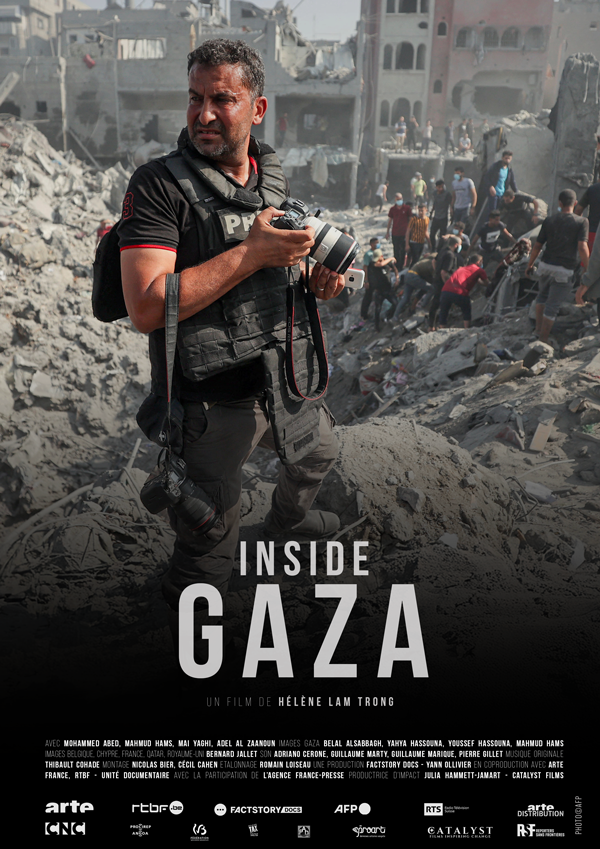
“Inside Gaza”: The Courage and Resilience of Palestinian Journalists Honoured at Montreal’s Cinemania Film Festival
Hélène Lam Trong’s documentary Inside Gaza has won Best Documentary at the 32nd Cinemania Francophone Film Festival in Montreal, Canada, bringing international recognition to the extraordinary courage of Palestinian journalists documenting Israel’s devastating military campaign in Gaza.
The 72-minute film follows four veteran Agence France-Presse (AFP) journalists — reporters Mai Yaghi and Adel Zaanoun, and photojournalists Mahmud Hams and Mohammed Abed — during the months following October 7, 2023. Through previously unseen footage and personal testimonies, it reveals the immense physical and psychological pressures of reporting from a territory devastated by bombardment, displacement and destruction.
Rather than attempting to explain the conflict itself, Inside Gaza examines the human cost of ensuring that independent information continues to reach the outside world. Its protagonists must document suffering while simultaneously confronting the dangers threatening their own lives and families. Their professional commitment becomes inseparable from their struggle for survival.
In spring 2024, AFP evacuated its Gaza-based staff and their families. Since then, Palestinian freelancers remaining inside the territory have continued documenting the war, despite severe dangers and restrictions that have prevented international journalists from entering Gaza independently.
Accepting the Cinemania award, Adel Zaanoun dedicated the honour to Palestinian journalists killed during the war and to those who continue reporting under life-threatening conditions. His tribute underscored the documentary’s central message: journalism in Gaza is not merely a profession but an indispensable act of witnessing, sustained through extraordinary courage and resilience.
Produced through a Franco-Belgian collaboration involving Arte France, RTBF and FACTSTORY, with AFP’s participation and a partnership with Reporters Without Borders, the documentary is also reportedly in contention for the 2027 Academy Awards.
Ultimately, Inside Gaza offers more than a portrait of four journalists. It preserves the experiences of those who have risked everything to ensure that Gaza’s suffering remains visible, reminding audiences that the freedom to report is inseparable from the public’s right to know — and that every journalist silenced represents another irreplaceable loss to historical memory.
NAZA: From the Machinery of Killing in Gaza to a 25-Minute Standing Ovation in Venice
A documentary built around testimony from inside Israel’s own military and intelligence apparatus has become one of the defining events of the 83rd Venice International Film Festival. NAZA, directed by Israeli filmmakers Yuval Abraham and Rachel Szor, received the Special Jury Prize after its premiere was met with an extraordinary standing ovation lasting roughly 25 minutes, reportedly the longest recorded in the festival’s history.
The 80-minute documentary is the product of almost three years of investigation and secret filming. Shot largely at night on Tel Aviv rooftops, with identities concealed, it brings together testimony from 24 Israeli soldiers, military intelligence officers and other insiders involved in the Gaza war. The title itself is revealing: NAZA derives from Nezek Agavi, an Israeli military term referring to anticipated “collateral damage” — in practice, the number of civilians expected to be killed in an attack.
At the heart of the film is an examination not simply of individual attacks, but of the bureaucratic machinery through which killing can become normalized. Its witnesses describe targeting procedures, permissible civilian-casualty calculations and AI-assisted intelligence systems that, according to their testimony, enabled attacks to be processed on an unprecedented scale. One of the film’s most disturbing allegations is that, in one instance, authorization was given for the anticipated deaths of as many as 500 civilians in order to kill a single target.
That is precisely what makes NAZA so unsettling. The horror it depicts is not principally one of soldiers losing control in the chaos of battle. Rather, the documentary asks what happens when lethal violence becomes embedded in databases, algorithms, casualty thresholds, authorization chains and administrative language — when human beings are transformed into numbers attached to a target and enormous civilian losses can be contemplated as variables within an operational calculation.
Israeli political reaction has been fiercer still: Prime Minister Benjamin Netanyahu denounced the film, while Culture Minister Miki Zohar reportedly called for measures to revoke the filmmakers’ citizenship.
Yet the response in Venice could hardly have been more different. The prolonged ovation, Palestinian flags raised inside the theatre, and ultimately the Special Jury Prize transformed the premiere into something larger than a conventional cinematic event. The jury’s recognition gave extraordinary international visibility to testimony that originated within the very institutions whose conduct the documentary scrutinizes.
Accepting the award, Abraham insisted that Israelis themselves needed to confront the film: “It’s our country that is doing these crimes.” He described what the intelligence officers interviewed for NAZA had revealed as systemic rather than accidental and linked it to the dehumanisation of Palestinians.
Perhaps this is ultimately NAZA’s most disturbing proposition. Atrocity need not always present itself as frenzy or lawlessness. It can acquire procedures, acronyms, software interfaces and bureaucratic rationality. It can be calculated, authorized and recorded.
And by awarding NAZA its Special Jury Prize after an unprecedented ovation, Venice ensured that testimony about that machinery would no longer remain confined to anonymous voices speaking in darkness on Tel Aviv rooftops. https://t.co/Ss2RmymTly
Industrializzare l’annessione: “Bustanei Hefetz” e l’aggregazione espansiva del sistema degli insediamenti israeliani
La posa della prima pietra della nuova zona industriale di Bustanei Hefetz, nei pressi dell’insediamento israeliano di Avnei Hefetz, a sud-est di Tulkarm, rappresenta molto più della costruzione di un’altra area commerciale nella Cisgiordania occupata. Progettato su circa 800 dunam e suddiviso in 96 lotti destinati a fabbriche e strutture commerciali, il progetto illustra un processo più profondo che può essere descritto come aggregazione espansiva: la crescita territoriale coordinata attraverso la quale insediamenti, industria, strade, servizi, occupazione e amministrazione vengono progressivamente saldati in un unico sistema territoriale israeliano integrato.
Questa distinzione è cruciale. L’espansione degli insediamenti non procede più soltanto attraverso la costruzione di unità abitative. La crescita residenziale genera domanda di strade, scuole, posti di lavoro e servizi; le zone industriali producono occupazione, entrate fiscali e investimenti privati; le strutture commerciali attraggono ulteriori infrastrutture e il miglioramento dei collegamenti di trasporto lega sempre più strettamente queste aree all’economia israeliana. Ogni componente rafforza gli altri.
Il risultato non è semplicemente un insediamento più grande, ma un ecosistema territoriale sempre più autosufficiente.
Questa è l’essenza dell’aggregazione espansiva.
Un insediamento circondato da fabbriche, uffici, strade di accesso, reti di servizi e infrastrutture commerciali diventa molto più difficile da smantellare rispetto a un semplice gruppo di abitazioni. L’investimento fisico genera permanenza politica. Le imprese acquisiscono interessi nel rimanere sul territorio; i lavoratori dipendono dal mantenimento dell’accesso; le autorità locali ottengono entrate; le infrastrutture acquistano valore e ogni nuovo livello aumenta il futuro costo economico e politico di un ritiro.
L’occupazione sviluppa così una vera e propria economia della permanenza.
Bustanei Hefetz è particolarmente significativa perché lo sviluppo industriale svolge una funzione che la sola costruzione residenziale non può svolgere. Una casa stabilisce una presenza civile; una zona industriale conferisce a quella presenza profondità economica. Le strade la collegano a Israele; le fabbriche la integrano nei mercati israeliani; le autorità di pianificazione la regolano e gli investimenti trasformano un territorio conteso in capitale produttivo.
La terra, dunque, non viene semplicemente occupata. Viene urbanizzata, industrializzata, capitalizzata e funzionalmente assorbita.
È così che i “fatti compiuti sul terreno” diventano progressivamente più difficili da invertire.
Il processo rimodella anche la geografia palestinese. L’espansione industriale e degli insediamenti richiede spesso nuove strade, zone di sicurezza e restrizioni all’accesso. I terreni agricoli palestinesi possono diventare frammentati o più difficili da raggiungere, mentre gli insediamenti israeliani diventano sempre più interconnessi. Con il tempo, il contrasto si accentua: lo spazio palestinese viene frammentato, mentre quello sotto controllo israeliano diventa sempre più continuo.
Il significato giuridico risiede precisamente qui. L’annessione de facto non richiede necessariamente una dichiarazione formale di sovranità. Può emergere attraverso politiche concepite per stabilire un controllo permanente, soprattutto quando insediamenti, infrastrutture e integrazione amministrativa creano realtà destinate a durare indefinitamente.
Bustanei Hefetz deve quindi essere compresa non come un progetto industriale isolato, ma come parte di una più ampia architettura territoriale.
Il modello è cumulativo:
insediamento → infrastrutture → industria → occupazione → crescita della popolazione → ulteriori infrastrutture → consolidamento territoriale.
Ogni fase genera le condizioni per quella successiva.
È per questo che aggregazione espansiva è un concetto analitico così utile. Esso coglie il momento in cui i singoli progetti di insediamento cessano di funzionare come iniziative separate e iniziano a operare come parti di un unico sistema regionale. Abitazioni, industria, commercio, trasporti e amministrazione si rafforzano reciprocamente fino a rendere sempre più difficile sostenere la distinzione tra occupazione temporanea e incorporazione territoriale permanente.
I più rilevanti “fatti compiuti sul terreno” non sono quindi necessariamente quelli più spettacolari.
Possono assumere la forma di un bando industriale, di una nuova strada di accesso, di un lotto destinato a una fabbrica, di un collegamento elettrico o di un parco commerciale.
Ma quando questi elementi si accumulano e si incastrano tra loro, producono qualcosa di molto più grande della semplice somma delle loro parti.
Quando l’occupazione acquisisce fabbriche, uffici, strade, entrate fiscali e dipendenze economiche permanenti, non sta più semplicemente trattenendo un territorio. Sta costruendo l’infrastruttura materiale della permanenza.
Ed è proprio attraverso questa infrastruttura — investimento dopo investimento, strada dopo strada, zona industriale dopo zona industriale — che l’aggregazione espansiva può trasformarsi nella sostanza territoriale di un’annessione de facto, molto prima che l’annessione venga formalmente dichiarata.
Epifonema (Nota informativa)
Il 18 settembre 2024, l’Assemblea Generale delle Nazioni Unite ha adottato a larghissima maggioranza una risoluzione (https://t.co/GPJGWqmOSF) che chiede a Israele di “porre fine senza indugio alla propria presenza illegale” nel Territorio Palestinese Occupato entro 12 mesi. La risoluzione ��� fondata sul parere consultivo della Corte Internazionale di Giustizia (CIG) del luglio 2024 — dichiara illegali, ai sensi del diritto internazionale, l’occupazione israeliana, la proliferazione degli insediamenti e lo sfruttamento delle risorse, e chiede riparazioni. Essa non si rivolge soltanto a Israele, ma obbliga anche tutti gli Stati membri delle Nazioni Unite ad astenersi dal sostenere questo status quo illegale.
Quel termine è ormai scaduto. Israele ha sfidato l’Assemblea Generale, ignorato la Corte e intensificato i propri crimini. La Commissione internazionale indipendente d’inchiesta sul Territorio Palestinese Occupato, compresa Gerusalemme Est, e Israele ha ora concluso che le azioni di Israele costituiscono un genocidio. Di fronte a questa gravissima realtà, la comunità internazionale deve impegnarsi — non nella retorica, ma nell’azione.
Industrializing Annexation: “Bustanei Hefetz” and the Expansive Aggregation of Israel’s Settlement System
The laying of the foundation stone for the new Bustanei Hefetz industrial zone, near the Israeli settlement of Avnei Hefetz southeast of Tulkarm, represents far more than the construction of another commercial area in the occupied West Bank. Planned across roughly 800 dunams and divided into 96 plots for factories and commercial facilities, the project illustrates a deeper process that may be described as expansive aggregation: the coordinated territorial growth through which settlements, industry, roads, services, employment and administration are progressively fused into one integrated Israeli spatial system.
This distinction is crucial. Settlement expansion no longer proceeds only through the construction of housing units. Residential growth creates demand for roads, schools, employment and services; industrial zones generate jobs, tax revenues and private investment; commercial facilities attract further infrastructure; and improved transport links bind these areas ever more tightly to Israel’s economy. Each component reinforces the others.
The result is not simply a larger settlement, but an increasingly self-sustaining territorial ecosystem.
That is the essence of expansive aggregation.
A settlement surrounded by factories, offices, access roads, utilities and commercial infrastructure becomes far more difficult to dismantle than a cluster of homes. Physical investment generates political permanence. Businesses acquire interests in remaining on the land; workers depend on continued access; local authorities gain revenues; infrastructure acquires value; and every new layer raises the future economic and political cost of withdrawal.
Occupation thereby develops an economy of permanence.
Bustanei Hefetz is particularly significant because industrial development performs a function that residential construction alone cannot. A house establishes civilian presence; an industrial zone gives that presence economic depth. Roads connect it to Israel; factories integrate it into Israeli markets; planning authorities regulate it; and investment transforms disputed territory into productive capital.
The land is therefore not merely occupied. It is urbanized, industrialized, capitalized and functionally absorbed.
This is how “facts on the ground” become progressively harder to reverse.
The process also reshapes Palestinian geography. Industrial and settlement expansion often requires additional roads, security zones and access restrictions. Palestinian agricultural land may become fragmented or harder to reach, while Israeli settlements become increasingly interconnected. Over time, the contrast sharpens: Palestinian space is divided, while Israeli-controlled space becomes more continuous.
The legal significance lies precisely here. De facto annexation does not require a formal declaration of sovereignty. It may emerge through policies designed to establish permanent control, especially when settlements, infrastructure and administrative integration create realities intended to endure indefinitely.
Bustanei Hefetz must therefore be understood not as an isolated industrial project, but as part of a wider territorial architecture.
The pattern is cumulative:
settlement → infrastructure → industry → employment → population growth → further infrastructure → territorial consolidation.
Each stage generates the conditions for the next.
This is why expansive aggregation is such a useful analytical concept. It captures the moment when individual settlement projects cease to function as separate initiatives and begin operating as parts of a single regional system. Housing, industry, commerce, transport and governance increasingly reinforce one another until the distinction between temporary occupation and permanent territorial incorporation becomes ever harder to sustain.
The most consequential “facts on the ground” are therefore not always dramatic.
They can take the form of an industrial tender, a new access road, a factory plot, an electrical connection or a commercial park.
But when these elements accumulate and interlock, they produce something much larger than the sum of their parts.
When occupation acquires factories, offices, roads, tax revenues and permanent economic dependencies, it is no longer merely holding territory. It is constructing the material infrastructure of permanence.
And it is through that infrastructure — investment by investment, road by road, industrial zone by industrial zone — that expansive aggregation can become the territorial substance of de facto annexation long before annexation is formally declared.
Epiphonema (Informative Note)
On 18 September 2024, the @UN General Assembly overwhelmingly adopted a resolution (https://t.co/GPJGWqmh37) demanding that @Israel “brings to an end without delay its unlawful presence” in the Occupied Palestinian Territory within 12 months. The resolution—grounded in the International Court of Justice’s (ICJ) advisory opinion of July 2024—declares Israel’s occupation, the proliferation of settlements, and resource exploitation illegal under international law and calls for reparations. It commands not just Israel but also obliges all UN member states to refrain from sustaining this illegal status quo.
That deadline has now passed. Israel has defied the General Assembly, ignored the Court, and intensified its crimes. The Independent International Commission of Inquiry on the Occupied Palestinian Territory, including East Jerusalem, and Israel has now concluded that Israel’s actions constitute a genocide. In the face of this grave reality, the international community must commit — not to rhetoric, but to action.
Jericho as the Next Front of Annexation: Settlers Seize Palestinian Homes as Strock Hails the “Dismantling” of Oslo
Around 30 Israeli settlers moved into eight Palestinian homes in Ein a-Duyuk al-Tahta, on the outskirts of Jericho, in what settlement organisations openly presented as the creation of a new Jewish outpost. The settlers said the properties had been purchased in secret with the involvement of the Nachala movement and the Binyamin Regional Council, while Palestinian officials disputed the legality of the transactions.
The takeover was accompanied by violence. According to the United Nations and Peace Now, settlers reportedly used live ammunition, assaulted Palestinians and threw stones, forcing families to flee. A Palestinian man was reportedly shot in the leg, while some displaced residents were left without adequate shelter. Israeli forces later declared the area a closed military zone, restricting access by Palestinians and humanitarian workers.
The political significance of the seizure is unusually explicit. National Missions Minister Orit Strock visited the settlers and described the move as part of “repairing the damage caused by Oslo,” while Nachala co-founder Daniella Weiss said the houses marked the beginning of the end of the Oslo framework. Strock went further, declaring that “the next step is returning to Gaza.”
That rhetoric matters because Jericho occupies a foundational place in the Oslo process. It was among the first areas transferred to Palestinian Authority control in the 1990s. Establishing a settler enclave only metres from Area A therefore carries a symbolic and strategic message: the territorial arrangements created by Oslo are not merely being eroded in practice, but openly targeted for reversal.
The episode also raises serious questions about state involvement. The IDF initially said the settlers’ entry had not been coordinated with the military. Subsequent Israeli reporting, however, alleged that Central Command chief Avi Bluth had been informed in advance and had met organisers before the takeover. Other reports said Prime Minister Benjamin Netanyahu and Defence Minister Israel Katz had also been notified beforehand.
The sequence is therefore deeply consequential: privately organised purchases are used to establish a settler foothold; armed settlers enter Palestinian space; violence and displacement follow; the army secures the area; and government figures then celebrate the outcome as a political breakthrough.
This is how annexation advances without a formal declaration.
No border needs to be officially redrawn when territorial control is altered house by house, road by road and outpost by outpost.
Jericho is now being used as a test case for that method: weaken Oslo, insert a permanent settler presence beside Palestinian-administered territory, protect it militarily, and convert the resulting reality into a new political fact.
When a cabinet minister openly celebrates such a takeover as progress toward dismantling Oslo and immediately points to Gaza as the next frontier, the message is clear: settlement expansion is treated as an instrument for permanently reshaping Palestinian territory.
The danger is not merely another isolated outpost.
It is the normalization of annexation through incremental seizure.
Epiphonema (Informative Note)
On 18 September 2024, the @UN General Assembly overwhelmingly adopted a resolution (https://t.co/GPJGWqmOSF) demanding that @Israel “brings to an end without delay its unlawful presence” in the Occupied Palestinian Territory within 12 months. The resolution—grounded in the International Court of Justice’s (ICJ) advisory opinion of July 2024—declares Israel’s occupation, the proliferation of settlements, and resource exploitation illegal under international law and calls for reparations. It commands not just Israel but also obliges all UN member states to refrain from sustaining this illegal status quo.
That deadline has now passed. Israel has defied the General Assembly, ignored the Court, and intensified its crimes. The Independent International Commission of Inquiry on the Occupied Palestinian Territory, including East Jerusalem, and Israel has now concluded that Israel’s actions constitute a genocide. In the face of this grave reality, the international community must commit — not to rhetoric, but to action.