What to do in the 3rd and the 4th? A Distinctive Position of ʿAlī b. Abī Ṭālib in Ṣalāt
A distinctive legal position attributed to ʿAlī b. Abī Ṭālib is that he used not to recite any Qur'an (even al-Ḥamd) in the 3rd and 4th unit of prayer.
ʿAbd al-Razzāq al-Ṣanʿānī (d. 211) narrates in his Muṣannaf from Sufyān al-Thawrī from Abū Isḥāq al-Sabīʿī from al-Ḥārith al-Aʿwar that “ʿAlī used not to recite (any Qur’an) in the last two (units) and would call them subḥatayn.“
عبد الرزاق، عَنِ الثَّوْرِيِّ، عَنْ أ��بِي إِسْحَاقَ، عَنِ الْحَارِثِ، عَنْ عَلِيٍّ قَالَ: كَانَ لَا يَقْرَأُ فِي الْآخِرَتَيْنِ، وَيُسَمِّيهِمَا سُبْحَتَيْنِ
In another report, ʿAbd al-Razzāq narrates from Maʿmar b. Rāshid from al-Zuhrī from ʿUbaydallāh b. Abī Rāfiʿ (a mawlā who was ʿAlī's scribe) that he (i.e. ʿAlī) used to “Recite Umm al-Qur’an (i.e. al-Ḥamd) and another sūra in the first two units of Ẓuhr and ʻAṣr and would not recite (any Qur’an) in the last two.”
عبد الرزاق، عَنْ مَعْمَرٍ، عَنِ الزُّهْرِيِّ، عَنْ عُبَيْدِ اللَّهِ بْنِ أَبِي رَافِعٍ، قَالَ: كَانَ يَعْنِي: عَلِيًّا - يَقْرَأُ فِي الْأُولَيَيْنِ مِنَ الظُّهْرِ وَالْعَصْرِ بِأُمِّ الْقُرْآنِ وَسُورَةٍ، وَلَا يَقْرَأُ فِي الْآخِرَتَيْنِ
Ibn Abī Shayba (d. 235) has a chapter in his Muṣannaf entitled: man kāna yaqūlu yusabbiḥu fī al-ukharayayni wa lā yuqraʼu or “Those (authorities) who used to assert that one glorifies in the last two (units) and does not recite”. Ibn Abī Shayba can only cite ʿAlī and (arguably) Ibn Masʿūd as companions who held this position.
All the Sunnī madhhabs (with the exception of the Ḥanafīs) ignore ʿAlī's position in favour of reports attributed to other companions which have them reciting al-Ḥamd in the 3rd and the 4th units.
The Imāmī school, on the other hand, and since it authentically preserves the legal positions of al-Bāqir (d. 114) and al-Ṣādiq (d. 148), and since both these Imams give preference to the positions of their ancestor ʻAlī in all matters, it comes as no surprise that it allows for one to make tasbīḥ in the last two units.
Thus we find al-Bāqir teaching Zurāra that it is sufficient to say subḥānallāh wa-l-ḥamdulillāh wa lā ilāha illā-llāh wa-llāhu akbar in the last two units.
مُحَمَّدُ بْنُ إِسْمَاعِيلَ، عَنِ الْفَضْلِ بْنِ شَاذَانَ، عَنْ حَمَّادِ بْنِ عِيسى، عَنْ حَرِيزٍ، عَنْ زُرَارَةَ، قَالَ: قُلْتُ لِأَبِي جَعْفَرٍ عليه السلام: مَا يُجْزِئُ مِنَ الْقَوْلِ فِي الرَّكْعَتَيْنِ الْأَخِيرَتَيْنِ؟ قَالَ: أَنْ تَقُولَ: سُبْحَانَ اللهِ، وَالْحَمْدُ لِلّهِ، وَلَا إِلهَ إِلاَّ اللهُ، وَاللهُ أَكْبَرُ، وَتُكَبِّرُ، وَتَرْكَعُ
In another report, al-Bāqir tells Zurāra: “Do not recite anything (of the Qur’an) in the last two units of a four-unit obligatory prayer, whether you are the Imam (leading others) or otherwise.“
Al-Bāqir instructs him to recite subḥānallāh wa-l-ḥamdulillāh wa lā ilāha illā-llāh wa-llāhu akbar 3 times instead.
وَرَوَى زُرَارَةُ عَنْ أَبِي جَعْفَرٍ ع أَنَّهُ قَالَ: لَا تَقْرَأَنَ فِي الرَّكْعَتَيْنِ الْأَخِيرَتَيْنِ مِنَ الْأَرْبَعِ الرَّكَعَاتِ الْمَ��ْرُوضَاتِ شَيْئاً إِمَاماً كُنْتَ أَوْ غَيْرَ إِمَامٍ قَالَ: قُلْتُ: فَمَا أَقُولُ فِيهَا؟ قَالَ: إِنْ كُنْتَ إِمَاماً أَوْ وَحْدَكَ فَقُلْ سُبْحَانَ اللَّهِ وَالْحَمْدُ لِلَّهِ وَلَا إِلَهَ إِلَّا اللَّهُ ثَلَاثَ مَرَّاتٍ تُكَمِّلُهُ تِسْعَ تَسْبِيحَاتٍ ثُمَّ تُكَبِّرُ وَتَرْكَعُ
This is what most Shias practise today and it is something that can be traced back to ʿAlī!
@TahaNaqvi114 A forced coercive Ba'yah means nothing and that is something out Mukhalifeen do not understand. It is basic logic that any action done through coercion is not valid. Imam Hassan(as) initially wanted to fight but due to treacheries of the Ummah, he was forced to make peace
@syedzaidi121 No need for Sunnis to become Zaidis because the adherents of Wilayatal Faqih have already infiltrated the philosophy of Zaydi school within the Imami Ithna Asheri school. Mixed the truth with falsehood.
@syedzaidi121 The delusion of WTF supporters is baffling. No moment they spare to compare their scholars with the divinely appointed Imams. This ignoramus doesn't even know S.Sistani doesn't believe in Absolute WTF concept besides having Fiqhi differences.
@muntazireimam84@I_am_the_Haider Because the experts barely give any proofs for what they preach. What's wrong in asking for proofs? It only gives conviction.
@I_am_the_Haider I literally cringe at the level of videos he makes to sensationalise and go viral. But then again, I pity on those who regard and follow him when he is just an ignorant frame seeker.
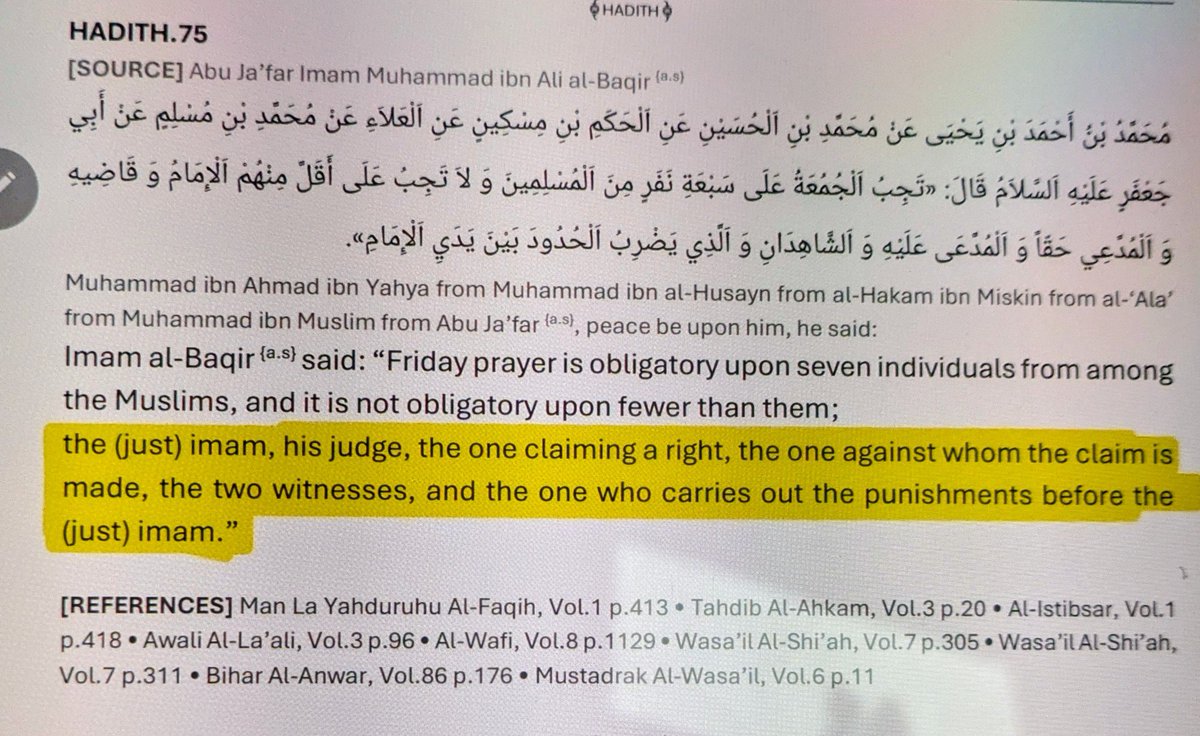
@shia_aliakbar It is obligatory undoubtedly but the critical question is when? At all times or only when its lead by Adil Imam or his appointee? The answer is debatable but a deeper research and the correct reasoning leads to the fact that Its a public affair only for Adil Imam(as) exclusively.
@unfilteredhaqq@LionHeart9001@Athar_Ink The manners of Muawiya's followers are unsurprising. The answer is in your reply itself. If an Iraqi doesnt name his child George Bush, it doesnt mean that such a name is bad, it just means the person associated with it is so. Umar, Yazid(Hur ibn Yazid) etc were common names then
𝗝𝗮𝗯𝗶𝗿 𝗶𝗯𝗻 𝗔𝗯𝗱𝘂𝗹𝗹𝗮𝗵 𝗮𝗹-𝗔𝗻𝘀𝗮𝗿𝗶'𝘀 𝗩𝗶𝘀𝗶𝘁 𝘁𝗼 𝘁𝗵𝗲 𝗚𝗿𝗮𝘃𝗲 𝗼𝗳 𝗜𝗺𝗮𝗺 𝗮𝗹-𝗛𝘂𝘀𝗮𝘆𝗻 (𝗮) 𝗮𝗻𝗱 𝗛𝗶𝘀 𝗘𝗺𝗼𝘁𝗶𝗼𝗻𝗮𝗹 𝗘𝘂𝗹𝗼𝗴𝘆
𝗔𝘁𝗶𝘆𝘆𝗮 𝗮𝗹-𝗔𝘄𝗳𝗶 𝗻𝗮𝗿𝗿𝗮𝘁𝗲𝗱:
I accompanied Jabir ibn Abdullah al-Ansari on a pilgrimage to the grave of al-Husayn ibn Ali (a). When we reached Karbala, Jabir went to the banks of the Euphrates, performed ghusl, then put on a simple garment and wrapped himself in a cloak. He opened a pouch containing Sa'd fragrance and sprinkled it over himself. With every step he took toward the grave, he remembered Allah.
When he came near the grave, he said, "Let me touch it," and placed his hand upon it. He immediately collapsed unconscious over the grave. I sprinkled water on him until he regained consciousness. As soon as he awoke, he cried out three times:
"O Husayn! O Husayn! O Husayn!"
Then he said:
"How can a beloved not answer the call of his beloved?"
He continued:
"But how can you respond when the veins of your neck have been severed and your head has been separated from your body? I bear witness that you are the son of the Seal of the Prophets, the son of the Commander of the Faithful, the son of the ally of piety, the guide of guidance, and the fifth of the People of the Cloak. You are the son of the leader of the righteous, the son of Fatima, the lady of the women of the worlds. How could you be anything but this, when the hand of the Messenger of Allah (pbuh&hp) nourished you, you were raised in the homes of the God-conscious, suckled by the breast of faith, and weaned upon Islam. You were pure in life and remain pure in death.
The hearts of the believers are filled with grief over your loss, yet they never doubt your lofty station. May the peace and pleasure of Allah be upon you. I bear witness that you followed the path of your brother, Yahya ibn Zakariya (a)."
He then looked toward the graves around him and said:
"Peace be upon you, O souls who have found rest in the courtyard of al-Husayn (a). Peace be upon you, O riders who dismounted here. I bear witness that you established prayer, gave charity, enjoined what is right, forbade what is wrong, fought against the deniers, and worshipped Allah until certainty came to you."
Then he declared:
"By the One Who sent Muhammad (pbuh&hp) with the truth, we have shared with you in what befell you."
Atiyya said:
"O Jabir, how can we have shared in it? We did not cross the valleys with them, climb the mountains with them, or draw our swords. The heads of al-Husayn (a) and his companions were severed from their bodies, their bodies were mutilated, their children orphaned, and their women left widowed."
Jabir replied:
"Yes, O Atiyya. By Allah, I heard my beloved, the Messenger of Allah (pbuh&hp), say: 'Whoever loves a people will be resurrected with them, and whoever loves their deeds will share in their deeds.'
By the One Who sent Muhammad (pbuh&hp) with the truth, my intention and the intention of my companions conform to the intention of al-Husayn (a) and his companions."
He then said:
"Take me toward the houses of Kufa."
As we continued on our journey, he said:
"O Atiyya, let me advise you, for I do not think I will meet you again after this journey. Love the lovers of the family of Muhammad (pbuh&hp) as much as you can, and hate those who hate them, even if they constantly fast and stand in prayer. Show kindness to the lovers of Muhammad (pbuh&hp) and his family, for even if they stumble because of their many sins, their love for the family of Muhammad (pbuh&hp) will ultimately set them aright. Their love will lead them to Paradise, while those who hate them will be cast into Hell."
𝗦𝗼𝘂𝗿𝗰𝗲𝘀: Basharat al-Mustafa (s), P 74; Bihar al-Anwar, V 65, P 130.
@unfilteredhaqq@LionHeart9001@Athar_Ink Go read the history books and you will find incredible amount of Shias who were named Muawiya(Muawiya ibn Ammar), Yazeed, Umar(Umar ibn Hanzala), even Shimr during the times of 12 Imams (as). There's Never a problem with a name inherently, it's the characters that are associated.
@unfilteredhaqq@LionHeart9001@Athar_Ink Kunya is often used by others. Other people call a man with Kunya. Imam Ali's(as) kunya Abu Turab wasnt given to him by Abu Talib(as), rather by the Prophet(saww). So if the Imam's son was called by a kunya of Abu Bakr, it was by the people.
हज़रत इमाम हुसैन जी का संघर्ष, त्याग और बलिदान हमें असत्य, अत्याचार और अन्याय के विरुद्ध मानवता की सबसे मज़बूत ढाल बनने की सीख देता है।
आज मुहर्रम के दिन हमें उनके बताए हुए रास्ते पर चलने की प्रेरणा लेनी चाहिए।
What the World is Worth 🧵
ʿAlī b. al-Ḥusayn said: My father said (on the road to Karbala), “A demonstration of the utter worthlessness of this world to Allah is that the head of John was presented to a prostitute from among the prostitutes of the Children of Israel!”