The death penalty is inadmissible because it is an attack on the inviolability and dignity of the person. The common good can be safeguarded and the requirements of justice can be met without recourse to capital punishment: effective systems of detention have been developed that protect citizens while at the same time do not completely deprive those who are guilty of the possibility of redemption. #NoDeathPenalty
Historian of fascism here. This is an escalation of an attempt to normalize extreme violence, ritualize violence, militarize the country, and make violence entertaining so when they ask you to commit violence in their name, you will be ready.
Pope to students and faculty of Rome’s Pontifical Universities: “In every age, there is no shortage of false teachers who exploit the religious sentiments of many believers for their own interests, often pushing them to radicalize certain aspects of the teaching they have received at the expense of the whole — the whole, which is Christ and his Gospel.”
Pope Leo at General Audience: “The believer cannot accept the oppression of the weak and the poor, nor the unjust structures that perpetuate conditions of dependence and injustice.” https://t.co/858PSE3aLK
In an age dominated by technology, in which efficiency and profit often take precedence, it is so important that we continue to cultivate a spirit of contemplation and allow time and space for beauty. Such an attitude will greatly help humanity, especially young people, to discover the ability of art to uplift and reveal the depths of the human spirit and our openness to the divine. Contemplation presents a marvelous opportunity to encounter the God who is Beauty.
Pope Leo to Artists; “We live in the age of search engines that offer us thousands of instantaneous answers. Yet, no matter how powerful they may be, they merely return what already exists and tend to give us what we already want. In the age of technology and consumerism, the great danger is not only censorship but also homogenization, and not merely imposed silence but the noise that makes it impossible to listen. Art is a different kind of ‘search engine,’ It does not proceed by indexing but by inquiry.”
In this era of artificial intelligence, it is becoming urgent to distinguish human art from what machines produce. There is an ontological difference, even before an aesthetic one, between art and what a machine can generate through statistical calculation based on millions of images created by others. Algorithms lack the spark of humanity. For this reason, the Church wishes to renew an alliance with artists and cultural institutions to safeguard our humanity.
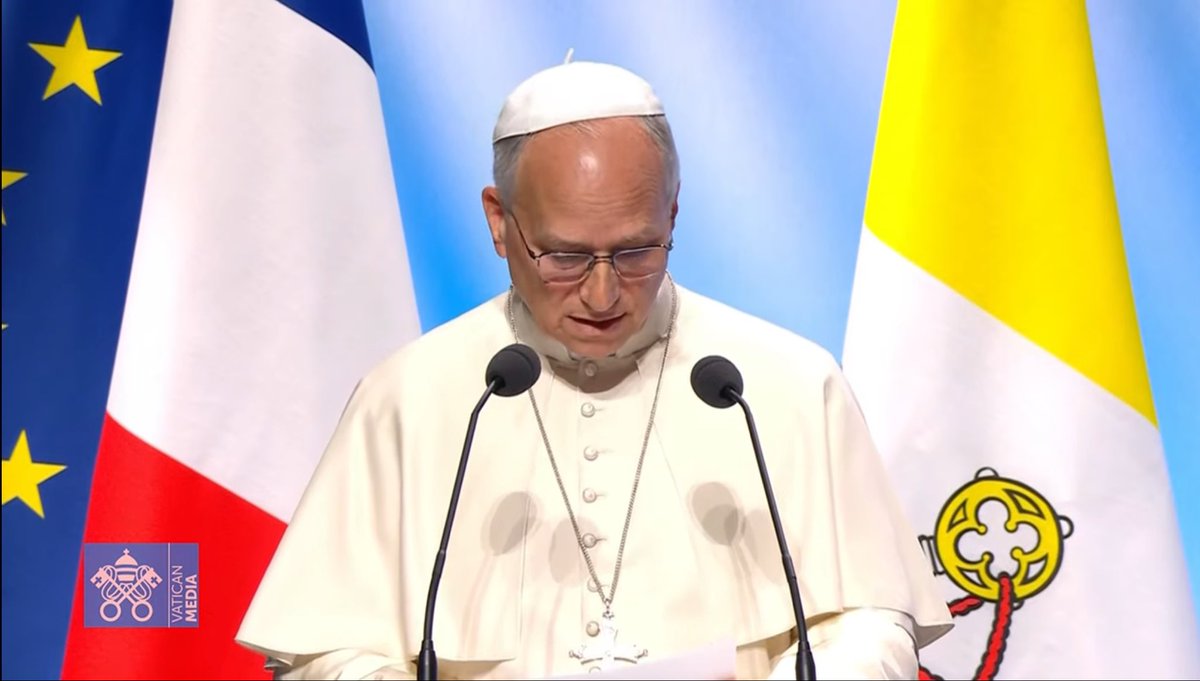
Pope in Metz: “Promoting peace is an active endeavor. Today, we must ask ourselves whether we are truly making creative efforts to promote world peace, or whether we are simply trying to ‘stem the hemorrhage of war’ and better prepare ourselves for those that we presume must still come.”
Invoking the name of God to legitimize violence or oppression constitutes a profanation of His name. Nothing that violates human dignity can claim authentic divine inspiration. Religious discourse must constantly call for hearts and words to be disarmed. #ApostolicJourney#France https://t.co/f5Q6CnXQZS
Serenity and joy can be found even amidst suffering, because God grants us the grace to look beyond our earthly horizon towards a more distant future of immeasurable happiness in God, which we are assured of attaining if we remain steadfast in faith and charity. The sufferings of this present time are not worth comparing with the glory about to be revealed in us (Rm 8:18). #ApostolicJourney #France https://t.co/2IzYe8OTyE
The #GospelOfTheDay is a call to conversion, both tender and urgent. God wants us to live, to open our eyes, and return to Him. To repent is to leave the paths on which we lost our way, and to follow the Way of Life, opening our hearts to the sole joy that never fades.
The Pope at Paris Mass: “We must acknowledge that nothing in this world can ever fully satisfy us. When we think that our work is finished at last and our efforts have been rewarded, that inner emptiness often returns, deeper than before…. none of us is merely a number or an entry in a register, but a unique and irreplaceable person.”https://t.co/KIizraaa1E
Among the challenges facing the worlds of science and education today, I would draw particular attention to those arising from the vast field of technology. Our efforts in this domain must ensure that new technologies remain at the service of the human person, rather than becoming yet another instrument of domination and injustice. @UNESCO #ApostolicJourney #France https://t.co/7zTjyitAIw
“When we look closely, the history of the Church and of humanity is not written by those who give the impression of winning by imposing themselves and ‘dominating the room,’ but by those who ‘make room,’ initiate processes of peace, build trust and encourage life.
“These are not merely sentiments, but decisions and commitments that run counter to prevailing trends, whose public importance and promise for the future we are recognizing with ever greater clarity.” — Pope Leo XIV
Many people are rediscovering the Gospel and embracing the faith against the backdrop of a society marked by a deeply secularized culture. With pastoral tenderness and fraternal charity, we must recognize, welcome, and protect the small flame that the Holy Spirit has kindled in the darkness of the night. #ApostolicJourney #France https://t.co/Uhu1qqqrzO
Pope Leo XIV (@Pontifex): "Communication has become much faster but not necessarily more truthful. Information is abundant, but that is not synonymous with wisdom. Without a shared ethical foundation, the many channels of communication risk multiplying false information and giving currency to words devoid of meaning, thereby hindering dialogue rather than fostering it. Artificial Intelligence amplifies this problem." https://t.co/ejmiZA6lww
Pope Leo XIV on AI:
The Tower of Babel represents a unity imposed through domination. At the same time, this edifice reveals that the more power seeks to oppress, the more it weakens itself, exposing its inhumane face. We see this in the suffering and injustice caused by despotism, as well as in forms of exploitation that damage both society and the environment. Today the temptation of Babel reappears in a globalization pursued without fraternity in rapacious forms of neocolonialism, in ideological impositions, and in all those contexts without bonds that reduce human life to commerce. Science itself, when reduced to a technique of power, no longer serves to elevate the human person but instead risks degrading the fruits of human endeavor.
Since I've been asked this over the last few days and it's being discussed on social media, here's how I understand sympathy, empathy and compassion, all important virtues in the Christian life (and all falling under, as I see it, the larger category of love).
A spiritual director once described these three qualities as follows: sympathy is imagining how *you* would feel in another person's situation (say, living in poverty, facing an illness, losing a loved one); empathy is imagining how *the other person* feels (not how you would feel, but how they in fact feel); and compassion is the willingness to suffer with, or alongside, the other person. Compassion literally means to suffer (or experience) with. "Pascho" (π��σχω) is also where we get the word "Passion."
It reminds me of James Keenan, SJ's helpful definition of mercy: "the willingness to enter into the chaos of another person's life." More basically, we see how God desired to be with us so intimately, and to experience and suffer what we experience and suffer, that God becomes one of us, as Jesus Christ.
Significantly, the Gospels often remind us that when Jesus saw people who were sick, hungry, lost or struggling, he felt it intensely. The usual English translation is "his heart was moved with pity." The Greek is stronger: he felt it in his σπλάγχνον ("splanchnon"), his guts, the seat of emotions for the Hellenistic world.
My sense is that this is what Jesus invites us to experience when we see any kind of suffering: deep sympathy, or a radical empathy, which awakens in us both compassion and the desire to act.
Pope Leo at Mass for Care of Creation: “Let us place in ‘silent mode’ the many noises generated by human activity, so that we may hear the melodious voice of creation, through which God, the Author of all things, speaks to us.” https://t.co/T7KlDhehoR