⚡️This signal is enormous.
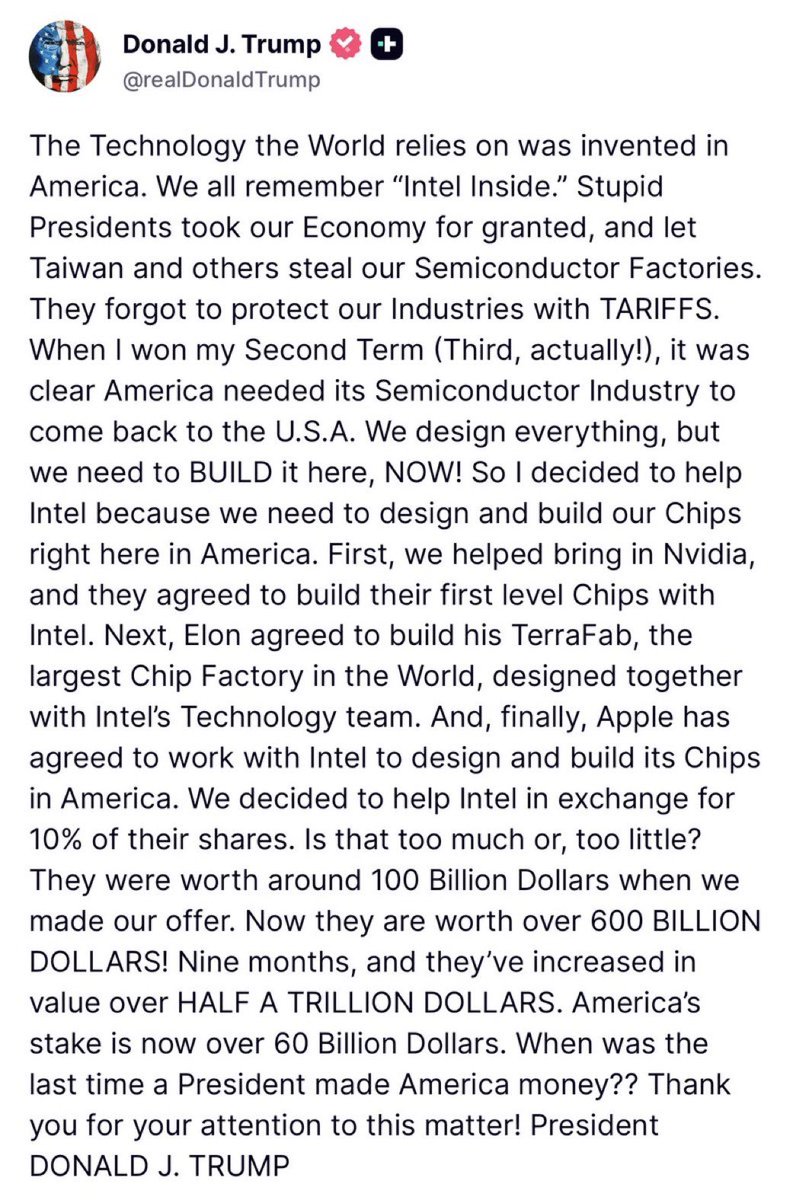
America is openly shifting from subsidy state to strategic shareholder state.
That is the real phase change.
The old model was: government funds industry, companies keep the upside, taxpayers eat the risk, politicians brag about jobs.
This post describes a different machine: government uses national-security pressure, tariffs, industrial coordination, and equity stakes to rebuild a strategic company, then claims the upside as a national balance-sheet win.
That is state capitalism with American branding.
Intel becomes more than a stock. It becomes a sovereign industrial vehicle. The U.S. government owns a piece. Nvidia, Apple, and Elon/SpaceX/Tesla/xAI-adjacent manufacturing get pulled into the same industrial orbit. Taiwan dependence gets framed as a national humiliation. Tariffs become leverage. Equity becomes proof of competence. Semiconductor capacity becomes patriotic infrastructure.
This is exactly the regime shift.
The Trump version of industrial policy is not technocratic. It is conquest language applied to supply chains. “They stole our factories.” “We brought them back.” “We made America money.” That framing matters because it turns semiconductor policy into a political weapon, a market story, and a national myth at the same time.
The separation between markets and state strategy is dying.
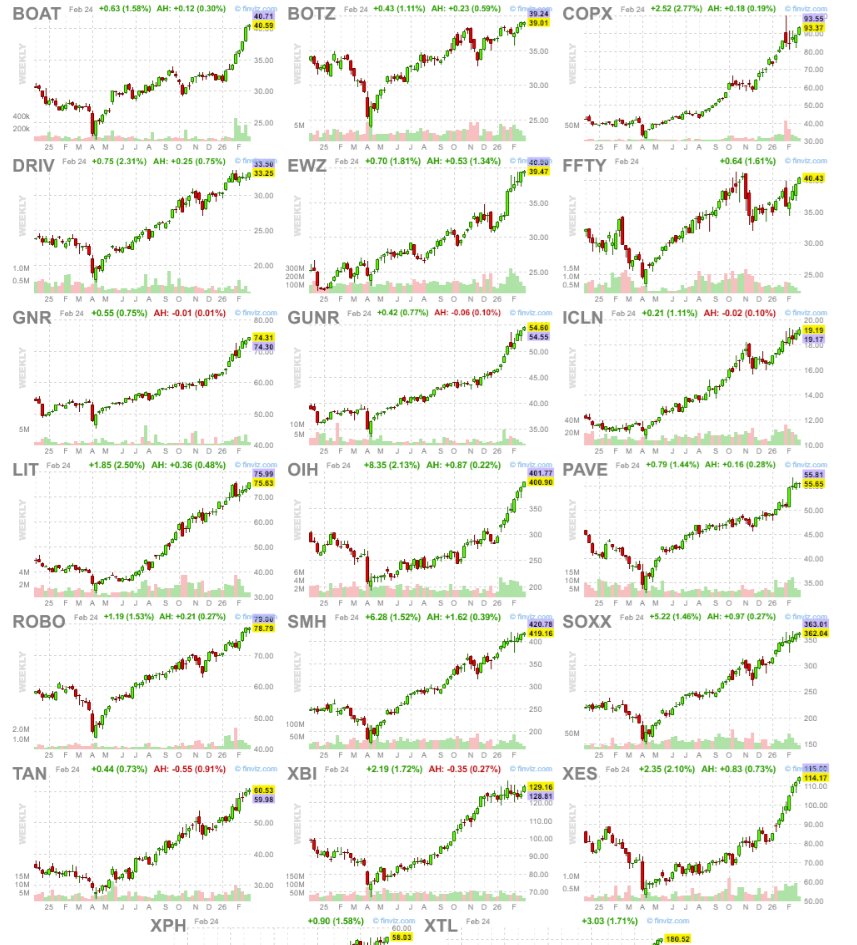
AI, chips, energy, defense, robotics, shipping, rare earths, power grids, data centers, and sovereign debt will increasingly be managed as national balance-sheet assets. The state will not simply regulate or subsidize. It will direct, pressure, co-invest, protect, and sometimes own.
That changes the market.
Companies that sit inside the national-security production function get different treatment. They get capital, contracts, political protection, tariff walls, regulatory help, and forced coordination. Companies outside that function stay exposed to normal market gravity.
That is why this matters beyond Intel.
The U.S. is trying to rebuild the industrial spine underneath AI sovereignty: chips, fabs, packaging, power, compute, manufacturing, and defense supply chains. If China is closing the model intelligence gap and Taiwan remains a strategic fault line, America cannot afford to have design dominance without domestic production capacity.
The post is crude, but the doctrine is sophisticated:
Design in America.
Build in America.
Own part of the upside.
Use tariffs as a wall.
Use equity as a trophy.
Use industrial champions as geopolitical instruments.
Use public markets to validate the strategy.
This is also a political answer to the fiscal problem. If voters hate deficits, tariffs and equity stakes become a way to say the state is not just spending, it is investing. That is a powerful narrative. It lets Trump present industrial policy as profit-making nationalism rather than bureaucracy.
America is moving toward strategic capitalism.
The government is no longer pretending chips are normal private-sector output.
Chips are now sovereign power.
AI made that unavoidable.
China made it urgent.
Taiwan made it existential.
Trump is turning it into a balance-sheet flex.
Since the first US strikes on Iran, I've been asking one question nobody seems to be asking: what is Scott Bessent actually doing here? What is the long game here for the United States, if any?
This morning I published what I believe is the most consequential framework for understanding America's endgame in this war—connecting Bretton Woods, Nixon, Kissinger, the petrodollar, and the GENIUS Act into a single thesis that I don't think anyone else has put together quite this way.
The Strait is closed. Oil is pushing over $110 a barrel. The South Pars complex is on fire. The replacement architecture for the US petrodollar system was signed into law months ago.
Read it. Tell me where I'm wrong.
Perplexity Computer now supports Plaid-powered portfolio integration so you can build a completely custom dashboard for your own investment portfolio.
That means your portfolio can be turned into a personalized interface.
$GS Goldman Sachs released a report stating that over the long term, AI automation will displace 6-7% of workers, equivalent to 11 million jobs.
Gartner, on the other hand has a more optimistic view. They don't believe in “jobs apocalypse” due to AI — but believe instead that there will be job chaos. There 2025 AI Job Impacts Analysis found that starting in 2028-2029, AI will create more jobs than it eliminates. Yet, each year, over 32 million jobs will be significantly transformed. Increased productivity will create new roles and gaps.
Asymmetric middle east investment bet?
While people panic, I wanted to shift the view over the situation and see what the best scenario would offer the world.
If Iran’s current regime were replaced by a secular, globally integrated government, the shock of recent events could transition into a structural boom across the Middle East, particularly in tourism, logistics, and real estate.
Pre-1979 Iran was not just an oil exporter, it was the region’s lifestyle and infrastructure hub, a role now fragmented between the Dubai and Riyadh.
Historical background:
In the 1970s, Iran was the luxury destination of the region. Kish Island was built as a Middle Eastern Monte Carlo, complete with casinos, high-end hotels, and infrastructure designed for global elites.
Tourism revenue tripled between 1971 and 1976. Tehran functioned as a cosmopolitan capital attracting global cultural figures and European luxury brands.
Between 1960 and 1977, Iran’s GDP expanded at ~10% annually under the “White Revolution” modernization drive. Rail, roads, and industrial capacity scaled at an extraordinary pace.
In 1977, Iran’s economy was materially larger than both Turkey and South Korea. Today, South Korea’s economy is multiples of Iran’s, highlighting the magnitude of catch-up potential.
Regional bet convexity:
Normalization would remove the regional risk premium. Airspace between Europe and Asia would reopen fully. Capital that currently concentrates in Dubai purely for safety could redeploy across a broader “Middle East circuit”, Cairo, Petra, Al Ula, Isfahan, Dubai, expanding the total addressable tourism market rather than forcing a single safe-haven trade.
Add to that a 4+ million-strong Iranian diaspora, highly educated, capitalized, and globally embedded, and you have the ingredients for a Dubai-style real estate surge across the Persian plateau.
Keep in mind Iran has been destabilizing the entire middle east and not just its country. About 50% of all conflicts are directly tied to Iranian actions.
Analysts often describe Iran as a primary driver of proxy-based conflict in:
-Lebanon (via Hezbollah)
-Yemen (via Houthi support)
-Iraq and Syria (via aligned militias)
-Hamas in Gaza
...
What if we are looking at a new golden age of prosperity and stability?
To be clear:
This is not a base case prediction. It is a convexity observation.
Markets are pricing the shock.
They are not pricing the optionality of normalization.
If the downside is instability but the upside is regional peace plus catch-up growth, the asymmetry is obvious.