If you are a lover of poetry & of Torah, you are the audience for my substack, Poems on the Parasha. It's good. I work hard on it. I'm grateful when people read & subscribe. Come check it out - https://t.co/Wl7auP7ox0
Here’s the plan. I’ll present a poem on each weekly Torah portion, connecting the poem to the Torah portion in order to shed new light on familiar verses.
The vision is a family gathered around the table puzzling through the poem, suggesting connections to the parasha, parents moved by the poem’s images and by the music of their children’s voices. Or, a rabbi teaching who’s found a perfect quote or image in the weekly poem to make the point about the parasha tangible. Or, a teacher making the English language–more than a secular temporal creole useful in the world economy–a channel for meaning. Or, a lone Jew sitting in the candle light enjoying the companionship of a good poem, or else a couple in love and wide open to the beauty of the world exploring the parasha through the enchanted words of a poem.
[...]
This project, then, aims to help ‘lift up the sparks’ in that opus of humanity just shy of miraculous that is poetry, to place the precious glowing jewel insights of outstanding poems into a setting where they can truly shine, to clarify who we are, where we are, and what we’re about, to celebrate our wondrous and mysterious existence.
Read the whole post and subscribe here:
https://t.co/2tXvO0Csnd
“How could it not be Jewish?”
That was Leonard Cohen’s response when people asked whether his music was Jewish.
Of course it was.
The poetry. The questions. The resilience. The refusal to surrender hope even after seeing the darkness of the world.
Cohen never treated being Jewish as something to hide, apologize for, or water down. It was woven into everything he created because it was woven into who he was.
He believed in peace. He believed in humanity. But he also understood that peace requires confronting reality, not escaping it.
There is something beautiful about that kind of confidence. Not loud. Not performative. Just deeply rooted.
Leonard Cohen didn’t become great despite being Jewish.
He became Leonard Cohen by being unapologetically Jewish.
And that’s something worth being proud of. 🇮🇱🎶
SOME THOUGHTS: THE IRAN PATTERN
The ceasefire began on April 8. The understanding appeared straightforward: the U.S. stops striking Iran, and Iran keeps the Strait of Hormuz open.
That never happened.
Instead, the IRGC turned the strait into leverage. Merchant vessels are harassed, shipping is disrupted, and Iran began charging vessels a $2 million "environmental fee" to pass through.
The U.S. response was a naval blockade.
The blockade appears to be hurting Iran. But it is not the same as some of the other options on the table, including directly targeting the regime's infrastructure and economic lifeline.
Now the focus seems to be shifting.
Iran is openly saying that any broader agreement requires protection for Hezbollah, a U.S. designated terrorist org that keeps firing rockets at populated civilian neighborhoods.
At the same time, U.S. appears willing to pressure Israel in that direction in pursuit of a broader regional arrangement.
Looking back, there is a pattern that is difficult not to notice.
When Hamas was under maximum pressure, a deal emerged. A major achievement that brought hostages home, but Hamas remained.
When the IRGC suffered the most severe military setback in its history, a ceasefire followed.
Now Hezbollah is under intense pressure, and suddenly its future is becoming part of the diplomatic conversation.
Maybe that's coincidence.
Maybe it isn't.
What happens next is not hard to imagine.
60 day ceasefire.
The U.S. blockade on Iran is gradually eased.
Hormuz reopens.
IRGC and regime get breathing room.
Hezbollah gets breathing room.
Nuclear talks restart.
Months pass.
Then we find ourselves in a familiar place.
Iran still has its nuclear program.
Iran still has its missiles.
Iran still has its proxy network.
And the regime is still in power.
Meanwhile, the original reason all of this started risks fading into the background (“Help is on the way”)
Potential outcome?
A 60 day ceasefire becomes 6 months.
6 months becomes another round of negotiations.
Another round of negotiations becomes another year.
And eventually we find ourselves right back where we started, except Iran is stronger, Hezbollah has recovered, and the nuclear program has moved even further ahead.
Maybe that's not what happens.
But Tehran has spent 40 years mastering the art of buying time.
Jay
@Moshe_H_@LadyNimby Me too. So that I can keep my dominant hand free. I wonder if the OP anecdote holds up in reality. The saliant variable is probably not gender but how much time you've spent caring for babies.
What do you look for in poems?
1 Dulce et utile ("instruct and delight")
2 Nature to advantage dressd (true things well said)
3 Spontaneous overflow of powerful feelings
4 Unification human consciousness
Tonight marks 85 years since the Farhud, the Third Reich-inspired pogrom that led to the end of Jewish life in Mesopotamia after 3,000 years.
Shlomo Mansour was 4 when crazed pogromists used a power vacuum in Baghdad—where my family had been the leading rabbis for 250 years—to unleash terror on the local Jews (“the Farhud”). It was then probably the most Jewish city in the world. Jews dominated commerce and civic life and were c. 40% of the population. His family survived and fled Jihadists for Mandate Palestine with nothing.
150,000 Baghdadi Jews—many with no initial love of Zionism—made that same journey, and now the city is free of Jews. Like all places that have no Jews, it’s no longer a good place to live for anybody. The local thugs drove the Jews out and pillaged everything they had, but where did it get them? Now there are no Jews left at all in Baghdad.
He was 85 when Islamist thugs came for him again, but this time, he wasn’t so lucky. He was dragged out of his home, away from his wife of 60 years, Mazal, and taken hostage into the tunnels by Hamas and UNRWA barbarian savages, and he was never seen alive again.
This time, the Jews have the IDF, so they can fight back. That is the only difference, really.
I've said from the very beginning, from a few days before the war began, that bombs won't bring down this regime. I explained why in a two-hour deep dive into its political theology.
And I've been saying almost since October 7 that we're in a multi-year war across multiple fronts -- in the way the wars of '56, '67, '69-'71 and '73 were all actually one war, a defining confrontation between Nasserism and Israel across multiple fronts.
America should be involved in what's going to come, if only because its interests will be massively affected by it.
Iran will close Hormuz again, every chance it gets. It was always going to do so. And it won't stop pushing for war because it really and truly wants our extermination and has spent its best people and scarce funding on building the violent mass-martyrdom proxies that threaten our borders.
This regime believes God has ordained them to lead a world revolution, Ali Shariati's "Red Shia" Marxist-coded Shiism. And it starts, for various ideological reasons, with Israel.
In other words, there's no way to avoid more war going forward, unless Iran somehow magically awakens from the 47-year nightmare of Khomeinist "revolution."
And global gas prices will inevitably be affected.
America should be involved to whatever degree gives it the ability to influence these outcomes and help mitigate the costs to America.
But America should calibrate that involvement to the understanding that this standoff isn't going anywhere, that it will periodically explode into war -- and that it will be a feature of the Middle East until one side collapses. Which could take a generation.
Oh, and our side won't lose. Because we're not incompetent self-destroyers like the mullahs.
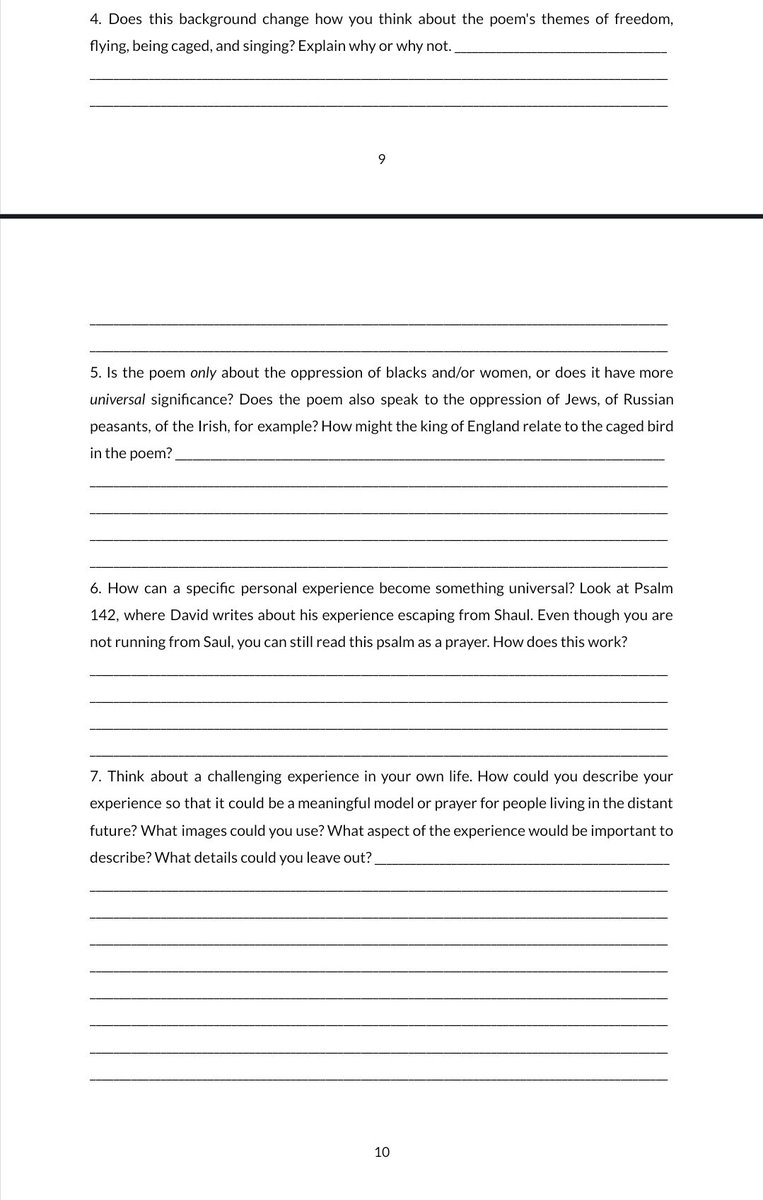
My Israeli 10th grade English students and I are finishing a unit on Maya Angelou's excellent poem 'Caged Bird'. We've talked about vocabulary, rhyme, rhythm, symbols, and whether freedom and liberty are the same thing or different things, and we're closing with questions about how the poem relates to its context in the experiences of American blacks and women and in Angelou's life.
Here are the last questions. I hope they help my students begin to think about the communicative power of poetry.




![MeirSimchah's tweet photo. Here’s the plan. I’ll present a poem on each weekly Torah portion, connecting the poem to the Torah portion in order to shed new light on familiar verses.
The vision is a family gathered around the table puzzling through the poem, suggesting connections to the parasha, parents moved by the poem’s images and by the music of their children’s voices. Or, a rabbi teaching who’s found a perfect quote or image in the weekly poem to make the point about the parasha tangible. Or, a teacher making the English language–more than a secular temporal creole useful in the world economy–a channel for meaning. Or, a lone Jew sitting in the candle light enjoying the companionship of a good poem, or else a couple in love and wide open to the beauty of the world exploring the parasha through the enchanted words of a poem.
[...]
This project, then, aims to help ‘lift up the sparks’ in that opus of humanity just shy of miraculous that is poetry, to place the precious glowing jewel insights of outstanding poems into a setting where they can truly shine, to clarify who we are, where we are, and what we’re about, to celebrate our wondrous and mysterious existence.
Read the whole post and subscribe here:
https://t.co/2tXvO0Csnd](https://pbs.twimg.com/media/G3YzTvEXEAAv4pZ.jpg)