🇫🇷🇷🇺Interview édifiante dans laquelle JLM confirme qu'il est pro-russe.
Oser dire « les Russes sont naturellement nos alliés » alors qu'à la télé russe ils montrent des cartes des villes françaises à nucléariser, c'est extrêmement grave.
Avec toujours la même rhétorique sur la Russie « si vous tirez sur la moustache du tigre, faut pas vous étonner qu'il réagisse » ce qui sous-entend clairement que la Russie a été provoquée dans cette guerre, et que donc la faute revient à l'Europe et à l'Ukraine. Au Kremlin ils doivent sabrer le champagne en entendant ces déclarations.
C'est absolument hallucinant que deux partis français candidats à l'élection présidentielle (RN & LFI) comptabilisant près de 50% des intentions de vote soient à ce point favorables à la Russie de Poutine. Malgré les meurtres de masse, les viols, les pillages, les tortures, ils soutiennent toujours la Russie.
Mélenchon ose rire lorsque l'on parle de « menace russe », alors même que le Kremlin a tenté un attentat sur un aéroport international allemand il n'y a pas deux mois. La menace russe existe bel et bien, tous les pays frontaliers ou de l'ancien bloc de l'URSS le savent. Mais on sait ce que pense JLM des Baltes...
Cet extrait est tellement consternant, même à la fin il dit vouloir « s'associer aux Chinois » pour parler de désarmement nucléaire, alors même que la Chine est en pleine expansion de nombre d'ogives nucléaires. Alors soit il ne comprend rien à rien à la géopolitique, soit il est clairement favorable à toutes ces dictatures qui nous menacent.
Son positionnement fait honte à la France.
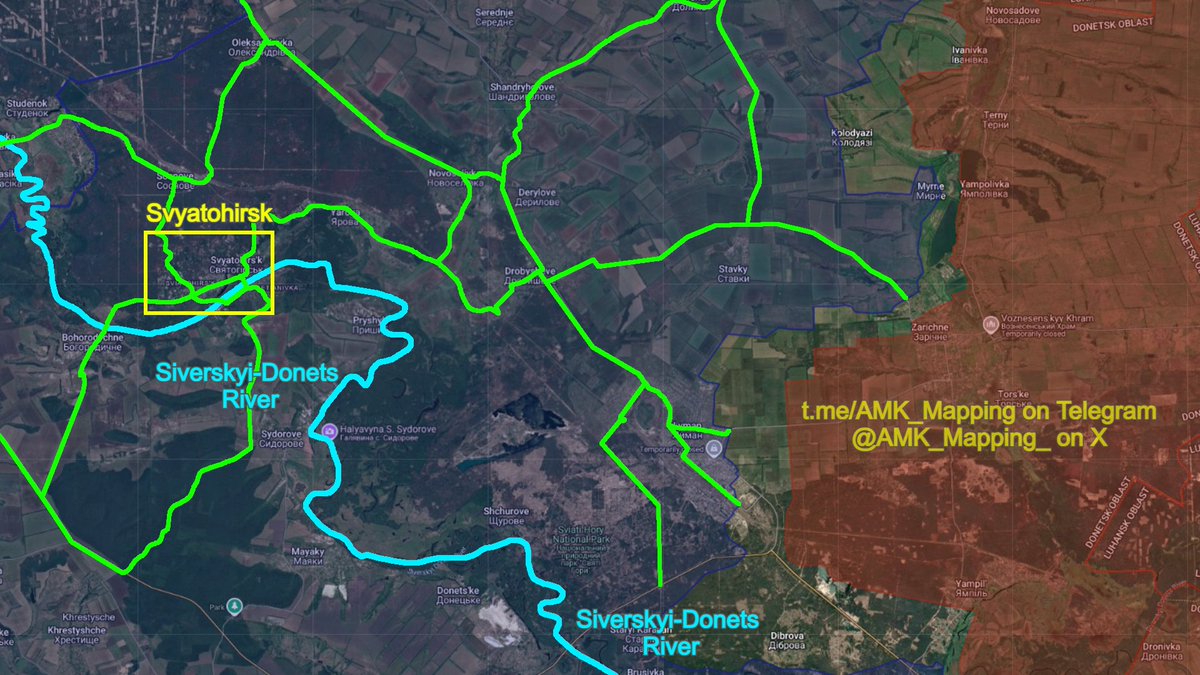
Due to the recent Ukrainian counteroffensive north of Lyman, the city of Svyatohirsk has gone from being a partially-contested city to being over 20 km from the nearest Russian-controlled territory.
This puts the city out of range of most barrel artillery, and puts it more than 2-times further from Russian-controlled territory than Slovyansk and Kramatorsk.
This is a very positive development for Ukrainian forces in Lyman, as previously, supply into Lyman could only be conducted either across pontoon bridges over the Siverskyi Donets River (all the ordinary bridges there are destroyed), or with UAVs. Now, the city can be supplied through Svyatohirsk as a rear logistical hub, as well as via roads leading from Kharkiv Oblast.
So, not only has this counteroffensive significantly alleviated pressure on Slovyansk to the south and Borova to the north, but it has also made the defence of Lyman much easier. As with all counteroffensives, it has a major PR element to it, but this one has real operational-level importance - more-so than the counterattacks in other parts of the frontline.
Si vous ne croyez pas que la Russie 🇷🇺 serait une menace pour la France 🇫🇷, voici une carte postée par Rybar, une chaine Telegram affiliée au FSB russe
La carte montre les cibles potentielles de frappes du drone Geran-5 si un site de lancement était mis en place en Algérie 🇩🇿, Etat allié de la Russie. Parmi les cibles, des centrales nucléaires, des raffineries, des bases aériennes et des ports...
Ukraine is so much more competent in using patriot systems. They receive extremely limited stockpiles and know how to conserve them, still managing to shoot down a portion of Russia's most advanced tactical ballistic missiles.
Meanwhile America just goes fucking crazy launching dozens within minutes, to the point where these $4-5 million dollar interceptors look like air defence flak, while still letting a portion of the Iranian missiles impact.
I feel like society collectively forgets how crazy it is that the most powerful military in the world is led by a former Fox News weekend host with no significant management experience who never held a high-ranking military command
Far too little discussion that the main assistance given to Russia this year came from the United States.
Russia was on the ropes, with oil prices heading into 40's, Ukraine getting enough interceptors. Then Trump suicided US and other nations' weapons supplies, sent oil prices soaring and took sanctions off Russia just long enough for them to sell off the record amount of stranded floating crude oil at top prices.
Now Kyiv is bring freely devastated, 24/7 massacres and the US whining about Ukraine hitting ships on the Black Sea.
Trump is purely Putin's dog.
Pour mettre deux pièces dans le débat sur la "jeune" et la "vieille école".
Pour avoir longuement étudié la question, et même fait une thèse d'histoire sur le cas précis de l'armée française avant et après 1914, puis après 1918 ; pour avoir observé aussi la chose de près à l'intérieur de l'institution, je pense qu'il y a un phénomène nouveau, par rapport à toutes ces époques : l'énorme poids des programmes militaro-industriels.
Malgré toute la bonne volonté du monde à se transformer - et pour l'armée de Terre au moins elle est indéniable - on est forcément obligé de faire avec des programmes-cathédrales que l'on met au moins dix ans à concevoir, quinze ans à produire en absorbant la majorité des ressources et vingt ans à conserver après le dernier produit.
Le conservatisme se crispe lorsque le nouveau oblige à effectuer trop de changements internes et suscite trop de perdants potentiels. Si le nouveau permet simplement à la grande majorité de faire sensiblement la même chose mais en mieux, l'évolution est rapide.
Ce que je ressens, encore une fois dans l'armée de Terre, est qu'il n'y a pas forcément beaucoup de perdants potentiels dans la révolution en cours (avec des nuances selon les armes) et celle-ci est accueillie avec enthousiasme dans les régiments, et notamment dans les régiments d'infanterie (2e RIMa et 2e REI) que j'ai pu voir récemment.
La vraie tension que j'observe n'est pas entre une jeune ou vieille école, mais entre les "innovants" et les "capacitaires". Pour faire simple : on voit à peu près dans quel sens il faut aller mais on est plombé par le programme de communications CONTACT (un milliard d'euros), déjà obsolète alors qu'il est en cours de mise en place et ce pendant des années, ou même les véhicules Griffon, Serval à un million pièce ou Jaguar à 4-6 millions, de bons engins en soi mais qui seraient mal adaptés au contexte ukrainien. Or, la simple acquisition de ces engins absorbe la majorité des ressources disponibles jusqu'en 2035.
Ce que j'entends donc c'est : réduisons les programmes lourds conçus depuis l'arrière, supprimons même les couteusement inutiles, et récupérons des ressources pour permettre aux régiments d'investir dans du léger moderne en liaison avec un écosystème industriel plus agile.
La vraie tension n'est pas entre les jeunes et les vieux, entre les capitaines et les généraux (tous les généraux que je connais sont "révolutionnaires") mais entre ceux qui sont destinés à aller dans une zone de mort peuplée de drones et robots terrestres, et le complexe militaro-industriel qui se destine surtout à faire toujours la même chose pourvu que ce soit plus cher.
Twenty months. Let's do the scoreboard 🤩
Assad fled to Moscow on 8 December 2024 and has not been heard from since, which is the most useful thing he has done for Syria in fifty years!
Since then:
The sanctions came off. All of them. The EU in May 2025, the US embargo in June, the Caesar Act repealed in December, and on Monday Syria came off the state sponsors of terrorism list after forty-seven years. Forty-seven. Syria was on that list longer than most of the people arguing about it have been alive.
There was an election. October 2025, a 210-member parliament, the first since Assad. A provisional constitution. A roadmap. Boring, procedural, unglamorous, and exactly what nobody thought these people could do.
The economy turned. Inflation from 72 percent down to 11. The pound appreciating since the day Assad left, which is its own commentary. The stock exchange reopened.
$28 billion in investment pledged.
In February the state took back its oil and gas fields and shipped heavy crude for the first time in 14 years.
Three million people went home.
1.5 million refugees, 1.7 million internally displaced.
Turns out people return when the man bombing them leaves.
The coast went from the most dangerous place in Syria in early 2025 to the safest by the end of it.
Kurdish became a national language. Citizenship restored to people the 1962 census erased. Newroz a national holiday. Kurdish in classrooms this academic year.
And on Tuesday the SDF dissolved itself. One army. Saudi Arabia sent congratulations today.
Now here is the part I enjoy.
Since December 2024, Syria has taken more than a thousand Israeli air and artillery strikes and at least 825 ground incursions.
Its response, every single time, has been diplomacy.
A thousand strikes and the man will not take the bait. Netanyahu has been trying to start a war with Damascus for twenty months and Damascus keeps sending negotiators to Amman instead.
Katz stood on Mount Hermon this week and told al-Sharaa to look up at the mountain every morning, and al-Sharaa's answer was to hold a ceremony, dissolve a militia, and get himself delisted by Washington on the same day.
That is what actually irritates them. Not that Syria is dangerous. That Syria refuses to be.
Twenty months. Nobody predicted this. Least of all the people who keep bombing it.
With #Israel's elections just 2 months away, it's no coincidence that [entirely unprovoked] Israeli military aggression has escalated sharply in #Syria.
For nearly 2yrs, #Syria has calmly faced this onslaught -- filing complaints through the @UN & seeking US-mediated diplomacy.
The twelve points:
1. Iran, the US and their allies will cease hostilities, including in Lebanon
2. Iran reiterates its commitment not to develop or acquire nuclear weapons
3. US and Iran pledge to resolve issue of disposal of enriched uranium stockpile
4. US and Iran to discuss enrichment issue and Iran's nuclear needs
5. Iran will maintain status quo on its nuclear program as long as negotiations continue
6. The US will lift the naval blockade, not impose new sanctions, and will not increase forces in the region during the negotiations.
7. Iran will make the necessary arrangements to ensure safe passage of commercial vessels through the Strait of Hormuz, free of charge, for 60 days.
8. US pledges to make frozen Iranian assets available for use with implementation of MoU
9. If a final agreement is reached, the US will withdraw its forces within 30 days and lift all sanctions on Iran.
10. Any final agreement will include a plan to establish a $300 billion fund for Iran's reconstruction.
11. US to give Iran temporary sanctions waivers to sell oil during negotiations
12. Negotiations will be held between Iran and Oman with the participation of Gulf policy to define "arrangements regarding shipping and maritime services"
Hungary has chosen Europe.
Europe has always chosen Hungary.
A country reclaims its European path.
The Union grows stronger.
Magyarország Európát választotta.
Európa mindig Magyarországot választotta.
Egy ország visszatér az európai útjára.
Az Unió erősebbé válik.
On peut toujours se rassurer autant que l’on veut avec nos « mais ils savent pas se battre » et « ils partent de loin », il reste que quand le budget de 150 milliards parle, le budget de 75 milliards écoute (ou va devoir apprendre à écouter)… Ne serait-ce que du fait de l’effet d’orientation du marché de la défense que crée un tel budget.
Les précédents de l’Irak, de l’Afghanistan et de la Libye doivent nous inciter à la prudence dans l’analyse d’un changement de régime imposé par l’étranger.
A year and a half ago, in April 2024, I warned (the section is highlighted in the auto-translated text) that aid to Ukraine would continue to dwindle, and that without proper changes we would find ourselves in a poor position. What we’re seeing now was set in motion a while ago.
La Russie vient de publier un bilan de l'évolution de la guerre moderne, et il absolument dramatique POUR NOUS. Les enseignements sont les mêmes côté ukrainien, voici les principales conclusions dont il faut s'inspirer d'urgence. #Thread 1/25 👇
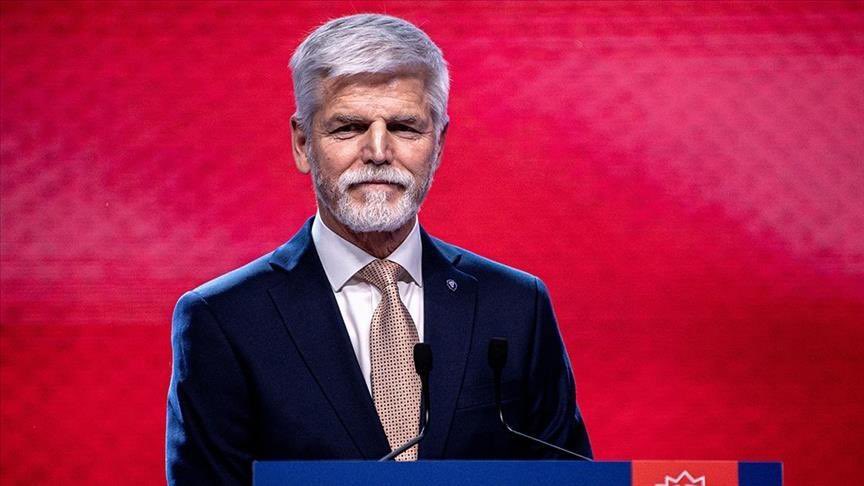
❗️The Czech President called for shooting down Russian aircraft that violate NATO airspace.
"I must call this [Russian MiG-31K fighter jets intrude into Estonian airspace] extremely irresponsible behavior, because violating airspace is a pretext for activating defense mechanisms and, consequently, shooting down such an aircraft. And no one, neither we nor Russia, would want that."
According to the Czech leader, only a military response will make Russia realize its mistake.
"They are testing our resilience, our resolve to defend ourselves. I think we must be absolutely firm in our understanding that if there is a violation of the rules, we must respond appropriately, including militarily. Russia will very quickly realize that it made a mistake, that it overstepped its bounds," Pavel said.
I'd like to share with you an opinion by a Ukrainian expert Oleksii Kopytko regarding Ukrainian and Russian air defense and strikes on Russian oil refineries.
Russians continue killing civilians day and night in Ukraine.
Several days ago, a representative of Ukraine’s Defense Intelligence said that Russia is preparing to reach production volumes of 2,700 Shahed drones with warheads per month - about 90 per day.
A month earlier, Defense Intelligence deputy chief Major General Vadym Skibitskyi stated that Russia is ramping up production and plans to manufacture about 79,000 long-range drones in 2025: 40,000 Shahed drones (around 110 per day on average, with output growing toward the end of the year), 34,000 Gerbera drones (about 93 per day, also with growth), and 5,700 Harpies.
In total, according to Ukrainian intelligence, Russia’s average daily production of long-range drones this year (including decoys, with output increasing by year’s end) at around 210-215 per day.
Thus, it should reach ~250 drones per day by December.
There are also predictions that there will be large-scale Russian drone attacks of 600 to 800 drones every night. Where do these figures come from?
Russians have been stockpiling drones for several months. The difference between what they’ve produced and what they’ve launched so far is about 2,800 units. This allows them to alternate periods of lower-intensity strikes with massive attacks.
That means Russia already has reserves for at least 5-6 massive attacks. But it doesn't look like there will be "1,000 Shahed drones every day."
Is it possible to build an air/missile defense system that can reliably intercept 500+ mixed targets (missiles and drones of different types) per day? Realistically, it isn't.
The best proof is Russia itself.
Just last week, I [Oleksii Kopytko] posted about an oil refinery in [Russia's] Krasnodar region. Within a 20×40 km area there are three large refineries (Ilsky, Afipsky, and Krasnodar - in practice four sites). Several days ago, Ilsky refinery was reported as successfully hit. Previously, it had been attacked several times without significant results.
So, in one month, in one small area of Krasnodar region, (!!!) all the refineries were successfully hit (Afipsky twice).
Did the Russians simply leave such critical facilities to fate? Don't they know the likely routes of attack? They are not idiots. They do know.
But even with their massive layered defense system:
1. ground-based SAMs;
2. long-range detection, EW, and SIGINT systems;
3. interceptor drones;
4. !!! combat aircraft and helicopters operating without interference;
5. mobile ground teams;
6. mechanical defenses (nets, etc.) -
the Russian Federation, a supposed "military superpower," cannot fully protect a cluster of refineries in a tiny square from strikes launched from over 500 km away!
And that’s just one example among many successful deep strikes in Russia in recent months.
What does this tell us?
That Ukrainian and Russian air/missile defense systems are developing at roughly comparable speeds, while in terms of long-range strike capabilities, Ukraine is moving faster - thanks to the "low base effect."
We still entirely depend on partners for ballistic missile interception, which is why we are pushing so hard for reinforcements in that area. Ukraine urgently needs systems like IRIS-T, NASAMS, detection equipment, and fighter aircraft with air-to-air missiles - to reliably counter cruise missiles and attack drones.
Russia targets not only residential buildings, hospitals, and schools, but also Ukraine’s military-industrial facilities every single day. No amount of relocation or underground storage can compensate. We need protected industrial zones, which means deeply layered air/missile defenses beyond Kyiv.
By February 2022, Russia already had most of the missiles it is using today. Some modifications were made to Kinzhal and Zircon missiles, but otherwise, nothing new. They also purchased Shahed drones from Iran and brought in North Korean ballistic missiles.
Meanwhile, Ukraine has managed to thin out Russia’s strategic aviation, Black Sea missile carriers, AEW aircraft, and detection stations.
At the start of 2022, Ukraine had essentially no long-range strike capability.
We’ve come a long way since then.
However, when the bodies of dead Ukrainian children are pulled from under the rubble, no words can ease the pain.
And massive strikes will not stop.
They can be halted for a time by an "air truce." But during that period, Russia will continue stockpiling drones.
The effectiveness of Russian attacks can only be reduced by striking the Russian production chain, storage sites, launch points, and personnel. And that is being done, to the extent possible.
Completely stopping the strikes is only possible with a sustainable ceasefire. That depends on:
▪️ resilience of Ukraine’s army on the ground;
▪️ resilience of the home front in supporting the Army;
▪️ tougher international sanctions;
▪️ deeper strikes into Russia to escalate internal problems and reduce its war resources.
Some of this is under our control; some depends on external support. But at minimum, we must ensure our part - including keeping the home front strong.
5. Can Ukraine do more in air/missile defense?
Theoretically, yes - when everyone acts constructively and in the state’s interest. Practically, it’s not that simple.
Imagine Russia striking Poland. Even under NATO’s umbrella, Poland would suffer devastating blows before NATO could react.
Although NATO fully understands all the risks and knows exactly what to do. The nuance is that implementing the right decision is not always possible with a single click.
We need to look at the situation realistically. On the eve of winter, just as we are depleting Russia's oil refining resources, Russia is now stepping up its efforts to deplete our energy system. Combining this with cannibalistic attacks on civilians.
A bridge in Kremenchuk was attacked, which is more important than the fire in the Cabinet of Ministers.
There are no magic solutions here.
There are solutions that can influence the situation. For example, I have written many times about Western weapons with a range of 300-500 km, which could deal a severe blow to the Russian army in a short period of time. Now there is some movement in this area, with promises to sell something. But if there are any real developments, they will not happen until the end of the year.
When I read accusations that Ukraine has not been mass-producing its ballistic missile interception system for three years, I want to remind people that dozens of highly developed and wealthy countries with enormous resources are not even thinking in this direction, but have been waiting in line for years to buy ready-made systems from literally a couple of countries. In other words, commentators are detached from reality.
🖋: a Ukrainian expert Oleksii Kopytko