Free Webinar for Students & Trainees | Inside the Toxicology Lab: Workflow, Results, and their Meaning for Pathologists by Marta Concheiro-Guisan, PharmD, PhD
🗓️ Thursday, December 17, 2026 | 4:00 PM ET
🔗 Register ➡️ https://t.co/eC4hfvqZaL
New this week! 👉📰 This study evaluates repeat FNA as primary AUS triage and the contribution of cytomorphologic subclassification in a population-based cohort without molecular testing.
https://t.co/XfW83wW2zf
#CytoPath@RAlaghehbandan@neha_khaitan1
A must watch for faculty and trainees navigating the digital transformation--this panel discussion addresses the impact of digital pathology on trainee education.
Thanks to @Pathologists for providing the platform for this timely discussion. Thanks to Savitri Krishnamurthi for her leadership of the DCPC and to my wonderful panelists.
@MeredithKHerman@01sth02@kawama92@DrBuiPathology
Grateful for the opportunity to present alongside the CAP Digital and Computational Pathology Committee and share my perspective as a pathology trainee!
🔗 Watch here: https://t.co/zIMrdgebMw
#DigitalPathology#PathologyEducation
Excited to share our Digital Pathology Association concept paper on Virtual Staining, now published in @ArchivesPath!
Grateful to be part of the @dpatweet team and this outstanding collaboration.
Read the full concept paper: 👇
https://t.co/ygm3RWy0GI
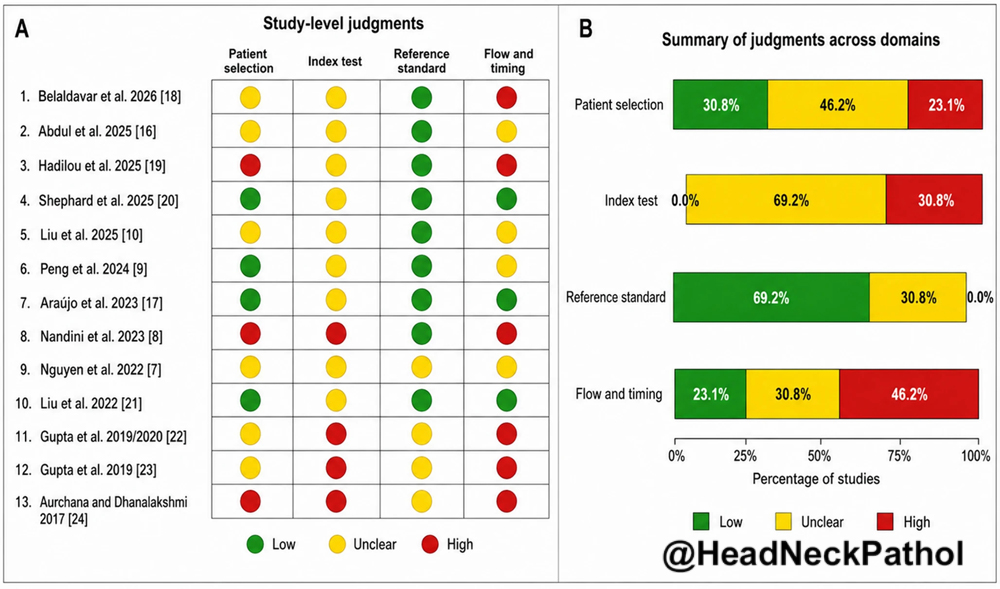
Artificial Intelligence-Assisted Histopathologic Diagnosis & Grading of Oral Epithelial Dysplasia: A Systematic Review & Functional Meta-synthesis
C M. Ardila, E Pineda-Vélez et al
https://t.co/xeflYxejhN
#HeadNeckPathol#HNPJ#HeadandNeckPath#Pathology#ENTPath#PathologyTweet
In response @NEJM_AI while AI is a useful tool, it cannot fully perform all the functions of a pathologist or the lab. Claiming its full replacement by AI is not fully supported by this limited data. Overly broad claims are harmful to our field and specialty. #PathX#MedTwitter
The authors analyze the degree to which clinical specialties are shielded from, or threatened by, AI depending on how much of their work requires in-person physical interaction. Learn more: https://t.co/Htplu16utD
@DrGeeONE@smlungpathguy@NEJM_AI I agree completely. People will quickly construe this to think our work is all AI. I’d love to see AI gross complex specimens, run tumor boards, perform frozens, FNAs, complex consultations, cut tissue on the microtome, and everything in between.
This new @NEJM_AI Perspective by Zeltzer et al. states that “software cannot physically examine, biopsy, or operate on a patient, so the share of a specialty’s work that requires in-person physical interaction sets a ceiling on how much of it AI alone could replace.”
On that measure, pathology is the most exposed specialty: 99% of its Medicare payments go to work with no physical barrier to AI. In their words, “pathology and diagnostic radiology consist almost entirely of nonphysical tasks, such as reading images and slides.”
As a pathologist, I think this oversimplifies our work. The study counts only physician-patient contact as physical work. Specimens do not reach the pathologist already digitized. Gross examination, lesion identification, margin assessment, and tissue sampling are hands-on “hand and knife” tasks that turn a specimen into the slides (glass or digital) that any reader, human or AI, interprets.
Not to mention FNAs, bone marrow aspirations, and intraoperative frozen sections. Software alone cannot do them. By the authors’ own reasoning, specimen contact should count as physical work. Leaving it out means the 99% figure overstates how much of pathology software alone could replace.
AI will transform how we read slides, but somebody still has to decide what goes on the slide.
#AI #Pathology @smlungpathguy@JMGardnerMD@TotalCytopath@Vik_deshpandeMD