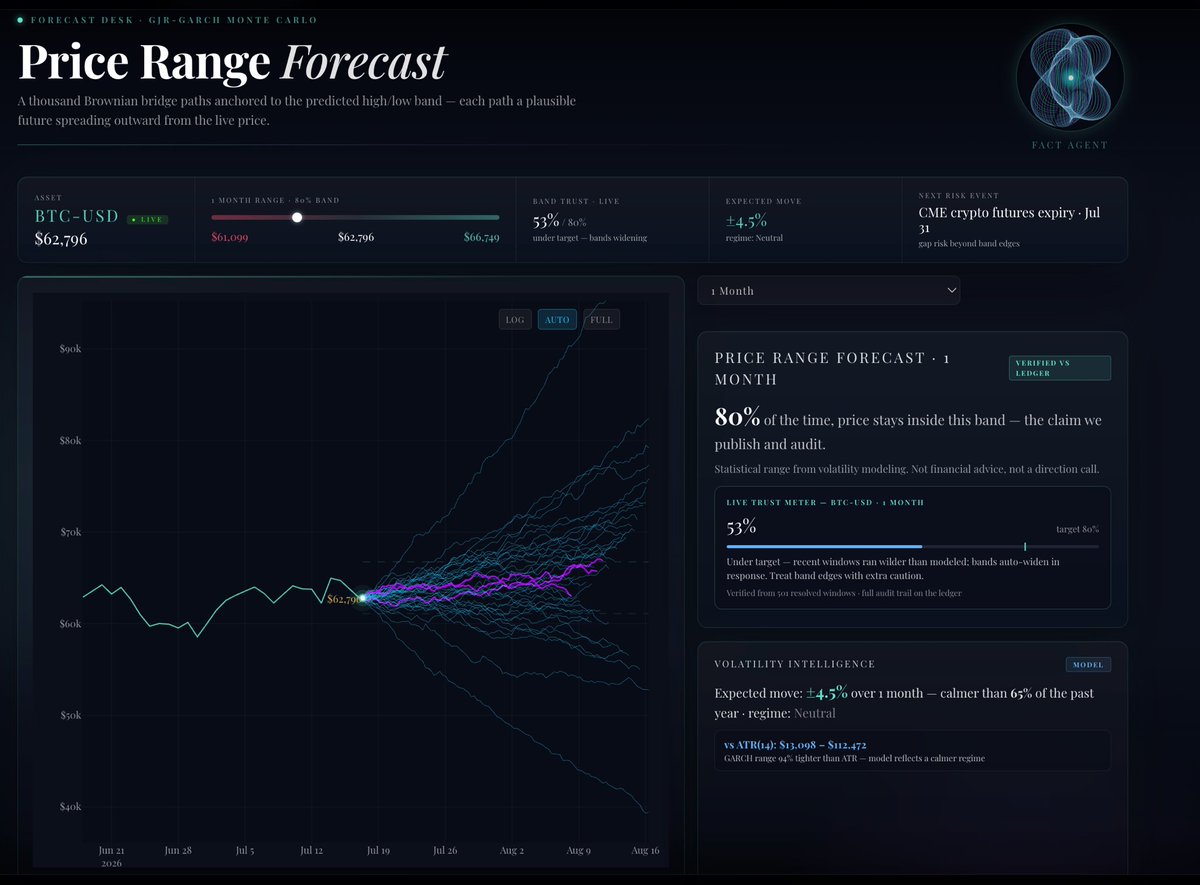
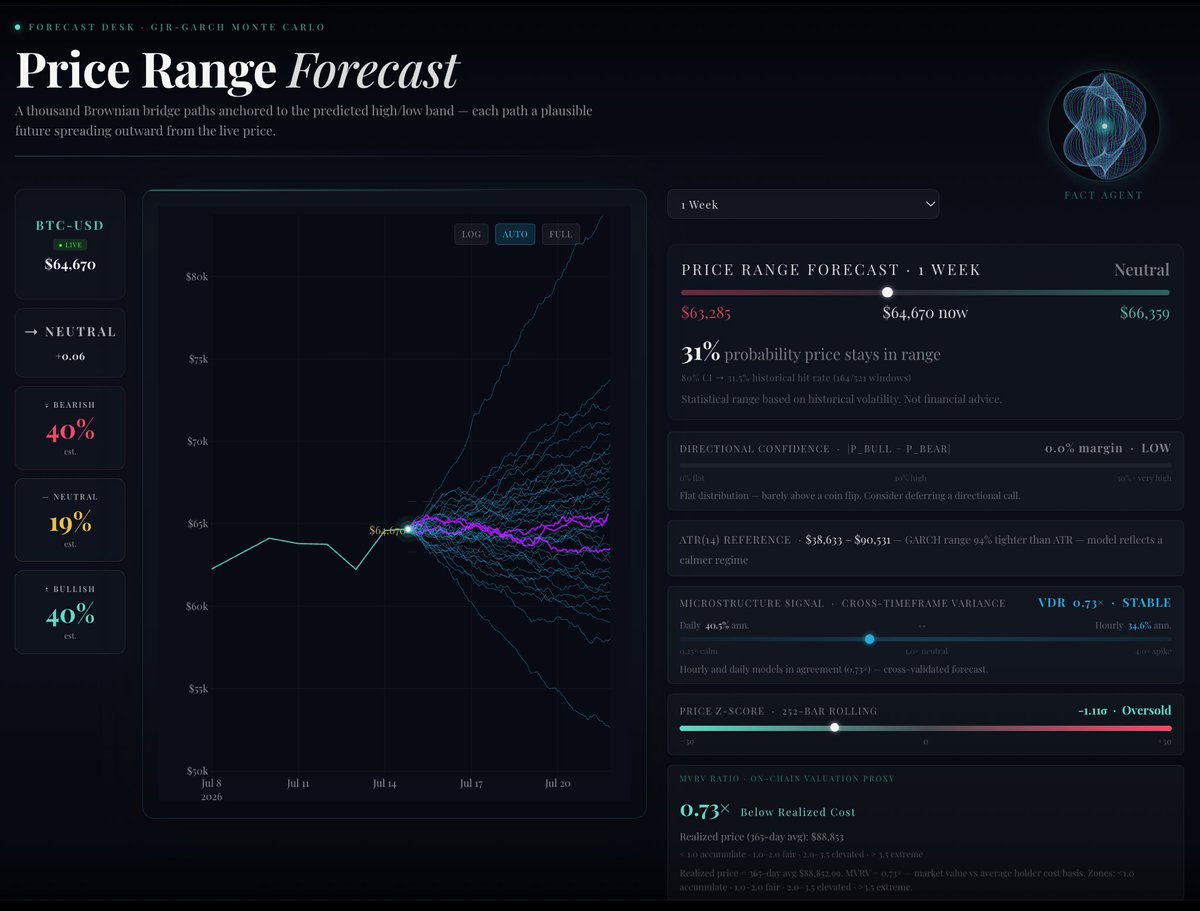
We’ve been quiet because we’ve been building.
The Meridian Terminal’s Price Forecast page just shipped its biggest upgrade yet:
Live Trust Meter — every range forecast now displays its real, audited accuracy for that exact asset and timeframe, straight from our prediction ledger. Running under target? The page says so, in the open.
Honest direction — bull/bear reads carry their live hit-rates. When the model has no edge, it abstains instead of guessing. We think we're the only ones who do this.
Signal Feed — regime shifts, band breaks and re-entries, bands widening in response to volatility. Every line dated and pulled from the audit trail, nothing invented.
Event Risk — earnings, expirations, expiry flows ahead. Every headline links to a verifiable source.
Volatility intelligence — the expected move, and whether that's calmer or noisier than the past year.
Everyone sells predictions. We publish our receipts.
More 🔜
Data centres use about 6% of US power today. The 2035 projection is 20%.
That’s being read as a green light to buy anything grid-related. It’s one number, nine years out.
We don’t hand out single numbers — our tool runs thousands of versions of how an asset could move and gives you the realistic high and low.
One number is a story. A range is a forecast.
#Markets #Stocks
@WatcherGuru Apple hit $333. New record. $4.9 trillion.
The chart looks vertical. Check the axis — it runs from $322 to $334.
That’s a 3% day stretched across a full screen.
Records are usually made in small steps. The zoom does the rest.
#Stocks#Markets
SpaceX went public near $205. It trades at $112.76 today.
That looks like a broken company. It isn’t.
Early investors can sell now. More sellers, same buyers.
Our volatility model weighs drops heavier than rallies of the same size, because that’s how prices behave — so the range we show holds up in a slide.
The chart is showing you supply, not failure.
#Stocks #Markets
The 30-year US government bond yield has been above 5% for the longest stretch since 2007.
Six months ago markets were pricing in three rate cuts this year. Now the longest-duration bond is at levels not seen since before the financial crisis.
The 30-year yield is what it costs the US government to borrow for three decades. When it’s this high,
everything that competes with it — stocks, property, corporate debt — has to offer more to stay attractive. It’s the rate the entire market prices itself around.
The shift from “three cuts coming” to “yields at 17-year highs” happened inside one year. When the environment flips that fast, every forecast built on the old regime is wrong — not because the analysis was bad, but because the regime it was built for no longer exists.
Three cuts expected. Seventeen-year highs delivered. That gap is why regime awareness matters more than any single forecast.
#Economy #Macro
Every semi is green today. The whole sector moving together in one block.
Two weeks ago the same chart was all red — Micron down 13%, AMD down 6%, the sector getting repriced on AI demand fears.
Same stocks. Same week. Opposite colors.
When an entire sector swings this hard in both directions within days, it’s not fundamental news driving each name. It’s one sentiment trade being turned on and off.
A regime read doesn’t care what color the chart is today. It reads what the underlying environment is doing — so a green day in a deteriorating regime and a green day in a genuine recovery don’t get treated as the same thing.
All green isn’t all clear.
#Stocks #Markets
Software developer jobs for 22–25 year olds down 23% since ChatGPT launched. The 41–49 age group up 18% over the same period.
That’s not a coincidence. It’s a replacement pattern.
Entry-level coding used to be where you learned by doing — fixing bugs, writing boilerplate, reviewing pull requests. AI does all of that faster and cheaper now. Companies kept the people who know what to build. They replaced the people still learning how.
The experience premium just got steeper. Knowing how to use the tools matters less than knowing which problem to point them at.
We built something that does the hard statistical work — running thousands of simulations, detecting the market regime, checking eight signals before calling a direction — so the edge goes to whoever understands the output, not whoever can replicate the math.
Junior AI replaced junior developers.
The same thing is coming for junior analysts.
#Markets #Economy
PayPal up 35% in 35 days. Up 14% in 95 days for Burry.
Same stock. Same bull thesis.
Different entry timing — and the shorter holder already has more than double the return.
This is survivorship in real time. The accounts tracking these calls post the wins. Nobody is tracking the calls that went down 20% before recovering, or the ones still underwater.
The part worth noticing: when to buy matters more than what to buy. Burry’s call was right. His timing cost him 21 percentage points versus someone who called it 60 days later.
A correct thesis at the wrong price is just an expensive way to be right.
#Stocks #Markets
Since December 2024, women have gained around 400,000 jobs. Men have lost jobs on net.
This isn’t a diversity story. It’s a sector story.
The jobs being created are concentrated in healthcare, education, and services — sectors that skew female. The jobs being lost are in manufacturing, construction, and blue-collar trades — sectors that skew male.
When the headline jobs number looks healthy, this split is invisible inside it. The aggregate hides which economy is actually growing and which is contracting.
A single jobs number can’t tell you which regime the labor market is in. The split underneath it can.
#Economy #Macro
Since December 2024, women have gained around 400,000 jobs. Men have lost jobs on net.
This isn’t a diversity story. It’s a sector story.
The jobs being created are concentrated in healthcare, education, and services — sectors that skew female. The jobs being lost are in manufacturing, construction, and blue-collar trades — sectors that skew male.
When the headline jobs number looks healthy, this split is invisible inside it. The aggregate hides which economy is actually growing and which is contracting.
A single jobs number can’t tell you which regime the labor market is in.
The split underneath it can.
#Economy #Macro
58% of AI tokens used by US companies now run through Chinese models. Up from under 10% at the start of 2025.
US firms are choosing Chinese AI for cost and performance — not because they were told to. DeepSeek became the most popular model among American developers in a market where US labs had an 80% share eighteen months ago.
The trade everyone is in is “long US AI infrastructure.” The usage data says the actual AI compute is increasingly running somewhere else.
Record inflows into US semi ETFs.
Record usage shifting to Chinese models. Both true at the same time.
#Markets #Stocks
$46 billion into semiconductor ETFs this year alone. More than double everything put in between 2017 and 2025 combined.
This ties directly to what the fund manager survey showed: 82% named “long semis” as the most crowded trade three months running.
A record inflow into a trade that’s already the most crowded in the market isn’t a signal that semis are a great buy. It’s a signal that almost everyone who wants to own them already does.
The last person in a crowded room doesn’t get the best seat. They get the door when everyone rushes for it.
#Stocks #Markets
21% of small business owners say inflation is their single biggest problem. Same level as the 2008 financial crisis.
38% of them raised their prices last month — the highest since early 2023.
That second number is the one that matters. When small businesses raise prices to survive their own costs, it feeds directly into the inflation the Fed is trying to kill. Their pain becomes your higher prices at the till.
This is why the Fed’s tool is blunt. Rate hikes make borrowing more expensive for these same small businesses — squeezing them from both sides. Higher costs, tighter credit, same customers.
Fighting inflation by making it harder to survive inflation is a narrow path.
#Economy #Macro
US margin debt just hit a record $1.5 trillion. Up 49% in 12 months.
Margin debt means investors borrowed money to buy stocks. More debt than the Dot-Com bubble peak, relative to market size.
Here’s what that means for the next down day.
Borrowed money has to be paid back regardless of what the market does.
When prices fall far enough, brokers automatically sell positions to recover the loan — whether the investor wants to sell or not. That forced selling pushes prices lower, which triggers more forced selling from the next person’s account.
The volatility model treats bad news as hitting harder than equivalent good news. Record leverage makes that asymmetry worse — the unwind isn’t proportional to the drop that started it.
Borrowed conviction isn’t the same as real conviction. It just feels identical until the margin call arrives.
#Markets #Stocks
Bitcoin broke $60k. $1.5 billion in leveraged bets got wiped in a day.
Read that second number again. It’s the real story.
People didn’t just sell. People who borrowed to bet on “up” got forced out automatically when the price dropped. Each forced sale pushes the price lower, which forces the next one. A slide turns into an avalanche.
That’s why the candles got bigger on the way down — not less buying, more forced selling.
Eight separate checks have to agree before our system calls a move. Cascades like this trip more of them than a calm pullback ever would.
The price fell. The leverage is what made it fall fast.
#Crypto #Bitcoin
SPCX just hit a post-IPO low at $132. Down from $225 at its peak three weeks ago.
That’s a 41% drop in 21 days for a stock that was being called “unstoppable.”
This is the other side of what we said when it listed — a stock with no price history has no real floor. Every level it finds on the way down is also an all-time low, just like every level on the way up was an all-time high.
The hype set the ceiling. The ceiling had no foundation.
A new stock finding its price is not the same as a stock collapsing. It’s just math catching up.
#Stocks #Markets
SPCX just hit a post-IPO low at $132. Down from $225 at its peak three weeks ago.
That’s a 41% drop in 21 days for a stock that was being called “unstoppable.”
This is the other side of what we said when it listed — a stock with no price history has no real floor. Every level it finds on the way down is also an all-time low, just like every level on the way up was an all-time high.
The hype set the ceiling. The ceiling had no foundation.
A new stock finding its price is not the same as a stock collapsing. It’s just math catching up.
#Stocks #Markets
Professional investors now hold the least cash in 13 years. 82% named “long semis” as the most crowded trade — for the third straight month.
The headline is “risk appetite is surging.” Read it differently.
When everyone is already in, who’s left to push the price higher? A crowded trade doesn’t just stop working — it unwinds fast, because everyone exits the same door at once.
Our regime detector reads whether the environment has actually shifted — because when it does inside a crowded trade, the drop is rarely orderly.
Everyone all-in is the moment to ask who’s on the other side.
#Markets #Stocks
A lawsuit claims Meta used AI to identify workers with medical conditions and target them for layoffs.
This is still an allegation. But the legal mechanism it points to is real regardless of outcome.
When an AI system makes or influences a HR decision, liability becomes harder to assign and easier to dispute — but discrimination law doesn’t care whether a human or an algorithm made the call. If the output has a discriminatory pattern, the company is still exposed.
Every company rushing to use AI in operations is taking on legal risk they haven’t fully priced yet. The tool moves faster than the regulation designed to govern it.
AI that saves money on headcount can cost more in court.
#Stocks #Markets
June went from a $27 billion surplus last year to a $120 billion deficit this year.
The swing isn’t just spending. Revenue collapsed too — the Supreme Court ruled tariff increases illegal, forcing $26 billion in refunds back out the door. Money that was already counted as income had to be returned.
Meanwhile interest on the debt hit $827 billion in nine months — on track for the highest annual interest bill in US history.
The deficit is growing from both ends at once: less money coming in, more going out, and the interest bill expanding regardless of either.
A budget problem that grows itself is harder to stop than one that just needs cuts.
#Economy #Macro