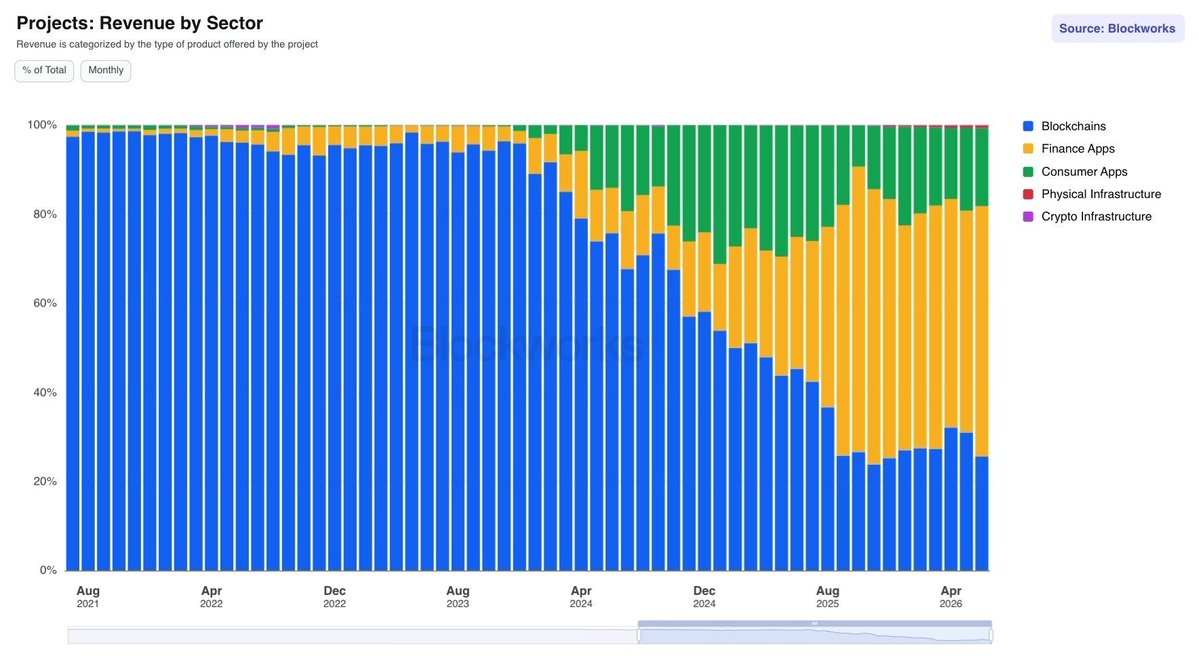
From August 2021 through 2023, blockchains captured 90%+ of monthly crypto revenue.
By mid-2026, that share dropped to 25%.
The new breakdown:
🔸 Finance apps: exceeded 50% in most months
🔸 Consumer apps: steady meaningful share
🔸 Blockchains: down to ~25%
🔸 Physical and crypto infrastructure: rounding errors
The economic center of crypto moved from the base layer to the apps running on it.
Early cycles were infrastructure-focused because infrastructure was the only place value could accrue.
Users paid L1 gas fees because there was nowhere else for the money to go. Ethereum's high fees, Solana's spikes, Bitcoin's security budget drove revenue.
As blockchains became cheaper, more scalable, and more reliable, apps could finally support real users and capture their own revenue streams.
Finance apps (perp DEXs, lending protocols, stablecoin issuers, trading tools) earn fees from trading volume, not just gas.
Consumer apps (memecoin launchpads, wallets, social tools) turn engagement into sustained revenue as they find market fit.
The internet followed the same arc.
In the 1990s, ISPs and backbone providers made the money. By the 2010s, applications and platforms captured most of the value.
Crypto is following that path, faster and with full transparency because everything settles onchain.
You can't value L1s solely on the claim that they capture all fees anymore.
App-layer protocols have proven that lean teams can generate hundreds of millions in revenue across:
🔸 @HyperliquidX -style derivatives platforms
🔸 @Pumpfun -style consumer platforms
🔸 The wider DeFi stack
These products now capture economic surplus that once flowed almost entirely to validators and miners.
That diversification is healthy. Crypto no longer depends on one revenue source or one narrative.
The infra succeeded, which is why its revenue share fell. Finance and consumer apps now generate the majority.
That's where the next decade of value compounds.
h/t: @Blockworks
Pendle just opened up leveraged exposure to Apple, Nvidia, Tesla and other tokenized stocks directly onchain.
These went live on 22 October. They're Coinbase's tokenized stocks on Base, each one backed by the underlying share held with Alpaca, a regulated broker-dealer
and they move onchain around the clock, so until now you could hold them but there wasn't much things to do with them.
Now you can put them to work inside @pendle_fi .
From the user side the flow is simple:
Deposit USDC → pick the stock → choose your leverage → one flow builds the position
Underneath, it's a loop:
🔸 @aave V4 supplies the USDC borrow
🔸 Pendle assembles the position: buy the stock token, supply it as collateral, borrow USDC, buy more, repeat
🔸 You end up with 2x to 3x the exposure you funded, depending on the stock
How far you can go depends on the token. On 23 Oct the max leverage ran from roughly 2.6x to 4x, with TSLAc at the low end and AAPLc and GOOGLc near the top.
To give context on the cost, Pendle's route quotes USDC borrowing at about 3.82% APY, and the Loop campaign pays 3.00% APR in USDC on net borrowing from 23 Oct to 6 Nov, claimable on Merkl.
On those inputs (my math, excluding gas and slippage):
🔸 2x: about 3.75% a year in borrow cost, 0.75% after the rebate
🔸 3x: about 7.50% before the rebate, 1.50% after
Pendle isn't charging a service fee on these routes right now (it's currently 0%), so nothing extra sits on top of those numbers.
There's already real size behind it, too. On 23 Oct the Aave route showed about $10.3m supplied as collateral across four of the tokens:
🔸 AAPLc: $1.83m
🔸 GOOGLc: $3.77m
🔸 NVDAc: $3.66m
🔸 TSLAc: $1.01m
Supply caps sit at about $4.1m to $5.8m per token, and these figures cover the whole lending route, so they include positions that didn't start in Pendle.
What I find interesting is what tokenization does once the share is on Base.
It can be collateral, it can go through a lending market, and it can also be composed with other DeFi primitives, whereas without something putting that to work a tokenized stock is just a stock in a different wallet.
Pendle is the layer that turns the holding into a position: you deposit one asset, pick the target, and the flow does the rest, w/ everything onchain and visible.
If you already know crypto, this takes out one of the last frictions between equities and DeFi, since stock exposure and leverage now sit in the same wallet on the same chain.
Imo the real unlock here is distribution. A tokenized stock, an Aave market and a USDC borrow were all there already, and what was missing was a workflow that put them together for you, which is what Pendle shipped.
It's currently open to eligible users outside the US, w/ AAPLc, AMZNc, GOOGLc, METAc, MSFTc and NVDAc and TSLAc in the launch set
so these are the same companies Wall Street trades, now something you can deploy onchain.
Aave has said it expects more tokenized stocks and its GHO stablecoin to join this market through governance, and each addition would widen what a Pendle Loop position can be built from.
1> One of the more useful developments across @aave lately has been how fixed-yield positions are gradually becoming a bigger part of its collateral markets.
@pendle_fi PTs are a good example. users can lock in a fixed return and still borrow against that position through Aave, giving the same capital another financial function without selling the underlying exposure.
And the growth is already showing up across different markets.
Here's how Aave and Pendle are gradually connecting fixed income with onchain credit
🧵
Pendle just opened up leveraged exposure to Apple, Nvidia, Tesla and other tokenized stocks directly onchain.
These went live on 22 October. They're Coinbase's tokenized stocks on Base, each one backed by the underlying share held with Alpaca, a regulated broker-dealer
and they move onchain around the clock, so until now you could hold them but there wasn't much things to do with them.
Now you can put them to work inside @pendle_fi .
From the user side the flow is simple:
Deposit USDC → pick the stock → choose your leverage → one flow builds the position
Underneath, it's a loop:
🔸 @aave V4 supplies the USDC borrow
🔸 Pendle assembles the position: buy the stock token, supply it as collateral, borrow USDC, buy more, repeat
🔸 You end up with 2x to 3x the exposure you funded, depending on the stock
How far you can go depends on the token. On 23 Oct the max leverage ran from roughly 2.6x to 4x, with TSLAc at the low end and AAPLc and GOOGLc near the top.
To give context on the cost, Pendle's route quotes USDC borrowing at about 3.82% APY, and the Loop campaign pays 3.00% APR in USDC on net borrowing from 23 Oct to 6 Nov, claimable on Merkl.
On those inputs (my math, excluding gas and slippage):
🔸 2x: about 3.75% a year in borrow cost, 0.75% after the rebate
🔸 3x: about 7.50% before the rebate, 1.50% after
Pendle isn't charging a service fee on these routes right now (it's currently 0%), so nothing extra sits on top of those numbers.
There's already real size behind it, too. On 23 Oct the Aave route showed about $10.3m supplied as collateral across four of the tokens:
🔸 AAPLc: $1.83m
🔸 GOOGLc: $3.77m
🔸 NVDAc: $3.66m
🔸 TSLAc: $1.01m
Supply caps sit at about $4.1m to $5.8m per token, and these figures cover the whole lending route, so they include positions that didn't start in Pendle.
What I find interesting is what tokenization does once the share is on Base.
It can be collateral, it can go through a lending market, and it can also be composed with other DeFi primitives, whereas without something putting that to work a tokenized stock is just a stock in a different wallet.
Pendle is the layer that turns the holding into a position: you deposit one asset, pick the target, and the flow does the rest, w/ everything onchain and visible.
If you already know crypto, this takes out one of the last frictions between equities and DeFi, since stock exposure and leverage now sit in the same wallet on the same chain.
Imo the real unlock here is distribution. A tokenized stock, an Aave market and a USDC borrow were all there already, and what was missing was a workflow that put them together for you, which is what Pendle shipped.
It's currently open to eligible users outside the US, w/ AAPLc, AMZNc, GOOGLc, METAc, MSFTc and NVDAc and TSLAc in the launch set
so these are the same companies Wall Street trades, now something you can deploy onchain.
Aave has said it expects more tokenized stocks and its GHO stablecoin to join this market through governance, and each addition would widen what a Pendle Loop position can be built from.
RedStone just shipped a practical onchain compliance layer that makes regulated DeFi far more accessible.
The Sanctions Oracle is live on Ethereum at 0x574Ad490fE8087B580DB227a8Ca7EfB7C19Dc8C4
and you screen a wallet with one line of code inside the same transaction w/o any offchain review step.
Here's what it covers
🔸 463 aggregated sources, including OFAC, the UN, the EU, the UK's FCDO and other national and international lists
🔸 Data from OpenSanctions, so you get a multi-jurisdictional view instead of relying on one feed
Then here's how you use it
→ isSanctioned() checks a single wallet
→ areSanctioned() checks a batch of wallets
→ If a flagged address shows up in a transaction, your protocol reverts it right there in the same execution flow
The interface is what I like most. It matches the Chainalysis sanctions oracle that many protocols already use, so if you screen onchain today, you can switch by updating a single address.
Freshness is handled in code too. @redstone_defi pushes reviewed updates every week, and getLastUpdateBlockTimestamp() shows you when the last one landed.
so you set your own staleness rules and enforce them without manual work.
On Etherscan you can see updates on Oct 6, 12 and 19.
Also on security, RedStone says updates are signed from cold storage through a geographically distributed 4-of-6 multisig, in line w/ its ISO-certified approach to infra.
This matters most if you build for institutions, because you can now put sanctions screening directly into your transaction logic. That covers
🔸 Stablecoin issuers
🔸 Tokenized fund platforms
🔸 Lending markets
🔸 Permissioned pools
The institutions you work w/ get more confidence that onchain activity can meet the standards they already expect in traditional markets.
As more RWAs, regulated stablecoins and institutional products move onchain, teams that already screen wallets can check RedStone's update history themselves, since every update is public on Etherscan.
For a team that builds for regulated users, this is a small change to test and a big chunk of compliance work you no longer carry.