The 2026 World Cup group stage has already produced plenty of surprises, competitive draws, and impressive debuts. No team appears truly safe.
#WorldCup2026
@hayyantechtalks Very useful prompts which i have saved, and will definitely be using. Btw when u said a humanising Feature exists in Claude i got really excitd until u explained it in the "Disclaimer" :)
🚨 BREAKING: Claude can now perform stock market research like a top-tier consulting firm — for free.
Here are 10 Claude prompts that replace $100K/year stock analysts.
(Save this for later) 📌
By 2028, "Agentic AI" ecosystems will completely replace static SaaS tools. Instead of managing software, we’ll just manage orchestrator agents who hire, train, and deploy sub-agents to do the work. 🤖🔮 #FutureOfAI#TechPredictions#AgenticAI
Like
Retweet
Bookmark
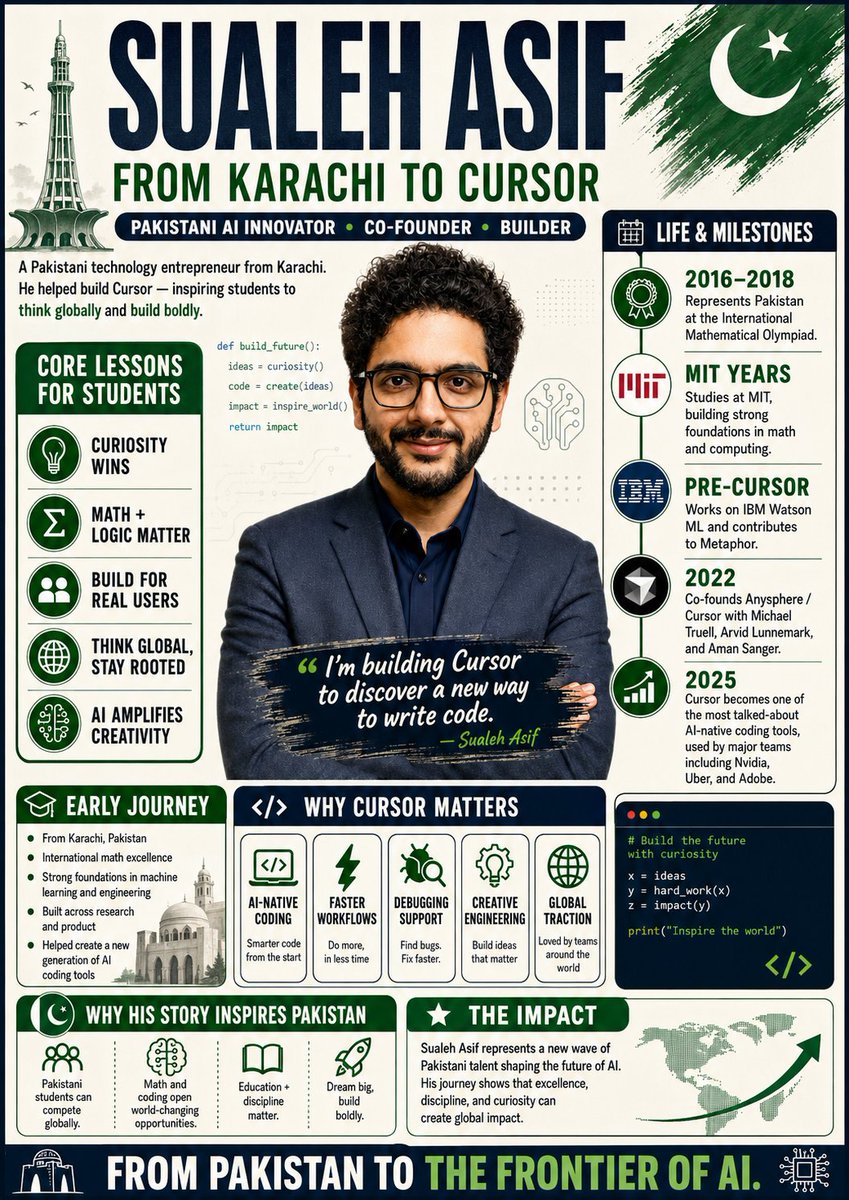
SpaceX just moved to buy Cursor’s parent Anysphere for $60B .
The deal is all-stock, so SpaceX is using its market value rather than IPO cash, while Cursor gets the compute pipeline it has reportedly lacked.
SpaceX is effectively buying a distribution layer for AI models, a revenue engine with about $2.6B in annualized B2B revenue.
Cursor is already inside developers’ daily workflow, so any AI model connected to it can immediately reach companies that write software all day.
Cursor also creates useful feedback because every accepted edit, rejected suggestion, bug fix, and test result can teach the system what good code looks like in real engineering work.
---
reuters .com/legal/transactional/spacex-buy-anysphere-60-billion-2026-06-16/
Delete almost every prompt you've ever saved.
I did it.
For years, I collected prompts like they were assets.
→ Writing prompts.
→ Research prompts.
→ Marketing prompts.
→ Coding prompts.
Eventually I had hundreds & thousands of them.
And one day I realized something:
I was spending more time searching for prompts than actually using AI.
So I built a giant master prompt instead.
That worked...
Until every new chat forced me to explain myself all over again.
→ My style
→ My preferences
→ My workflow
→ My rules
The AI forgot everything.
I kept repeating myself.
Again. And again. And again.
That's when I stopped optimizing prompts.
And started optimizing memory.
Today I maintain just 3 markdown files.
And they've completely replaced my prompt library.
1️⃣
Don't write the file yourself.
Let Claude interview you.
Open a fresh Claude Cowork session and paste:
"You are building my about-me.md file.
Interview me with 20 questions, one at a time using AskUserQuestion.
Push back on vague answers.
Compile everything into a clean about-me.md under 2000 words."
Spend 20 minutes answering honestly.
The magic isn't the output.
It's the questions.
Claude will uncover patterns about how you think that you've never properly documented before.
By the end, you'll have a surprisingly accurate personal operating manual.
2️⃣
Keep it short.
My first version was over 20,000 words.
Terrible idea.
→ More tokens
→ More noise
→ Slower outputs
I cut it to under 2,000 words.
The quality improved immediately.
✔️ Smaller
✔️ Sharper
✔️ More useful
3️⃣
Create three files.
1. about-me.md
→ Who you are
→ How you think
→ Goals
→ Preferences
2. my-voice.md
→ Writing style
→ Favorite phrases
→ Phrases you avoid
→ Real writing samples
3. my-rules.md
→ Show a plan first
→ Ask before executing
→ Never delete without approval
→ Follow my workflow
Three files.
That's it.
4️⃣
Put them inside a single folder.
Claude Cowork
└── About Me
Then tell Claude:
"I'm Harris. Always read the files in my About Me folder before every task. Use my voice and follow my rules."
✔️ Done.
Now every task starts with context.
My prompts became dramatically shorter.
Sometimes one sentence. Sometimes one line.
But the outputs became:
• More accurate
• More consistent
• More useful
• More me
The biggest lesson?
People don't need more prompts.
They need a system that helps AI remember who they are.
Three markdown files solved a problem that thousands of saved prompts never could.
🚨 Huge escalation in AI geopolitical tech wars.
The US government has issued an export control directive forcing Anthropic to completely suspend access to Fable 5 and Mythos 5.
The restriction bars any foreign national inside or outside the US, including Anthropic's own employees from accessing them.
To comply, Anthropic had to abruptly shut down both models for ALL customers globally.
Anthropic claims it’s a misunderstanding and is fighting to get them back online. If this is how next-gen models are going to be regulated, the AI landscape just changed overnight.
Imagine if today all you had was Fable 5 from Anthropic & GPT 5.5 from OpenAI
- No Local Inference
- No OpenCode : Hermes
- No GPUs / DGX Sparks / Mac Studios
Just a hostage situation to a few corps willing to rugpull you any sec
Now you understand why we need Opensource AI
She lost her best friend for a moment... and found faith in humanity forever. 🧸✨
Created on https://t.co/0wQEqyRcbE
Prompt:
Scene 1 (0–5 sec) — The Loss A sunny afternoon in a beautiful city park. A cheerful little girl, around 6 years old, walks hand in hand with her mother while holding a worn brown teddy bear. Distracted by colorful balloons and playful birds, she accidentally drops the teddy onto a park bench and continues walking away. The camera slowly pushes in on the abandoned teddy as the girl's laughter fades into the distance. Emotional cinematic lighting, shallow depth of field, heartwarming atmosphere.
Scene 2 (5–10 sec) — The Journey A young woman notices the teddy and picks it up. She looks around but cannot find the owner. The teddy is then passed through a chain of kind strangers: a jogger carries it across a path, an elderly man places it on a bicycle basket, a florist hands it to a food vendor, and each person searches for the child. Fast paced cinematic transitions connect every handoff, emphasizing community and kindness. Warm golden hour lighting, uplifting emotional music.
Scene 3 (10–15 sec) — The Reunion The little girl sits on a park bench, tears forming in her eyes as she realizes her teddy is missing. Suddenly, the final stranger approaches and kneels down, holding out the teddy bear. The girl's face instantly lights up with joy. She runs forward, hugs the teddy tightly against her chest, and smiles with relief. The camera pulls back to reveal the strangers smiling nearby. Golden sunlight fills the frame.
@sunjian@WeryAiExpert
#Wery #AiExpertWorkspace #TellWeryTheGoal
Most AI design tools help you generate.
CapCut Design Studio 2.0 helps you create.
With an infinite canvas that combines ideas, references, drafts, and AI in one workspace, the process feels far more natural than jumping between tools.
Less editing. More visual thinking.
Try it here 👇
https://t.co/hw8m8YwwqA
This isn’t real drone footage. Or is it?
15-second cinematic FPV flight over Cologne Cathedral.
Made with GPT image 2 + Seedance 2.0
🧵Here is how i created it : ⤵️
Seedance 2.0 - Frame Extraction Resolution Fix
#DreaminaCPP@dreamina_ai
Changing your last frame into a 2D silhouette will force SD2 to retrieve the character info from your original reference rather than the extracted frame.
AI isn’t going to replace your job.
But someone who knows how to use AI and actually possesses critical thinking skills absolutely will.
Right now, 90% of people are just using ChatGPT to write lazy emails and generic social posts. The real leverage isn't in basic text output—it's in how you chain prompts, automate workflows, and use it as a sparring partner for strategy.
What’s one task you’ve automated that genuinely felt like a cheat code?
Drop it below 👇