Systematic reviews and meta-analyses, from question to forest plot. Free to run by hand, with AI help when you want it. Every decision keeps its reason.
A 95% confidence interval covers random error and nothing else. Lose a third of the participants, or measure the wrong outcome, and the interval can still come out narrow. A precisely measured wrong answer.
https://t.co/TKaVfUNyCn
Endocrine therapy alone or surgery for older women with ER-positive breast cancer? A new meta-analysis pooled only the 6 trials (HR 1.14, 0.98 to 1.33) and kept 23 cohorts out, because the frailest get the pill.
Right call. Not significant isn't the same as equal.
8/8 Being short of time is the wrong reason to pick a scoping review. A deadline calls for a rapid review, with its shortcuts declared.
All six types in one table, rapid and umbrella reviews included. Free lesson:
https://t.co/UZLBzpELQE
1/8 Literature review, systematic review, scoping review, meta-analysis.
They get treated like small, medium and large versions of one thing. They're four different tools, and one of them isn't a review at all.
Which is which, and when to use each:
7/8 Scoping review. Systematic methods, different question: what has been studied here, and where are the gaps? It maps, so usually no pooled effect and no certainty rating.
Use it when you can't yet name a precise question. It's often the step before a systematic review.
@WilliamWallace Good to see the caveats spelled out. One more: people eating the most magnesium are also eating the most greens, nuts and whole grains, and the adjustments listed don't include overall diet, so the mineral and the food are hard to pull apart.
@Outdoctrination Reverse causation is the usual suspect. Once someone is told their sugar is creeping up, ice cream is one of the first things they cut, so the people eating none are enriched with exactly the ones at risk.
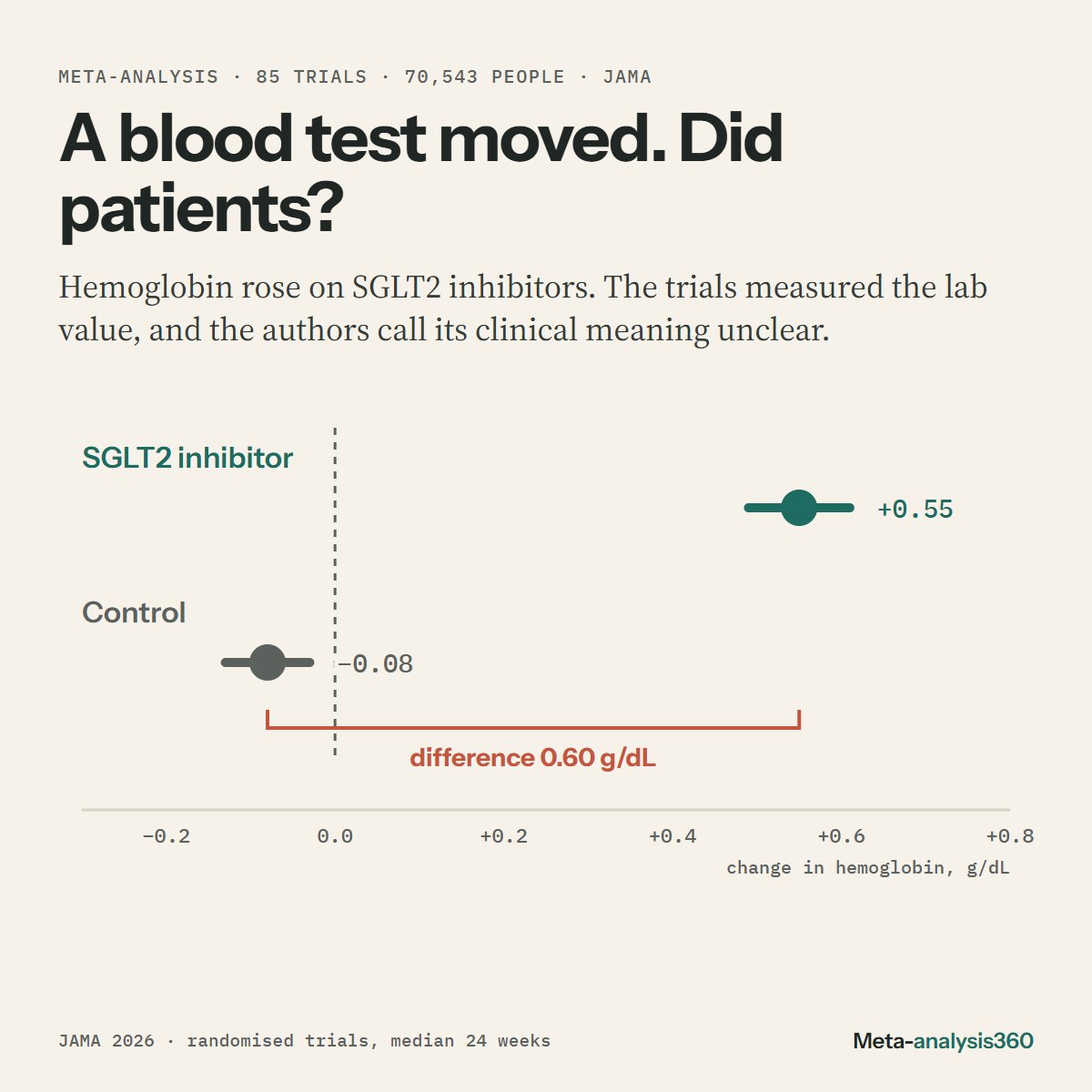
SGLT2 inhibitors raise hemoglobin. A JAMA meta-analysis of 85 trials (70,543 people) found about +0.6 g/dL against control, with EPO up and transferrin saturation down.
A lab value moving isn't a patient feeling better, and the authors call the clinical meaning unclear.
@TheLancet@LancetRH_Europe From the paper's own panel: all-cause death rose even more than heart attacks and strokes, while the usual risk factors barely moved after stopping. That leaves room for sicker people stopping, which the authors raise themselves.