Exciting prediction: #Bitcoin aiming for 42k this week! 🚀📈 Remember, it's just my perspective, not financial advice. Always do your research and make decisions based on your own analysis. #CryptoForecast#NotFinancialAdvice
@Ripple 🚨 Scam Alert! 🚨 Beware of a fraudulent YouTube ad promising to double your #XRP. 🚫 Do NOT send any funds – it's a scam! Your money will be gone forever. Let's spread awareness and protect the community. Retweet to save others! @Ripple#ScamAlert#CryptoSafety
🚨 Scam Alert! 🚨 Beware of a fraudulent YouTube ad promising to double your #XRP. 🚫 Do NOT send any funds – it's a scam! Your money will be gone forever. Let's spread awareness and protect the community. Retweet to save others! @Ripple#ScamAlert#CryptoSafety
In the world of crypto, every dip is a chance, every hodl is resilience, and every rally is a reward. Embrace the volatility, ride the waves, and let the blockchain of possibilities unfold. 🌐🚀 #CryptoWisdom ( Not my quote)
Just diversified my crypto portfolio with some exciting moves! 🚀 Currently holding #SOL#GPT#ETH#BTC#AGIX. Remember, this isn't financial advice – do your own research and only invest what you can afford to lose. #Crypto#investing#ai#cryptogpt
To understand the efforts to launch a spot bitcoin ETF, one must first understand how ETFs get to market.
Most ETFs are registered under the Investment Company Act of 1940. These “1940 Act” ETFs have a fairly simple pathway to approval: Issuers file an application with the SEC, and the filing automatically goes effective after 75 days unless the SEC blocks it.
Spot bitcoin ETFs, however—like all spot commodity ETFs—are filed under the Securities Act of 1933. The key feature of the “1933 Act” structure is that filings do not automatically go effective after 75 days. Instead, the SEC must affirmatively approve a 1933 Act filing before it can launch, which typically takes up to 240 days.
How Does the 1933 Act Review Process Work?
The 1933 Act review process follows a specific timeline. First, the ETF issuer files a prospectus with the SEC, describing the fund it wants to launch. Then, the stock exchange where the ETF will trade (such as the New York Stock Exchange) files a “19b-4.” A 19b-4 filing is a petition to the SEC to allow the ETF to list and trade on the exchange.
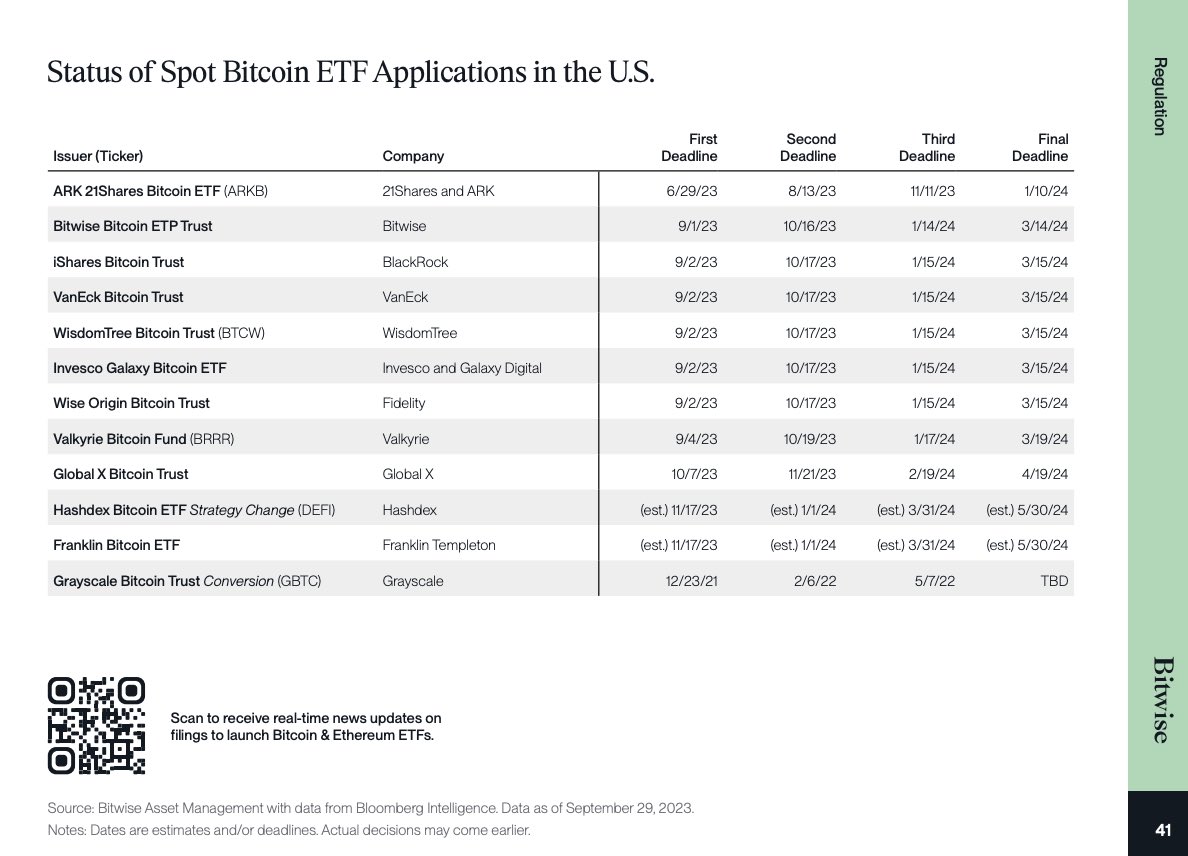
Up to 15 days after the 19b-4 is submitted to the SEC, the filing is published to the Federal Register, the U.S. government’s official record of government actions. From that moment, the SEC has up to 240 days to approve or reject it.
It’s worth noting that a filing’s progression from one stage to another does not imply that it has an increased likelihood of approval. Therefore, when the SEC extends its review it should not be read in a positive or negative light. It’s just part of the process.
The SEC has historically extended the review deadlines for spot bitcoin ETF applications up to or close to the full 240-day period, but there is no guarantee that will be the case in the future.
(h/t @Matt_Hougan, @EricBalchunas & @JSeyff)
Source: https://t.co/O1QVLvzPf8