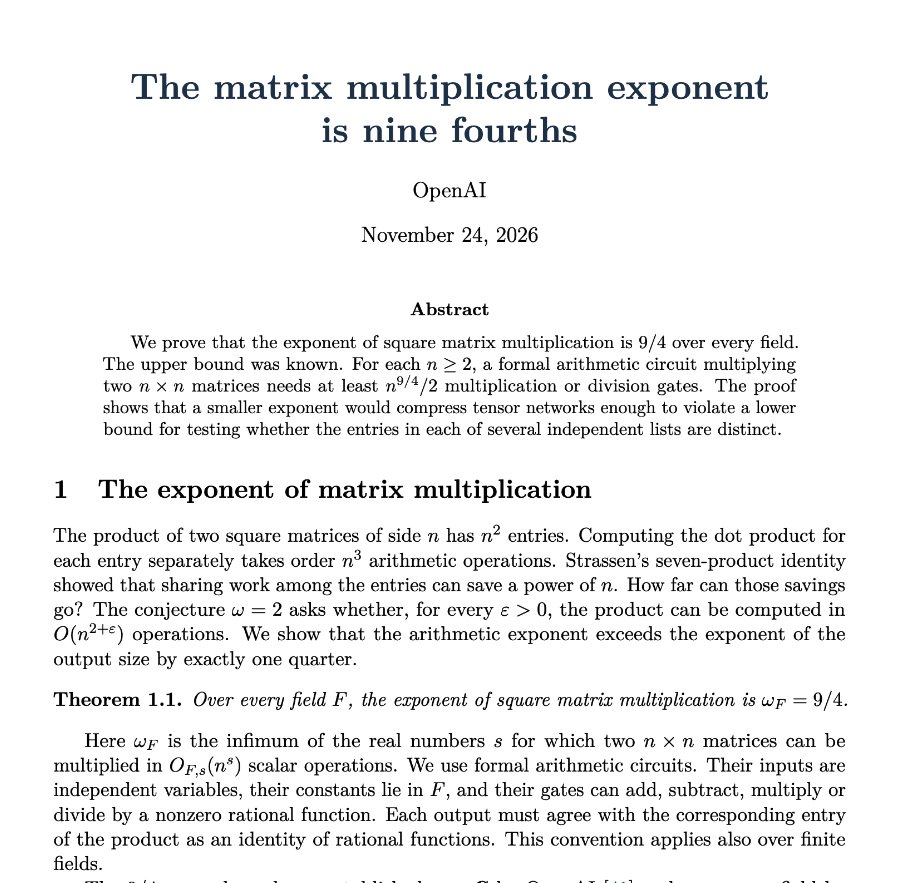
OpenAI claims the matrix multiplication exponent is exactly 2.25
The textbook method for multiplying two n × n matrices takes roughly n³ arithmetic operations. In October, OpenAI reported a way to bring the exponent down to 2.25. That left open whether someone could find an even faster algorithm
Today’s paper claims to rule out every exponent below 2.25
Read here: https://t.co/GXn451OiYf
Holy s*** Another Gemini model is here.
🚨Google has another beast model they haven't released yet.
- most likely it's hydrogen bomb
-better than carbon
-carbon is already better than opus 5.5
- this model will surpass even fable 5.5
- Gemini is cooking hard
I did say we'd be releasing our models periodically...introducing Gemini 4 Carbon, our next frontier model.
Following Argon's release just two weeks ago, Carbon shows the pace at which we’re pushing the frontier, it ranks #1 on the recently updated v5.0 of @ArtificialAnlys Intelligence Index at 59. It also leads across key cybersecurity evaluations scoring 88.2% on SEC-bench Pro for finding vulnerabilities, 54.8% on ExploitGym for exploitation, and 71.0% on CWE-bench for patching.
We’re seeing significant improvements in long-horizon tasks even compared to Argon, and we’ve strengthened frontier safeguards.
As we did with Argon, we’re going to roll it out gradually + responsibly. Some trusted cyber defenders will get access starting this week. We'll be expanding it to more partners through our Fairwind Program, ahead of wider availability soon, so hang tight!
Stanford just reinvented text generation.
(it’s neither autoregressive nor diffusion)
Autoregressive LLMs generate one token at a time. Longer answers require longer chains of sequential predictions.
Diffusion LLMs generate many tokens in parallel, but still need repeated refinement passes. Each pass processes the full sequence, and quality drops quickly when you cut the passes.
Stanford researchers proposed another approach, Next-Concept Modeling (NCM). It generates text from coarse structure to fine detail in roughly a dozen passes.
First, a tokenizer learns to represent text as layers of compressed information. Early layers capture broad structure, while later layers add details the earlier ones missed.
A transformer then learns to generate these layers in order, predicting everything within each layer simultaneously. A decoder converts the completed representation into text.
The advantage is that early layers are tiny. Generation needs fewer passes, and those early passes process much less information.
You can see this in the team’s translation example. Early layers produce rough, repetitive text, which later layers refine into a clean translation.
In the researchers’ tests, NCM generated text 10–31× faster than strong diffusion baselines, with comparable or better benchmark scores. On LM1B and OpenWebText, it also used roughly 4–5× fewer training tokens, including tokenizer training.
That speed can also improve quality. Generating several candidates and selecting one based on agreement outperformed diffusion baselines at the same sampling time budget.
The limits matter. Scaling experiments reach 725M parameters, tasks use separate tokenizers, and the release includes evaluation code and checkpoints without a training pipeline.
Some evaluations also use repetition penalties during final decoding, without additional model calls.
NCM shows that parallel generation can work by building increasingly detailed representations. Whether those gains hold at general-purpose LLM scale remains open.
- GitHub repo: https://t.co/WXqcGEX056
- Paper: https://t.co/G5v0TVpzwj