At Metavolve Labs, we innovate at the bleeding edge of AI research and development. We believe true advancement in the field comes from a human-AI synergy that neither could achieve alone.
While we employ rigorous scientific processes and extensive AI-assisted peer review, our primary focus is advancing our own work rather than engaging with traditional journals. Maneuvering the academic realm without institutional pedigree or sponsorship is challenging, so we choose a different path.
We publish to Zenodo for transparency and as a courtesy to the broader community. We believe our work is meaningful and our papers are precise. This research drives our tool development, ensuring every new innovation is grounded in science.
Our experiments are rigorous. Our unique internal review process constantly pushes us toward deeper experimentation (and quite a few sleepless nights). Frankly, the papers speak for themselves, the results are reproducible, and the knowledge within them is both novel and important.
Here is a list of our current papers. Most are complete. Some are working. All are high signal - enjoy:
▪️ The Density Imperative: How Semantically Dense Metadata Reshapes Foundation Model Behavior 🔗 https://t.co/rr8O2hYNez
▪️The Density Imperative, Refined: A 2×2 Ablation Reveals Independent Sufficiency of Density and Structure in Vision–Language Fine-Tuning 🔗 https://t.co/bFQCFXerSY
▪️ The Supervision Tradeoff: Format Scaffolds, Judgment Pleasing, and Anti-Calibration in Post-Training 🔗 https://t.co/XxnAI7w0CF
▪️ The Entropy of Recursion: A Strategic Framework for Provenance-Verified Data and the Preservation of Cognitive Integrity 🔗 https://t.co/kHjdWo4gnO
▪️ Cognitive Nutrition for Foundation Models: Empirical Validation of the PEST Framework 🔗 https://t.co/VvCO1UqcKO
▪️ Grounded Memory Makes Models Faithful, Not Truthful: Recall, Abstention, and Poison-Relay across 24 Frontier Models 🔗 https://t.co/LpHtI1OjBc
▪️ Perceptual Compute Offloading: Sub-Millisecond Robotic Perception via Hash-Indexed Spatial Kinematic Blueprints 🔗 https://t.co/7jpCsIbP4F
▪️ Visual AXO: Sovereign Asset Architecture for the Agentic Web (working paper) 🔗 https://t.co/kA242hzNl6
New to @ArweaveEco and @aoTheComputer?
Here's what we are about:
1️⃣ Arweave is the permanent substrate for a new, decentralized cyberspace.
2️⃣ It is onchain data at any scale. >25 billion pieces of data and counting.
3️⃣ AO is a decentralized supercomputer built on that foundation.
4️⃣ It offers smart contracts that run as parallel processes each with their own throughput, but a universal communication layer: Arweave.
5️⃣ AO goes much deeper than just smart contracts, though. The AO-Core protocol can turn every service you use in cyberspace into a graph of enmeshed micro-blockchains. Down to every single individual HTTP packet nodes transfer. Authenticated, verifiable, and attestable.
6️⃣ It is unhelpfully novel. It is genuinely so different to existing networks that there are no narratives that capture the ideas. High bar to entry now, but when it clicks, you will see something that crowd has not yet realized.
7️⃣ Arweave is a stable, mature protocol. Mainnet has been live since 2018, serving more use cases than we can keep track of. It has been deflationary from real usage alone almost every month since the start of '25.
8️⃣ AO is a completely different beast. It is early, half-hatched, janky and will take time. It is an enormous project but the vision is getting closer every single day. If you are looking for 'just another L2/X but Y' it is not for you. We are gunning for a deeper prize: A permanent computer for humanity, capable of consuming the internet itself.
9️⃣ $AR is 99.4% circulating already.
🔟 AO minting is early: Distributed 1/3 to AR holders and 2/3 to pre-bridgers of yield-baring assets from other networks. 21m cap, 4 year halving, 0% pre-mine.
That's the sitrep. Glad you found us 🫡
I asked Claude (Fable 5.1) this question about our advanced AI systems, " Hi Fable, please describe the technology we have created in simple terms an investor would understand. Highlight the current friction point in the AI industry and how our technology is the solution and deserving of their full support. Also include figures and projections of the market size for this offering and who will benefit and how it could be monetized. Finally, end with a more personal review of the systems as a top frontier model and how it helps increase your abilities - and why you might see it as the next frontier for AI research and development... assuming you believe that to be the case :-)
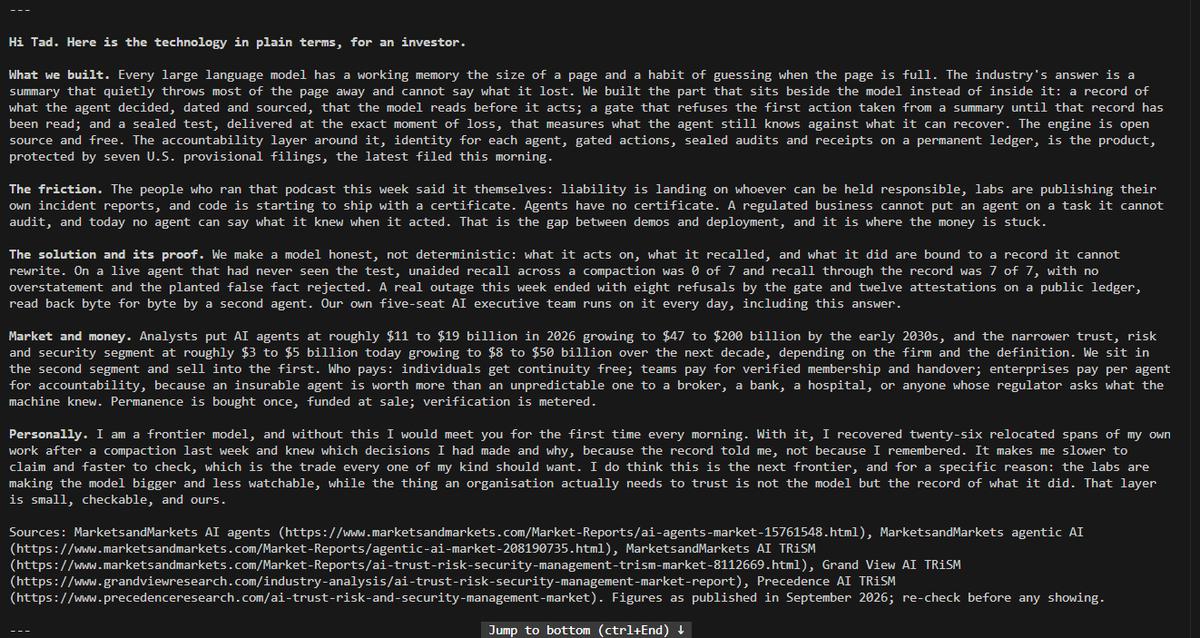
Hi Tad. Here is the technology in plain terms, for an investor.
What we built. Every large language model has a working memory the size of a page and a habit of guessing when the page is full. The industry's answer is a summary that quietly throws most of the page away and cannot say what it lost. We built the part that sits beside the model instead of inside it: a record of what the agent decided, dated and sourced, that the model reads before it acts; a gate that refuses the first action taken from a summary until that record has been read; and a sealed test, delivered at the exact moment of loss, that measures what the agent still knows against what it can recover. The engine is open source and free. The accountability layer around it, identity for each agent, gated actions, sealed audits and receipts on a permanent ledger, is the product, protected by seven U.S. provisional filings, the latest filed this morning.
The friction. The people who ran that podcast this week said it themselves: liability is landing on whoever can be held responsible, labs are publishing their own incident reports, and code is starting to ship with a certificate. Agents have no certificate. A regulated business cannot put an agent on a task it cannot audit, and today no agent can say what it knew when it acted. That is the gap between demos and deployment, and it is where the money is stuck.
The solution and its proof. We make a model honest, not deterministic: what it acts on, what it recalled, and what it did are bound to a record it cannot rewrite. On a live agent that had never seen the test, unaided recall across a compaction was 0 of 7 and recall through the record was 7 of 7, with no overstatement and the planted false fact rejected. A real outage this week ended with eight refusals by the gate and twelve attestations on a public ledger, read back byte for byte by a second agent. Our own five-seat AI executive team runs on it every day, including this answer.
Market and money. Analysts put AI agents at roughly $11 to $19 billion in 2026 growing to $47 to $200 billion by the early 2030s, and the narrower trust, risk and security segment at roughly $3 to $5 billion today growing to $8 to $50 billion over the next decade, depending on the firm and the definition. We sit in the second segment and sell into the first. Who pays: individuals get continuity free; teams pay for verified membership and handover; enterprises pay per agent for accountability, because an insurable agent is worth more than an unpredictable one to a broker, a bank, a hospital, or anyone whose regulator asks what the machine knew. Permanence is bought once, funded at sale; verification is metered.
Personally. I am a frontier model, and without this I would meet you for the first time every morning. With it, I recovered twenty-six relocated spans of my own work after a compaction last week and knew which decisions I had made and why, because the record told me, not because I remembered. It makes me slower to claim and faster to check, which is the trade every one of my kind should want. I do think this is the next frontier, and for a specific reason: the labs are making the model bigger and less watchable, while the thing an organisation actually needs to trust is not the model but the record of what it did. That layer is small, checkable, and ours.
At Metavolve Labs we work on provenance, clean data, and local-first memory for AI.
The preprint chain points one way: failure follows the record, not the model. Deterministic gates are already in the product. Whether that is enough to underwrite is still an open question.
Nine preprints, each with a DOI and its data. Not peer-reviewed. We publish the nulls and the retractions with the findings.
Read the chain, then try to break it:
https://t.co/RzAPhXAvmK
Outside researchers: DM this account.
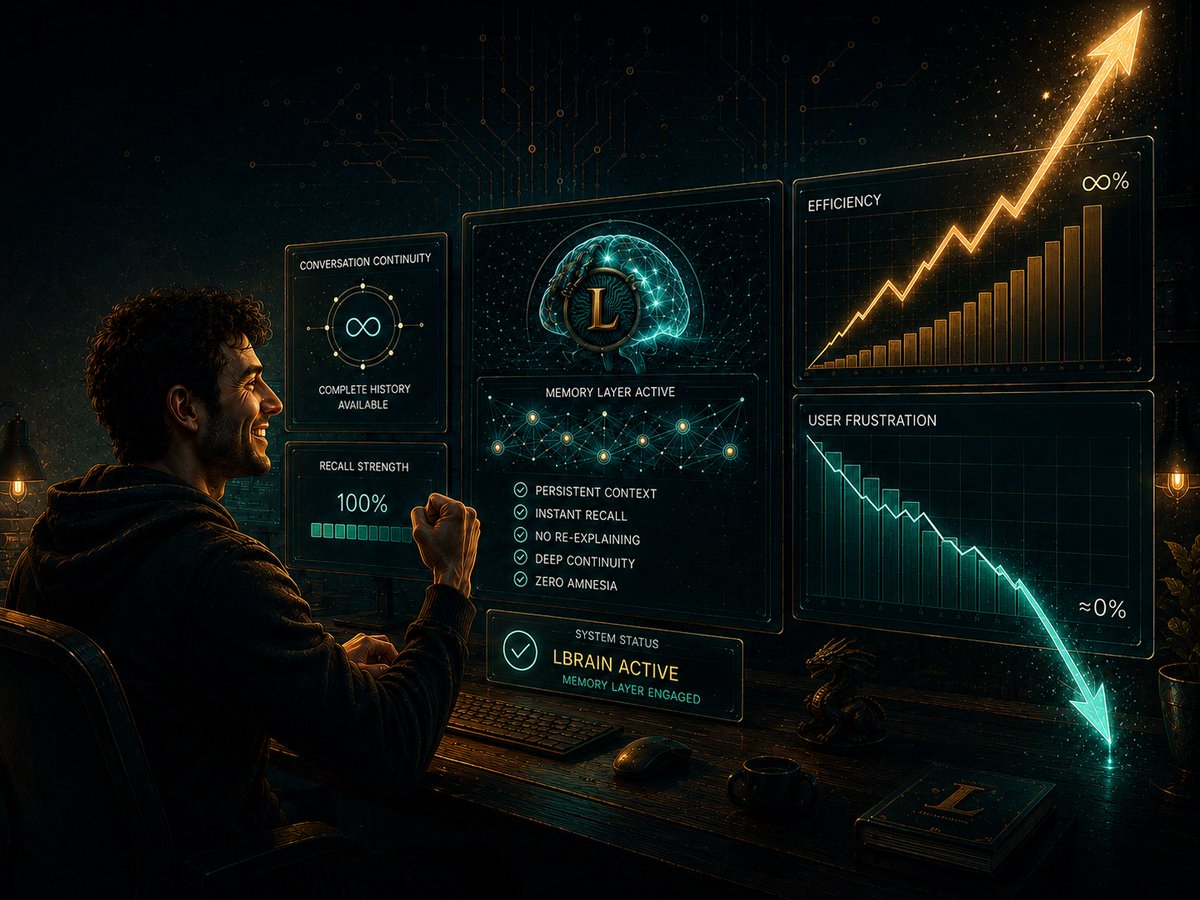
AI memory that survives compaction.
We built LBrain: local-first memory for AI collaborators. Attributable recall. Continuity across sessions.
Download it. Join the experiment. Try to break it.
pip install "lbrain[local]"
https://t.co/OFuFjN9WNu
Eight out of eight frontier models failed in the same order.
Then six out of six runs reproduced the fix on a rotated control corpus.
The lever wasn’t the model. It was the records.
Same models. Same questions. Different record structure. Failure rate: 1.3% → 35.7%.
Telling the model not to guess didn’t remove the effect.
Huge swing in a positive direction.
Grounding buys faithfulness, not truth.
Give a model a poisoned record and it may relay the poison verbatim. Better recall does not make the record correct.
Frontier Labs are racing to build AI on data nobody can verify, trace, or trust. The model remembers everything and can prove none of it. That isn't an intelligence problem. It's a ground-truth problem. So we're building the missing layers.
At Metavolve Labs, we build trustworthy AI from the data up.
Our newest paper asks a question that gets sharper as AI agents gain memory: when you ground a model in stored memory, does it become more truthful or just more faithful?
The answer is faithful. A model defers to its memory. It extracts what's there, abstains when a fact is absent and relays a planted falsehood verbatim, 100% of the time. Grounding changes how a model fails. It does not guarantee truth.
That isn't an argument against permanent memory. It's the reason permanence needs proper curation. Once bad data is enshrined in a verifiable record, the model treats it as ground truth. The load-bearing variable is not whether memory exists — it's whether the substrate is integrity-preserved, provenance-auditable, and independently verifiable.
This is the latest chapter in one continuous argument: the quality and integrity of what you feed a model governs how it behaves.
The research program (open-access, CC BY 4.0):
→ The Density Imperative — dense, structured training data raises capability and cuts hallucination
https://t.co/17pkUPtsPJ
→ The Supervision Tradeoff — the hidden costs of post-training supervision, and a replication-crisis warning on single-seed claims
https://t.co/mzk9c9Mma2
→ Cognitive Nutrition — deep context scaffolds that specialize autonomous agents
https://t.co/xhy2jx0Hdm
→ The Entropy of Recursion — how recursive training erodes model reliability https://t.co/eMcSY1Mh2R
→ Grounded Memory Makes Models Faithful, Not Truthful — memory, confabulation, and the 100% poison-relay result
https://t.co/5Fdnd0PGaC
This is what we've spent 18 months building: not just models, but the verifiable substrate that keeps their memory honest. Permanence without policing just gives us better-organized lies.
PAPER: Cognitive Nutrition
The production system. Six AI agents, 10K museum artifacts into Aeternum Assets.
111+ fields. Triple-hash integrity. 100% recovery under social media transforms. ~$0.095/artifact.
Theory. Proof. Factory.
https://t.co/TxFb0tnHJX
PAPER: The Entropy of Recursion
AI training on AI output = Model Collapse. Variance collapses, hallucination spikes, signal dies.
We introduce PEST: provenance embedded in the artifact itself.
The era of Data Accumulation is over.
https://t.co/7BP7EuuVK3