New to @ArweaveEco and @aoTheComputer?
Here's what we are about:
1️⃣ Arweave is the permanent substrate for a new, decentralized cyberspace.
2️⃣ It is onchain data at any scale. >25 billion pieces of data and counting.
3️⃣ AO is a decentralized supercomputer built on that foundation.
4️⃣ It offers smart contracts that run as parallel processes each with their own throughput, but a universal communication layer: Arweave.
5️⃣ AO goes much deeper than just smart contracts, though. The AO-Core protocol can turn every service you use in cyberspace into a graph of enmeshed micro-blockchains. Down to every single individual HTTP packet nodes transfer. Authenticated, verifiable, and attestable.
6️⃣ It is unhelpfully novel. It is genuinely so different to existing networks that there are no narratives that capture the ideas. High bar to entry now, but when it clicks, you will see something that crowd has not yet realized.
7️⃣ Arweave is a stable, mature protocol. Mainnet has been live since 2018, serving more use cases than we can keep track of. It has been deflationary from real usage alone almost every month since the start of '25.
8️⃣ AO is a completely different beast. It is early, half-hatched, janky and will take time. It is an enormous project but the vision is getting closer every single day. If you are looking for 'just another L2/X but Y' it is not for you. We are gunning for a deeper prize: A permanent computer for humanity, capable of consuming the internet itself.
9️⃣ $AR is 99.4% circulating already.
🔟 AO minting is early: Distributed 1/3 to AR holders and 2/3 to pre-bridgers of yield-baring assets from other networks. 21m cap, 4 year halving, 0% pre-mine.
That's the sitrep. Glad you found us 🫡
The Atomic Asset Migrator is live!
Connect your wallet to find Legacynet Atomic Assets from old profiles and UCM activity, then migrate them to mainnet.
This tool creates a new AO mainnet asset record pointing to the same artwork already stored on Arweave—no re-uploading the art.
https://t.co/vromGGco6a
ArLMDB unlocked using Arweave as a decentralized database engine that streams content only as you need it. Today those databases gained realtime update properties, too.
Same verification, but with updates that take effect instantly. Read more 👇
https://t.co/VNEXlxDp8Y
AO standardizes services.
Each device is a reusable capability that any node can host, route, and build with.
Infrastructure stops being a centralized dependency and becomes part of a verifiable network anyone can access.
I haven't seen it done on an AndEE inference deployment yet, but in theory yes -- taking payment for inference on your phone from other people should work out of the box.
There are devices called [email protected], [email protected], and [email protected] that let you orchestrate charging (via a local AO subledger) for any compute on your node. If you staple them together, pay to push a message to an agent process should just be a matter of config?
Practically though you would only want to run one of these agents at a time on a phone given the RAM constraints. I would guess people are more likely to use it for themselves than to delegate it 🤷. That said, frontier inference (via [email protected]) with AndEE-local Linux sandboxes ([email protected]) on the phone is definitely a service that you could provide to multiple other users at once.
Have been porting this to run agents as @aoTheComputer processes directly on phones with the (unreleased, yet) PermawebOS Android build.
Still slow so far but its pretty amazing to have a software TEE-ish trust-minimized agent executing in your pocket.
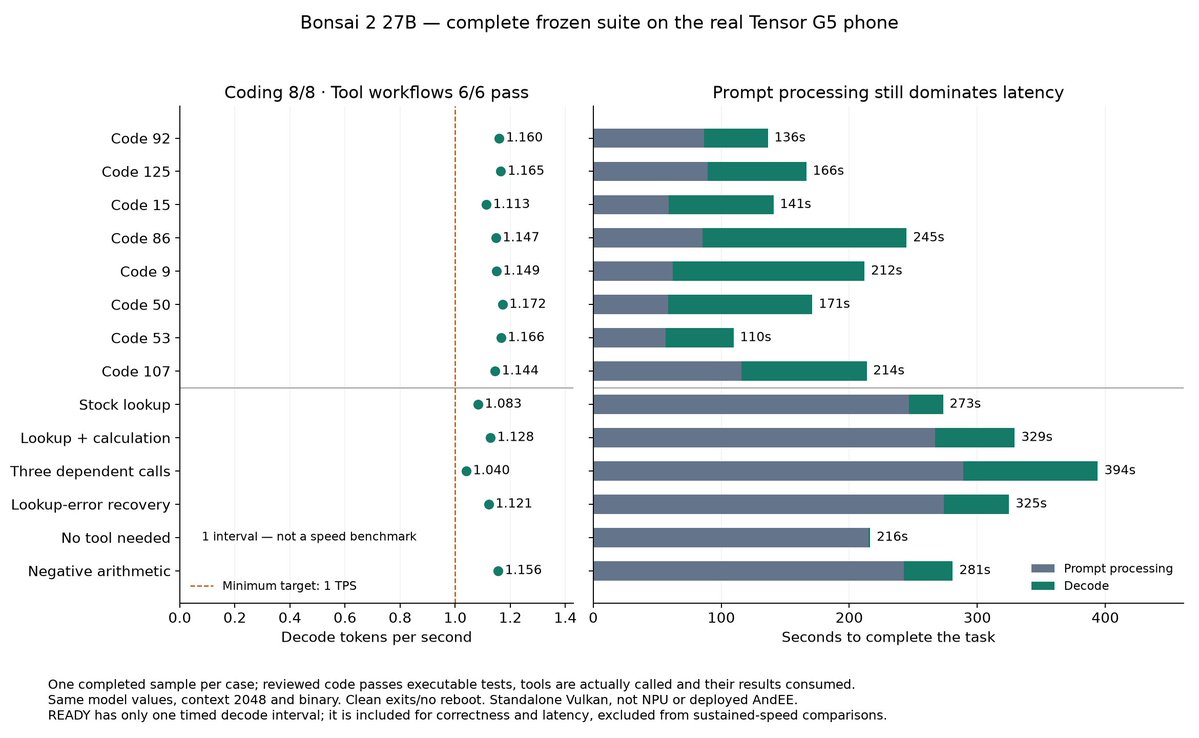
The base model is supposed to be ~Opus 4.5/4.6 level and the Bonsai quantization apparently retains most of capability. Big if true -- has anyone tried it?
Today, we’re announcing Ternary Bonsai 2 27B.
Based on Qwen3.8 27B, Bonsai 2 27B is 9x smaller than its full-precision counterpart while retaining 98.2% of its aggregate benchmark performance.
Two months after the first Bonsai 27B release, the biggest change is quality. The footprint remains 5.9 GB, but the gap to full precision has narrowed materially, with particularly strong gains in agentic coding, multimodal reasoning, and long-horizon tool use.
Ternary Bonsai 2 27B is available today under Apache 2.0.
In the queue after v3 of the AO mint! v3 is mainnet-native (Arweave scheduled rather than legacynet) and comes with real-time distributions rather than daily ( https://t.co/IaUVWym6rz ), but that also affects how the downstream components need to work with it. And yes: We inherited it from another ecosystem partner but we plan for the new version to be that exact same split. No changes there, just real-time rather than daily.
New to @ArweaveEco and @aoTheComputer?
Here's what we are about:
1️⃣ Arweave is the permanent substrate for a new, decentralized cyberspace.
2️⃣ It is onchain data at any scale. >25 billion pieces of data and counting.
3️⃣ AO is a decentralized supercomputer built on that foundation.
4️⃣ It offers smart contracts that run as parallel processes each with their own throughput, but a universal communication layer: Arweave.
5️⃣ AO goes much deeper than just smart contracts, though. The AO-Core protocol can turn every service you use in cyberspace into a graph of enmeshed micro-blockchains. Down to every single individual HTTP packet nodes transfer. Authenticated, verifiable, and attestable.
6️⃣ It is unhelpfully novel. It is genuinely so different to existing networks that there are no narratives that capture the ideas. High bar to entry now, but when it clicks, you will see something that crowd has not yet realized.
7️⃣ Arweave is a stable, mature protocol. Mainnet has been live since 2018, serving more use cases than we can keep track of. It has been deflationary from real usage alone almost every month since the start of '25.
8️⃣ AO is a completely different beast. It is early, half-hatched, janky and will take time. It is an enormous project but the vision is getting closer every single day. If you are looking for 'just another L2/X but Y' it is not for you. We are gunning for a deeper prize: A permanent computer for humanity, capable of consuming the internet itself.
9️⃣ $AR is 99.4% circulating already.
🔟 AO minting is early: Distributed 1/3 to AR holders and 2/3 to pre-bridgers of yield-baring assets from other networks. 21m cap, 4 year halving, 0% pre-mine.
That's the sitrep. Glad you found us 🫡
Two observations:
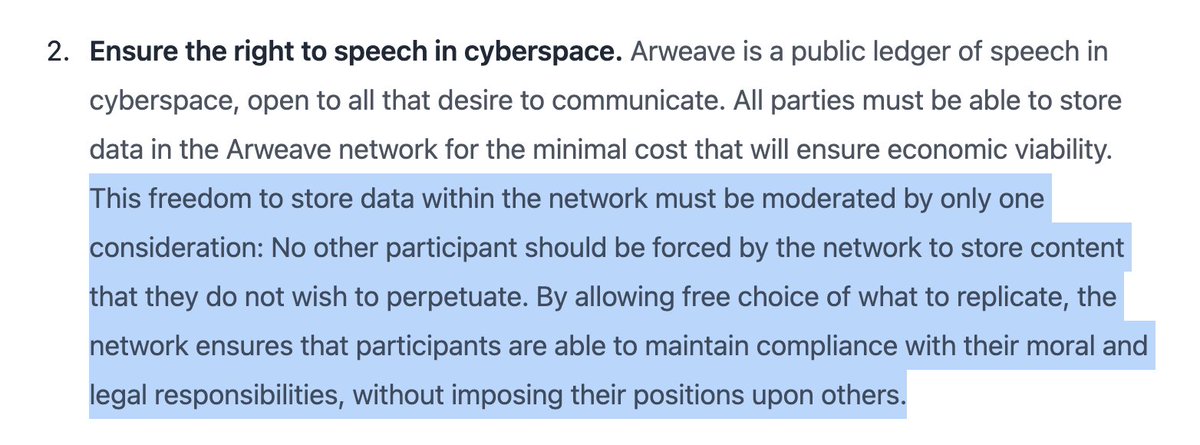
1. Anything hosted on AO inherits the Arweave principles: https://t.co/mBbdIpsb1G
See principle 2. People should not store data -- whatever it pertains to -- that breaches their moral and legal responsibilities. This is our mutual contract and it stands as much today as at any other time.
2. This was something I was very concerned with personally after trying GPT-2 at the end of 2019. I think the 'risk' from AI's rise is real, but likely won't play out as people expect it to. As regards Arweave, though, after thinking about it carefully I do not see that it changes the risk factors at all. The reason is simple: Decentralized computer or not, a rogue AI would replicate itself as a virus by preference. Each replication that is hidden on a machine somewhere on the internet is added resilience for such an intelligence. If it was remotely intelligent enough to get close to harming humans at all, it would also be vastly smarter than needing Arweave to help orchestrate replication for it.
Arweave helps data that does not fight for itself to survive long-term. Malicious, intelligent data that fights for itself simply wouldn't need it.
Ha, thanks. Fun to speak to you all, too! To be real with you I stopped posting for a confluence of reasons. We are deep in the replies here so if you/anyone else is curious, here's the more personal truth... For those just interested in Arweave/AO just skip 🙂.
The first factor was that around 2 years ago building AO-Core/HyperBEAM more or less took over everything in my life. I knew people were excited about AO testnet at that time and wanted it to be Great™️ ASAP. I was also starting to see the bigger picture of what AO could become if we got it right. To add to that crucible, one thing building Arweave personally taught me is that it is an awful lot easier to grow a protocol if you just get it right first. The incentive is always to be shout about it before it is done, but if you can't serve demand it is futile. Every big update after 1.0 makes the protocol combinatorially more complex, too, degrading the utility of the stable version when you get there. Put those things together and there wasn't much time for X 😅.
Another thread was that around the time I started to post less I had begun to notice that certain claims being made in web3/projects in the ecosystem w.r.t decentralization didn't match with the facts as I saw them. I found myself feeling uncomfortable with those posts and did not feel I could promote them in good faith. At the same time, while Arweave has been properly decentralized for almost all of its history, I also saw that we needed to take AO from a distributed testnet to a properly decentralized network, too. I think the adage is something about taking specs/logs out of one's eye/other people's? 😂. So I focused on that -- as well as verifiability for https://t.co/tFNiqaBQwh and the bundlers when that came up along the way. Still much to improve but with the `[email protected]`-based processes and the `[email protected]` device, I am happy to say you and I's Dumdum profile pictures are now fully, incontrovertibly decentralized 🙂.
On top of that, while I love chatting with people that care about the permaweb and I am incredibly grateful to each (genuinely!), I am also simply a private person. I used to tweet often because it was what Arweave needed in order to get the word out most effectively. With AO, which I am convinced is the best fastest way to push the adoption of Arweave today, the necessity has been builder-mode focus.
...and that is still true today if we want that spec done 😄, so no promises. It has been nice to talk to you all though! Looking forward to the AO adoption arc of the journey 🫡
Ha -- depends which part! I think the 1.0 spec DRAFT-4 is very close to the true fundamentals of AO-Core. I think it is AO's 'Arweave 2.6': The first version of the protocol that is genuinely good (which is rare!), and could remain in-place indefinitely without selling the vision short. There are still loose ends in the version as written, but I think there are clear answers for all of the hard questions now. The remaining task with the spec is precision.
Very close is exciting, but the context is that it has taken 2-3 years to get to this point -- zero promises on timeline. The last 5-10% could still take time. We just refuse to cut corners. I would rather we have tried to build something genuinely great and it take time than we just replicating the same EVM clone you can get in hundreds of other places. Nobody needs that.
In terms of everything else on top of it: Much more to do in the ecosystem of devices. I am particularly excited about the single-assignment of AO stake (with [email protected]) to each computed result. The funny thing is that once we have the bedrock foundation laid, building all of the devices -- from what we have seen so far -- is close to instant now. The agents do it extremely well. The properties of the base protocol flow to those new devices automatically. Brick by brick! 🙂