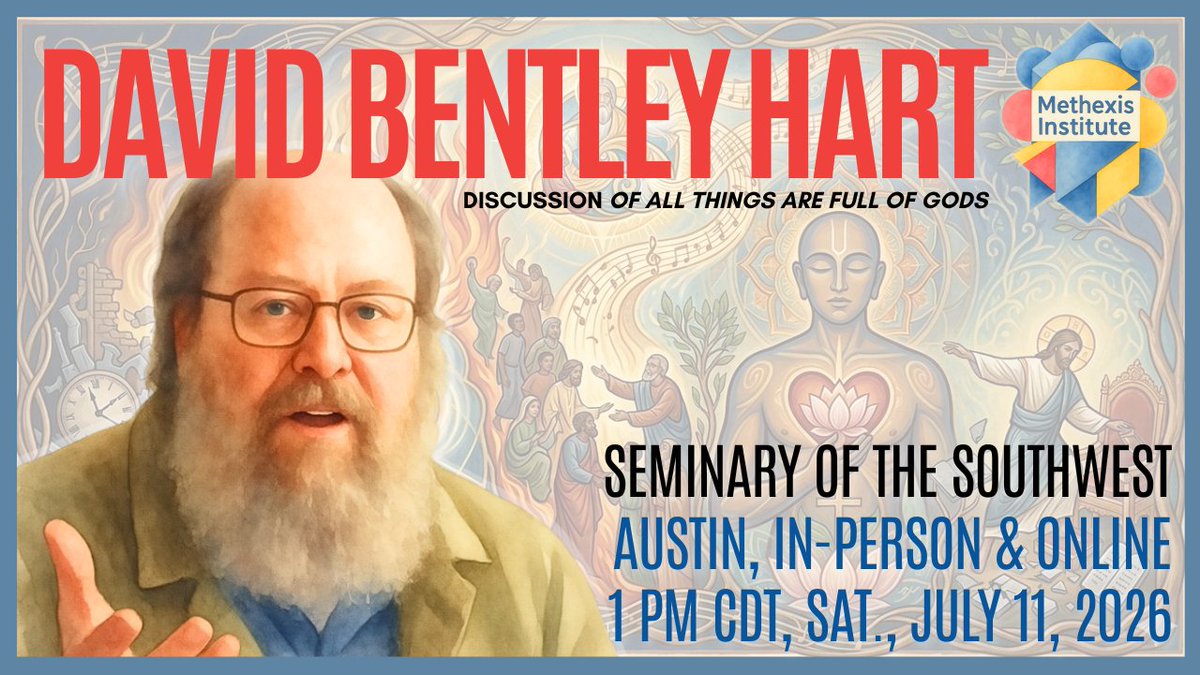
David Bentley Hart
'All Things are Fully of Gods' Discussion
Online & In-Person, Austin Texas
Seminary of the Southwest @mySSW
1 PM CDT, Saturday, July 11, 2026
Register to join: https://t.co/83hM6c3C9b
I am delighted to announce that my article 'Hegel’s Dialectical Syllogism: A Contribution to Theology of Logic' has been accepted for publication in Logica Universalis, a peer-reviewed academic journal that studies universal logic and dialectic.
Abstract:
Hegel’s dialectical syllogism links his logic to his theology. For the middle term of the syllogism in logic is essentially mediated by the absolute Idea of Logic, as ultimately by the self-return of Logic in Spirit, and the Holy Trinity of the Christian Religion in a trinitarian ontology of logic, that is, a trinitarian logic. This link of logic to theology signals the clearest contribution to what I designate as ‘theology of logic’. Theology of logic is a theological interpretation of logic: in contrast to philosophy of logic, it asks the prior question of the contingent grounds for our very belief in logic. Hegel has, in the Syllogism chapter of his Logic, developed a post-Aristotelian dialectical syllogism, in which the Concept dynamically differentiates even as it sublates its extremes to produce new knowledge. This dialectical syllogism is distinguished as a dynamic self-mediating cycle of judgments, where indifferently connected judgments are circuitously united through the reciprocal intermediation of a shared middle term. Since mediation and extremity mutually coincide, each syllogism may be intermediated by each other. This exchange of judgments further implies an interchangeability of concepts, where each subordinate concept interchangeably cycles within every superordinate concept, in dialectical triads consisting of a self-dirempting universal, a coincident opposition of mutually related particulars, and a reconciling concrete singular. Every such dialectical triad of concepts can then cycle around one another, through such interchangeable relations of mediation and extremity, like a ‘circle of circles’, in which the intermediating centre and the furthermost periphery forever coincide. Hegel presents the Holy Trinity in the Lectures on the Philosophy of Religion as the absolute triad of all triads in each syllogism, which comprises this ‘absolute syllogism’ of the entire system of philosophy. Since, finally, the system itself is an absolute syllogism, and this absolute syllogism is the economic procession of the Trinity, every conceptual category of the system can ultimately be sublated and re-posited in and through the logic, dialectic, and syllogisticity of the Holy Trinity. The Christian Trinity thus not only figuratively corresponds to but truly coincides with the logical moments of every concept, and any thought. In answer to this absolute theological questioning of logic, Hegel shows logic to be ontology, ontology to be theology, and theology to be trinitarian, in a trinitarian ontology of logic, that is, a trinitarian logic.
David Bentley Hart
'All Things are Fully of Gods' Discussion
Online & In-Person, Austin Texas
Seminary of the Southwest @mySSW
1 PM CDT, Saturday, July 11, 2026
Register to join:
https://t.co/83hM6c3C9b
At 1 pm CST on Sunday, 14th June, the Methexis Institute Forbidden Books reading group will host a discussion of Iain Hamilton Grant's 'Philosophy of Nature After Schelling' (2006)
Link to join:
https://t.co/PDFgwCnGMR
At 1 pm CST on Sunday, 7th June, the Methexis Institute Forbidden Books reading group will host a discussion of Luce Irigaray and Michael Marder's 'Through Vegetal Being: Two Philosophical Perspectives'. (2016)
Link to join:
https://t.co/83I2wT70QJ
Dr. Paul Tyson joined the Methexis Institute co-directors Dr. Ryan Haecker and Rev'd Dr. Matthew Boulter for an interview about his recent books 'A Christian Theology of Science' (2022) and 'Gender Theory Is Wrong' (2026).
https://t.co/JnyHwmFTw5
Dr. Paul Tyson joined the Methexis Institute co-directors Dr. @RyanHaecker and Rev'd Dr. Matthew Boulter for an interview about his recent books 'A Christian Theology of Science' (2022) and 'Gender Theory Is Wrong' (2026).
https://t.co/wkEhq66e8C
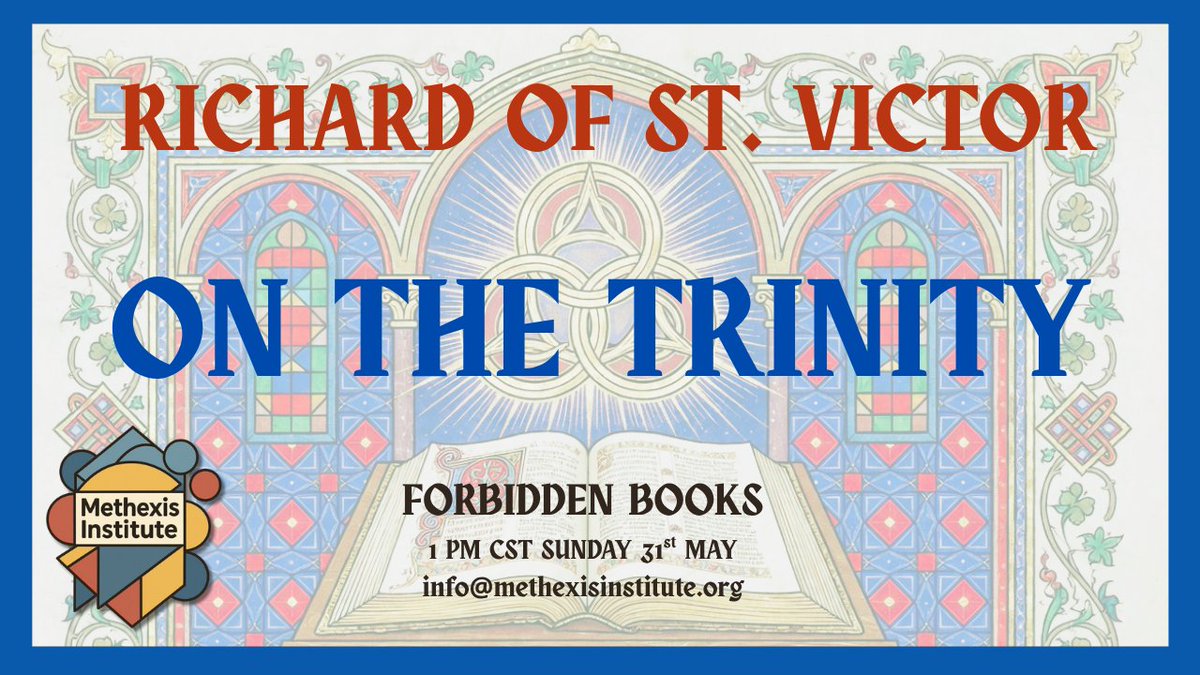
At 1 pm CST on Sunday, 31st May, the Methexis Institute Forbidden Books reading group will host a discussion of Richard of St. Victor's 'On the Trinity'.
Richard was canon regular at the Abbey of Saint-Victor in Paris, studying under Hugh of Saint-Victor, serving as prior from 1162 until his death in 1173.
In On the Trinity, Richard argues that supreme charity (caritas) cannot be self-contained. It inherently requires a plurality of equal persons. Starting with the necessity of a single, maximally perfect divine substance, Richard reasons along four steps: (i) God must have maximal charity, or other-love; (ii) to be perfectly good, delightful, and glorious, God’s other-love must be shared among at least two, and (iii) among at least three, divine persons; (iv) the metaphysics of divine processions and love each ensure the impossibility of four divine persons. By analyzing this shared, altruistic love, Richard demonstrates that the Divine essence must logically exist as three distinct, mutually giving persons.
Please, if you can, read as much as you can of books One through Three (pp. 51-153). As ever, it is not required to read in advance to attend this group.
The full book (in English and Latin) is available to download here:
https://t.co/LlxWrOo3bU
Please, if you can, read as much as you can of books One through Three (pp. 51-153).
The full book (in English and Latin) is available to download here: https://t.co/LZ7tU03rms
At 1 pm CST on Sunday, 31st May, the Methexis Institute Forbidden Books reading group will host a discussion of Richard of St. Victor's 'On the Trinity'.
https://t.co/83I2wT70QJ
By analyzing this shared, altruistic love, Richard demonstrates that the Divine essence must logically exist as three distinct, mutually giving persons.