Excited to join @WhiteheadInst community! I’m grateful to @manoliskellis and @MITEECS for my graduate training and supporting my journey here. My lab will study the complexity of cell-cell communication and explore its broader implications across various biological scales.
Brainwashing.
We're learning more about how the glymphatic system achieves waste removal from the brain and preserves immune response (such as surveillance) integrity
https://t.co/UVNJ3jTCHM
@ScienceMagazine by @jonykipnis
I am delighted to share that I am joining the Chemical Engineering Dept & ChEM-H Institute as an Assistant Professor at Stanford in fall 2025! My lab will explore the nano-neuro interface, building nano-tools & micro-brain models to tackle neurodegenerative disease 🔬🧪🧠💡
Excited to announce that the Victor Lab is coming to NYC this Fall at the @IcahnMountSinai@SinaiBrain!
My lab will be housed at a new state-of-the art biotech hub on Manhattan's West Side! Check out the lab space and learn more from our website: https://t.co/Omj40wavfY
In @Nature today: 40Hz light and sound stimulation increases peptide release from interneurons, driving clearance of #Alzheimers protein via the brain’s glymphatic system. Study led by @DrLiHueiTsai, @mhmurdock1. https://t.co/FmEO4R8UJE @mitscience@mitbrainandcog
In our new study, we used fluorescent Localization microscopy to generate Hemodynamic maps of the whole Pial & Calvarial vascular connectome. Here, we used Pia-Flow in stroke, other applications for this transcranial powerful microscopy? #Topology#Velocity#direction#diameter
Excited to share our work, out today @CellCellPress.
We show that DNA double-strand break accumulation leads to mosaic gene fusions and 3D genome disruption in human samples and mouse models with Alzheimer's disease pathology.
https://t.co/5rPlP6rlsj
Lucky to have been part of this amazing team (🙌🏻), and to have had a chance to contribute to this body of work across several papers! Check the story from @MIT_Picower summarizing all our findings:
https://t.co/hUbzfueoND
This issue of Cell comes with 3 other papers from collaborations across the labs of @DrLiHueiTsai @manoliskellis 🔥🔥🔥
Check out the cover art designed by our very own Carles Boix!
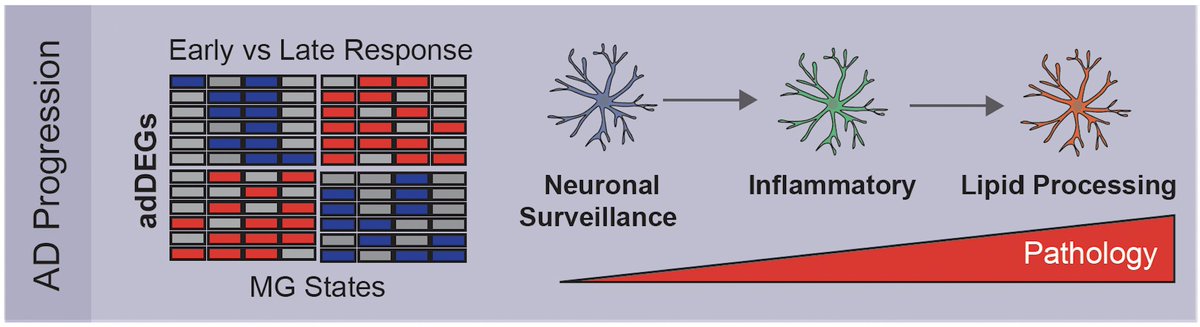
Through differential gene expression, we report transcriptional changes of microglial states in a disease-stage specific manner!
We define the enrichment of microglial inflammatory and lipid processing states, at the expense of surveillance states in the human AD brain!
We build a network of master transcription factors (TFs) poised to dictate microglial states and their transitions in Alzheimer's disease (AD)!
We demonstrated the activity of key TFs in the induction of microglial states through ectopic expression or CRISPRi in iPS-microglia!
Through snATAC-seq, we noticed that microglial state heterogeneity is much higher at the transcriptional level than at the chromatin accessibility level!
One idea is that microglia may retain a relatively permissive chromatin landscape to allow for dynamic state transitions.
Together, @nasun818 and I combined the power of this snRNA-seq data with in vitro modeling using iPSCs to leverage the transcriptomes of 152,459 in silico sorted microglia for functional studies on microglial state dynamics.
Interact with the data here: https://t.co/y3GtoGJweA
What do you do when you have 2.3 million single-cell transcriptomes from 427 human brains with varying degrees of AD pathology?
You spend 3 years exploring the microglia cluster obviously!!💁🏻♂️
Excited to share our work out today @CellCellPress !
https://t.co/Emu0mTPUKf
New pre-print! Are endothelial cells from different brain regions all the same? How are they impacted by the temporal progression of AD pathology? We wanted to know and performed a giant snRNAseq study using 5 different cortical areas 1/3 https://t.co/C7zaTn4lXu
Thrilled to share our work led by @panshelei on region-specific CSF circulation in the developing brain - out today in @NatureComms. This has implications for neuron-CSF interactions and cognitive outcomes in #hydrocephalus@WashUNeurosurg@WUSTLmed https://t.co/vjV3ARYnqF
Super excited to share our work identifying an enhancer regulating Prox1 expression, lymphatic identity and the ability of lymphatic endothelial cells to produce haematopoietic cells, published online today in @Nature! An amazing team effort! https://t.co/E8PW17sJ34