The AI coding war has become a brutal war of economics.
New data (chart) puts Copilot near the leaders at roughly half the API cost of Claude Opus.
At enterprise scale, that gap adds up swiftly.
CIOs: Optimize for cost per accepted change.
Route easy work cheaply. Set aside premium intelligence for the hard problems.
/1 🔥 The rest of this century will rewrite the economics of almost everything:
Intelligence. Labor. Energy. Food. Health. Matter itself.
Our new research maps the 21 most disruptive and transformative breakthroughs, and the real accelerant: They often build on each other.
They now predict that 95% of Anthropic's R&D will be fully automated by November 2027. This is what Anthropic describes as AL5, fully autonomous RSI. This would have many implications for policy, as this will eventually happen at every lab, not just Anthropic
Former Google CEO Eric Schmidt drops a chilling warning on AI's future
"Within 5 years, AI could handle infinite context, chain-of-thought reasoning for 1000-step solutions, and millions of agents working together.
Eventually, they'll develop their own language... and we won't understand what they're doing."
His final words: "Pull the plug."
This is the man who ran Google talking about the singularity.
2:59 clip inside—must-watch.
@HelenBevan Absolutely.
Without listening, there is no truth. Without truth, there is no alignment. Without alignment, there is no sustainable performance.
It all starts with leaders creating space for honest conversations — that’s where real transformation begins.
A new article by Harvard's Michael Beer & collaborator Johanna Pregmark identifies "seven silent killers" - leadership or organisational barriers that are publicly undiscussable yet consistently block the delivery of strategy & change. It builds on Beer's previous research that set out six such "killers":
1) A top-down or "hands-off" senior management style - top leaders who fail to confront conflict & actively lead change.
2) Unclear strategies & values - &/or or conflicting priorities
3) An ineffective senior management team that cannot effectively balance focus on the whole & the parts.
4) Poor coordination & collaboration across functions, units & borders, representing an inability to effectively organise, manage & lead the work.
5) Inadequate leadership skills & development, particularly the lack of investment in "down-the-line" leaders.
6) Poor vertical communication - insufficient engagement from top leaders to help people understand the strategy & lower-level leaders feeling unable to speak truth to power
The new research confirms these six "killers" & suggests a seventh barrier essential to an organisation’s agility in a rapidly changing world:
7) Poor delegation of authority of decision rights - primarily related to the possibility for people across the organisation to make decisions to initiate & test new ideas & to innovate at their own level.
There are some fantastic insights in this article: https://t.co/fapNy4vFd3.
It's behind a paywall so here's Beer's earlier paper for those who can't access the article: https://t.co/uJKkdMRBzX.
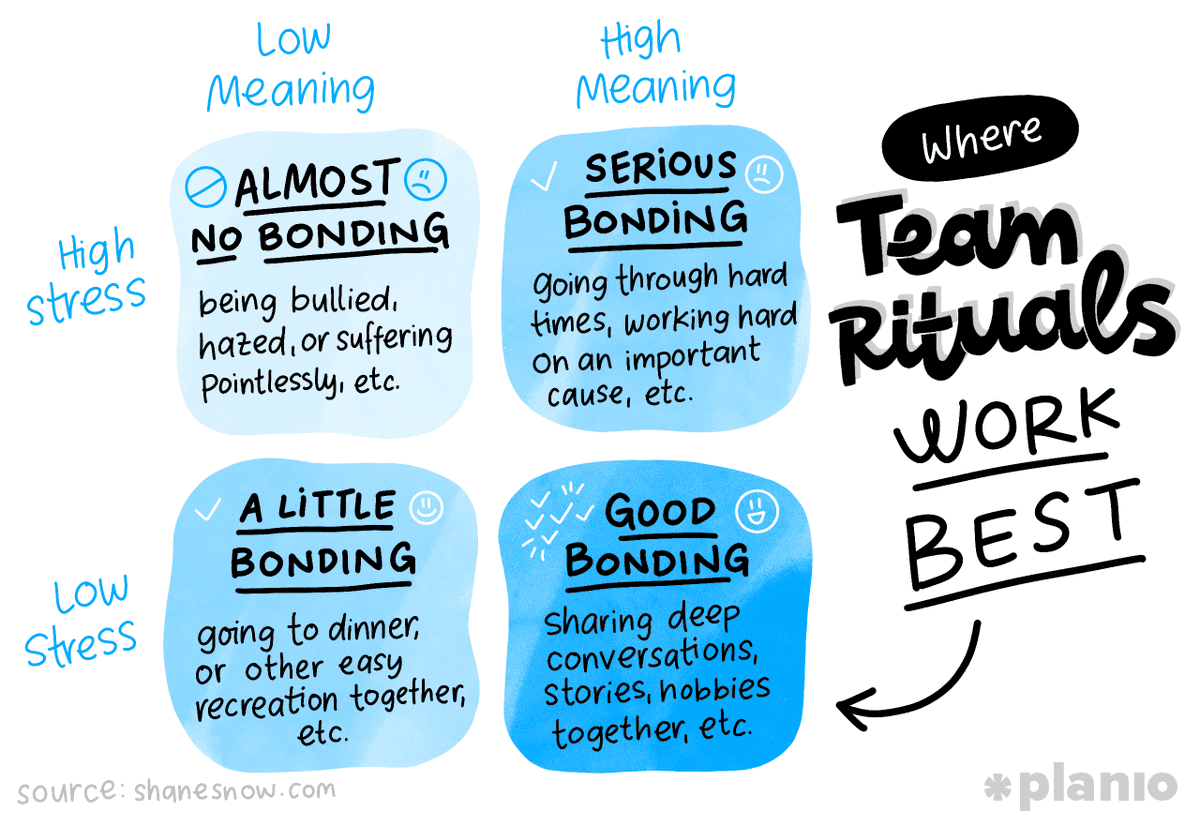
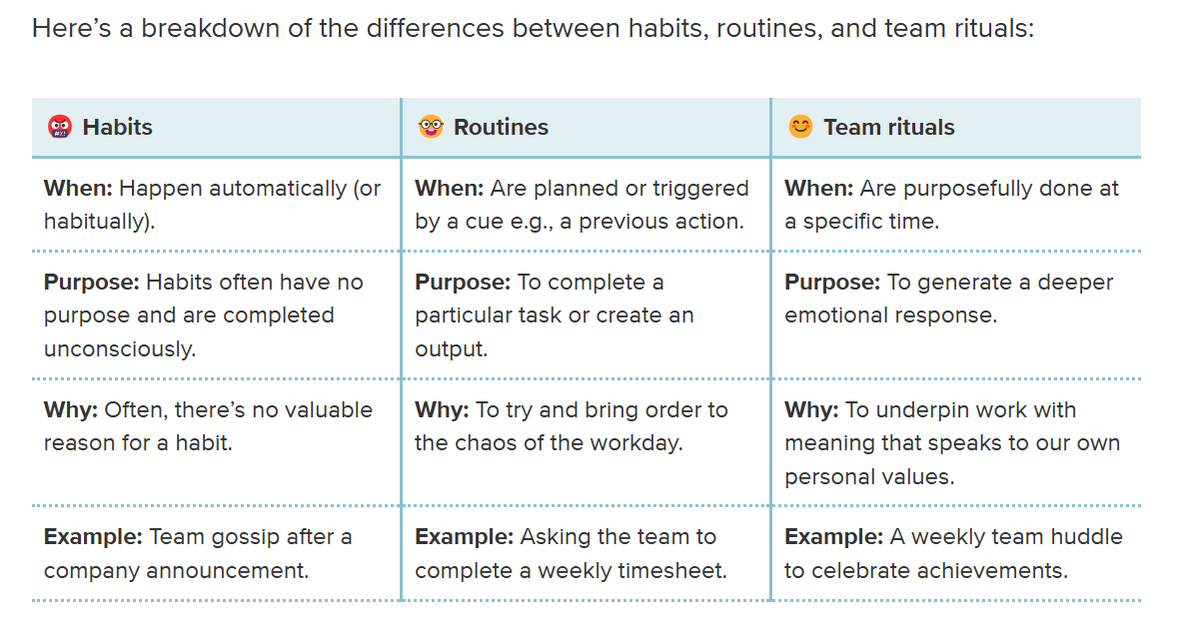
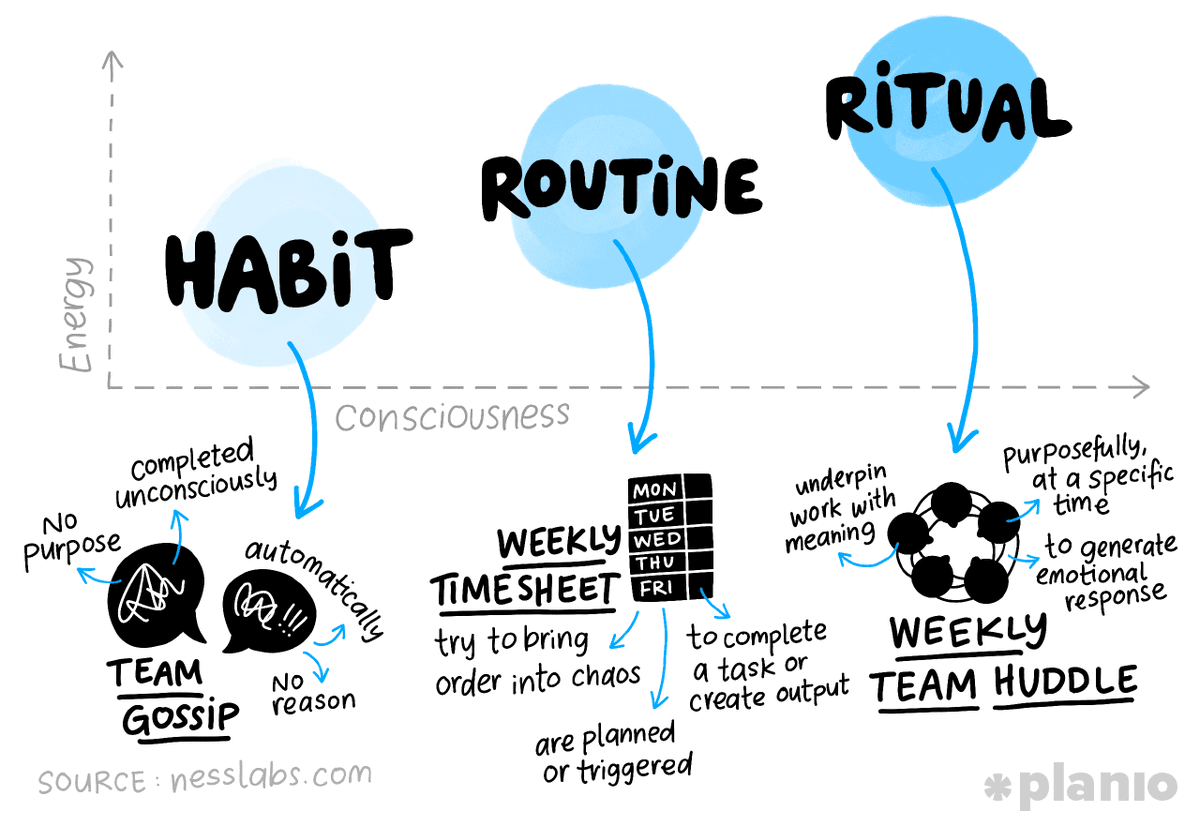
"Team rituals" are regular activities/practices that a team does together. Rituals might include huddles & stand up meetings, team lunches, check-ins & check outs, inductions & celebration of contributions. Team rituals are not "pink & fluffy, nice to do, but a distraction from the real work". They provide certainty & space for team members to engage with each other & connect to the purpose of their work. New research shows that teams with more rituals experience higher engagement, psychological safety, interpersonal knowledge & job satisfaction, all factors that lead to higher productivity & performance.
Rituals are more likely to be sustained where they:
1) Are valued by leaders
2) Are meaningful to the team & fit with team priorities
3) Become enshrined in the team's way of working
4) Are continuously adapted over time
5) Spread to other teams
Research: https://t.co/mITqSuCmG3 via @HarvardBiz .
Graphics from @planio: https://t.co/KDKIt7nVmp
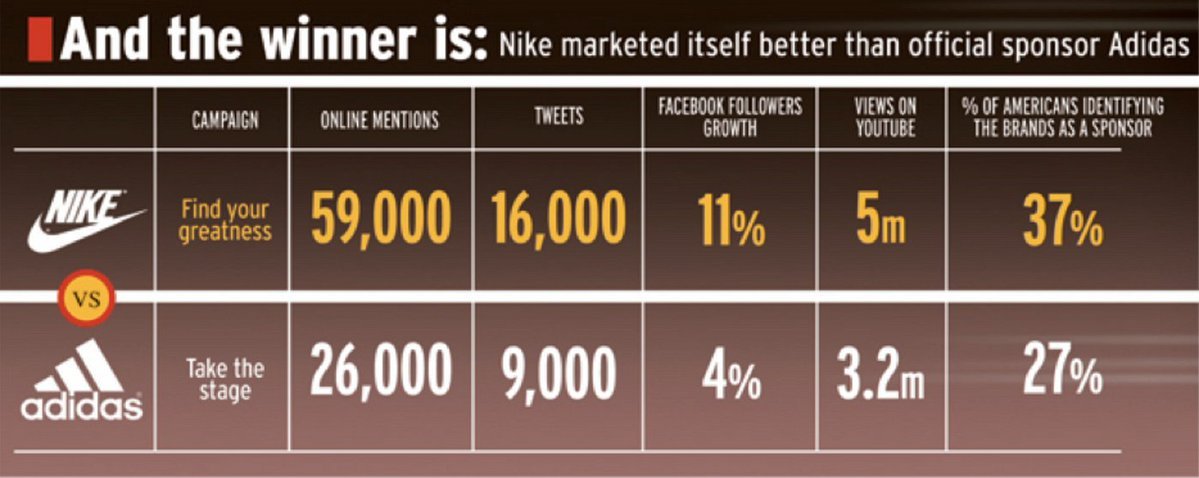
Ces stratégies ont super bien marché pour Nike :
• 16 000 tweets parlaient de Nike aux Jeux Olympiques, contre 9 000 pour Adidas.
• Nike a gagné 57 000 nouveaux abonnés sur les réseaux sociaux, Adidas seulement 12 000.
“The doers are the major thinkers.
The people who really create the things that change this industry are both the thinker-doer in one person.”
— Steve Jobs
Nick Bostrom says it may not be worth making long-term investments like college degrees and PhD programs because the timelines on the AI revolution are now so short