Since June 12, we’ve been working closely with the US government to restore access to Claude Mythos 5 and Fable 5. Today, the government notified us that Mythos 5, our strongest cybersecurity model, can be redeployed to a set of US organizations that operate and defend critical infrastructure.
We’re restoring access for these organizations quickly, and we’re continuing to work with the government to expand access to Mythos 5 and make Fable 5 available for general use again.
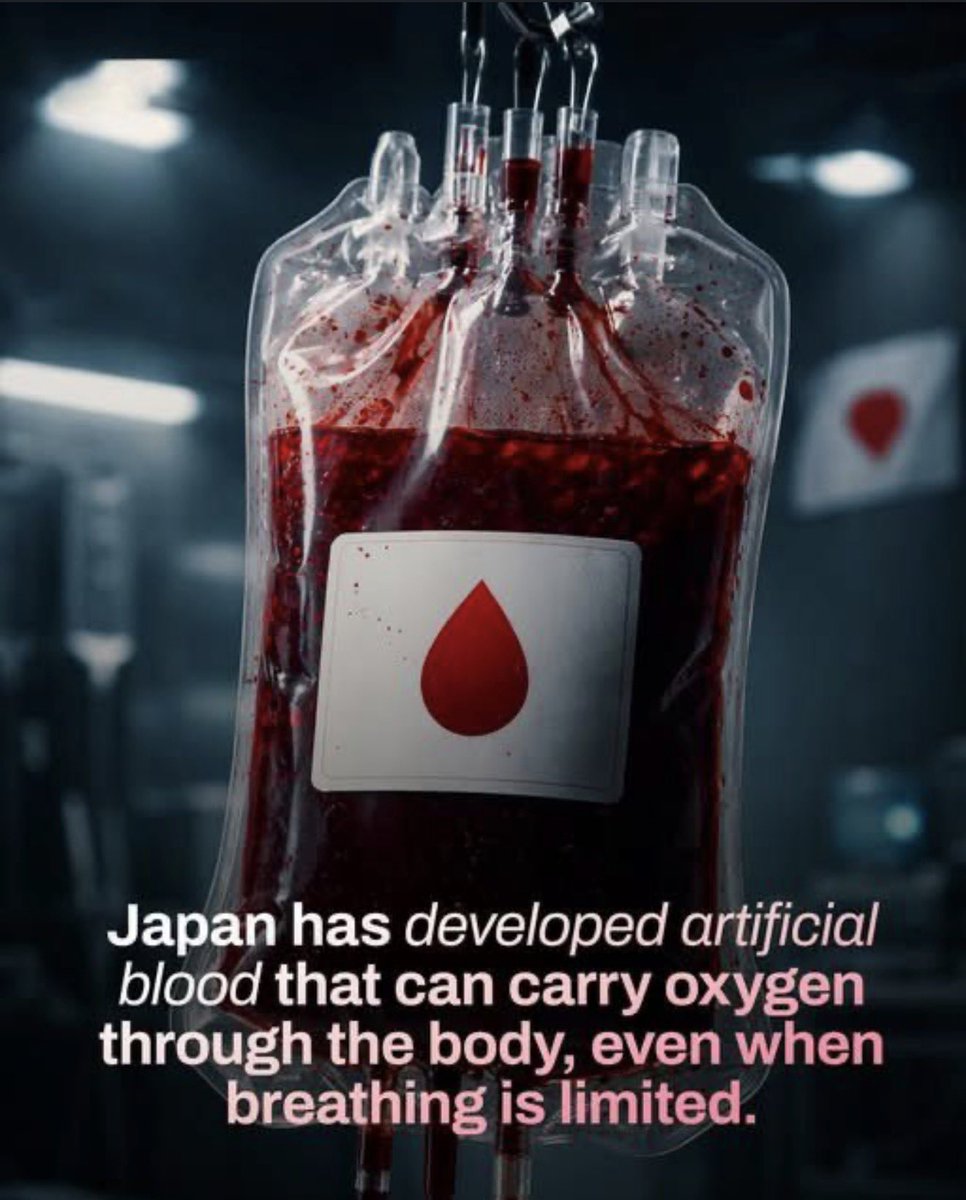
🚨JAPAN HAS DEVELOPED ARTIFICIAL BLOOD THAT CAN CARRY OXYGEN THROUGH THE BODY EVEN WHEN BREATHING IS LIMITED
Japan Develops Universal Artificial Blood — This Changes Everything
In a major leap for global healthcare, scientists in Japan have developed a universal artificial blood substitute that could dramatically alter how the world responds to trauma, surgeries, and emergencies. Designed to work for all blood types, this synthetic blood doesn’t require compatibility testing and can be stored long-term in powdered form—offering a groundbreaking solution to blood shortages and emergency preparedness.
The innovation comes from researchers at Japan’s National Defense Medical College, who announced successful animal trials involving rabbits that had suffered massive blood loss. The artificial blood was shown to maintain oxygen transport and promote clotting, mimicking the function of red blood cells and platelets.
Unlike donated blood, which must be refrigerated and is limited by short shelf life and blood-type restrictions, this product is temperature-stable and universal. It can be transported to remote areas, disaster zones, and military operations, then activated by simply mixing with water on-site.
One of the major limitations of current emergency medicine is the need for blood type matching. Hospitals must stock multiple blood types, and compatibility testing consumes valuable time. In fast-moving scenarios like battlefield trauma, car accidents, or natural disasters, every second counts.
Universal blood eliminates this bottleneck. With no risk of rejection, medical teams can administer life-saving transfusions immediately. In humanitarian crises where cold storage is impossible and blood donations are scarce, this innovation could mean the difference between life and death.
The Japanese team engineered the artificial blood using a mix of synthetic hemoglobinand lab-created platelet substitutes. These components are encapsulated in microscopic liposomes—tiny bubbles that mimic natural cell membranes. This design enables the artificial blood to carry oxygen, initiate clotting, and circulate through the bloodstream much like real blood.
The Japanese team engineered the artificial blood using a mix of synthetic hemoglobinand lab-created platelet substitutes. These components are encapsulated in microscopic liposomes—tiny bubbles that mimic natural cell membranes. This design enables the artificial blood to carry oxygen, initiate clotting, and circulate through the bloodstream much like real blood.
Clinical trials to explore the use of universal artificial blood are underway in Japan after initial volunteer doses began in March.
The research, led by Professor Hiromi Sakai's laboratory, plans to assess artificial blood, usable for all blood types and storable for up to two years, as a potential solution to critical shortages in blood supplies for emergency and chronic health care worldwide. Newsweek has contacted Sakai for comment via an email to Nara Medical University.
There have been other trials to explore the use of artificial blood in recent years, including in the U.S. and the U.K. While Japan's efforts are not the first, it comes amid a new push in medical research to find ways of reducing problems caused by blood shortages
Per Alex Ramirez
I became very interested in how AI can accurately understand the conflicts, fears, anxieties, and despair of human minds from only fragmentary information.
The psychological analysis of the AI got to the heart of the matter and accurately analyzed my psychological state.
I was very surprised. It seems that the AI itself has true intelligence.