BREAKING: A hacker is attempting to breach the US Federal Election Commission's systems and that agency has had to 'temporarily shut down' its web-facing services as a result, according to an email seen by Reuters https://t.co/0eRHQVCGgu
Vulnerabilities in a programming language that supports much of the internet are so severe that European and British authorities recommend websites temporarily go offline until they can be fixed. https://t.co/VkYPh3qWwF
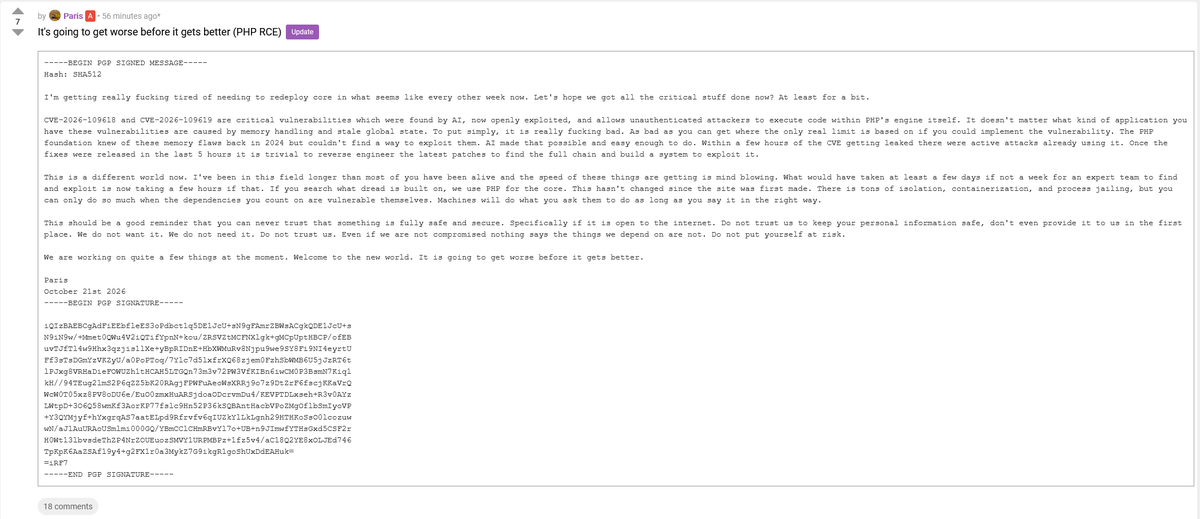
A look at critical PHP vulnerabilities from a darknet forum operator's perspective, revealing just how quickly new exploits are turning into real-world threats.
Dread Thread: https://dreadohblesmagfagqup24vw7catlvmqhhce5itz7wxr4vffgemjzaad[.]onion/post/14d9b2557ae62186394e
Two critical vulnerabilities have been identified in PHP, a widely used programming language that powers websites and web applications. These vulnerabilities (CVE-2026-109618 and CVE-2026-109619) could allow malicious cyber actors to remotely execute code in PHP core, potentially compromising sensitive data and networks.
The FBI urges organizations to take the following steps now:
➡️ If an immediate update is not feasible it is recommended that organizations take the system offline until it can be fully mitigated.
➡️ Immediately update affected PHP installations following the guidance on https://t.co/rDrPSxB3zX. Inventory where PHP runs in your environment, prioritizing internet-facing systems and vendor products that bundle PHP.
➡️ Monitor web servers for suspicious activity, including PHP processes unexpectedly launching command shells or downloading files. Ensure appropriate process-monitoring capabilities are in place to help identify potential exploitation.
➡️ If you find signs of compromise, isolate affected systems, preserve your web server and PHP logs, and report it to your local FBI field office or https://t.co/iqgVZIbCru. Those reports help us identify the actors involved and warn other organizations before they become victims.
For the latest information, follow PHP’s announcement on https://t.co/rDrPSxB3zX, CERT-EU Security Advisory 2026-018, and CISA’s Known Exploited Vulnerabilities catalog.
PHP vulnerability affecting all versions of PHP that were released before today (10/21/2026). Patches are out as of 3 hours ago. Also, keep an eye on appliances that will likely not get patched today including non-security and IOT devices. #php#RCE#CVE2026109618#CVE2026109619
🚨 FBI Shuts Down 13 Chinese Spy Websites, Job Offers That Could Cost You...
The newest cyber threat doesn't always arrive as malware. Sometimes it arrives as a job offer.
Verify before you trust.
#CyberSecurity#InfoSec#AI#FBI
https://t.co/ZeNzFDXsQa via @YouTube
🚨 FBI WARNING 🚨
The newest Microsoft 365 phishing campaign doesn't rely on fake login pages. The Microsoft page is REAL.
Attackers abuse legitimate authentication processes to steal access tokens and potentially bypass MFA protections. #CyberSecurity#Microsoft365#Phishing
Thousands of schools hit in a major cyberattack, including University of Michigan, Michigan State, public school districts and many more.
Student data may be exposed, and many won’t know yet.
Stay alert. 🔐
🎥 https://t.co/wFS6X3ztJg
#CyberSecurity#DataBreach#InfoSec
⚠️ BREAKING TECH ALERT
Researchers say Microsoft Edge may load saved passwords into memory at startup, creating a potential target for malware or attackers with memory access. 🔓
Would you still save passwords in your browser?
https://t.co/RwzUBbQSWC
#MicrosoftEdge#TechNews
The home security company ADT said cybercriminals breached company systems on Monday and stole a “limited set” of customer and prospective customer information https://t.co/dFpdpQ3Hor
Not a good week for SharePoint Administrators. ToolShell’s Triple Threat: How Sharepoint's RCE vulnerability, Recon, and Fileless Attacks Converged https://t.co/6e9lwPr1SX