Our @NatureEnergyJnl paper demonstrates significant energy gain at a utility-scale wind farm by collective control based on a new predictive model. Collective control increases energy without cost for existing farms+enable higher energy density designs 1/9 https://t.co/oOzpYVqq8s
PRFluids Editors' Suggestion: @MIT researchers Klemmer & Howland unveil new insights into wind turbine wakes! They reveal how atmospheric stability transforms momentum & turbulence dynamics, paving the way for smarter, more efficient wind energy solutions! https://t.co/3o30hHnTEg
🚨My lab at @MIT has multiple openings for fully funded PhD students! Topics include computational fluid dynamics, atmospheric flow, uncertainty quantification, renewable energy, and decarbonized power systems under climate change. App due Dec. 1st.
https://t.co/xxEdqqrIFt
Congrats to Prof. Michael Howland on receiving a 2025 Young Investigator Program award from the Office of Naval Research to support his project, “Closing the Loop on Joint Physics- and Data-Driven Modeling of Marine Boundary Layer Turbulence Above Waves.”
https://t.co/QRaBnjiGe8
🚨Postdoc position available in the Howland Lab at @MIT!
Our lab is seeking a Postdoc for a two-year project on "Multi-fidelity modeling and uncertainty quantification of wind power aerodynamics."
Further information about the position: https://t.co/xxEdqqrIFt
@MIT_CEE#energy
Congratulations, 2025 #YIP awardees! 🎉
The ONR Young Investigator Program is a highly competitive program that attracts outstanding early-career academics in #STEM to propose innovative solutions to @USNavy + @USMC warfighter challenges.
📰: https://t.co/T1eVgmcE0E
CEE engineers have developed the first physics-based model that accurately represents the airflow around rotors, even under extreme conditions. The model could improve the way turbine blades and wind farms are designed. https://t.co/R5FUJthvRu
Our new study develops a Unified Momentum Model to predict rotor aerodynamics across operating regimes, eliminating the longtime reliance on empirical corrections used in aerodynamic modeling.
https://t.co/VUs0IB2j5m
@MIT_CEE@MIT
The Unified Momentum Model lowers prediction error across yaw and thrust coefficient regimes by 60%, 83%, and 78% for the induction, streamwise wake velocity, and spanwise wake velocity, respectively, compared to classical one-dimensional momentum theory.
Our lab @MIT_CEE partnered with @VineyardWindUS for community outreach and education focused on the power and opportunities of offshore wind energy at the AHA! New Bedford event
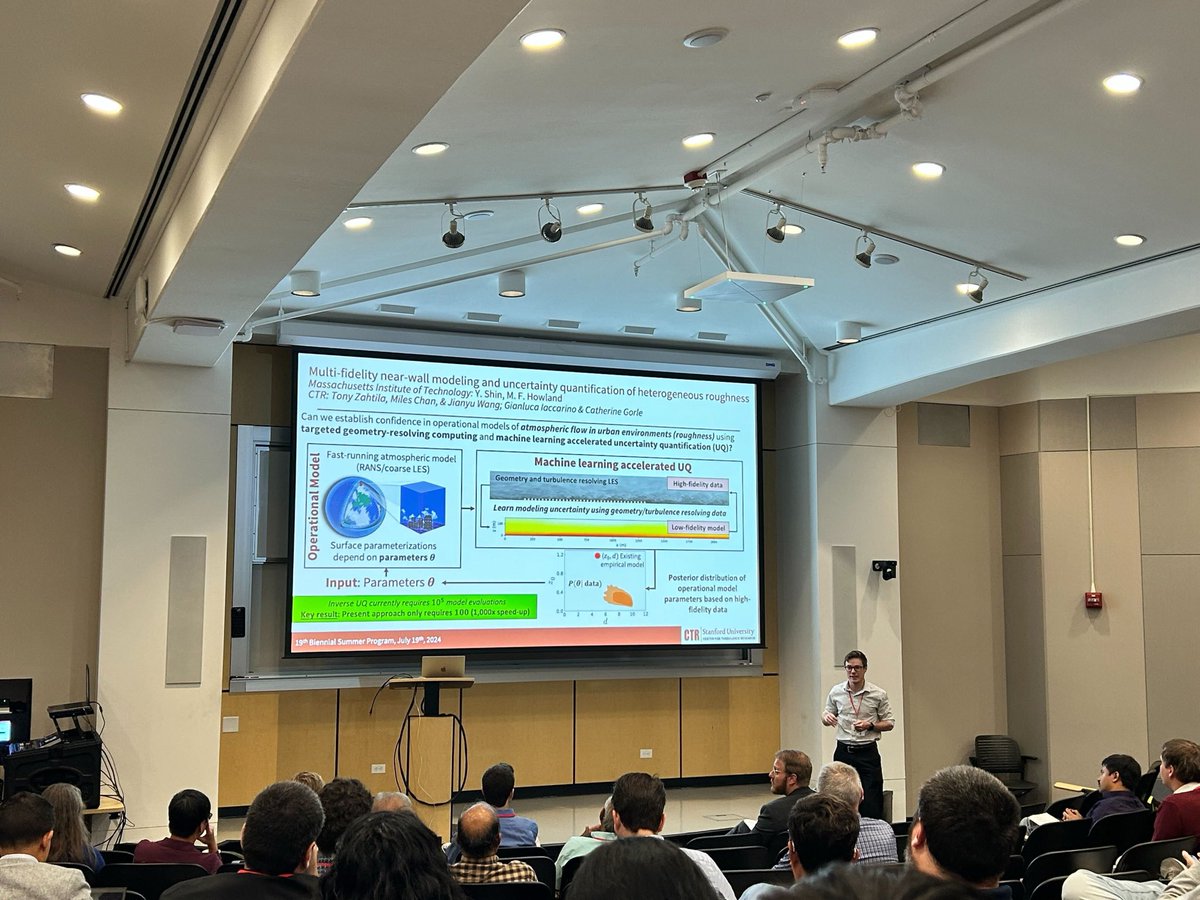
Had a fantastic time at the @Stanford Center for Turbulence Research (CTR) Summer Program, working on our project “Multi-fidelity modeling and uncertainty quantification of heterogeneous roughness.” Thanks to our hosts and CTR for the support!
Wind turbines, especially offshore, are rapidly growing in hub-height and rotor diameter, increasing the impact of wind shear on wind power production. This motivates the urgent need to improve aerodynamic models of the impact of wind shear on power production, wakes, and loads.
New paper from our lab! We performed a field experiment at a utility-scale wind farm with @SiemensGamesa and ReNew, finding that wind speed and direction shear impact wind power by -19% to +34% relative to the mean power curve, depending on the shear.
https://t.co/NWuwdmX9Wi
The blade element representation has lowest error, but all models substantially underpredict the magnitude of the impact of wind shear on power production.