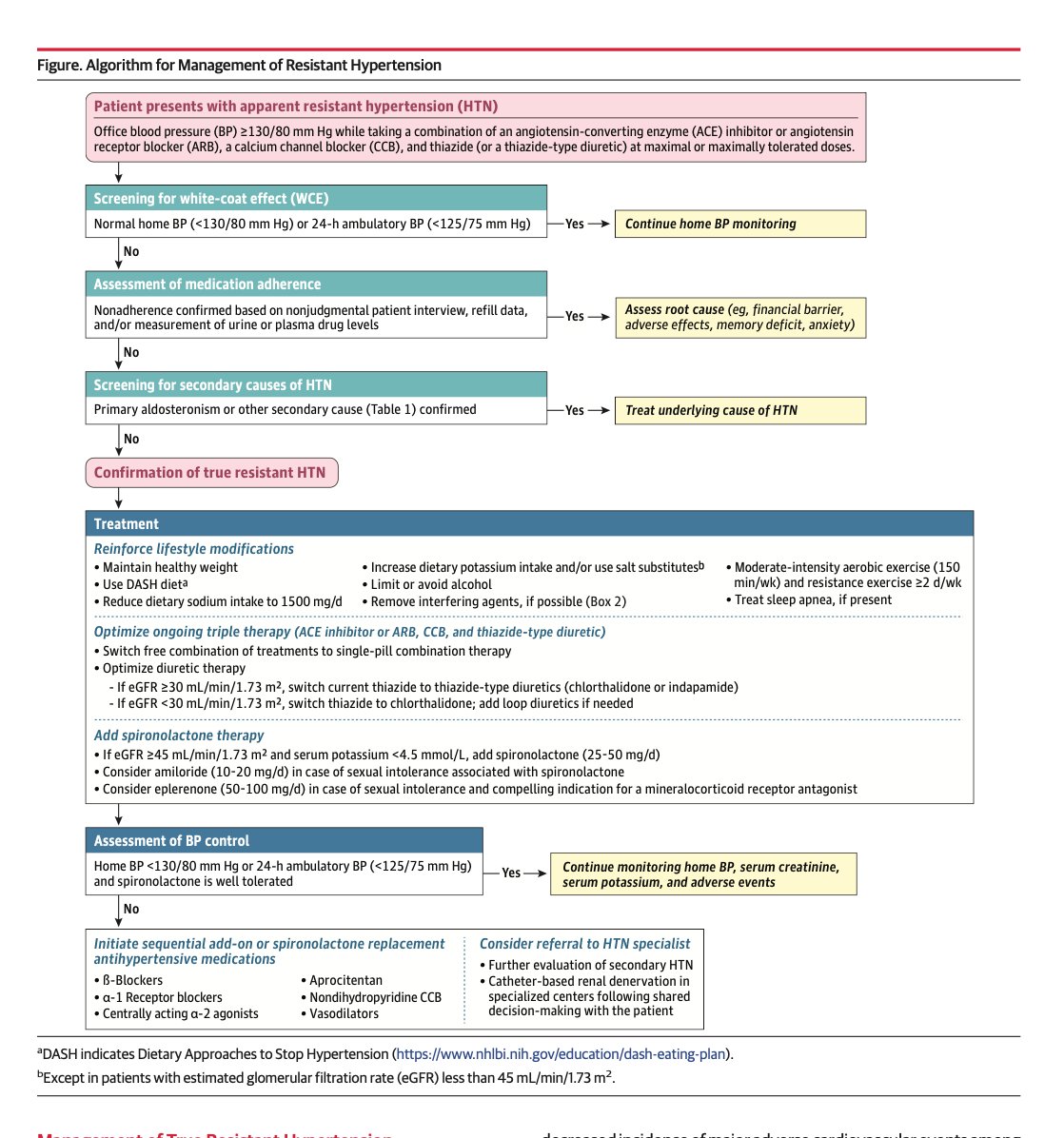
La última revisión de hipertensión resistente (JAMA 2026). Puntos clave:
🔴 Hipertensión resistente aparente: Presión arterial de ≥130/80 mm Hg a pesar del uso de 3 o más medicamentos antihipertensivos (IECA o ARA-II, un bloqueador de canales de calcio y un diurético tipo tiazida) a las dosis máximas toleradas. Guías europeas aun dicen ≥140/90.
🔴Hasta 50% de la hipertensión resistente es por mala adherencia. Importante entonces el MAPA y automonitoreo. Mantener sospecha de causas secundarias (hiperaldosteronismo primario o AOS)
🔴Casi un 20% consumen medicamentos que elevan la presión arterial (AINE o ISRS).
🔴Antes de escalar, incluir un IECA o ARA-II, un calcioantagonista y un diurético tiazídico a dosis máximas toleradas.
🔴Añadir espironolactona reduce -13.3 mmHg. No usar si TFG <45, o hiperkalemia. Cuidado con la ginecomastia.
🔴Aunque está en las guías, la denervación renal transcatéter solo disminuye la PAS ambulatoria en un modesto promedio de -4.4 mm Hg. La evidencia no es muy contundente.
Descarga del PDF en el canal (https://t.co/3O93s10lns).
A 3-year-old child presents with barking cough, hoarseness, inspiratory stridor. X-ray shows “steeple sign.”
Diagnosis?
A) Epiglottitis
B) Croup
C) Bronchiolitis
D) Foreign body aspiration
📌 This Review summarizes the current evidence on the effects of cannabis on commonly encountered mental health conditions and provides clinicians with basic information about cannabis pharmacology and biology.
https://t.co/kYoc7k7O65
TTP vs HUS
Residents, here you go. Brief cheat sheet to learn TTP vs HUS, role of ADAMTS13 and use of plasmic score.
Save, learn and share.
#MedTwitter#MedEd#platelets
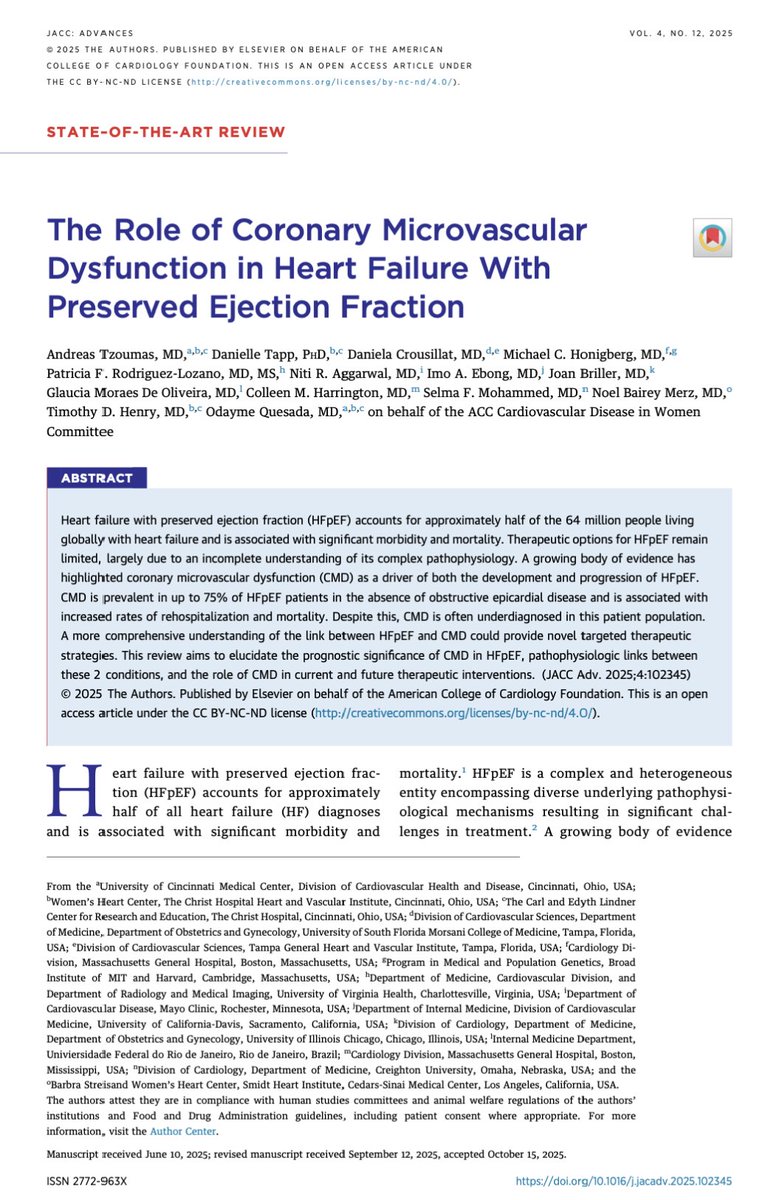
🫀🧠 HFpEF is not just “diastolic dysfunction”: the microcirculation is the missing link
This 2025 JACC: Advances state-of-the-art review reframes heart failure with preserved ejection fraction (HFpEF)through a crucial, often underrecognized lens: coronary microvascular dysfunction (CMD) .
📊 How common is CMD in HFpEF? Very.
Up to 75% of HFpEF patients—even without obstructive coronary disease—have CMD. And this is not an innocent bystander:
CMD is independently associated with higher HF hospitalizations
Increased mortality and MACE
Worse quality of life
Yet, CMD is rarely sought and even more rarely diagnosed in routine HFpEF care.
🧠 Why CMD matters pathophysiologically
CMD disrupts the heart at multiple levels:
🔻 Reduced coronary flow reserve (CFR) → subendocardial ischemia
🔥 Microinfarctions & fibrosis → stiff myocardium
⚙️ Impaired cardiac–coronary coupling → blunted flow during stress
🧬 Inflammation & endothelial dysfunction → vicious cycle of ischemia and diastolic failure
HFpEF and CMD reinforce each other in a bidirectional loop, rather than a simple cause–effect relationship.
👩⚕️ A sex-specific disease
Women are disproportionately affected:
Higher CMD prevalence
Smaller coronary vessels, higher resting flow
Postmenopausal estrogen loss → inflammation, fibrosis, reduced CFR
This helps explain why HFpEF is more common and more complex in women.
🧪 Diagnosis: we’re under-testing
CMD can be assessed by:
PET or CMR perfusion
Invasive coronary functional testing (CFR, IMR, acetylcholine)
But there is no standardized diagnostic pathway in HFpEF—yet.
💊 Therapy: signals, not solutions
Some treatments show promise (SGLT2i, statins, RAAS modulation, lifestyle, GLP-1/GIP agonists), but no therapy specifically targets CMD in HFpEF so far.
🔮 Bottom line
HFpEF is not only a myocardial disease—it’s a microvascular disease.
If we keep ignoring CMD, we will keep failing HFpEF patients.
👉 Understanding and treating HFpEF may finally require looking beyond the ventricle—into the microcirculation.