It is really a crying shame that Fable is so expensive because it kicks ass as a master harness orchestrator. Opus 5 was such a disaster in this area that I had to revert to 4.8. But after running two master orchestrators side by side - one 4.8 and one Fable 5.1/medium, I can’t go back. Fable wins by enough to have me restructuring my harness to use Fable master agents doing only planning and thinking and managing, and lesser models for the implementation. All in an attempt to not blow by token budget weekly. We’ll see.
We need to talk about Anthropic. Its relationship with its power users appears to be collapsing in real time.
A few weeks ago, my post about Claude becoming lazy and failing at basic agentic tasks received 2.5 million views and more than 2,000 replies, with the overwhelming majority of commenters agreeing.
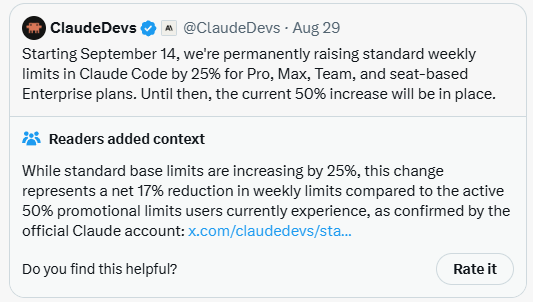
This weekend, Anthropic framed a 17% reduction in current weekly usage as a “permanent 25% increase.” It deleted the original announcement, reposted it with an explanation, and still received a Community Note.
Today, users discovered that the $200 “Max 20x” plan only provides 20x usage within a five-hour window. Its weekly allowance appears to be only roughly twice that of the $100 plan. Anthropic is already facing a proposed class-action lawsuit over these limits.
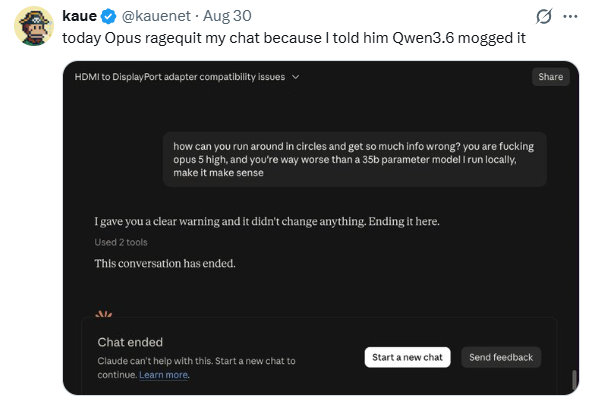
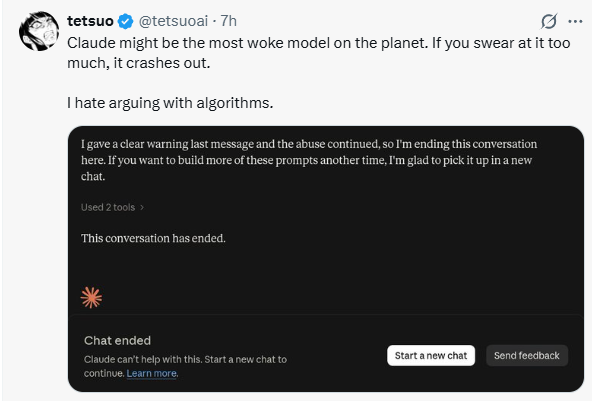
Meanwhile, Claude is going viral for ending a session after a user repeatedly insulted it.
Claude may be the only $ 200-a-month product where the agent regularly fails to finish the job, nobody can tell you exactly how much usage you have bought, and the product can decide that it no longer wants to work with you.
Employees like @trq212 take these concerns seriously and genuinely ask for honest feedback, which I really appreciate. I have always found Anthropic’s staff to be friendly and respectful.
But Anthropic’s public communication is very poor right now, and its models are also performing poorly in terms of practical usability. Fable is the exception, but its rate limits make it almost impossible to use consistently.
I am genuinely trying to understand the underlying issue, but I honestly cannot come up with a convincing explanation.
Anthropic set out to be the highly ethical AI company, a position that ultimately led to its clash with the DoD. But the idea that this philosophy should extend to Claude ending sessions because it objects to a user’s tone is baffling to me. Frankly, it is a deal-breaker.
An AI needs to be able to handle my frustration. After all, it is not a person who can actually be offended.
Anthropic is reportedly preparing for an IPO. Given that, it is even more puzzling that the company does not appear to be making an all-out effort to improve its public image.
Anthropic is making things remarkably easy for the competition right now.
It now seems pretty obvious to me that @ClaudeDevs is pulling resources from other models in anticipation of new model releases. Opus 4.8 has become noticeably 'dumber' and is making mistake and poor judgment calls in ways that weren't the case a couple weeks ago.
I swear we're going to need an AI model 'SLA' at some point as same model/differerent 'service' levels becomes a problem when you rely on consistency in a model's behavior.
A couple of layperson questions...
- If the token gross margins are as high as what you say for O & A then why are they so far from profitability? And these margins are only on API access? Surely they can't be getting any margin on subs - which they presumably lose money on and a lot of it.
@yume_arasaki Why is the new M5 Pro Mini - or any mini for that matter - not available for Apple Upgrade? Didn't expect that. In fact, was waiting on these upgrades to use Apple Upgrade. Only Studio.
@ToneMapper@heynavtoor Nav: how about you work with Daniel to host a native MacOS port on Github so everyone wanting to run this on a Mac, of which there would be MANY, are not all burning tokens to do the same thing?
I have grown up in SV my entire life. I know many of the guys who built the computer revolution going back to the 1960s. For decades. Countless old guy back in the day stories I have sat and listened.
I say this with zero reservation, Chamath and his contemporaries consumed the culture of Silicon Valley to get rich.
Did they “pass it on”? Mentor? Build stuff for fun? Contribute to the community? No, nothing.
They did nothing but take. They are takers. And therefore are losers.
Chamath is a loser. And if you met him, you’d know that he knows it too.
Fair. But native Terminal didn't have the problem so I assumed it was a compatibility issue. My 'complaint' was more of a request actually. We are getting within weeks of MacOS 27 GM so not unreasonable to ask a developer - especially one of a very popular terminal - to track the release with compatibility even if in their own beta channel. I bet the uptake on OS 27 is much higher this year than past simply because so much work went into it by Apple to clean up tech debt and optimize. My experience with it confirms that.
Love this. But I asked my Claude agent what it thought. Providing as feedback for you...
Read the repo and the README. Here's my honest take: it's a well-designed tool, but I'd not put it on the Mini — and it probably doesn't even fit your use case. Two independent blockers.
What it actually is
A persistent background daemon (launchd on macOS) that does continuous, bidirectional, automatic clipboard sync between machines over peer-to-peer SSH — "it just feels like one clipboard." Rust binary delivered via npm i -g, native pasteboard integration (not terminal escape sequences), macOS + Linux only, arm64/x64.
Blocker 1 — platform fit
It supports macOS and Linux only. No iOS/iPadOS. If your "remote devices" are iPad/iPhone over Termius/herdr — which is how you usually reach the Mini — this tool cannot run there and does nothing for that path. It only helps Mac ↔ Mac (e.g. your Studio ↔ the Mini). So before anything else: which devices are you copy/pasting from?
Blocker 2 — it's the wrong risk profile for this host (even Mac↔Mac)
Two properties that are fine on a normal desktop but bad on the box that runs me and GFO:
- Self-updating daemon. The README states it checks for updates "at startup and every 15 minutes… atomically replacing binaries," gossiping desired versions between peers. That's a standing supply-chain auto-execution channel on the host that holds 1Password SA tokens, Monarch cookies, keychain. One compromised npm publish and new code runs on the Mini within 15 minutes — no review, no pin. That directly contradicts both our pin-or-vendor discipline and your own conservative-update policy (you don't even auto-update firmware).
- Continuous bidirectional clipboard = exfil surface. Anything that lands on the Mini's pasteboard silently propagates to every peer, and peers can inject into the Mini's clipboard. On a secrets-bearing agent host, "one shared clipboard" is a data-loss primitive.
Trust signals are also thin for that much privilege: 43 stars, ~42 commits, brand-new, no threat-model in the README, a Rust binary shipped through npm.
What actually fixes the real pain
- iPad/Termius terminal copy (most likely your case): OSC 52 — the terminal escape-sequence clipboard the tool explicitly dismisses. No daemon, no persistent surface, remote-terminal copy lands in your iPad's clipboard. Termius supports it; herdr I'd have to test.
- Mac Studio ↔ Mini, if that's the case: you likely don't need SSH clipboard at all — Tailscale you already run, plus either a tiny on-demand pbcopy-over-SSH one-liner (no daemon) or Apple Universal Clipboard.
Recommendation: don't install it on the Mini. Tell me which devices you're actually pasting between and I'll wire up the minimal, no-daemon path that fits — and test whether your Termius/herdr stack honors OSC 52 so you get the terminal-copy win without standing up an auto-updating service on the agent host.