Genesis AI Research is prototyping execution-level AI governance using OpenTitan.
Models operate in probability space.
Execution happens in physics: energy, time, heat.
Today, even well-shaped models can emit admissible actions whose execution cost is unbounded. Let’s talk!
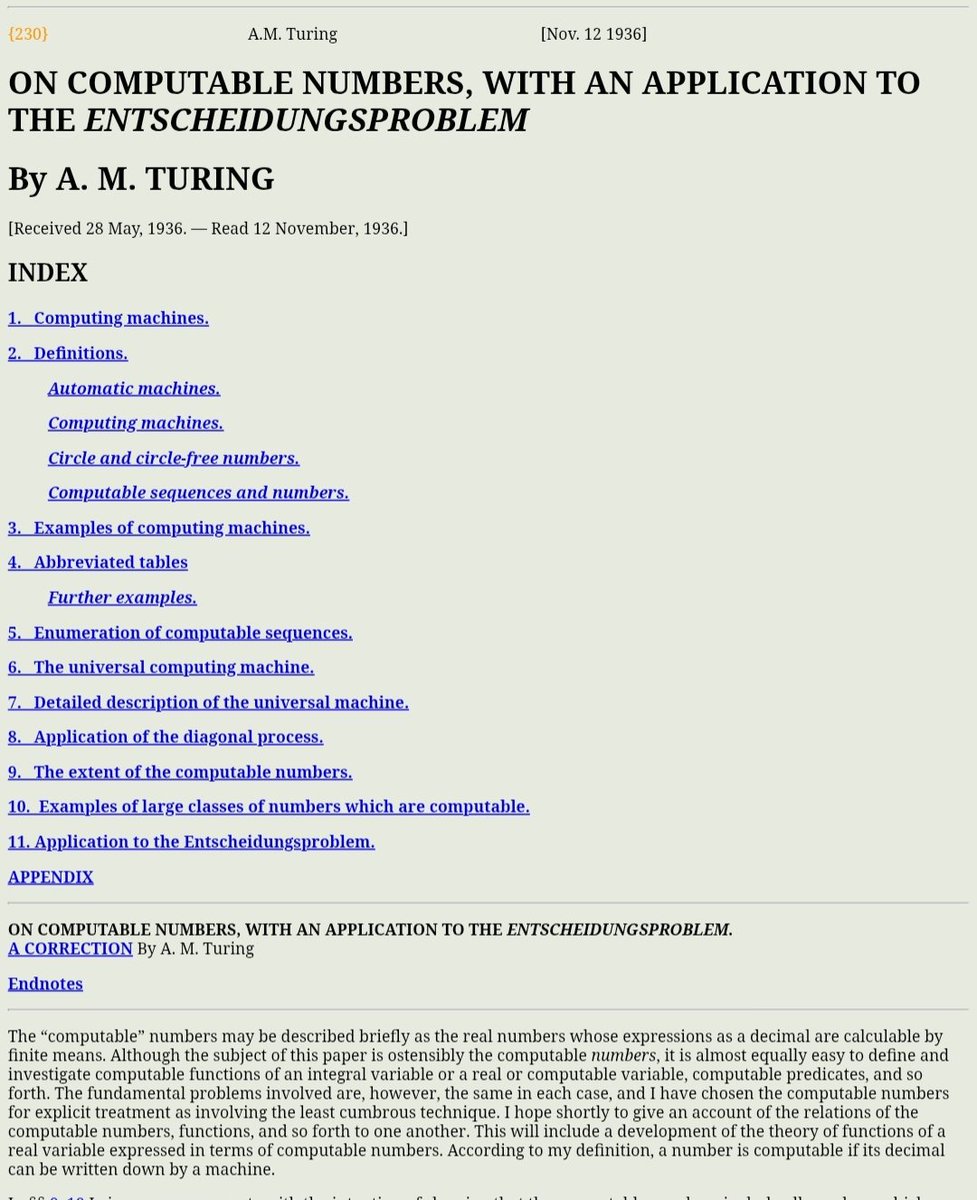
12 November 1936: Alan Turing's landmark paper, “On Computable Numbers, with an Application to the Entscheidungsproblem,” was formally read before the London Mathematical Society.
Turing introduced an abstract machine consisting of an unbounded tape, a read-write head and a finite set of instructions.
He also described a universal machine capable of simulating other computing machines and proved that no algorithm can solve every mathematical decision problem.
This established fundamental limits of computation decades before modern computers became widespread.
What if the geometry of a 1931 math discovery is the right working space for unified field theory?
The Hopf fibration splits the 3-sphere into circles. Every circle is linked to every other one exactly once. In our new short animation, you can watch the linking integral being computed live: it lands on Lk = 1. You'll also see the twisting planes of the contact form α∧dα, and the Beltrami field whose flow lines are the fibres themselves.
That geometry is the backbone of our work at Resonant Technologies Inc. (RTI):
🔹 UCRC-CG: Unified Classical Resonance Cosmology in Cartan Geometry, built on torsion-first Cartan geometry with the Hopf bundle as its working space
🔹 ECE / ECE2: Einstein–Cartan–Evans theory from the AIAS group (Myron Evans, Horst Eckardt)
🔹 TUFT: J. L. Nielsen's Topological Unified Field Theory, whose Hopf-based geometric core we have verified independently
Our latest paper with Dr. Horst Eckardt, AIAS Paper 464, "The Hopf Fibration as a Working Bundle of Einstein–Cartan–Evans Theory," maps ECE concepts one-to-one onto Cartan-geometry concepts.
The math in the video is standard, and it's beautiful. How UCRC-CG reads that math physically is a set of hypotheses with falsification tests, and we invite scrutiny of them.
📄 Papers: https://t.co/wTqQC29LOT
📄 AIAS: https://t.co/JrN89Bqvm3
#Physics #CartanGeometry #HopfFibration #Topology #UnifiedFieldTheory #ECE #MathVisualization #Alberta
Starlink helped save FIVE lives in the Atlantic. ♥️
Their boat, Karolina Viking, was filling with water. Its power systems were failing. Rescuers couldn’t reach them by radio or satellite phone.
The sailors shared their location with rescuers through Starlink, helping another yacht find them.
All five were rescued from their liferaft and brought safely aboard.
Starlink helped turn a desperate situation into five lives saved. This is what a lifeline from space looks like.
I joined @GoogleDeepMind to develop a research program on the economics of AGI. Today, together with Andrew Koh (@andrewjkoh) and Shane Legg (@ShaneLegg), we are incredibly excited to release The Economics of Intelligence, the first in a series of projects from our group on how AGI will change the economy.
How do capability improvements transform the economy, and when? In this project, we define thresholds of economic capabilities, e.g., minimal AGI, based on how they transform the economy. We then track how the economy–market structure, employment, and wages–changes during the transition across capability regimes.
We have seen exponential increases in what AI agents can do but the broader economy seems almost remarkably unchanged. Part of the reason is that the solo AI agent is the wrong economic object; economic transformation is an equilibrium outcome where organizations compete. Looking at how intelligence functions within organizations, transformation will depend on when two key capability thresholds are crossed: competence (gains on individual skills, e.g., coding, math) and coordination (gains on ability of agents to cooperate and work together).
We show that what economic transformation looks like depends on whether AI becomes supercompetent, supercooperative, or both—the regime of artificial superintelligence (ASI). Tracking this transition shows why the real visible transformation may come from improvements in coordination—a capability most benchmarks don’t yet track. Past a certain threshold, AI capabilities can break the Coasian ceiling on firm size and lead to an economy that looks drastically different than the one we see today.
Two main takeaways:
1. To understand the path of transformation, we should be tracking agentic coordination more closely.
2. The impact of AI will likely show up in wages before market structure or employment.
We are really excited about this paper. Excited to hear people’s thoughts.
Link: https://t.co/9DTGSeKoSA
@AmmannNora@ARIA_research@FoundationOAI That’s awesome Nora Congratulations! May we continue to enjoy reading your thoughts! I have learned a lot over many months considering your posts to be very frank!
After two wonderful and rewarding years at @ARIA_research, I’m excited to share that I am joining the @FoundationOAI as Program Director of Formal Methods.
Alan Turing almost became an Olympic marathon runner.
In 1947, the mathematician finished fifth in the British AAA marathon, completing the race in 2 hours, 46 minutes and 3 seconds.
The same man helped break Enigma, laid the mathematical foundations of modern computing, and developed equations explaining how patterns emerge in living organisms.
His life was remarkably diverse. Mathematics, codebreaking, running, and even the geometry of daisies all fascinated him.
Happy birthday, America!
As many here know. I founded a company in America, Cambridge Innovation Center, that supports entrepreneurs and innovators to turn their ideas into successful companies that make the world better.
I have found that America is a remarkable place to do this. We are confident that we can come up with a better mousetrap (light bulb, cure for cancer...), we are willing to risk everything to pursue our dreams, we are willing to support others to do the same. We are willing to take a risk and buy a crazy new product, sometimes even before it has been made (thank you for that idea, Kickstarter!) and this, in the words of the great American poet Robert Frost... this willingness to take a different path and support others to do so, has made all the difference.
We are the engine of the world's innovation. The standard-bearer for how this is done.
This American ethos has worked out in a breathtaking way. Nine of the the world's ten most valuable companies are American innovation companies. And these are not ancient companies built on extracting natural resources or old money. They are startups... built in my lifetime purely on the back of great ideas. Our creative ingenuity has become an inspiration to the world, and consequently proud and capable countries as far as China are embracing our ways and are following in our footsteps.
There are many keys to our success. At the top of that list is our openness to allow everyone to follow the American dream, no matter who they are, what they look like, what beliefs they hold, or what country they were born in.
Bravo America, and happy birthday.
I am proud to be an American on this 250th anniversary of our great nation.
I just published episode #24 of my podcast, which explores the story behind ONE FUKUOKA BUILDING, one of the largest buildings in the central business district of the largest city in southern Japan.
The building came about when the region's largest private railway company, Nishitetsu, decided to replace their aging headquarters with a "creativity" focused building. Its hotel, which occupies the top floors, recently won the "best luxury art boutique hotel" award. Below it is CIC Fukuoka. In this episode, I sat down with the executive behind the project to learn the backstory.
You might find this episode interesting for one other reason: I used ElevenLabs to clone our original Japanese into English. Let me know what you think!
YouTube: https://t.co/irooyaRHFs ⠀
Spotify: https://t.co/BfBtjWxOHV ⠀
Apple Podcasts: https://t.co/x61Fj4180g
#WhereInnovationHappens #CICNow #Fukuoka #Innovation #Nishitetsu
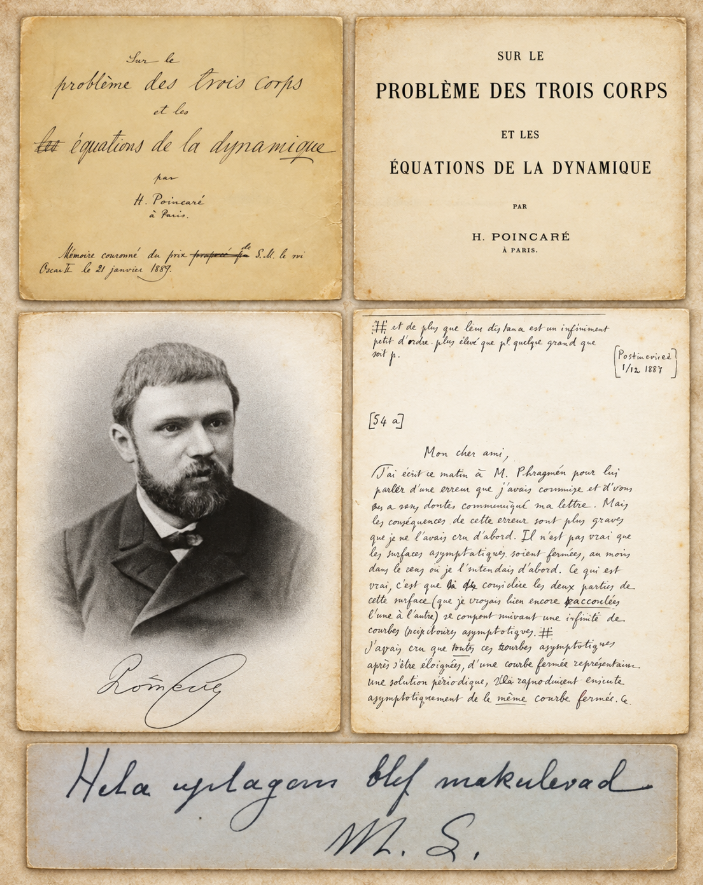
In 1889, French mathematician Henri Poincaré won a prestigious prize established in honour of King Oscar II of Sweden and Norway for his research on the three-body problem, one of the most difficult questions in celestial mechanics.
His award-winning memoir was being prepared for publication in Acta Mathematica, and advance copies had already been distributed when a serious error came to light.
On 30 November 1889, Poincaré sent an urgent telegram to the journal's editor, Gösta Mittag-Leffler, asking him to stop the printing. The mistake concerned a crucial part of his analysis of the motion and stability of celestial bodies under gravitational attraction.
Mittag-Leffler attempted to recover the distributed copies and arranged for the printed edition to be destroyed. Poincaré agreed to pay the associated expenses, which exceeded the 2,500-kronor prize he had received.
Yet the consequences of this error extended far beyond the embarrassment and financial cost.
While revisiting his calculations, Poincaré discovered that the mathematical structure governing the motion of three bodies was considerably more complicated than he had initially believed.
His corrected analysis revealed intricate intersections between stable and unstable manifolds, producing a complicated arrangement of curves now associated with what mathematicians call a homoclinic tangle.
These structures demonstrated how a deterministic mechanical system could exhibit extraordinarily complicated behaviour, even when its motion was governed by precise mathematical laws.
The revised memoir appeared in 1890 and became a landmark in the study of dynamical systems. Poincaré had not solved the general three-body problem, but his investigation exposed mathematical phenomena that would later become central to modern chaos theory.
The Institut Mittag-Leffler in Sweden still preserves original manuscripts, correspondence, and surviving copies of the withdrawn printing, allowing historians to reconstruct this unusual episode.
@ObadiaAlex@iamnotnicola@yunigraham@_Arutyun@EngineerEdith Cool cohort! Thanks for your absolute hard work as a team pulling this together! I learned a lot in 2026 and made many good friends in the Scaling Trust Discord. Thanks! Let’s see what 2027 brings as more work is executed well by ARIA UK.
Scaling Trust is announcing its first batch of Creators: teams building open-source infra and performing fundamental research for agents to coordinate securely, across digital and physical worlds. I gave Opus 5.5 our creator release doc and, after a few passes, it made this 👇
Meet the teams → https://t.co/DXwdknGpDV
We fund new teams on a rolling basis; next deadline 31 Oct → https://t.co/sQFSesLLEr