Specialist in musculoskeletal and sports physiotherapy. Accredited Mulligan Concept Teacher. A clinical and scientific focus on manual therapy and pain sceince.
@sciqst@AdamMeakins Great answer.
The question would be...
If you acknowledge the correlation and the symptom response of posture, would you advise the patient the chance their posture?
Perhaps only as an way change sx and not in the long term?
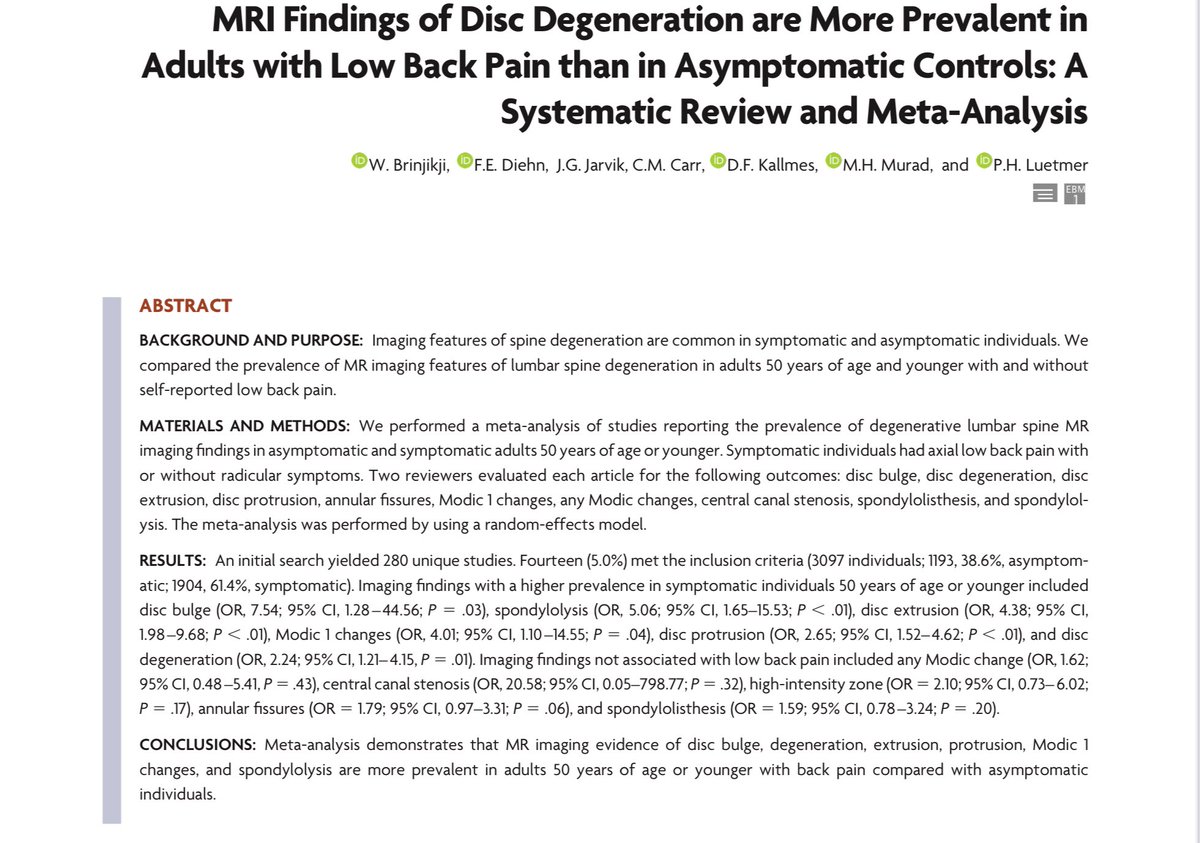
MRI Findings of Disc Degeneration are More Prevalent in
Adults with Low Back Pain than in Asymptomatic Controls: Systematic Review and Meta-Analysis https://t.co/HKsA3bfchX
@PeteOSullivanPT@ruth_chang Same findings in patients with Cx pain and HA...
Velocity is a great measure, but did you also measure acceleration and jerk?
Jerk could be more useful to evaluate their motor system, but need special equipment to test it and therefore not suitable for the clinic.
@Retlouping Thanks 👍
I use "teach it back" in the end of my courses.
Handing out patient cases to start the process.
Also use a "wish list" for topics the participants would like to know more about.
Great thoughts to advise the participants to setup a learning portfolio during the course👍
@Retlouping Establishing a good relationship is key and fundamental for all treatment modalities.
Not to value and prioritycise this in the treatment would reduce the chance of successful outcome.
The process starts in the therapist way of handling themselves and welcoming the pt.
@CorKinetic Could use Mobilization with movement 😉 as it is focused on the client specific impairment - relevance.
Pain free - Instant results.
Quick progression to relevant exercises and integration into ADL.
Combined with relevant patient information-education (talk therapy).
@CorKinetic The pt presentation will guide the choice of treatment.
Talk therapy...
MT...
Other pain relief modalities...
Exercise...
It is all about getting the pt moving again and being confident moving.
No treatment fits all people.
@CorKinetic A recent Cochrane review showed that exercise has very limited effect on acute LBP.
Exercise therapy for treatment of acute non‐specific low back pain
Wilhelmina IJzelenbergTeddy OosterhuisJill A HaydenBart W KoesMaurits W van TulderSidney M RubinsteinAnnemarie de ZoeteAuthors
Hi @Seth0Neill
I listened to your podcast on physioedge - no. 082 where you talked about tendinopathy.
Thanks for the podcast - very interesting :-)
You mention some exciting results with fasciculations/tremors in the calf muscle when testing patients,
but that this is not observed in healthy people.
I'm curious to hear your interpretation of this observation?
Do you think it is due to spinal reflexes?
or midbrain?
or cortical inhibition?
In conjunction with this, you refer to two other researchers who also found tremors here
@Retlouping Love this 🙏
Totally agree.
The effect of exercise is neurophysiological plus placebo which is also neurophysiological.
The effect of exercise on relation to pain is EIH NOT biomechanical changes 👍
Could you wrap your posts into a pdf file on af webpage for download?
@GregLehman@DrJohnOrchard Agree.
No one can argue that exercise should be a core part of all treatment.
But we need to have a critical look at our clinic reasoning in regard to why we choose exercise.
We have now experienced more than a decade with a very critical viewpoint in relation to manual therapy.
@AdamMeakins@GregLehman Many strength and conditioning coaches charge more than physios...
What is the difference between MT and education to increase ROM and self efficacy
vs
exercise and education to increase self efficacy... and perhaps ROM.
No therapist would use only one "modality".