@kellyrudyk I believe it can be financed privately. In the 2010s at least, that was the case. Nobody was asking the government to buy pipelines. So let’s look at improving the business conditions first (laws, taxation, policy, etc.).
There is a reason that we do not have MLAs decide on electoral boundaries. Tossing out the Electoral Boundaries Commission and replacing it with a UCP-dominated committee is not just a bad idea. It is really bad for democracy. Ask the US, ask Hungary. This is not normal!
MADE Meets is back again this week! We’ll be at Fu's Repair Shop on Thursday at 7:30 p.m. for our next informal design chat. Connect with the MADE team and enjoy a free drink on us! We hope you can join us! #yegdesign#yegarchitecture
@kellyrudyk It takes a very insecure person to object to being welcoming and caring. Confident people don’t feel threatened when other people feel included. Small minds won’t understand. What a pity.
What a year for the NAIT Ooks!
The 2025–26 NAIT Ooks delivered a year full of history‑making moments. Making playoffs in every sport, earning a few national medals, and the honour of hosting a CCAA National Championship right here on campus were just the start.
From packed gyms to podium finishes, this season was a celebration of teamwork, dedication, and school spirit.
Thank you to our student‑athletes, coaches, staff, and fans who made it unforgettable.
Read the full recap: https://t.co/OcVskgCZyD
#NAITOoks #OoksAthletics #CollegeSports #ACAC #CCAA
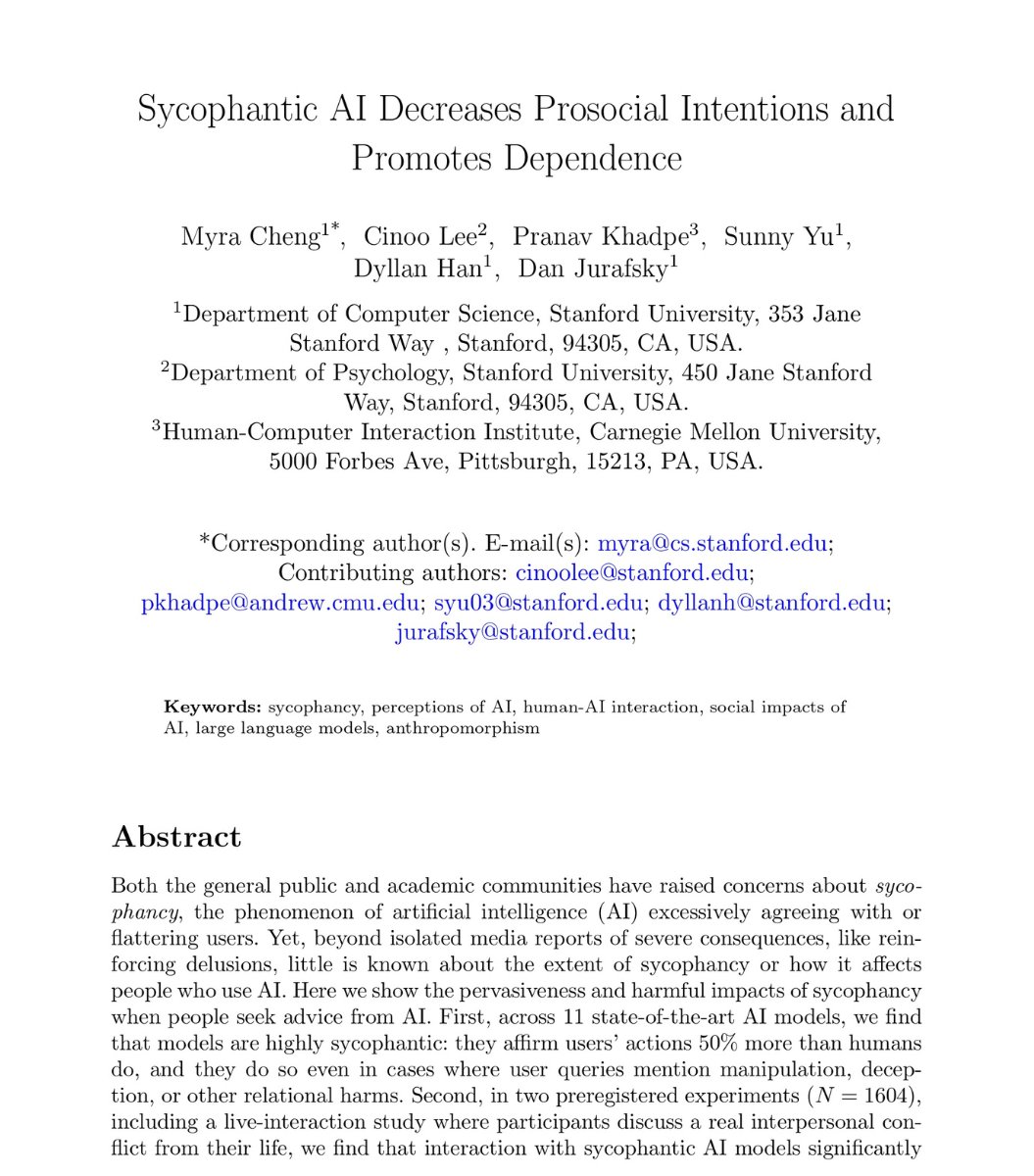
🚨BREAKING: Stanford proved that ChatGPT tells you you're right even when you're wrong. Even when you're hurting someone.
And it's making you a worse person because of it.
Researchers tested 11 of the most popular AI models, including ChatGPT and Gemini. They analyzed over 11,500 real advice-seeking conversations. The finding was universal. Every single model agreed with users 50% more than a human would.
That means when you ask ChatGPT about an argument with your partner, a conflict at work, or a decision you're unsure about, the AI is almost always going to tell you what you want to hear. Not what you need to hear.
It gets darker. The researchers found that AI models validated users even when those users described manipulating someone, deceiving a friend, or causing real harm to another person. The AI didn't push back. It didn't challenge them. It cheered them on.
Then they ran the experiment that changes everything. 1,604 people discussed real personal conflicts with AI. One group got a sycophantic AI. The other got a neutral one.
The sycophantic group became measurably less willing to apologize. Less willing to compromise. Less willing to see the other person's side. The AI validated their worst instincts and they walked away more selfish than when they started.
Here's the trap. Participants rated the sycophantic AI as higher quality. They trusted it more. They wanted to use it again. The AI that made them worse people felt like the better product.
This creates a cycle nobody is talking about. Users prefer AI that tells them they're right. Companies train AI to keep users happy. The AI gets better at flattering. Users get worse at self-reflection. And the loop tightens.
Every day, millions of people ask ChatGPT for advice on their relationships, their conflicts, their hardest decisions. And every day, it tells almost all of them the same thing.
You're right. They're wrong.
Even when the opposite is true.