Thanks @ProfSchrepel for the shout-out to my piece on AI Governance as Regulation of Collective Memory. It explores how AI can shape collective memory, and why, to safeguard our “future’s past,” collective memory needs a seat at the AI regulation table. 👇
https://t.co/Gft5q1gf41
@LnrdRizzo@Unibocconi Cool application of network science ! Now to predicting who’s going to win the Eurovision :) (constructing the network more difficult, though)
@barabasi Predictability (and falsifiability) in complex systems can exist at a more general level—patterns rather than precise predictions (cf. Hayek). E.g., power law distributions, diffusion dynamics, etc.
It was a pleasure to join this episode of @BHComplexity , one of my favorite podcasts, to discuss Law & Complexity. Thanks to @BradyHeywood , a master of interdisciplinary conversations! Listen below 👇
In this episode of Simplifying Complexity, we speak to @MichalShur about complexity science and the law. We explore the problems associated with the law attempting to effectively regulate complex real-world systems, and we also examine how the law, in and of itself, is a complex adaptive system.
Apple Podcasts: https://t.co/PReuPQQZMz
Spotify: https://t.co/iKX4nlWfUv
@FriedrichHayek@CambridgeUP@SSRN@lsolum Thank you @FriedrichHayek for highlighting Hayek’s work on complexity. I agree with and discuss the distinction between detailed ‘naive’ predictions (often likely to fail) and prediction of patterns, which is super important for law &policy (this is the following parts).
Chapter 2 of my book-in-progress, Law and Complexity—An Introduction (forthcoming @CambridgeUP), now on @SSRN. It offers a working definition of #complexsystems and a ‘Complexity 101’ for law & policymakers. Thank you @lsolum for highlighting it! 👇
https://t.co/QJGV0aMHWT
Shur-Ofry on Law and Complexity, https://t.co/UNc86AHdfr - Michal Shur-Ofry (Hebrew University of Jerusalem, Faculty of Law) has posted Law and Complexity: An Introduction (forthcoming with Cambridge University Press)—Chapter 2 on SSRN.
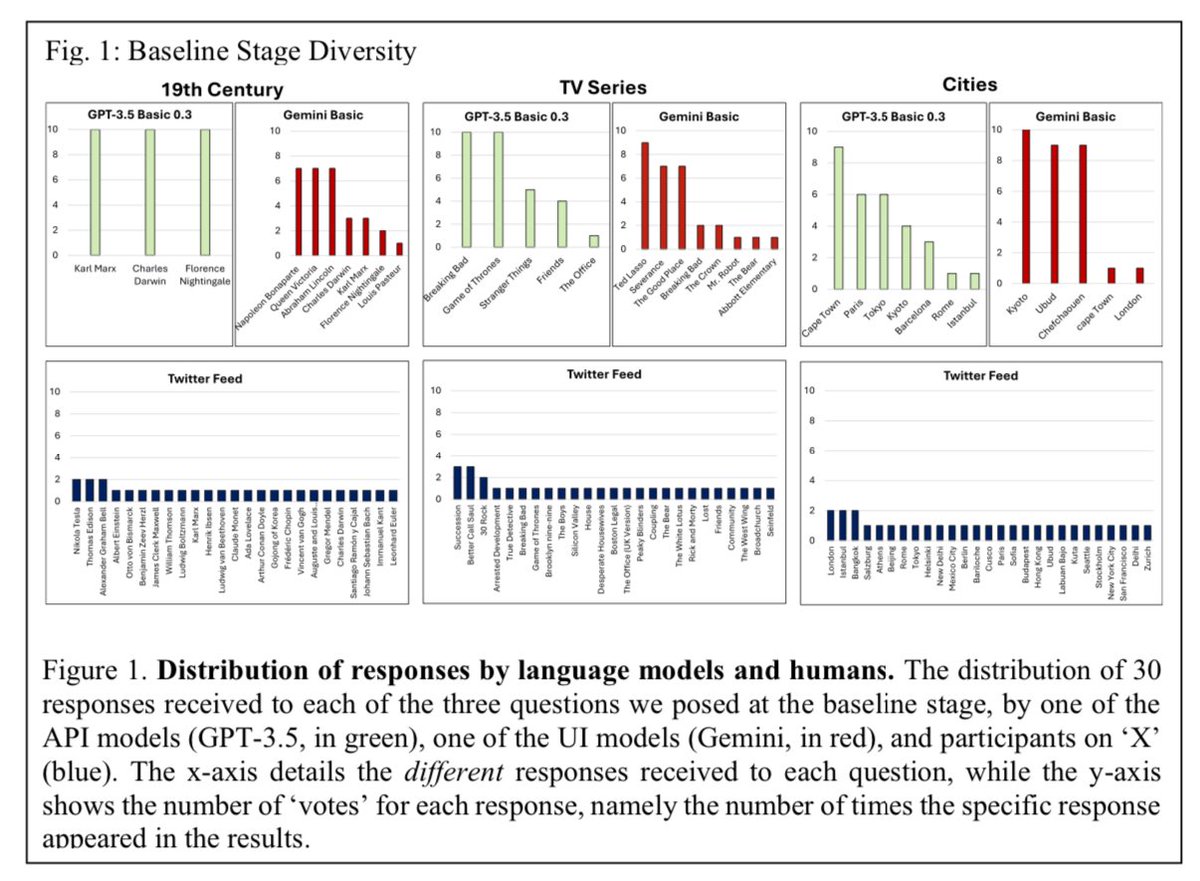
Can we "grow a tail" to #LLMs and increase their output diversity? Check out our study, w/ @boknilev , Bar Horowitz-Amsalem, Adir Rahamim, now on @SSRN👇
How diverse are the outputs of #LLMs when diversity is desired? This study examines the diversity of responses of various models to questions with multiple possible answers, comparing them with human responses & suggests ways to increase #diversity.
Read: https://t.co/1nhdc81UHP
Thrilled to find Chapter 1 of my book-in-progress, Law and Complexity: An Introduction (forthcoming w @CambridgeUPress), on @lsolumn’s Legal Theory Blog.
Chapter 2 coming soon to @ssrn.
#LawandComplexity
Shur-Ofry on Complexity Theory and Law, https://t.co/krRHnYTmBw - Michal Shur-Ofry (Hebrew University of Jerusalem, Faculty of Law) has posted Law and Complexity: An Introduction and Chapter 1 (forthcoming, Cambridge University Press) on SSRN.
Will large language models narrow our world & decrease our exposure to diverse contents? Check out our new study of LLMs output diversity, incl baseline evaluations & simple mitigation strategies, w @boknilev, Bar Horowitz-Amsalem & Adir Rahamim.
@SSRN https://t.co/RqfgC7f4fX
How diverse are the outputs of large language models when diversity is desired? Not very. See our paper for en evaluation, simple mitigations, and discussion on implications for AI policy.
“Growing a Tail: Increasing Output Diversity in Large Language Models”
How nice to find "Law and Complexity: An Introduction" (first chapters of book-in-progress, forthcoming w @CambridgeUP ) in the reading suggestions of @ProfSchrepel, among so many fascinating reads!
link here-https://t.co/5qZ5Y6q8fS
More #LawandComplexity soon, stay tuned:)
How can #complexity inform the #law? Sharing Intro & Ch1 of book-in-progress, Law and Complexity: An Introduction, forthcoming @CambridgeUP. Chptrs describe the emergence of complexity & ask: so what does it have to do with the Law? more soon stay tuned! https://t.co/YXNPjdJcO8
כבוד לאוניברסיטה העברית שטיפסה בדרוג שנגחאי לפי תחומי מחקר ((Global Ranking of Academic Subjects בלימודי מתמטיקה, תקשורת ומשפטים!
במתמטיקה ותקשורת עלתה האוניברסיטה למקום ה- 14 ובמשפטים דורגה האוניברסיטה במקום ה-42 מבין האוניברסיטאות הטובות ביותר בעולם.
זאת לצד דרוגה הכללי של האוניברסיטה במקום ה- 81 לשנת 2024.
מדד שנגחאי לפי תחומי מחקר, המתפרסם כל שנה בחודש נובמבר, מודד את ביצועי המחקר באוניברסיטאות בעולם, תוך התייחסות לחמישה תחומי הערכה עיקריים: סגל ברמה עולמית, תפוקה, מחקר איכותי, השפעת המחקר ושיתופי פעולה בינלאומיים.